avatarPaddy Corry

Free AI web copilot to create summaries, insights and extended knowledge, download it at here

4723

Abstract

ty, and <b>vulnerability</b> helps strengthen relationships when it is needed. (<a href="http://www.scheinocli.org/publications/"><i>Peter Schein & Edgar Schein</i></a><i>: “<a href="https://www.bookdepository.com/Humble-Leadership-Edgar-H-Schein/9781523095384">Humble Leadership</a></i>)</p><p id="30d5">This doesn’t mean you have to be a doe-eyed pushover. No, it means you relate to your colleagues as whole people, rather than <i>roles </i>or<i> resources</i>.</p><p id="d59d">Kim Scott’s ‘<a href="https://www.bookdepository.com/Radical-Candor-Kim-Scott/9781250103505">Radical Candor</a>’ model is one way for leaders to <i>personize</i> their relationships by requesting and giving <b>feedback</b>. The courage and openness required are just two reasons why I believe Radical Candor supports the Scrum Values and enables psychological safety in teams and organisations. (<a href="https://readmedium.com/radical-candor-is-about-respect-courage-and-openness-3dd9e8c799a6">I wrote about this before</a>). Is it a coincidence that Radical Candor was put together by a female leader?</p><figure id="9db4"><img src="https://cdn-images-1.readmedium.com/v2/resize:fit:800/1*X6KlguPdgZOMGtrx29DfxQ.png"><figcaption></figcaption></figure><h1 id="80de">3. Leaders simplify with commands</h1><h2 id="6164">Instead: experiment, build understanding</h2><p id="bf91">Traditional leadership was authoritarian or paternalistic: orders were given and followed. Top down, and no backchat. However this approach is inappropriate for knowledge work where teams of experts must collaborate to discover answers to complex problems.</p><figure id="e656"><img src="https://cdn-images-1.readmedium.com/v2/resize:fit:800/1*tfZtmY8RaVITCvclZjK1xw.jpeg"><figcaption>But it could also lead Scrum Teams to Chaos!</figcaption></figure><p id="b870">Authoritarian leadership models originate from a different world, figuratively: when leaders simplified situations, and pointed the way forward for compliant teams of ‘subordinates’.</p><p id="74a0">Modern reality is very different from Da Vinci’s times. Complex, adaptive demand different skillsets. In complex environments, a charismatic leader with an inappropriate assumption of simplicity can lead a team to disaster. (<a href="https://www.joe.ie/movies-tv/fyre-festival-655119">Fyre Festival</a>, anyone?)</p><p id="2996">Another way of putting this: <b>simplify after building understanding, not before. </b>(<a href="https://twitter.com/snowded"><i>Dave Snowden</i></a><i>: <a href="https://cognitive-edge.com/blog/simplicity-after-understanding/">CognitiveEdge</a></i>)</p><figure id="b819"><img src="https://cdn-images-1.readmedium.com/v2/resize:fit:800/1*NYrtgakN2WWRgtIqjsU3Fg.jpeg"><figcaption></figcaption></figure><p id="3503">One example of over-simplification is a false dichotomy. In <b>Crucial Conversations</b>, the authors describe a <i>Fool’s Choice</i>, where we must decide between two alternatives that seem to be mutually exclusive. The authors describe a painful choice between telling the truth or keeping a friend. Or how about another: a choice between releasing to production more frequently, or improving code quality. (Source: <a href="https://www.bookdepository.com/Crucial-Conversations-Tools-for-Talking-When-Stakes-Are-High-Second-Edition-Kerry-Patterson/9780071771320?ref=grid-view&amp;qid=1552758330992&amp;sr=1-1"><i>Crucial Conversations</i></a>).</p><p id="1ea8">In reality, when tackling problems such as these, we may not need to achieve one thing at the expense of another. There may be other, <i>better</i> options available, unknown to leaders. <b>Scrum</b> provides multiple opportunities for teams to learn and uncover new ways of working together, building contextual awareness through empiricism and experimentation.</p><figure id="3de1"><img src="https://cdn-images-1.readmedium.com/v2/resize:fit:800/1*X6KlguPdgZOMGtrx29DfxQ.png"><figcaption></figcaption></figure><h1 id="a651">4. Leaders value leadership over service</h1><h2 id="f6be">Instead: be a servant leader, continuously improve yourself</h2><p id="641b">Traditional, ambitious, masculine managers set out to be leaders, and act primarily out of self-interest, even when serving others.</p><p id="eda2">By contrast, <b>servant leaders</b> begin with the instinct to serve others, and the instinct to lead is secondary.</p><p id="7d32">The Scrum Guide describes the Scrum Master role as a <b>servant leader</b> for a development team, a product owner and an organisation. (<a href="https://www.scrumguides.org/scrum-guide.html#team-sm"><i>The Scrum Guide</i></a>)</p><p id="055d"><b>Robert Greenleaf</b> coined the term ‘Servant Leadership’ in 1970, and describes it below:</p><blockqu

Options

ote id="516b"><p>“While traditional leadership generally involves the accumulation and exercise of power by one at the “top of the pyramid,” servant leadership is different. The servant-leader shares power, puts the needs of others first and helps people develop and perform as highly as possible.” (<a href="https://www.greenleaf.org/what-is-servant-leadership/">The Greenleaf Institute</a>)</p></blockquote><p id="678a">Traditional leaders succeeded or failed as a result of the actions of <i>their teams </i>(ownership implied). By contrast, servant leaders create environments where <i>everyone can succeed</i> together, not only leaders.</p><figure id="52a6"><img src="https://cdn-images-1.readmedium.com/v2/resize:fit:800/1*aoFtz-8QMI4TlCyKvprnlA.jpeg"><figcaption>(Source: <a href="https://www.linkedin.com/pulse/kaizen-lost-translation-jun-nakamuro-1/">Jun Nakamuro: LinkedIn</a>)</figcaption></figure><p id="0d1c"><b><i>Hansei</i></b><i> </i>is a Japanese word describing a desire to ‘live for others’. I believe this encapsulates what servant leaders instinctively do.</p><p id="be54">Another part of <i>hansei</i> is <b>self-criticism: </b>continually searching for opportunities to improve yourself. The Scrum Master is a manifestation of this for a team, searching for improvements in environment, process or values.</p><p id="cce6">I also love the internal process of <i>hansei</i>. If we want to impact others, we first need an ability to analyse our own behaviours and improve ourselves. This continuous improvement <b>mindset</b> is part of Scrum, and couldn’t be further from a limiting belief.</p><figure id="770c"><img src="https://cdn-images-1.readmedium.com/v2/resize:fit:800/1*X6KlguPdgZOMGtrx29DfxQ.png"><figcaption></figcaption></figure><h1 id="a4f1">5. Leaders don’t change their minds</h1><h2 id="f711">Instead: Be flexible and know that you can change</h2><p id="8fe0">In ‘The Shallows’, Nicholas Carr looked at the Internet’s economies of distraction, and what they do to our brains, but also, more interestingly, how we can <i>undo the damage. </i>The human brain is resilient. (even the male brain!) We can train ourselves into new behaviours, and our brains will adapt in kind. (<a href="https://twitter.com/roughtype"><i>Nicholas Carr</i></a><i> — “<a href="https://www.bookdepository.com/Shallows-Nicholas-Carr/9780393339758">The Shallows</a></i>)</p><figure id="bd5f"><img src="https://cdn-images-1.readmedium.com/v2/resize:fit:800/1*lNZ4HdgG8mseSdor_g0Gmg.png"><figcaption></figcaption></figure><p id="9eb8"><b>Neuroplasticity</b> describes the ability of our brains to rewire pathways, simply through regular practice of new behaviours.</p><p id="6c72">Just as we can become distracted, and also overcome distractions thrown at us, we can adapt to <i>any </i>new behaviour. Critically, we need to be aware of the behaviour that causes the issue, and to be flexible enough to change.</p><p id="24ba">As <a href="undefined">Maarten Dalmijn</a> has recently pointed out here at Serious Scrum, flexibility is a core component of Scrum. With willingness to change and adapt, a Scrum Team can learn together how to overcome problems. With flexibility, problems can be overcome <i>together</i>. Here’s the thing though: this flexibility requires an adaptive mindset, and will only thrive in a psychologically safe environment. Guys, are you listening? (<i>Maarten Dalmijn: <a href="https://readmedium.com/if-you-are-not-flexible-you-are-not-doing-scrum-ebf41f47d151">Serious Scrum</a></i>)</p><figure id="7d46"><img src="https://cdn-images-1.readmedium.com/v2/resize:fit:800/1*X6KlguPdgZOMGtrx29DfxQ.png"><figcaption></figcaption></figure><h1 id="ef81">Closing Thought</h1><p id="04c3">Guys, you <i>are</i> showing emotion. You <i>can</i> show strength by being vulnerable. You <i>can</i> simplify, but <i>after</i> building understanding. You <i>can</i> lead by offering service to others, and <i>everyone</i> wins in the end. You <i>can</i> check yourself for learning opportunities, and yes, you <i>can actually </i>change your mind if you want to.</p><p id="c599">Scrum can help enable all of these upgrades in teams and organisations.</p><p id="629f">Enabling these upgrades will not make you any less of a man.</p><p id="d389"><i>In fact, they will make you more of a leader.</i></p><figure id="f883"><img src="https://cdn-images-1.readmedium.com/v2/resize:fit:800/1*qsg-zjcnz5A8B1xmBbdIfw.png"><figcaption><a href="https://join.slack.com/t/serious-scrum/shared_invite/enQtNjQ5MDY0NTg5OTg0LWExYmZkZjZhOTQ4ZGNkMTU2OTgxODY3ZjZjZDA5OTI2NDY4N2ZiYTUxOTMxM2RlNDRlMTJkYTUwMDMwZjgzNTg">Do you want to write for Serious Scrum or seriously discuss Scrum?</a></figcaption></figure></article></body>

5 limiting beliefs associated with a traditionally ‘masculine’ leadership style

And how Scrum can provide some upgrades

Men: it’s time for some upgrades.

The Premise: Male Leadership needs an upgrade

“In a 2011 study of more than 14,000 human resource professionals and other managers, the respondents rated barely 26% of their current leaders positively and only 18% of future leaders as promising.” (Dr Tomas Chamorro: Medium)

In addition to a perception of bad leaders, there is an acute gender disparity at the top of organisations. In 2017, among the S&P 500 companies, just 20% of board members and 6% of CEOs are female.

This post describes 5 limiting beliefs of leaders that I believe are deep-rooted in ‘maleness’. Limiting beliefs influence behaviour, constrain achievement of potential, and typically elude awareness. (Zia Malik: BeLiminal.com)

Also, because guys like upgrades, I’ll look at how Scrum can help bring the Dude Operating System up to date. Go on my son!

1. Leaders need a stiff upper lip

Instead: Be aware that you are always emotional

“Every moment of every day is emotional for everyone; we can’t turn our feelings off. Because men on the whole are less aware of their feelings, they characterise their often angry, mocking, combative view of the world as dispassionate.” (Grayson Perry: “The Descent of Man”)

The “Stiff Upper Lip”. Do keep calm, dear…

Men like to believe that emotional displays are counter-productive: to get ahead, park emotion, be ‘clinical’ or ‘measured’. However, let’s face it: many men are relatively illiterate when it comes to emotional intelligence. They are failing to realise that all behaviours carry emotional impact.

Hiding or numbing emotions comes with health risks, and not only to yourself. Brene Brown strongly advises us against selectively numbing emotions. When we numb fear, or choose not to show it, we also risk numbing the positive stuff, and this creates an environment. (Brene Brown: “The Power of Vulnerability)

By contrast, Scrum teams strive for an environment where individuals can interact with openness, and without fear. (I wrote about this before)

2. Leaders are invincible, and infallible

Instead: show strength through vulnerability

A paradox: if leaders project an air of over-confidence or invincibility, people will feel less likely to speak up about problems in their presence.

Psychological Safety at work is critically important these days. Teams that feel safe work together better: it really is that simple. (Amy Edmondson: Harvard Business Review)

People, teams and managers need to “feel safe in reporting when things are not going well, when you don’t understand each other, and, most important, when you need each other’s help.” Humility enables this safety, and vulnerability helps strengthen relationships when it is needed. (Peter Schein & Edgar Schein: “Humble Leadership)

This doesn’t mean you have to be a doe-eyed pushover. No, it means you relate to your colleagues as whole people, rather than roles or resources.

Kim Scott’s ‘Radical Candor’ model is one way for leaders to personize their relationships by requesting and giving feedback. The courage and openness required are just two reasons why I believe Radical Candor supports the Scrum Values and enables psychological safety in teams and organisations. (I wrote about this before). Is it a coincidence that Radical Candor was put together by a female leader?

3. Leaders simplify with commands

Instead: experiment, build understanding

Traditional leadership was authoritarian or paternalistic: orders were given and followed. Top down, and no backchat. However this approach is inappropriate for knowledge work where teams of experts must collaborate to discover answers to complex problems.
But it could also lead Scrum Teams to Chaos!

Authoritarian leadership models originate from a different world, figuratively: when leaders simplified situations, and pointed the way forward for compliant teams of ‘subordinates’.

Modern reality is very different from Da Vinci’s times. Complex, adaptive demand different skillsets. In complex environments, a charismatic leader with an inappropriate assumption of simplicity can lead a team to disaster. (Fyre Festival, anyone?)

Another way of putting this: simplify after building understanding, not before. (Dave Snowden: CognitiveEdge)

One example of over-simplification is a false dichotomy. In Crucial Conversations, the authors describe a Fool’s Choice, where we must decide between two alternatives that seem to be mutually exclusive. The authors describe a painful choice between telling the truth or keeping a friend. Or how about another: a choice between releasing to production more frequently, or improving code quality. (Source: Crucial Conversations).

In reality, when tackling problems such as these, we may not need to achieve one thing at the expense of another. There may be other, better options available, unknown to leaders. Scrum provides multiple opportunities for teams to learn and uncover new ways of working together, building contextual awareness through empiricism and experimentation.

4. Leaders value leadership over service

Instead: be a servant leader, continuously improve yourself

Traditional, ambitious, masculine managers set out to be leaders, and act primarily out of self-interest, even when serving others.

By contrast, servant leaders begin with the instinct to serve others, and the instinct to lead is secondary.

The Scrum Guide describes the Scrum Master role as a servant leader for a development team, a product owner and an organisation. (The Scrum Guide)

Robert Greenleaf coined the term ‘Servant Leadership’ in 1970, and describes it below:

“While traditional leadership generally involves the accumulation and exercise of power by one at the “top of the pyramid,” servant leadership is different. The servant-leader shares power, puts the needs of others first and helps people develop and perform as highly as possible.” (The Greenleaf Institute)

Traditional leaders succeeded or failed as a result of the actions of their teams (ownership implied). By contrast, servant leaders create environments where everyone can succeed together, not only leaders.
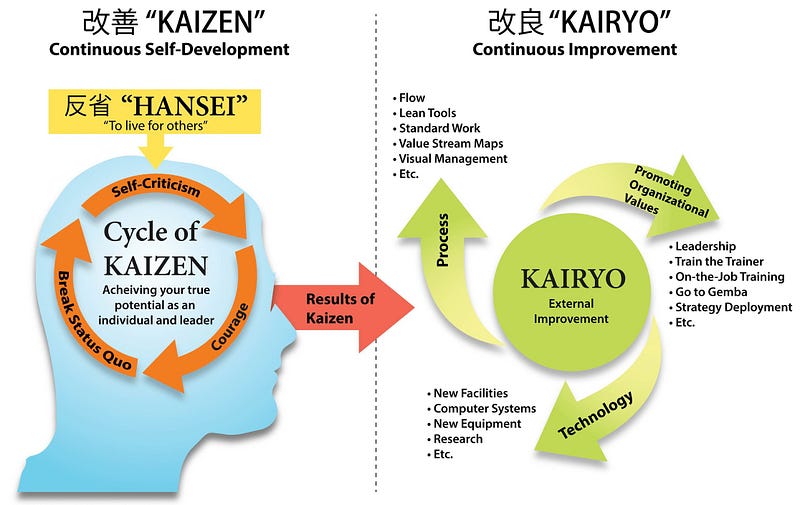
(Source: Jun Nakamuro: LinkedIn)

Hansei is a Japanese word describing a desire to ‘live for others’. I believe this encapsulates what servant leaders instinctively do.

Another part of hansei is self-criticism: continually searching for opportunities to improve yourself. The Scrum Master is a manifestation of this for a team, searching for improvements in environment, process or values.

I also love the internal process of hansei. If we want to impact others, we first need an ability to analyse our own behaviours and improve ourselves. This continuous improvement mindset is part of Scrum, and couldn’t be further from a limiting belief.

5. Leaders don’t change their minds

Instead: Be flexible and know that you can change

In ‘The Shallows’, Nicholas Carr looked at the Internet’s economies of distraction, and what they do to our brains, but also, more interestingly, how we can undo the damage. The human brain is resilient. (even the male brain!) We can train ourselves into new behaviours, and our brains will adapt in kind. (Nicholas Carr — “The Shallows)

Neuroplasticity describes the ability of our brains to rewire pathways, simply through regular practice of new behaviours.

Just as we can become distracted, and also overcome distractions thrown at us, we can adapt to any new behaviour. Critically, we need to be aware of the behaviour that causes the issue, and to be flexible enough to change.

As Maarten Dalmijn has recently pointed out here at Serious Scrum, flexibility is a core component of Scrum. With willingness to change and adapt, a Scrum Team can learn together how to overcome problems. With flexibility, problems can be overcome together. Here’s the thing though: this flexibility requires an adaptive mindset, and will only thrive in a psychologically safe environment. Guys, are you listening? (Maarten Dalmijn: Serious Scrum)

Closing Thought

Guys, you are showing emotion. You can show strength by being vulnerable. You can simplify, but after building understanding. You can lead by offering service to others, and everyone wins in the end. You can check yourself for learning opportunities, and yes, you can actually change your mind if you want to.

Scrum can help enable all of these upgrades in teams and organisations.

Enabling these upgrades will not make you any less of a man.

In fact, they will make you more of a leader.

Do you want to write for Serious Scrum or seriously discuss Scrum?
Leadership
Serious Scrum
Livingthescrumvalues
Management
Scrum
Recommended from ReadMedium