
5 Lessons From The American Unemployment Insurance System
Why America needs unemployment insurance reform

Introduction
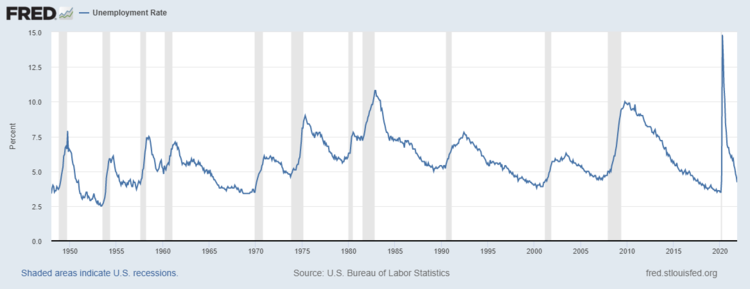
When COVID-19 hit, the global economy froze. Unemployment skyrocketed. People could not leave their homes to work, the American government had to do something. Enter: the 2020 CARES Act. The largest stimulus bill in American history.
When this bill was active, Laid-off workers were eligible for a $600 or $300 check, which was added onto their pre-existing UI benefits — depending on the time of the application.
This extra income was above and beyond the prior wages of many laid-off workers. Many economists questioned this move, usually on the basis of moral hazard. Do UI benefits disincentivize work by giving workers free money? Or do they just give job seekers the ability to look for a better fit?
No matter your position on this debate, it is obvious that the UI system is flawed. However, the research is clear, abolishing UI would do more harm than good.
In this story we are going to dive into the 5, most important, economic consequences of unemployment:
** This story is part two of a series on unemployment insurance, you can find part one at Insert Published Link Here
On Overall Employment
It’s often posited that UI benefits cause unemployment. The logic for this argument is simple: people would rather live off the government than work.
Christopher Boone, Arindrajit Dube, Lucas Goodman, and Ethan Kaplan (BDGK) found this logic to be lacking. They use a method known as the Border-County-Pair method (BCP) to study the Emergency Unemployment Compensation (EUC) program. Which was enacted in response to the Great Recession of 2008–9.
The BCP method basically takes two adjacent counties, separated by a state border, and looks at the impact of a change in one of the county’s state policies. Researchers repeat this process many times to develop data that is relatively immune to outside or unobservable factors. Since adjacent counties have similar economic conditions; all else equal, a change in the employment of one county is most likely due to the change in its state’s UI policy. This method was also used by Arin Dube and other researchers featured in my first story, on the minimum wage.
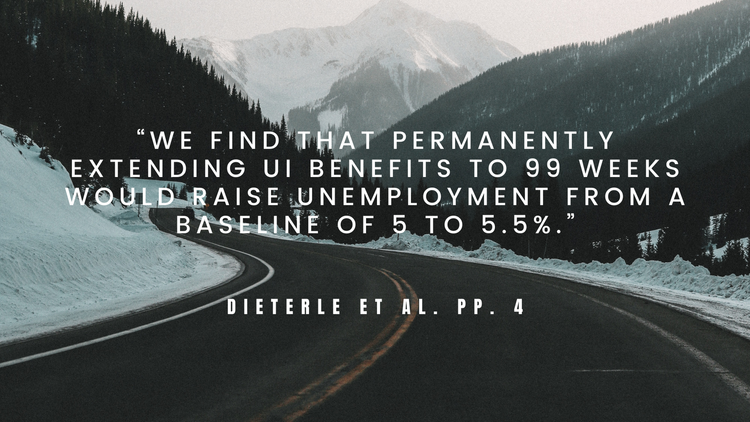
BDGK found that the UI has a small but negative effect on employment. This was inconsistent with popular studies authored by Marcus Hagedorn (Hagedorn et al, 2016; Hagedorn et al, 2013.). Who found that higher UI benefit durations led to over 1/3rd of the employment drop during the Great Recession.
Steven Dieterle, Otavio Bartalotti, and Quentin Brummet (DBB) explain why Dube et al. and Hagedorn et al. got contradictory results. They found one problem in the Hagedorn studies and two problems with the BCP method itself:
- Workers in the county-pair with low UI benefits respond to increases in UI benefits in their paired county. Which shrinks results.
- The use of county-level aggregate (overall) data is biased towards the amplification of results.
Workers in counties with low UI benefits will look for employment in counties with higher UI benefits. Although they won’t necessarily move into the other counties. This is called a policy spillover: the change in one county’s UI policies had effects that spilled over to another county.
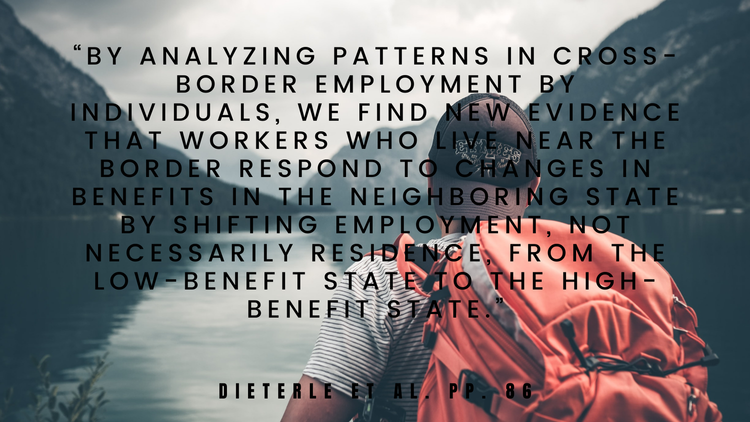
This problem does not apply to the Hagedorn studies, as DBB found that the shrinking effect- from the policy spillovers- deteriorates the further separated the sample counties get from each other. Hagedorn used samples that were to far away from each other to be experience policy spillovers.
However, Hagedorn does not account for the biases associated with the use of aggregate county-level data (also called macro-data). Biases that tend to significantly overstate results. DBB formed a method to account for this bias that they called the Measurement-Error-Corrected Regression Discontinuity Approach (Don't expect me explain this, I have not taken econometrics yet) They found results similar to BDGK, who’s modified approach to the BCP method accounted for the biases associated with macro-data.
In other words, high UI benefit durations would hardly decrease employment.
** Arin Dube’s name was highlighted because he shows up in a number of my stories. Authors that I mention frequently will be highlighted.
On Unemployment Durations
Another unemployment related problem, that is often brought up, is that of increased unemployment durations.
The consensus is that UI undeniably causes an increase in unemployment durations. Where economists diverge, however, is on the question of whether or not the higher unemployment durations are a problem.
Raj Chetty, one of my personal heroes, took a look at this question and found that the conflict of two powers determined its answer: the substitution effect and the liquidity effect.
If people take UI benefits for granted, meaning they engage in more leisure at the expense of taxpayers, then unemployment durations will increase. This is called the Substitution Effect, which is a moral hazard.
If the recently unemployed don’t have cash-on-hand -thus they are liquidity-constrained- then UI benefits should provide them with the money they need to have an adequate level of consumption.
However, UI benefits would also decrease the severity of being unemployed which, as result, would increase unemployment durations. This is called the Liquidity effect.
If UI’s impact on unemployment durations is a product of moral hazard, then UI generosity would be bad for the economy. Since, the UI would cause recipients to not look for or even deny job offers.
If it is a product of the liquidity effect, then the UI would help recipients to smooth consumption when liquidity-constraints would usually stop them from doing so.
For the liquidity effect to occur, people would have to be money-starved. In this way the liquidity effect is consistent with reality, since Chetty found that nearly half of recipients had no cash-on-hand.
This leads to Raj Chetty’s conclusion: “60 percent of the increase in unemployment durations caused by UI benefits is due to a liquidity effect rather than distortions in marginal incentives to work (moral hazard).”
On Job Acceptance
During the peak of the pandemic, congress passed the largest stimulus bill in American history: the 2020 Cares Act. Which provided the recently unemployed with $600 in benefits, from late March to July 2020, and 300$, from late December to early September 2021. These benefits were provided through the Pandemic Emergency Unemployment Compensation (PEUC) program.
In their study Nicolas Petrosk-Nadeu and Robert Valleta took a look at the effects of these supplements on job acceptance rates.
They use a concept called the Reservation Level of Benefits which basically indexes the level of UI benefits required to make the recently unemployed neutral toward job offers.
Reservation Benefits will be used synonymously with the Reservation Level of Benefits in this blog post. Since PV also used those terms synchronously
PV calculated reservation benefits through a number of variables:
- The recipient’s expected employment duration.
- The job offer arrival rate. Basically the rarer job offers are, the more likely people are to accept them.
- The duration of UI benefits remaining. If UI benefit duration is unlimited and the UI replacement rate is above the recipients prior wages, then recipients will not accept any jobs at prior wages. The opposite occurs if UI duration is low, recipients will become desperate and will accept nearly any job offer.
So now that we know how reservation benefits are calculated, let’s look at how PV used it.
First they noted that, with the enactment of the PEUC and the triggering of extended benefits in many states, UI durations rose to 52 weeks of benefits. Almost double the normal benefit duration of 26 weeks.
Whenever unemployment is high, state UIs may trigger something called Extended Benefits (EB) which provides additional weeks of benefits to recipients.
They then used econometrics and calculated the reservation benefits for groups of various education levels (Dropouts, College grads, etc.)
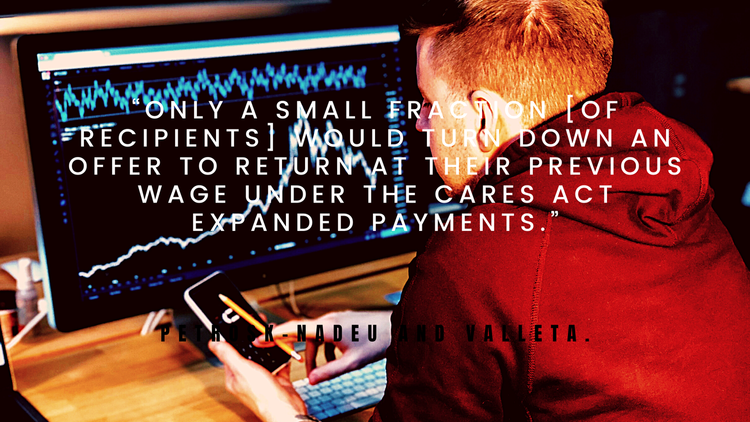
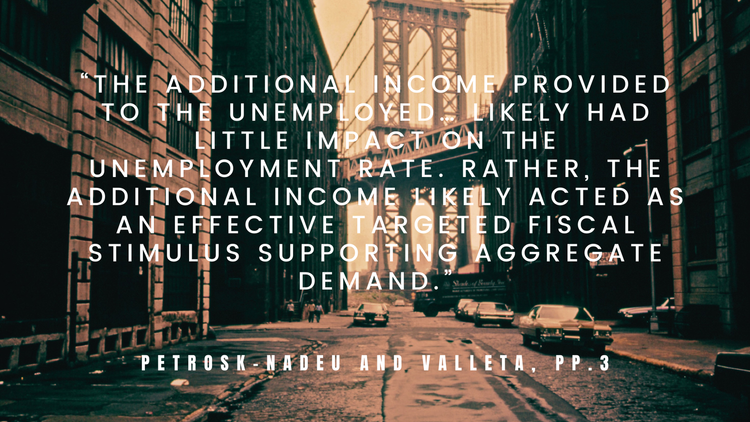
Using the reservation benefits method, PV measured the amount by which the supplements discouraged work and found that both, the $300 and $600 supplements, had a small disincentive effect. Which got even smaller during recessions.
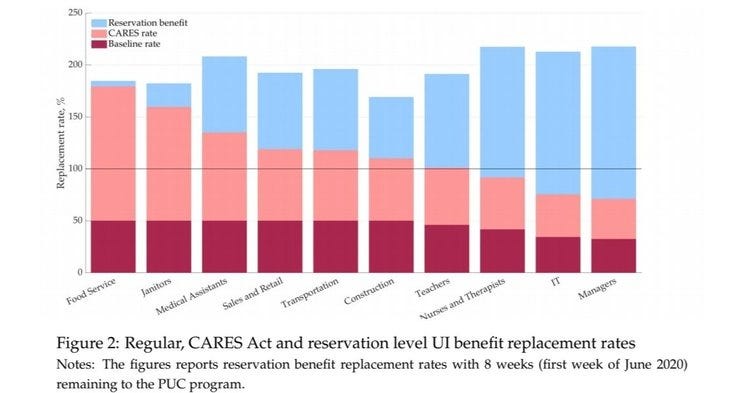
Just to put this into perspective, economists know that UI benefits have a disincentive effect, however they disagree on the size of it.
A larger disincentive effect would support the argument that large UI benefits are bad for the economy-even during recessions.
A smaller disincentive effect, however, would provide ammunition to the argument that high UI generosity is beneficial in times of hardship.
However, PV’s analysis does not end at measuring the disincentive effects of the PEUC supplements. They also found other, desirable, consequences of these cash transfers.
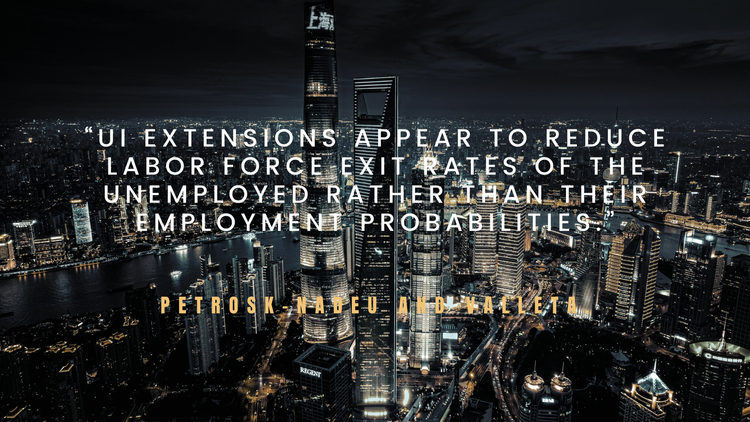
In other words, the PEUC supplements stopped people from becoming discouraged workers- workers who stop looking for a job- keeping them tied to the labor force instead.
This effect is probably the result of the job search requirement for UI eligibility: you must be looking for a job to be eligible for UI benefits and thus you have to be attached to the labor force.
So, now that we know that UI has little effect on people’s incentive to work and it increases labor force attachment. Let’s move on to the next subsection.
On Job Match Quality.
Ammar Farooq, Adriana Kugler, and Umberto Muratori (FKM) found that UI generosity, during recessions, improved sorting-the matching of skills to the jobs that need them-and as a result the functionality of the labor market overall.
They used data from the Longitudinal Employer-Household Dynamics program to perform this study and found that increasing UI benefit durations increased the sorting of educated people to jobs that need their skills.
The job match quality effect of increased UI benefit durations is even more pronounced for marginalized people such as women, people of color, and the less-educated.
Mostly because they tend to have less cash-on-hand when they are unemployed, in other words they are liquidity-constrained.
Recall that UI benefits alleviate liquidity constraints which increases job search rates and unemployment durations. Without money, you don’t have the gas to search your town for a job.
How do we know that UI benefits increase job searching? This is an important question because if UI does not increase job search rates then job match quality won’t improve.
Well we can look at recipients’ wages. If they search for jobs more frequently than nonrecipients, then the wages of recipients should be relatively higher, since higher job search rates should improve job match quality, which should, in return, improve wages
Arash Nekoei and Andrea Weber (NW) did just that in their study: Does Extending Unemployment Benefits Improve Job Quality?
They use the Austrian Social Security Database for their experiment. Using its data they find that a nine-week benefit extension, “causes workers to obtain jobs that pay on average 0.5 percent higher wages,” (Nekoei and Weber, pp. 2) and that the same extension adds two days onto unemployment spells.
These two effects are pivotal for understanding NW’s fundamental argument. Although they found UI benefits to increase wages, it is stillpossible for UI benefits to actually decrease them.
This is due to something that NW called Duration Dependence: “An unemployed agent’s job opportunities, skills, and UI benefits decrease the longer she remains without a job.”
Thus the direction of the UI’s wage effect is dependent on two forces:
- UI’s effect on the selectivity of workers
- UI’s effect on unemployment durations
Worker selectivity increases wages- UI benefits give workers the power to look for better jobs without starving- while duration dependence causes wages to decrease.
While the UI’s wage effects can be negative, NW’s results did find positive wage effects. Which is consistent with the hypothesis: that UI benefits improve job match quality.
On Family Health
UI’s impact on families is both interesting and somewhat concerning.
First lets go over the data, and then we will go over why it’s a concerning issue.
Issac Swenson, Jason M. Lindo, and Krishna Regmi (SLR) found that the UI increased fertility and decreased the chances of a divorce for men.
In fact a $100 increase in UI benefits offsets about 14% of the divorce effects of unemployment for men.
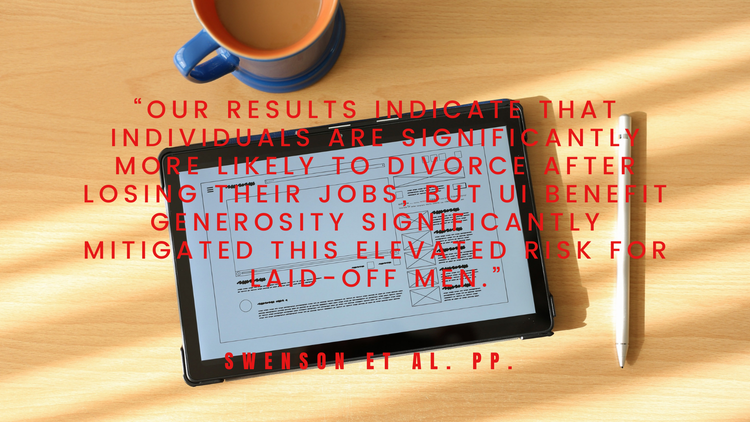
However it has a significantly different impact on women.
High UI generosity had no effect on the divorce rates of women and even decreased their fertility.
Marriane Bertran, Jessica Pan, and Emir Kamenica (BPK), found that this was due to the “Breadwinner” stereotype. The idea that men have to be the ones to support the family, an idea that is ingrained into them by society.
What happens when a man loses his breadwinner status? There is a lower chance of marriage. The wife will be more likely to decrease her labor supply and she will probably be given a bigger share of household chores. There is also a higher risk of divorce when a man loses his breadwinner status.
BPK found that this sexist stereotype is responsible for a descent portion of the gender wage gap.
Speaking of the gender wage gap women, who work part-time, are often ineligible for UI benefits.
This is especially problematic when you look at the demographics of tipped and part-time workers. Women make up 2/3rds of tipped workers and more than half of part-time low-wage workers. This lowers the income of women workers and further increases gender inequality.
Conclusion
We took a look at the economic consequences of our UI system. Let’s go over the main pointers:
- UI causes a small, nearly insignificant, decline in employment.
- 60% of the UI’s positive effect on unemployment durations (unemployment durations go up when UI benefits go up.) is due to the liquidity effect. Which actually increases economic welfare.
- People are unlikely to deny the permanent income that comes with a job for temporary UI benefits instead. Even when UI benefits exceed prior wages.
- UI increases job match quality and might raise wages.
- UI keeps people attached to the labor force.
- UI can stabilize demand during recessions.
- UI decreases the divorce rate and increases the fertility of men.
- UI has no effect on divorce rates and even decreases the fertility of women.
- A lot of women are ineligible for UI benefits which decreases their wages and increases the gender wage gap.
Given these pointers, it seems obvious that unemployment insurance has a net positive impact on the economy. Now that we know how the UI system works we can aim to fix it.
Leave a comment on how you think we can fix the American unemployment system.