
5 Reasons Why America Needs A Minimum Wage Hike.
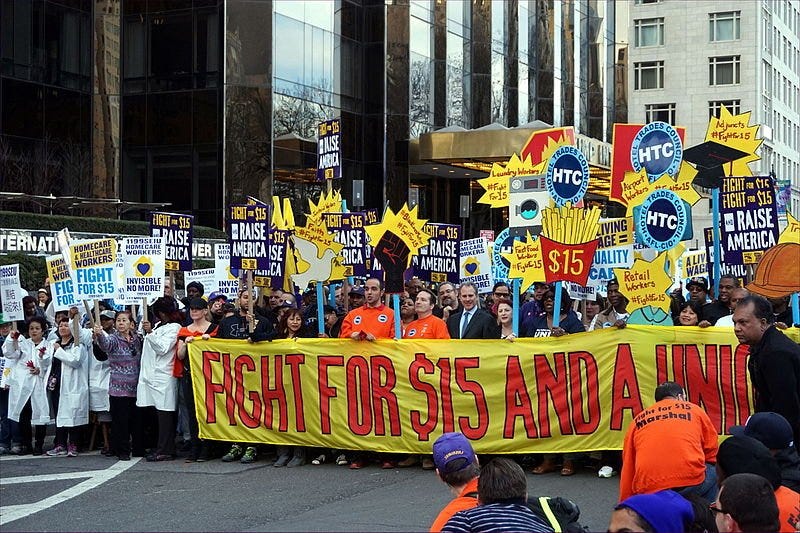
The minimum wage is one of the most contentious issues in labor economics and politics. Economists are just starting to understand the minimum wage’s effects on the economy. Contrary to classical economic theory, much of the present research has found minimum wage hikes to have favorable outcomes, even in employment. There is still no economic consensus, however, thus the debate tends to boil down to philosophy.
Would a minimum wage increase be worth its costs? That depends on your ideology. Is increased health, consumption, and decreased inequality worth a very small increase in inflation? Hopefully, when you finish reading this article, I would have convinced you that America needs a minimum wage hike.
1. A Minimum Wage increase Would Have no Adverse Effect on Employment…
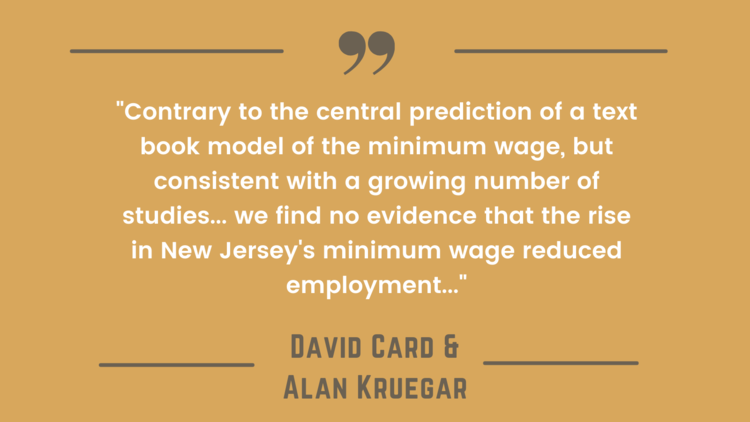
This once extraordinary finding, by David Card and Alan Krueger, rocked the economic orthodoxy when it was published in 1994. Although some disagree with the methods used by Card & Krueger (see Arindrajit Dube, et al.), most of today’s economists agree that the minimum wage has no significant adverse employment effect ( or any significant positive effect like what Card & Krueger found)
There have been many attempts to explain this finding, Card & Krueger believed that the firms they studied passed on their increased production costs to consumers. However they found no evidence indicating that any of the firms in question increased the prices of their goods.
Another possible explanation, with a decent amount of evidence backing it up, is the efficiency-wage hypothesis. I plan on discussing this hypothesis in a separate more-comprehensive article. The general takeaway is that: wages above the market-rate increase workers’ productivity.
This ties in well with Card & Krueger's findings, in that, the minimum wage might pay for itself.
More likely, is that the increased productivity pays for some of the minimum wage but not enough to negate its cost to individual firms. If this is true then we would still need to decide whether or not an increased minimum wage is worth the acquired costs and to what extent a minimum wage increase would pay for itself.
2. A Minimum Wage Increase Would Have no Adverse Effect on Workers’ Hours…
When Card & Krueger's findings were made somewhat mainstream, a new movement of anti-minimum-wage economists sprung up.
This new movement argues that a minimum wage hike decreases the amount of hours workers can obtain. Thus a minimum wage hike would be a net loss for workers, although it may not directly translate into job losses.
You can probably see some merit to this theory. There might be more than one way in which a minimum wage hike could be harmful (or beneficial) to affected workers.
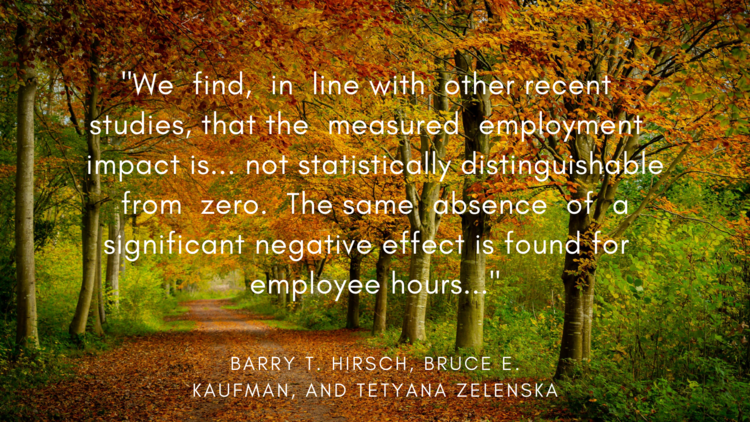
Barry Hirsch, Bruce E. Kaufman, and Tetyana Zelenska (HKZ) all explored this question In their landmark paper, Minimum Wage Channels of Adjustment. HKZ argued that the production costs, associated with the minimum wage, were internalized or passed along through more methods than just cuts to employment. However, they also found no evidence that the minimum wage affected workers’ hours in any meaningful way.
Instead, they found that firms compensated for minimum wage costs by increasing their menu prices. However, the level of inflation may not actually be that much.
**HKZ noted that a minimum wage hike caused decreased turnover rates. Which in turn saved managers from the costs accrued from the hiring process. The minimum wage was found to also increase workers’ morale, productivity, and the number of high quality job applicants.
3. A Minimum Wage Increase Would Raise Inflation, But Not by Much…
If a minimum wage hike does not have a negative effect on employment or hours, then it would be reasonable to assume that it must negatively affect either prices, profits, or both. In fact, HKZ found that increased inflation accounted for 2/3rds of the costs imposed by a minimum wage hike.
Indeed much of the research on the impact of the minimum wage on inflation confirm this finding. According to a Meta-Study by Sara Lemos, “most studies found that a 10% US minimum wage increase raises food prices by no more than 4% and overall prices by no more than 0.4%. “
It seems that the majority of the costs are delivered through increased prices. However, in Denmark, McDonalds’ workers are paid about $22 an hour with many benefits. Yet their prices are only 30 cents more on average than American McDonalds. Given this example, a minimum wage might not raise inflation by much.
**It’s worth noting that Denmark has no national minimum wage, even though its workers are paid high wages. Instead, their high wages arrive through strong worker power levels and unionization.
4. A Minimum Wage Increase Would Lower Economic Inequality.
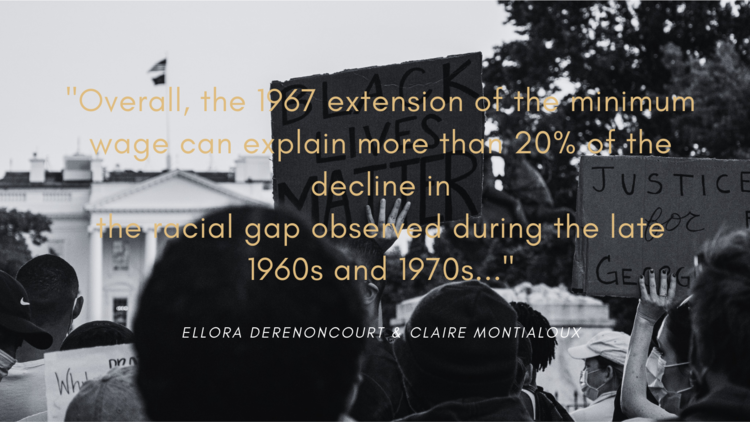
Racial and Gender inequality is hardly mentioned in the minimum wage debate. Which is sad, because a minimum wage increase could make a real improvement in these areas. In fact, during the civil rights movement, a minimum wage hike caused more than 20% of a gargantuan drop in economic racial inequality (Derenoncourt, et al. 2021). This was due to an extension of the fair labor standards act, which expanded the minimum wage’s coverage to more jobs. Jobs that were predominantly taken up by black workers.
If a minimum wage increase occurred today, we would probably see a similar level of decline. The National Employment Law Project found that, “More than half of African American workers are paid less than 15$ [an hour]” (which is below what Americans want the minimum wage to be.). They also found that more than 60% of latinx workers make under that threshold.
However, increasing both the tipped minimum wage and regular minimum wage would especially decrease gender inequality, since 72% of all tipped workers and 55% of the workers making below 15$ an hour are women (The White House, 2014).
**The pandemic has especially impacted women workers. There are many reasons as to why this is the case, however I do not know the specifics. It could well be the case that the level of women workers making below $15 an hour fell dramatically.
5. A Minimum Wage Increase Would Boost Household Consumption Rates and Workers’ Health

The minimum wage’s influence here is a no-brainer, but the specifics matter.
Especially important is the amount by which a minimum wage increase would raise consumption rates. An increase in household consumption could offset some of the inflation caused by a minimum wage hike.
This is exactly what Daniel Aaronson and Eric French found in their study. A minimum wage hike of about $1.75 (about a 24% increase) raises overall household consumption rates by 0.3%. This does not necessarily mean that the minimum wage’s impact on inflation is void. Rather, it means that a minimum wage increase may not be as expensive as previously thought.
However, there are more benefits associated with increased household consumption (or increased household income) than just offsetting increased prices. It improves the health of minimum wage workers and their families
A study by Rajiv Bhatia found that California’s minimum wage hike, in 2014, improved health on multiple fronts.
- It decreased smoking
- It increased exercise and decreased obesity
- It improved mental health
- And hundreds of premature deaths were avoided.
Conclusion
The minimum wage debate is contentious, and there are valid arguments on both sides. This article seeks to make one of those arguments. The minimum wage is good for workers, families, and overall welfare.
Do you think that congress should raise the minimum wage, why or why not? Leave your answer in the comments.
Bibliography
Autor, David H., et al. “The Contribution of the Minimum Wage to US Wage Inequality over Three Decades: A Reassessment.”
American Economic Journal: Applied Economics, vol. 8, no. 1, Jan. 2016, pp. 58–99, https://www.aeaweb.org/articles?id=10.1257/app.20140073
Arindrajit Dube, T. William Lester, and Michael Reich. (2010). “Minimum Wage Effects Across State Borders: Estimates Using Contiguous Counties.”
IRLE Working Paper №157–07. https://www.jstor.org/stable/40985804
Card, David & Krueger, Alan B, 1994. “Minimum Wages and Employment: A Case Study of the Fast-Food Industry in New Jersey and Pennsylvania,”
American Economic Review, American Economic Association, vol. 84(4), pages 772–793, September. https://www.aeaweb.org/articles?id=10.1257/aer.90.5.1397
Daniel Aaronson & Eric French, 2013. “How does a federal minimum wage hike affect aggregate household spending?,”
Chicago Fed Letter, Federal Reserve Bank of Chicago, issue Aug. https://ideas.repec.org/a/fip/fedhle/y2013iaugn313.html
Derenoncourt, Ellora, and Claire Montialoux. “Minimum Wages and Racial Inequality.”
The Quarterly Journal of Economics, vol. 136, no. 1, Feb. 2021, pp. 169–228, https://scholar.harvard.edu/elloraderenoncourt/publications/minimum-wages-and-racial-inequality
Doucouliagos, Hristos, and T D. Stanley. “Publication Selection Bias in Minimum-Wage Research? A Meta-Regression Analysis.”
British Journal of Industrial Relations, vol. 47, no. 2, 2 June 2009, pp. 406–28, https://ideas.repec.org/a/bla/brjirl/v47y2009i2p406-428.html
Dube, Arindrajit. 2019. “Minimum Wages and the Distribution of Family Incomes.”
American Economic Journal: Applied Economics, 11 (4): 268–304. https://www.aeaweb.org/articles?id=10.1257/app.20170085
Hirch, Barry T., et al. “Minimum Wage Channels of Adjustment.”
Industrial Relations, vol. 54, no. 2, Apr. 2015, pp. 199–239, https://onlinelibrary.wiley.com/doi/abs/10.1111/irel.12091
Human Impact Partners. May 2014. “Health Impacts of Raising California’s Minimum Wage.”
Oakland, CA. http://healthpolicy.ucla.edu/publications/search/pages/detail.aspx?PubID=1310
Lemos, Sara. “The Effect of the Minimum Wage on Prices.”
IZA Discussion Papers, no. 1072, Mar. 2004, https://www.iza.org/publications/dp/1072/the-effect-of-the-minimum-wage-on-prices
“THE IMPACT OF RAISING THE MINIMUM WAGE ON WOMEN: And the Importance of Ensuring a Robust Tipped Minimum Wage.”
The White House, Mar. 2014, https://obamawhitehouse.archives.gov/sites/default/files/docs/20140325minimumwageandwomenreportfinal.pdf
Tung, Irene, et al. “The Growing Movement for $15.”
National Employment Law Project, Nov. 2015, https://www.nelp.org/publication/growing-movement-15/