
Fun Facts About France You Should Know Before Studying Abroad
French sandwiches don’t come in regular square bread
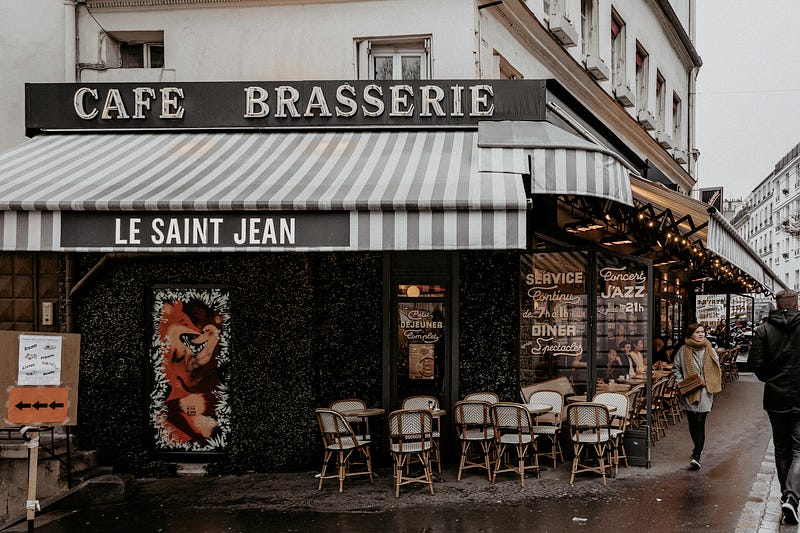
Oh la lá
We all want to learn to speak the language of love and about the french kiss.
When you get to France as an international student beware that:
- Sometimes it will be easier to speak English with your friends. All of you are still learning French, this is another reason for studying abroad.
- You will barely listen to mademoiselle. Your title will change to madame if you are a woman. If you are a man, then read this.
Here are compelling fun facts I observed during my stage in France.
Chances are that if you are a French guy this may not seem accurate to you.
This is written from my perspective as a traveller spirit; always curious. Please read it as a chill and humoristic story.
Frenchies wearing a beret and striped shirts is not a cliché; it is indeed a fact. Although they will try to convince you of the contrary.
“Frenchies wearing a beret is a cliché”
Said my teacher in one of my first classes in France. A cultural introduction is a frequent starter point to warm up and faire la connaissance. Aka, break the ice.
She asked us, international students, about which other clichés we have heard about the french culture. She was taking her coat off when someone in the background said:
“It is a cliché that Frenchies always wear a beret and a striped shirt.”
The teacher laughed when she founded herself keeping her beret inside her bag and wearing a striped shirt under her coat.
A 750 ml bottle of wine can be as cheap as 3 euros
This is not a myth, it is for real.
I don’t know your country's regulations but here in Canada, supermarkets don’t sell alcohol. If you want to buy wine, you have to go to the liquor store.
In France, you go to the regular épicerie, supermarket or grocery store and grab a bottle of wine.
I am sure they have specialized liquor stores. But if you are studying abroad, this is valuable information for you about where to buy non-expensive wine.

Haven’t had wine since 2016.
You can imagine how much wine I drank during those 6 months of living in Lyon.
As soon as you arrive in France, you will notice that indeed France is the capital of wine.
Close to one of the bus stops nearest to the Residence André Allix, we had containers to recycle glass bottles. — Or was it to recycle wine bottles only?
Every time I passed through to take the bus; or for throwing a glass bottle, it smelled like fermented wine.
Please acknowledge that no bottle of wine was poured inside. No, no. All of them were introduced all empty. I make this disclaimer in case you are afraid of wine being wasted.
The remaining drops of every bottle kept fermenting inside the big recycle container. The smell was quite strong, and it could be disgusting but now I remember it as an evocative scent.
I’d say the fermented wine smell is a délicatesse Français.
The best part is that you don’t have to go to a luxury liquor store to enjoy a Frenchy fragrance.
Take note: You better get used to drinking wine at every party because it’s the cheapest alcohol to get. FYI.
Also, your friends will expect you to bring a bottle of wine to your gatherings. You are young, you are a student, none will expect you to bring an expensive wine. The one you get in the Carrefour, Lidl or Leader Price is fine for these gatherings.
French sandwiches are not regular square bread
When you go to the bakery; if you were planning to buy one baguette, get two. If you were going to take two, then buy three baguettes. And so on.
You want to buy an extra baguette to eat on your way home.
Can’t tell how many times I arrived home expecting to make a sandwich out of a nonexistent baguette.
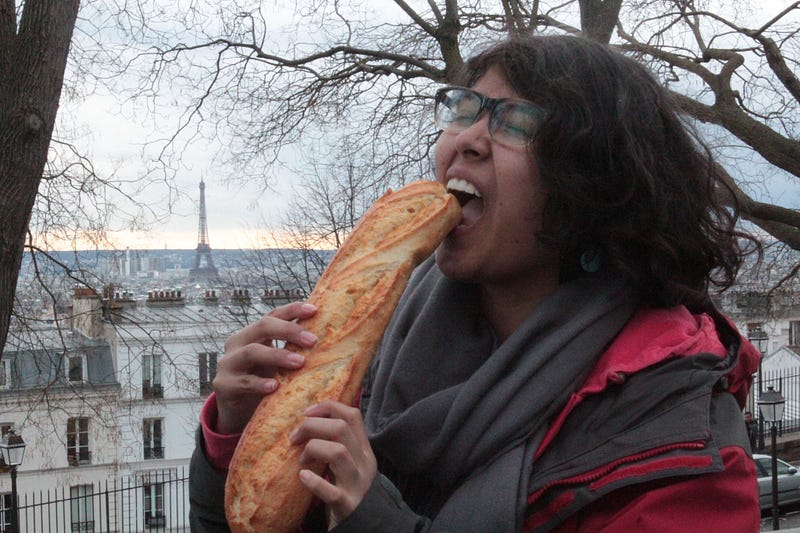
Oh, yes. In France, a baguette is an empty bread.
In Mexico and in Canada, a baguette could be an empty bread, as we know it. But when you ask in a cafe for a baguette, you will receive bread filled with something, ham and cheese at least.
However, this description in France would be a sandwich.
If you go to France and ask for a sandwich in a cafe or the food court, don’t expect your regular square slices of bread. You will receive a stuffed baguette.
What is the difference between Camembert and Brie cheese? — I asked a man in the Supermarket
I don’t work here. — He said.
I know. But do you know that’s the difference between these two kinds of cheese, Camembert and Brie? — I insisted.
Brie is more creamy than Camembert, which has a stronger flavour.
Voilá. That’s it. That’s all I wanted to know. I took Brie and went home.
When I open the package it looked like Panela cheese, which is a Mexican type of cheese with a very soft and moist texture, and lactose flavour. Similar to fresh Mozzarella.
I put a slice of Brie cheese in the middle of a baguette chunk and I gave it a gross bite.
Yup, Brie is indeed creamy. Can’t imagine how far stronger Camambert could be. I wasn’t used to these flavours.
Brie indeed resulted very strongly to me in the first try out.
This will also happen to you, but you will get used to strong and different flavours.
At the end of my stage in France, I could enjoy strong flavours like garlic-seasoned olives and could eat big chunks of Camembert cheese on a tiny piece of bread followed by a generous slip of wine.
This is something no longer enjoyed when I returned to Mexico. Flavours tasted different to me.
I have the theory that flavours belong to where you originally tried them out.
These are my short stories regarding my stage in France, which are yours?
I’d like to hear from you.