5 Design Approaches to start a New Creative Project
from Design Thinking, Design Driven Innovation to Speculative Design
First and Foremost
Expansion of the word “Design”
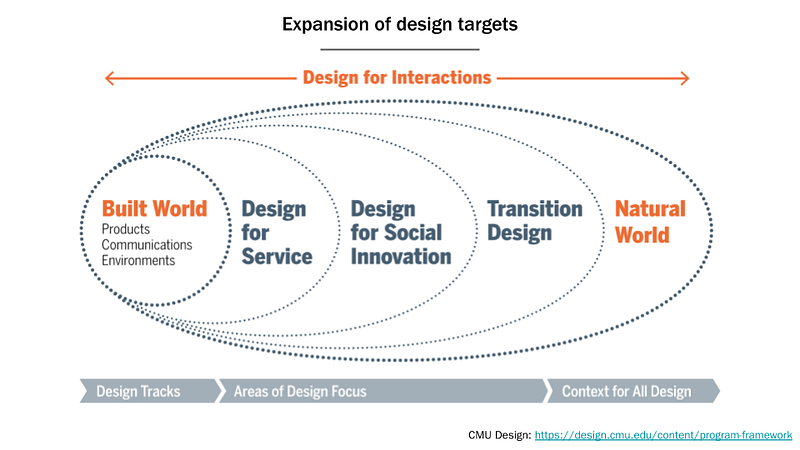
Recently, the word “design” goes beyond traditional product and communication realms. People expect that design plays the role of more socio-technical interventions such as experiences, services, and social innovations.
Furthermore, it will be extended to ultimately interdisciplinary layers such as culture, policy, and society as CMU’s Transition Design mentions. It was also an innovative event that the UK Policy Lab was established under the government office in 2014 to brings open and people-centered design approaches to policy-making.
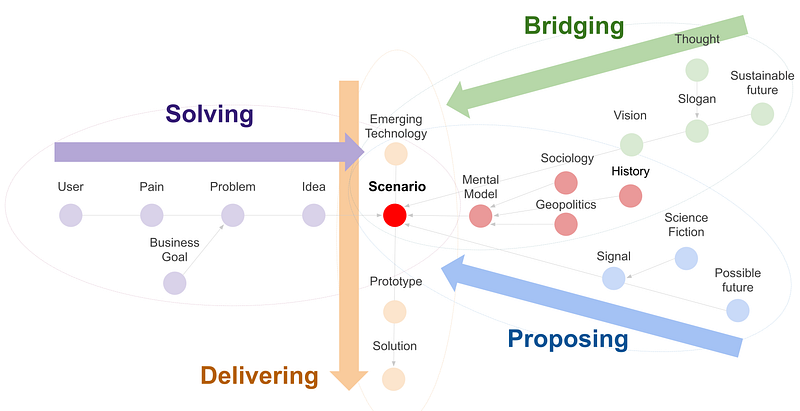
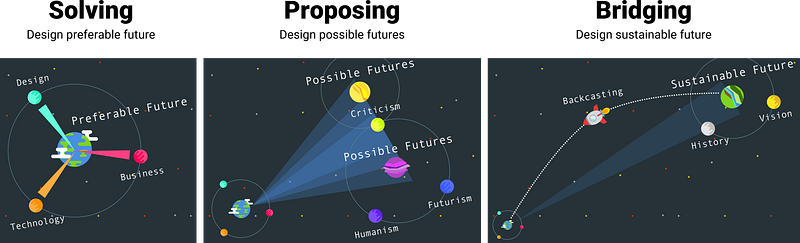
Also, the purpose of design is not only solving the problem, which is just in front of us. Speculative Design is the new field of design which aims to propose problems of the future introduced in the book Speculative Everything. Additionally, according to the rise of demand to make planetary visions such as the SDGs, how to deal with wicked problems and bridge to the sustainable future is starting to become a big topic for designers in the 21st century.
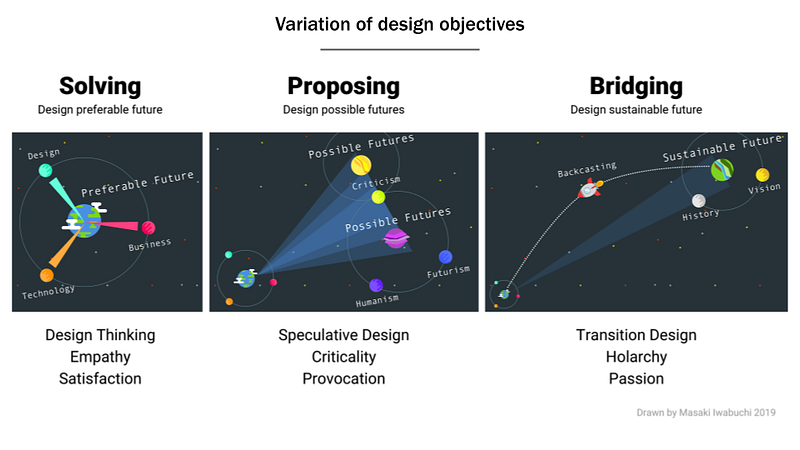
Based on these two axes, I organized current horizons in design theory. Especially I originally paid attention to Transition Design, which declares to design people’s values on a societal scale. This ultra-large-scale design theory suggests a new role of the designer in the 21st Century as the result of the expansion of the scope of design.
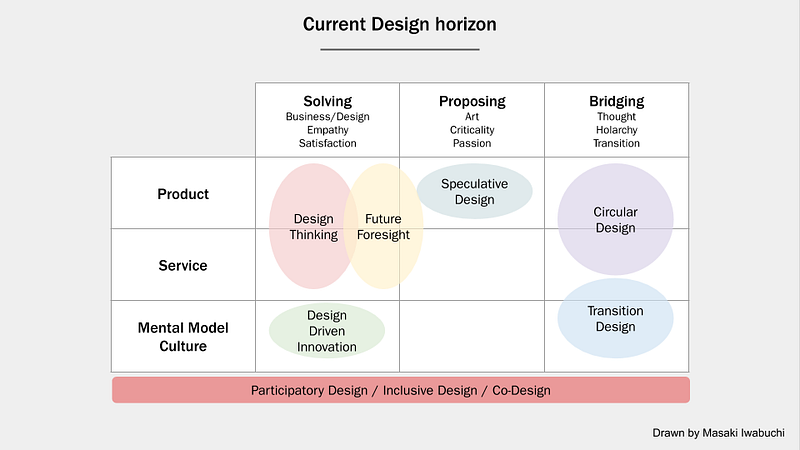
Including Transition Design, I summarized the current representative five design approaches. The model diagrams below depict a typical process, and I don’t say these are the only processes. Various strategies and research methods are being fused and evolved every day, and I expect each approach to keep changing and evolving.
1. Forecasting Approach
Think about the future from the past and the present.
1.1. Design Thinking
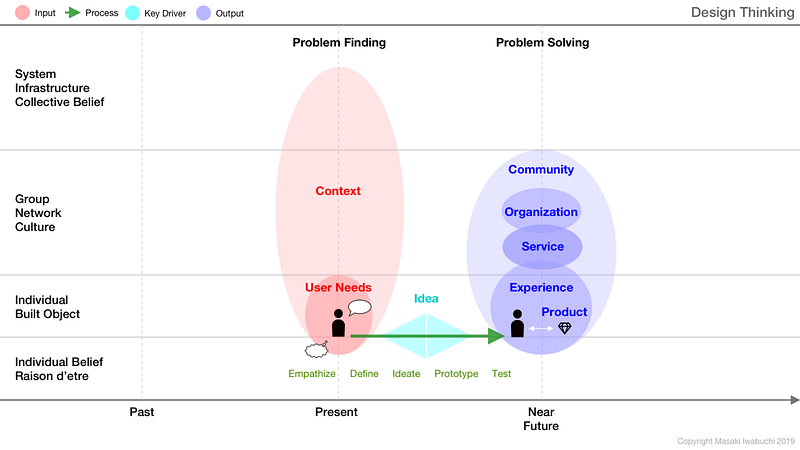
Feature User-centric and bottom-up approach. Empathize with specific users and extract their needs/pains, and create many ideas and prototypes to try to solve their issues smartly.
Current situation Initially proposed by ideo, and it is becoming a boom; being applied to many business projects as a method for creating innovation. On the other hand, there are criticisms that it is not easy to create innovative products just by satisfying user needs.
It is challenging to extract 100% of the value of Design Thinking unless there is a member who understands and masters the essence of the methodology. You cannot create fantastic artifacts just by knowing and applying methods/tools of Design Thinking.
Key Points 1. Keep seeing the user’s face from the beginning to the end 2. Visualize and prototype quickly and iteratively 3. Test assumptions and respond flexibly
These are essential and unique points of design thinking, and it is the key to dive into the user ultimately and always think from the eye of the user. There are many practical case studies and knowledge, mainly in the UX design community, and it is an excellent strategy to refer to successful cases.
Design Thinking is becoming a diffused method for problem solving. — Roberto Verganti
1.2. Systems Thinking
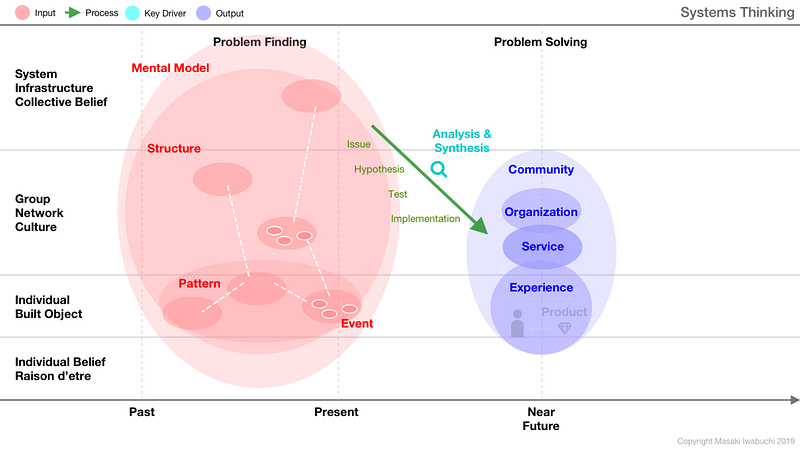
Feature A system-centric and macro approach. Rather than a specific user, it often starts with a big problem such as a declining birthrate, an aging population, sluggish sales, etc., and analyzes the root cause systematically and create a new system by decomposing and patterning changes, components, and dependencies.
Current situation and key points It is particularly fit with fields of social innovation, community design, and process improvement because Systems Thinking captures problems from the top-down perspective. However, there are situations where it is difficult to access individual users from the perspective of Systems Thinking, so some books mention that it is a great strategy to incorporate other methods’ advantages for designing specific experiences and touchpoints.
1.3. Design-Driven Innovation
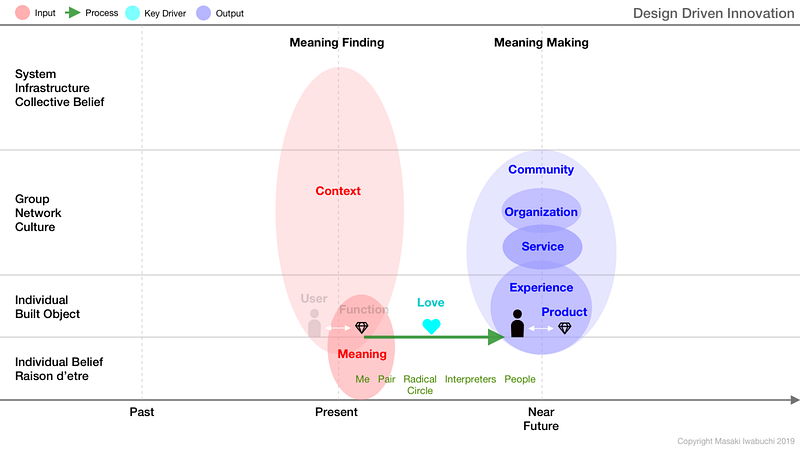
Feature Inside-out approach proposed by Roberto Verganti instead of outside-in approach such as Design Thinking. It means focusing on the meaning of things in the world we live in, and he explains that creating new meanings leads to innovation. Therefore, rather than listening to the user’s voice, it is crucial to listen to your inner voice, produce products from the desire of changing the world, and grow the product with receiving constructive criticism.
Current situation and key points Based on the limitations of Design Thinking that the user does not know what he wants, Verganti advocates creating meaningful products from the designer’s inner voice. Inspiration, sense, and asking WHY are essential elements. However, regardless of design approaches, the attitude of always asking about the value and meaning of the product is the primary designer’s mindset.
2. Backcasting Approach
Think about what we should do now from the future.
2.1. Speculative Design
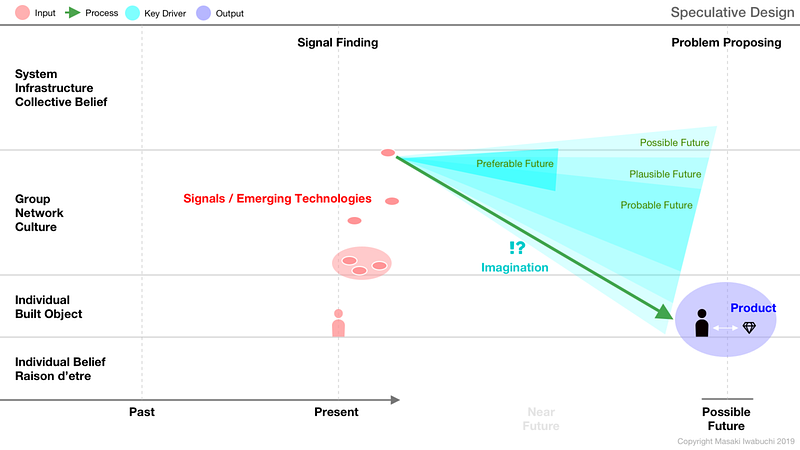
Feature Problem proposing approach. It captures driving forces that may change the world, such as future signals and advanced technologies. And from these inputs, it exhibits radical worldviews through tangible products to encourage audiences to speculate the possible future together. It is often introduced as a design for proposing problems, not a design for solving problems. The purpose of this type of design is to evoke the debate about what we should live/think/do now. Strictly speaking, Speculative Design proposes the future, but it doesn’t propose to-do actions of the present. To think about them and take actions are up to audiences.
Current situation and key points This concept was proposed by Dunne & Raby, and their students such as Sputniko!, James Auger, E. Montgomery, and C. Woebken has been teaching at universities all over the world to keep Speculative Design’s DNA.
However, there has been a criticism of how to connect with the current situation because Speculative Design only proposes the possible future. Under such circumstances, Dunne & Raby now collaborates with anthropologists and philosophers at Parsons rather than engineers and scientists when they were at RCA. They are exploring the concept of Designed Reality, which visualizes the philosophy behind technology rather than the future that technology can lead.
2.2. Transition Design
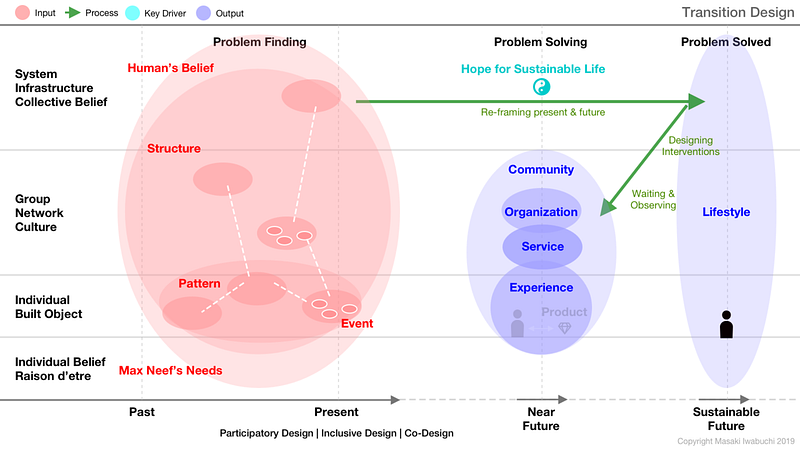
Feature A system-centric and macro-level backcasting approach. It envisions a sustainable and ideal lifestyle where “wicked problems” no longer exist, and returns back to a feasible project proposal to bridge to that long-term future.
Current situation and key points Proposed by Carnegie Mellon University in 2015. It is a super-interdisciplinary design approach which incorporates the viewpoint of people’s lifestyles (from Design Thinking), the concept of holarchy (from Systems Thinking), the radical envisioning (from Speculative Design), and the attitude of going back to the present through backcasting.
On the other hand, it is still an ideal theory, and there are still few practical case studies. However, the design theory that pursues shining ideal futures is challenging and valuable because it is more and more challenging to envision long-term visions and future dreams. I believe that capability will be required for future designers. Besides, it envisions not the future “technology” but the future “lifestyle,” which means that Transition Design focuses on how people’s values and beliefs should be. This is a similar philosophy as Dunne & Raby’s Designed Reality.
In this Summer, as a visiting design researcher at Kyoto Design Lab, I conducted the Transition Design project and delivered outcomes as the first practical case study of Transition Design in Japan. Please see this article for more detail.
3. Participatory Design Approach
3.1. Participatory Design 3.2. Inclusive Design 3.3. Co-Design
These concepts are considered as an organization of the project rather than a design process/approach. So these are placed in the above diagram as the infrastructure for the design project.
Final Thoughts
Is there a universal approach?
Deciding an approach and taking a stance means abandoning something, so I think there is no single, universal approach. For this reason, Designers need to have various design approaches in drawers, and use appropriate one or combine multiple approaches according to the project’s situation and phase.
You can flexibly design the process just by asking simple two questions at the beginning:
- Think from the present (forecasting) or the future (backcasting)?
- View from the micro (individual layer) or macro (system layer)?
Scenario making is a universal skill for designers
The ability to envision a future scenario and visualize it is the common designer’s capability regardless of which design approach is applied. Input information varies project by project. However, designers need to convey how people’s experiences and values change with a lively resolution. I think this capability will continue to be a core skill that will not change even if the definition of the design is expanded.