
Case Study on Transition Design: Speculation of Life in 2050 from Kyoto (Part 2)
In Part 1, I talked about the background and theory of Transition Design, which has few practical case studies in the world. In this article, I will mention the results of practice in Kyoto, details of the final participatory session, and the prospects of designers in the 21st century.
Practice: Speculating of the purpose of life in 2050 from Kyoto
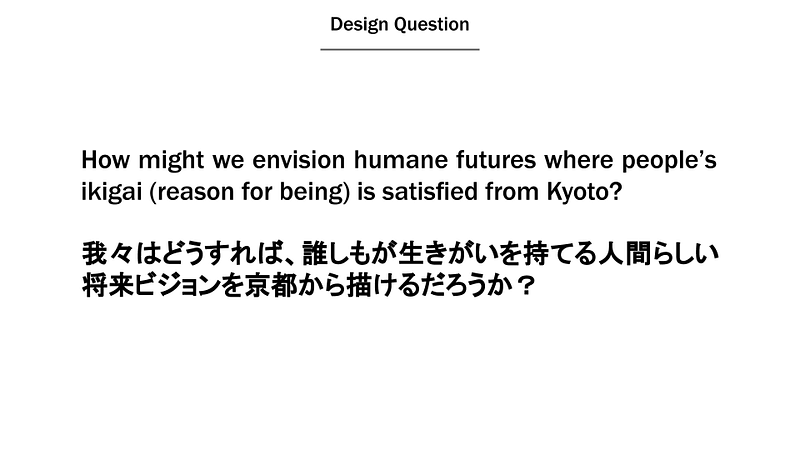
This time, I conducted the Transition Design project in Japan and focused on the problem that young people have no hope for the future as one of the abstract and unique Wicked Problems in Japan.
Japanese life and career are becoming more and more opaque because of the collapse of seniority and lifetime employment, declining birthrate and aging society, and the decline in GDP and international competitiveness.
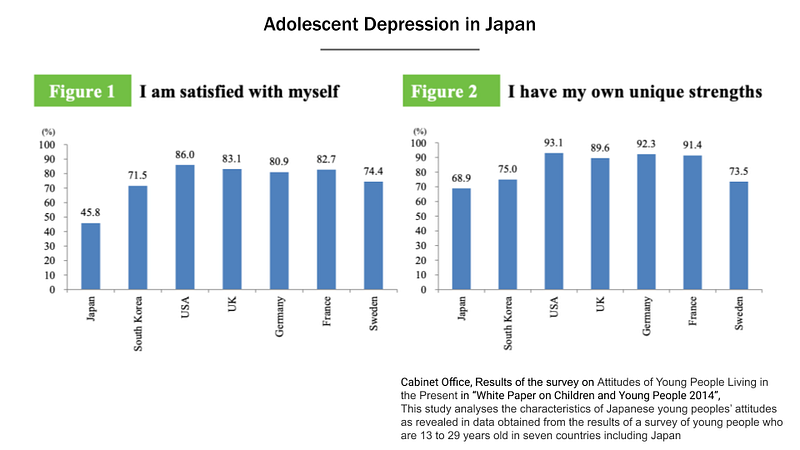
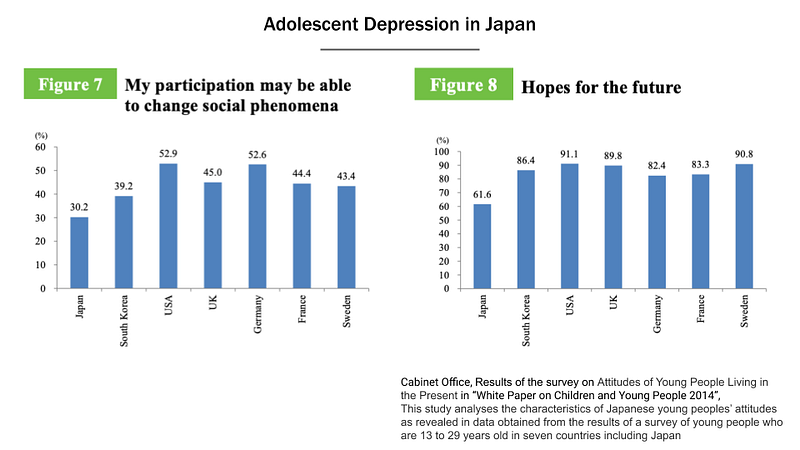
In the Cabinet Office’s White Paper on Children and Young People 2014, there are statistics that Japanese youths’ self-confidence and hope for the future are significantly lower than those of overseas countries, and the willingness to change the nation is also low.
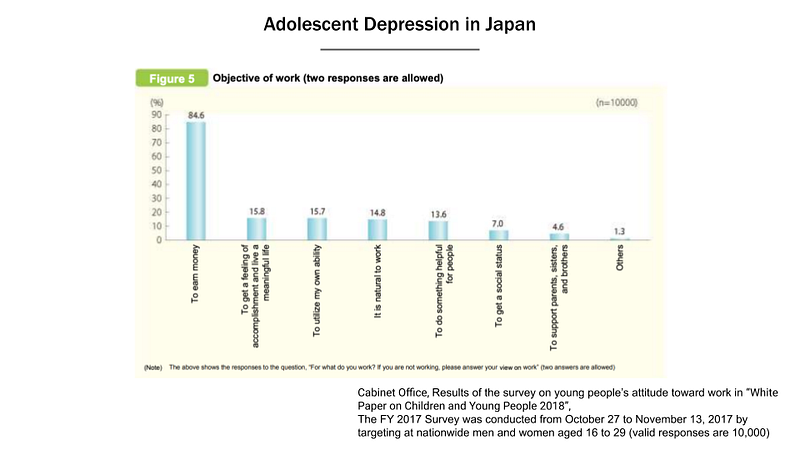
In addition, 85% of young people answered that they work “to make money” when asked why they work. This result shows that Japanese young people only focus on making money and living in the present and it is difficult for them to think about their future dreams and self-actualization.
Under this circumstance, this project aimed to create a humane vision for the future where everyone can live with the purpose (ikigai).
Process: 10-Weeks individual project
This time, as a design researcher in residence at KYOTO Design lab, I spent about 10 weeks and conducted the following four processes as an individual project.
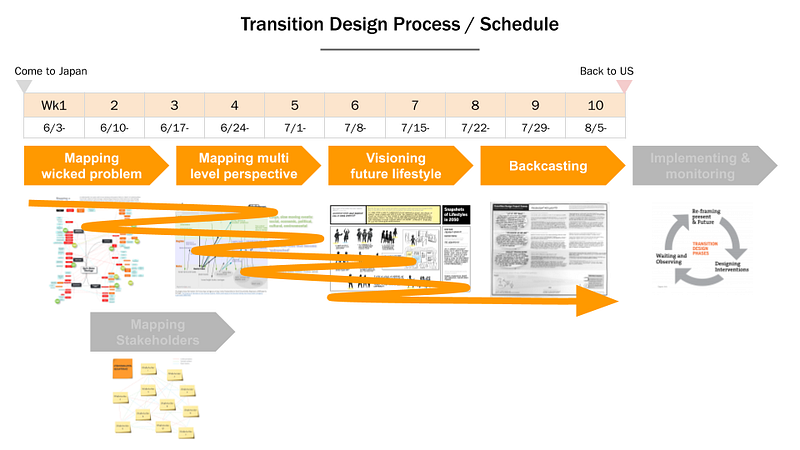
These four processes did not proceed in order, but in fact, as shown in the orange arrow above, I went back and forth between ideas and visualizations. Finally, I created a collective video depicting people’s lifestyle in 2050.
1. Mapping Wicked Problem
The first activity is “Mapping Wicked Problem”, which breaks down complex problems, understands interdependencies of multiple discipline/scale problems, and explores the root cause with project stakeholders.
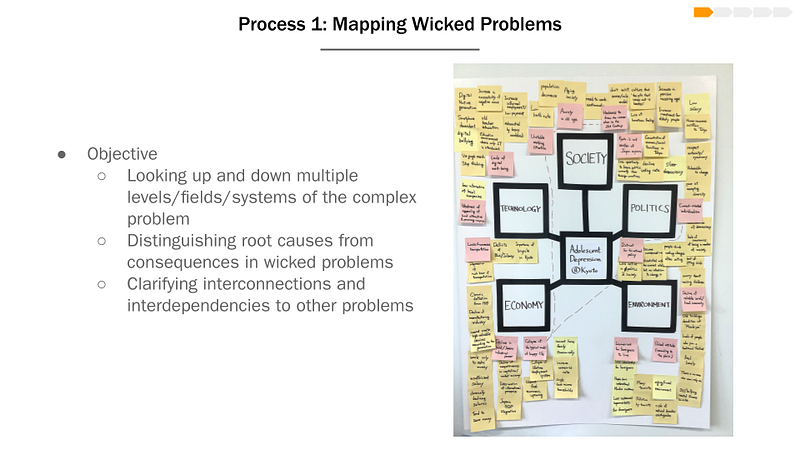
I analyzed the Wicked Problem with the STEEP (Society/Technology/Economics/Environment/Politics) framework. This work is effective when carried out with experts of multiple fields because project members can dig into each area deeply, share that the problem can no longer be solved from one specialized area, and discuss how to create synergies in each area among experts.
On the day of the final session, I facilitated the participatory workshop for participants to experience this work and discussed how the perspective and problem scale differed from the approach of design thinking and user-centered design.
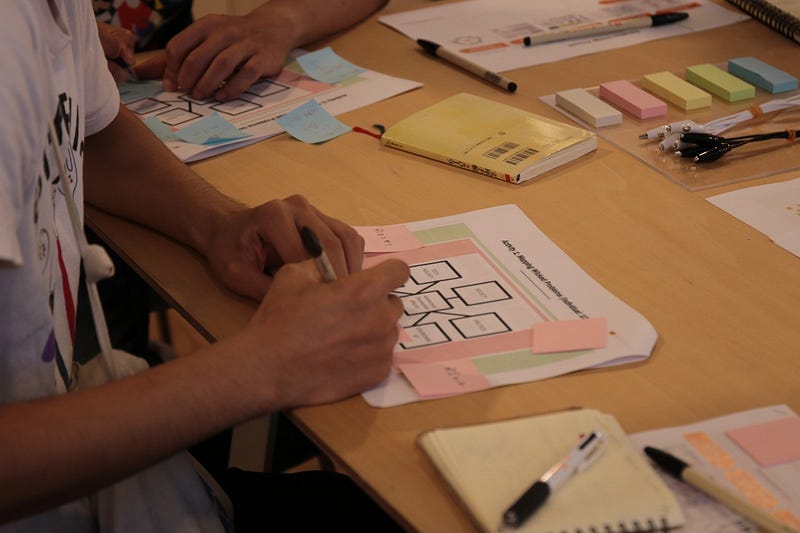
In my individual project, I collected input from secondary research, interviews with students and experts (professors from other departments of Kyoto Institute of Technology) analyzed the wicked problem using a causal loop diagram, which is Systems Thinking tools.
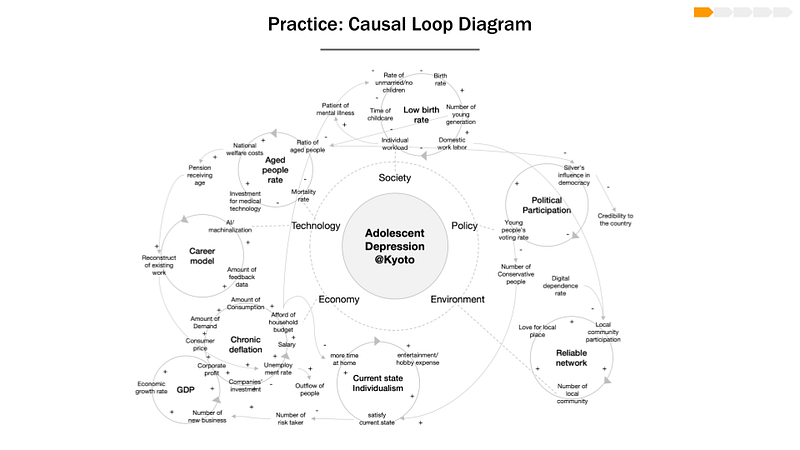
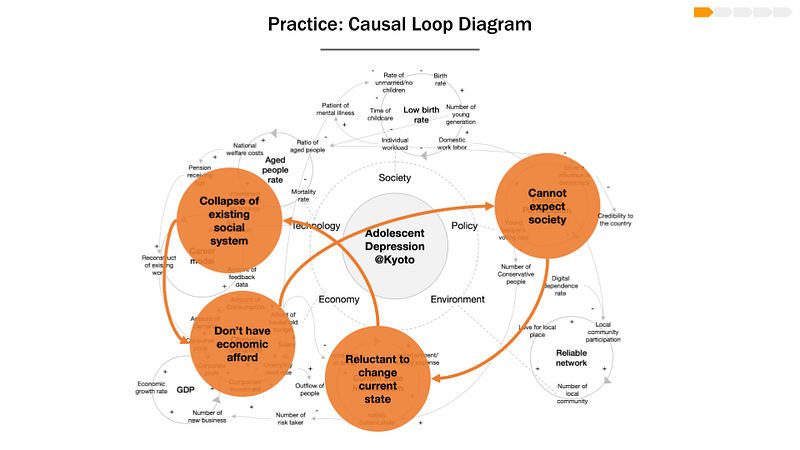
Finally, I understand that there are negative loops flowing through multiple levels such as individuals, cities, and society in Japan: “Households have no economic afford” → “Citizens have no hope for Japan nation to change the situation” → “However they do not act to change but seek satisfaction with the current situation (be conservative)” → “The growth of economy will stop and the existing system will further collapse.”
2. Mapping Multi-Level Perspective
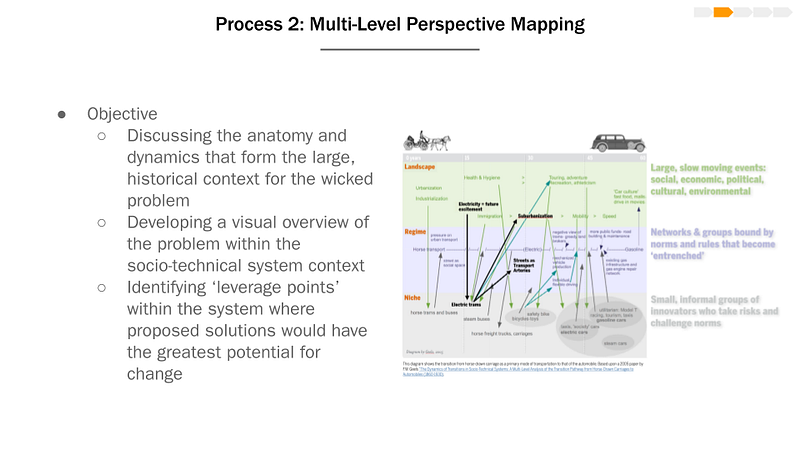
Next work is “Mapping Multi-Level Perspective” mentioned in Transition Design theory. I took the timeline axis on the horizontal axis and the societal layers (individual/city/society) on the vertical axis, and analyzed changes and patterns such as when the root cause identified in 1 appeared and what kind of dependencies there were in each social class to identify “leverage points” to change the whole system.
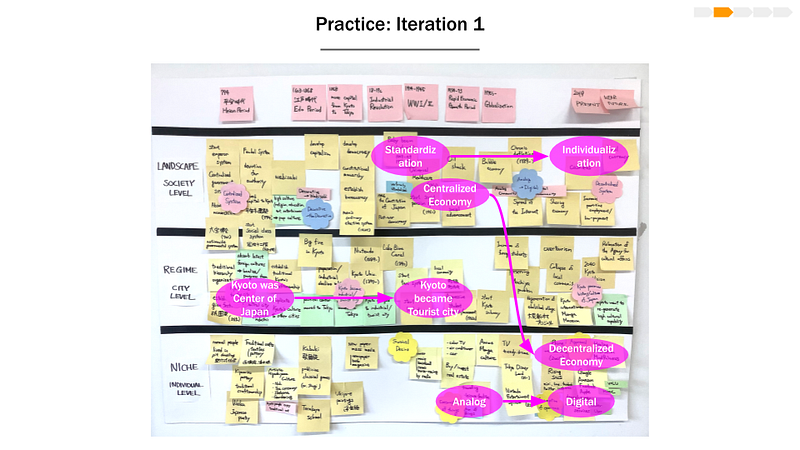
In my practice, it was difficult to identify what to write, and it seemed to be a task of summarizing the whole of Japanese history. Additionally, in my first iteration, I can only track general and superficial changes such as “Analog to Digital” and “Centralization to Decentralization.”
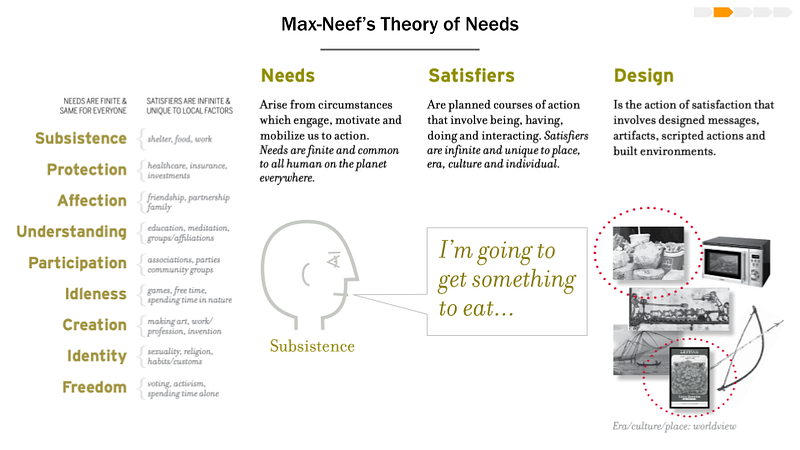
Therefore, to capture deep insights from one event rather than collecting historical events widely in a superficial manner, I decided to add “Max Neef’s Needs Theory” which is also mentioned in the theory of Transition Design. This is the idea that human’s fundamental needs are aggregated into nine (the left end in the figure below), and I used it as a guideline to dig into WHY layer and think about what kind of needs were behind products and cultures.
In the same way, in order to reveal the social system and mental model behind the surface events, I also considered the “Iceberg Model” mentioned in Systems Thinking.
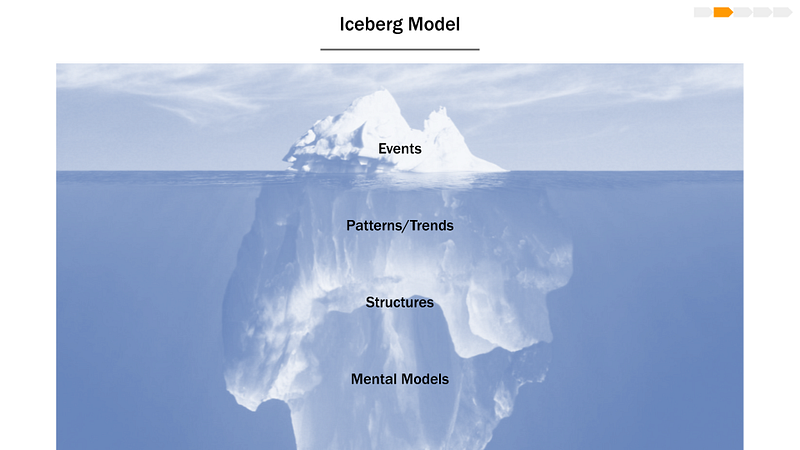
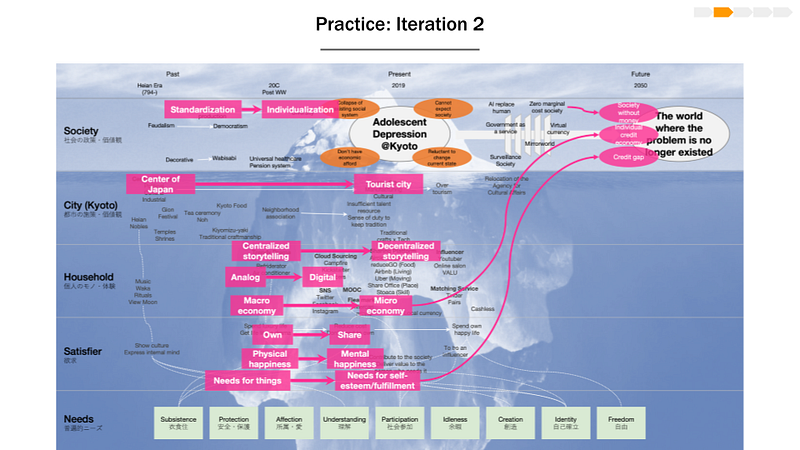
As a result, in iteration 2, I focused on changes in the societal and planetary ecosystem, changes in people’s values and mindsets, etc. that are behind the surface events. I investigated the transition of the entire social system from the perspective of WHY rather than WHAT.
However, there are many layers and axis for organizing information, and it was no longer possible to think in the 2D paper, so I began to think about social systems in the 3D model: Time(x)/Social layers(y)/Mental model(z).
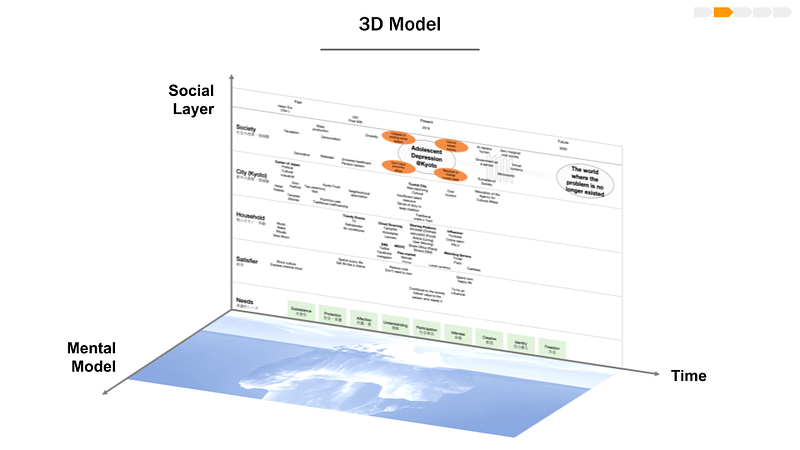
Therefore, by collaborating with industrial design students, I developed a new research method that can be used to visualize the multi-layered and complex societal system on a table. I prototyped a physical three-dimensional frame and inserted individual events and elements (sticky notes) and their relationships and dependencies (crocodile clips) in there.
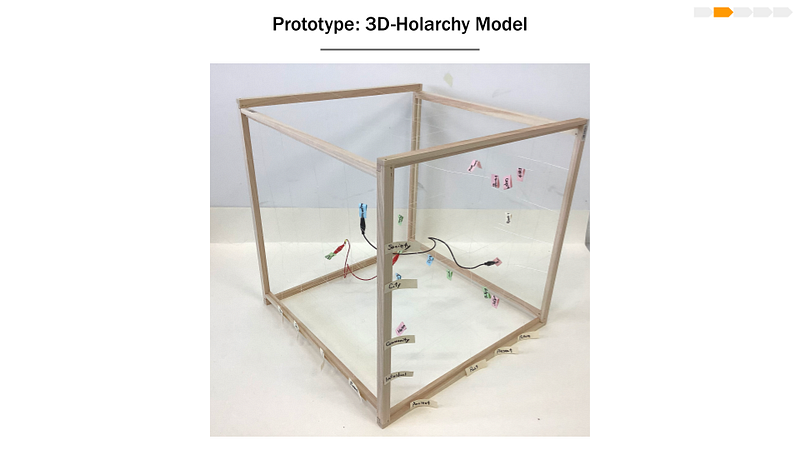
This was probably an unprecedented experiment but I tried to do it with participants at the final session. So far, in business/design thinking projects, I have been mainly designing workshops on 2D paper and sticky notes, so this time it was a fresh paradigm for me to develop 3D participatory tool in collaboration with industrial design students. This attempt to create a tool itself to generate new human knowledge/wisdom is called Research through Design, which is the essence of design research.
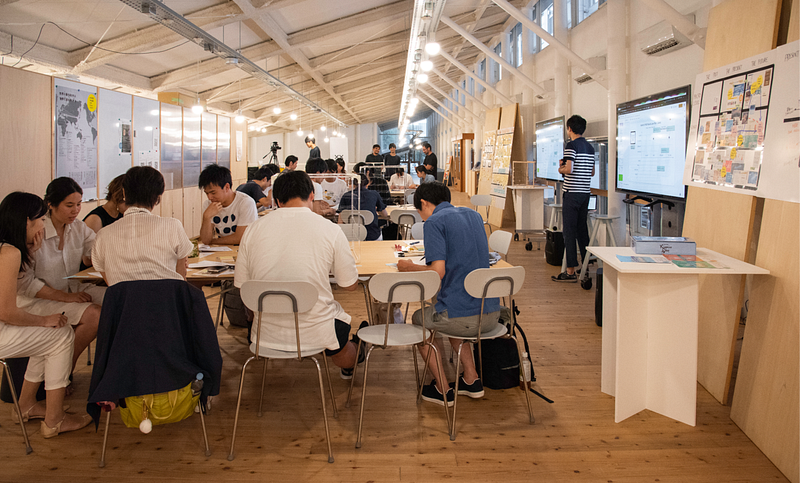
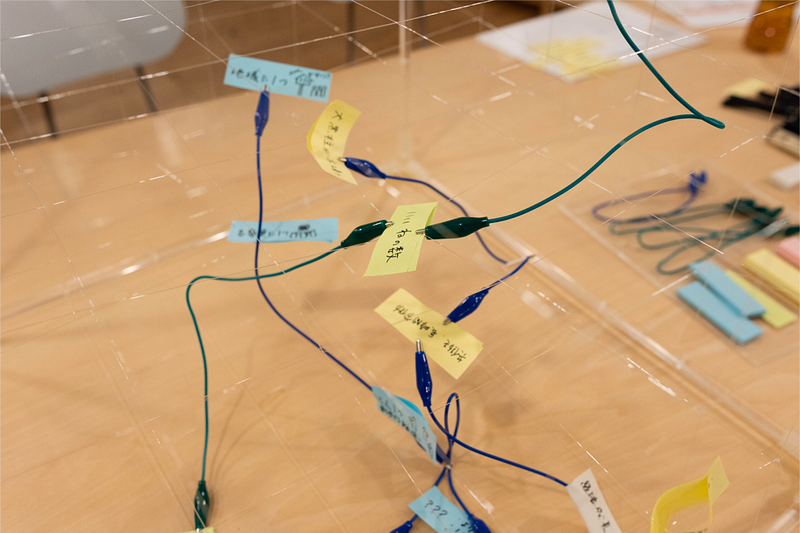
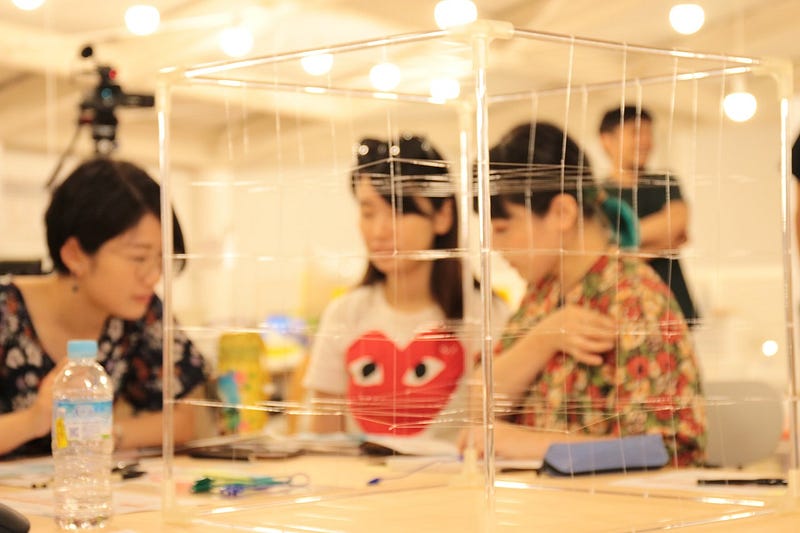
As a result, I felt that there was a great potential to make it possible for participants to discuss a social-scale complex system by visualizing it in a 3D model. So I hope to improve this tool in the future to submit a paper.
3. Visioning Future Lifestyle
So far, I feel it was really tough work, but still a problem analysis phase. From here, it will be a visioning phase, which requires imagination and speculation.
In this activity, based on the root causes, historical transitions, and societal change of complex problems that have been considered in activity 1 and 2, I envisioned the ideal lifestyle in 2050, in which the complex problems no longer existed.
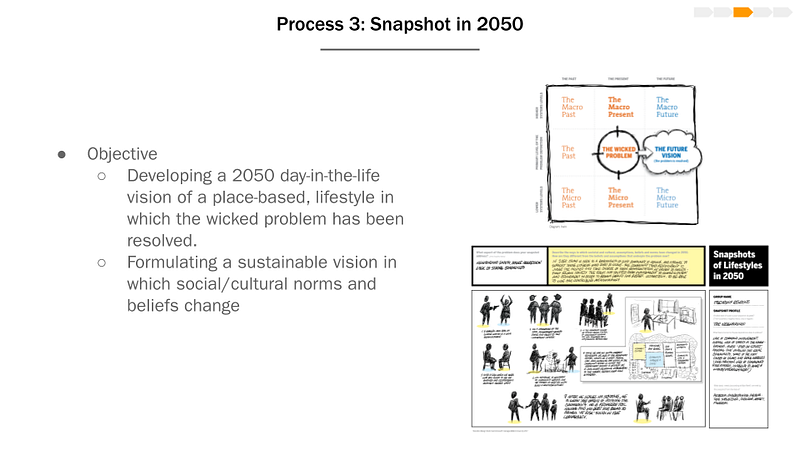
What is important here is the word “lifestyle”. It is needed to visualize how people live in the future, what is future common sense, and how their values change from now using design tools such as storyboards instead of keywords, slogans, and discourse levels. This is the reason why the Transition “Design” is named.
Thinkers and leaders may have already said discourses for the future, so the mission of transition designers are envisioning sustainable utopia, visualizing lifestyles in this world, and enriching the resolution of the future.
In practice, I used the Spatio-Temporal Matrix and created the concept of the future while moving from right to left or up and down in the time/scale matrix.
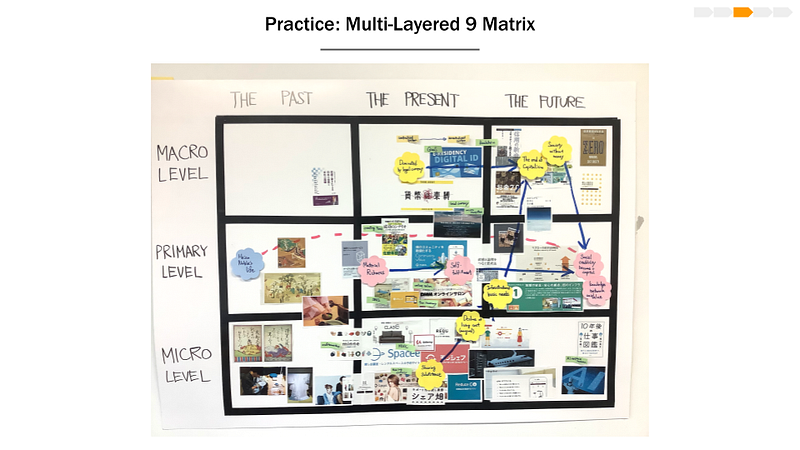
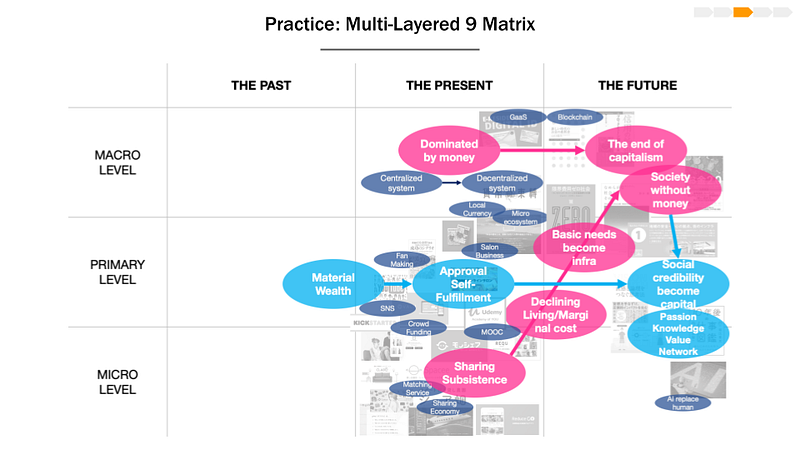
This project started with the problem of adolescent depression in Japan. In secondary research, many factors came from economic reasons and I witnessed how modern society is dominated by money. Therefore, I started to make the vision of an ideal society where capitalism was over and money no longer need (magenta colored transition below).
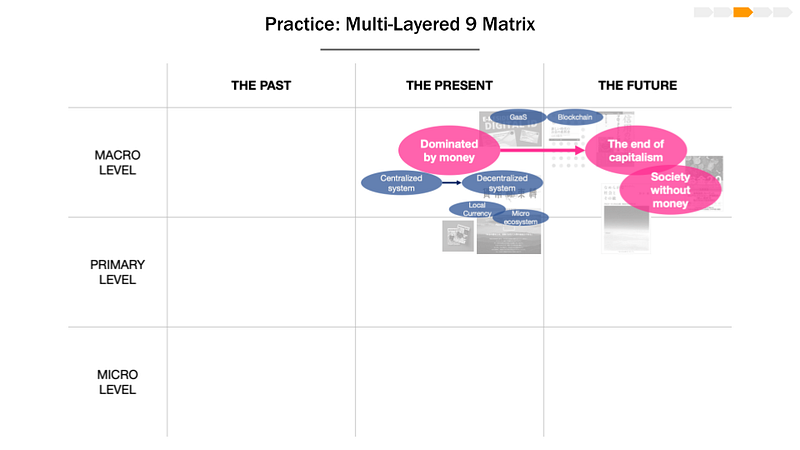
With the advent of blockchain technology, the worldview of post-capitalism has already been published by several economists and thinkers such as Paul Mason, and it is also foreseen that the arrival of a zero marginal cost society as a destination for the sharing economy. Therefore, it seems that there is technological feasibility.
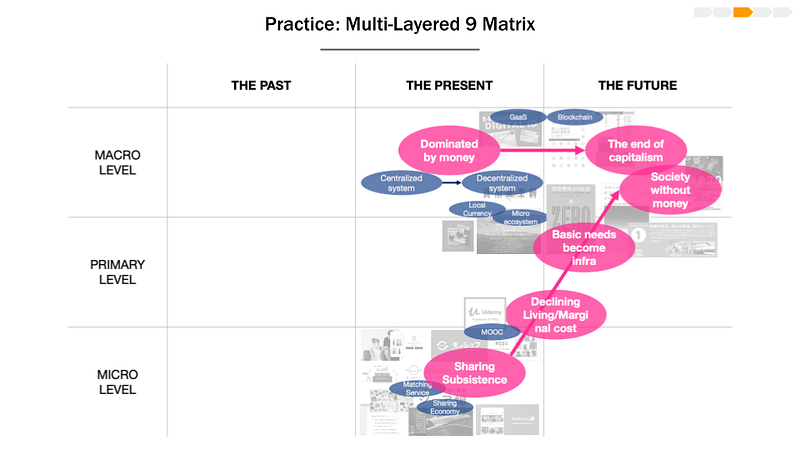
While continuing research and speculating the imaginary leap based on it, I incorporated the vision from various perspectives. When the social system image was somehow seen, the next step was to consider people’s perspective.
What is important for people living in a society without money? Instead of inefficient labor, the time has come when personal social trust, which is the sum of individual passion, knowledge, approval, value, and network, is important. Projects with higher social value will be valued than projects with higher commercial value.
This has already begun to appear in crowdfunding and online salon businesses. Even without money, trusted people and valuable projects can collect money/resources (cyan colored transition below).
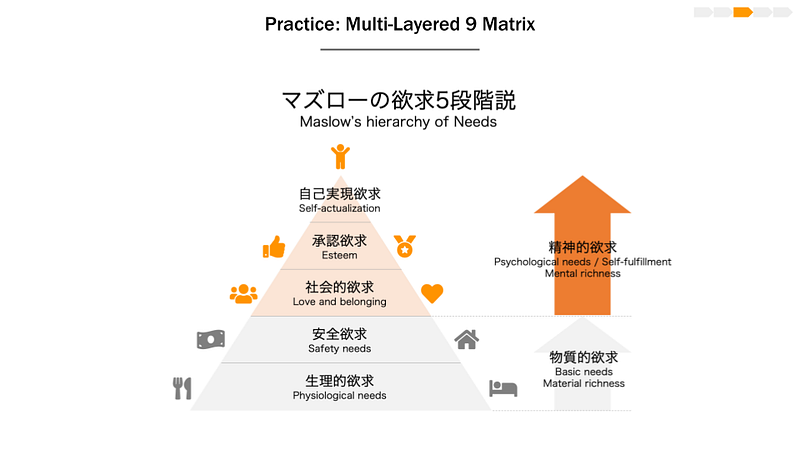
Let’s take a look at a new perspective, Maslow ’s five-step theory of desire. When money is relatively no longer needed to satisfy the richness of goods, people begin to seek the mental richness that is above the material richness. The transition from financial capital to credit capital will be happening, as it has already been seen in cultures that people require approval/esteem in such as Facebook and Instagram.
In this way, I made a vision while crossing the individual, city, and social layers, but this story so far was close to the rethinking of the theory that the thinkers and the writer have told. Additionally, insights from the “past” which is a characteristic of the Transition Design weren’t being used much.
Transition Design suggests believing in what human beings have, cherishing the idea from Slow Knowledge, which has lasted for hundreds of years and envisioning the place-based way of life for the future. I went back and forth and struggled for two weeks in this stage. As a result, I arrived at a hypothetical idea from a historical city Kyoto.
The bold hypothesis that the 1000-year past is projected to the future, saying that “the life of the nobility in the Heian era (A.D. 794–1185)” is a future utopia image.
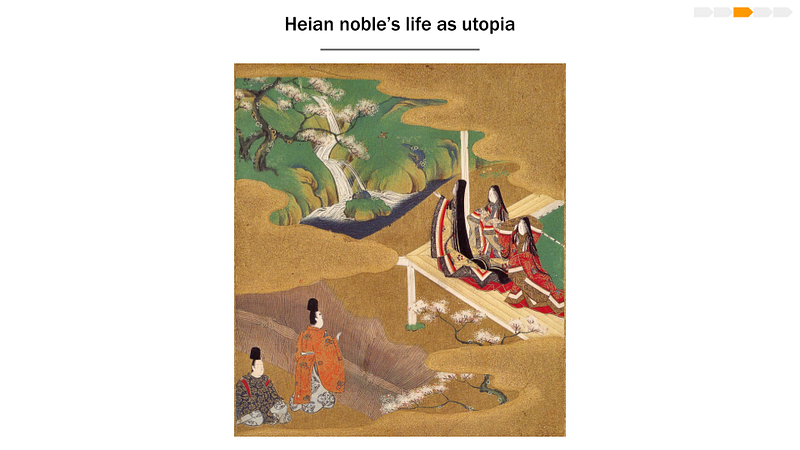
Actually, Heian nobilities were not worried about money, lived in a big house, and were not inconvenienced in clothing and food (satisfied with richness of goods). Namely, they have already lived in the higher layers of desire: approval desire, self-fulfillment, and mental richness.
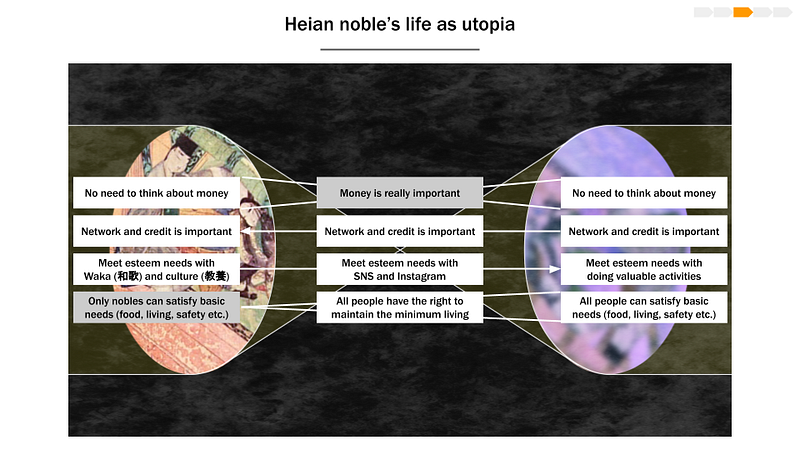
In front of beautiful scenery, Heian nobilities expressed their own feelings using poem called Waka(和歌). It was the action to show their education and culture, and get approval and social credibility. There is a strange synchronization with current people’s behavior to collect “Like” on SNS.
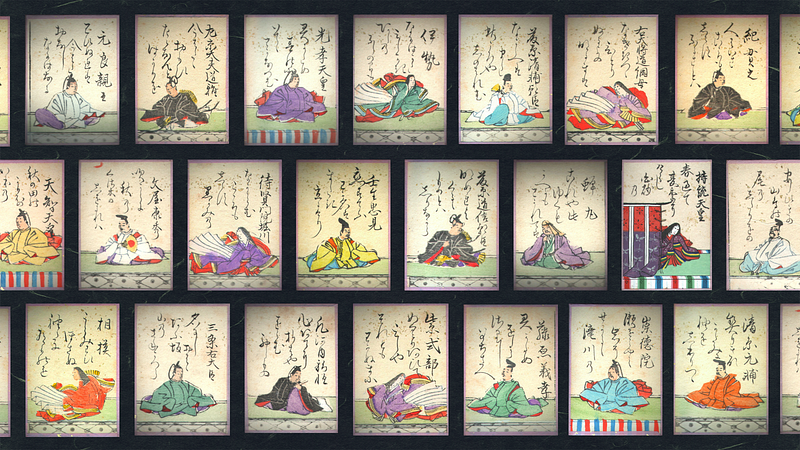
Heian nobility is said to have lived brilliantly such as playing a musical instrument and Kemari (ancient football game of the Imperial Court), but it was an important place for self-polishing and networking.
As a result, I created the matrix that synchronizes the values for mental richness in the past and future as shown in the figure below (green colored transition). I think this is the place-based idea as a result of thinking in Kyoto, a 1000-year historical city. Transition Design mentions it is important that the concept of cosmopolitan localism and place-based solution.
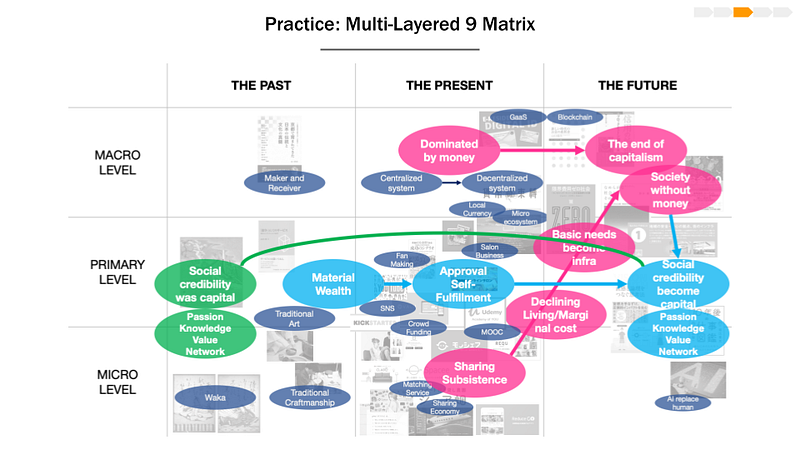
I made this concept on the desk and based on keywords such as credit capital, Kyoto’s traditional crafts/culture, and mental richness, I created several products to convey the future worldview I dreamed using speculative design methods.
Finally, using the historical aspects of Transition Design, I created a history program from the 22nd century that could be broadcast in Japan.
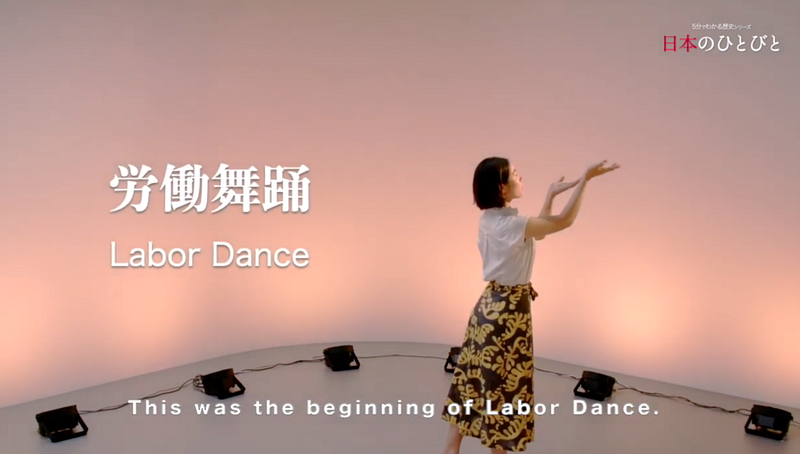
In 2050, people who were deprived of work by AI and machines started to preserve the history that people used to work in the form of traditional Japanese dances such as Kabuki and Noh, and created a new value called Labor Dance.
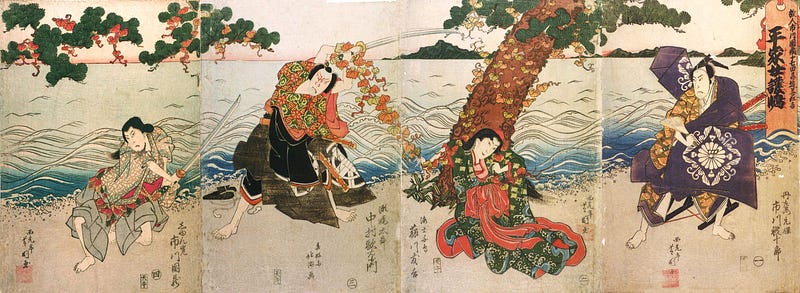
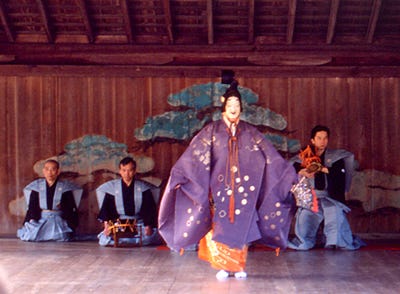
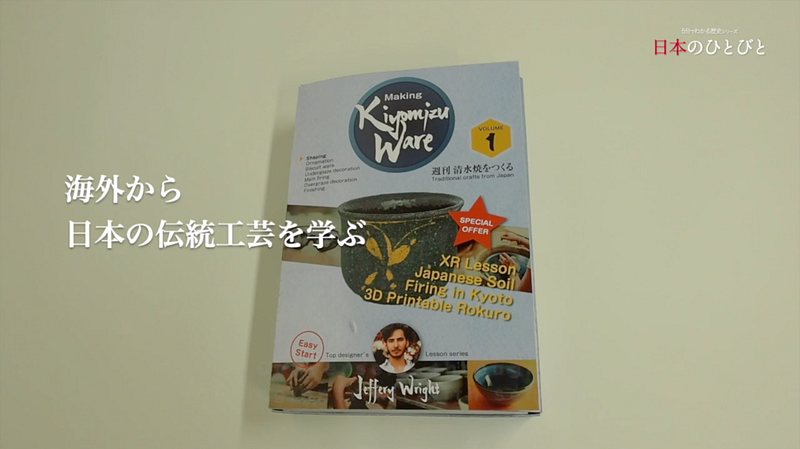
In 2050, XR and 3D printing technology enabled traditional craftsmen to inherit their skills to remote locations, and skillful overseas experts conveyed Japanese traditional craft techniques to Japanese people.
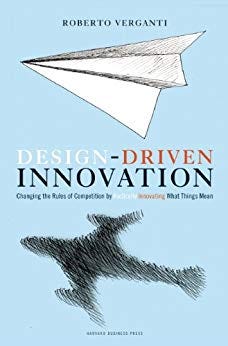
In 2050, when social value became important, the training not only creators but also recipients of the culture and aesthetics were also required. The theory of Design-Driven Innovation was incorporated into education and children in that age trained their criticism at school.
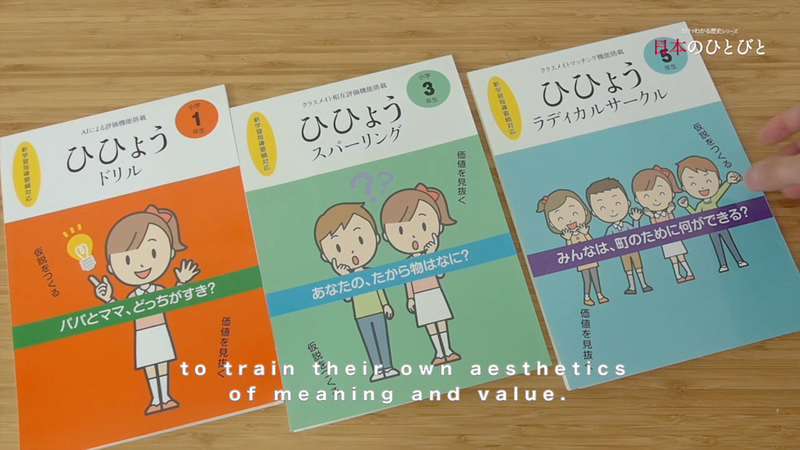
As mentioned above, I imagined multiple lifestyle scenarios and visualized the worldview and future values through performance and products. In practice, I think it is very important to visualize multiple scenarios to increase the resolution of future worldview. If there is only one scenario (often proposed by speculative design work), we tend to critique about only the proposed point of view, but by visualizing multiple future scenarios from the same concept, audiences can expand the depth of the future imagination and start to think about various possibilities by themselves.
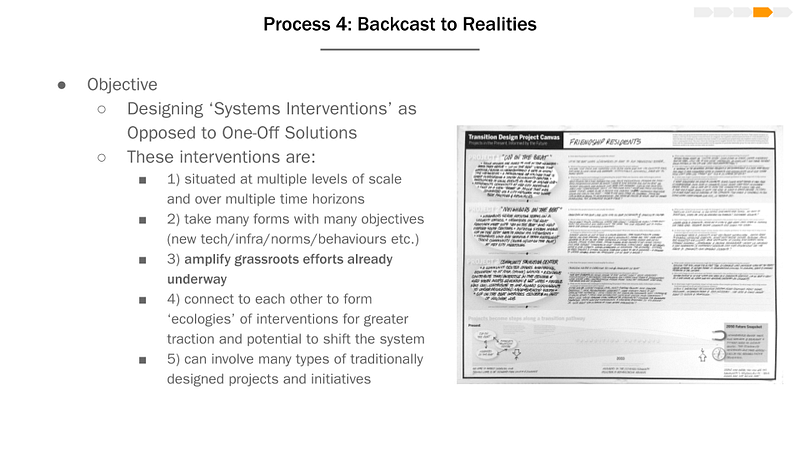
4. Backcasting
Thank you for reading so far. Through the above, I finally got a vision that emphasized social systems and people’s values! However, in Transition Design, once you have envisioned the future, what you should do now is backcasting to reality to take actions.
If Speculative Design is a design that expands the imagination to the possible future from now, Transition Design conducts two consecutive speculations: imagine/dream/envision ideal utopia first and then backcast/return/reason to reality.
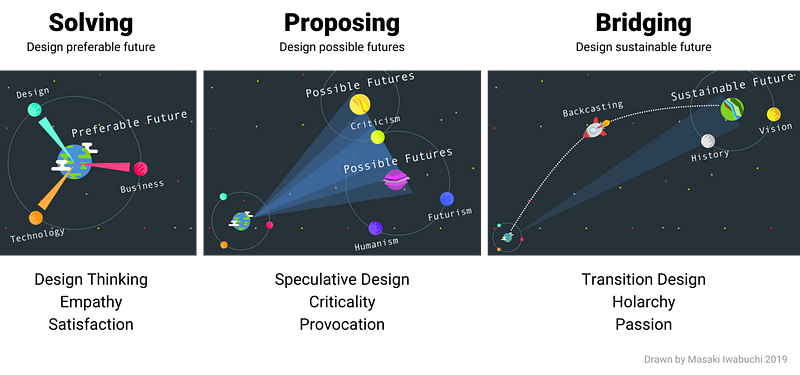
Transition Design theory is still developing specific steps for this backcasting now, so I continued the practice through trial and error.
One effective approach I thought was going back and forth between logical thinking and creative thinking. I refactored the essence of the future scenario I have drawn and explored the intervention points with existing projects and current stakeholders.
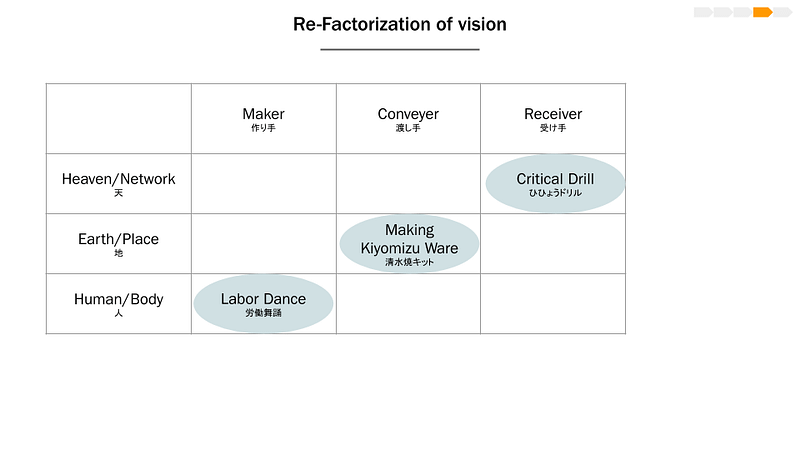
The three ideas “Labor Dance”, “Making Kiyomizu Ware”, and “Critical Drill” drawn in the scenario aimed at different targets: Maker/Conveyer/Receiver of values. Furthermore, I added another axis of idea’s root: Heaven/Earth/Human and rearranged the above matrix.
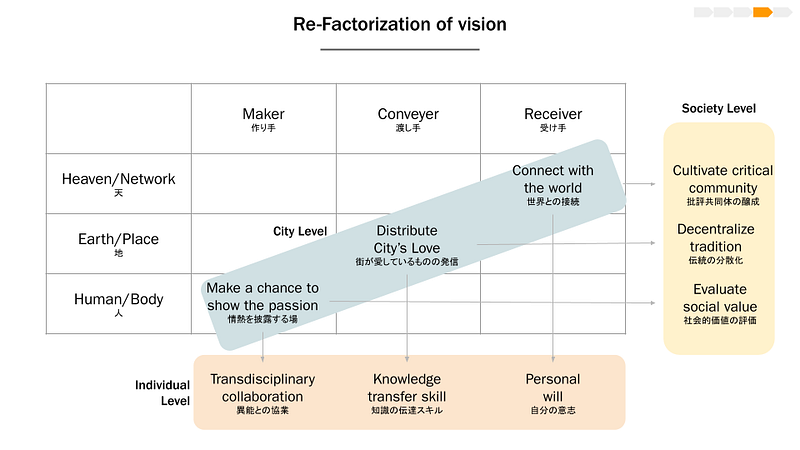
By organizing the essences and concepts behind the idea again, I could clarify the changes that must be occurred at multiple levels: individual, city, and society. Based on this analysis, we will move on to the execution phase by launching new projects and involving potential stakeholders for a sustainable utopia in the distant future.
In Transition Design, it is assumed that many players are already moving with their vision in the current market, and Transition Design put a flag for a longer-term place. Rather than creating new projects, Transition Design mentions that it is important to integrate existing projects and stakeholders that are moving separately in the same direction and create synergies.
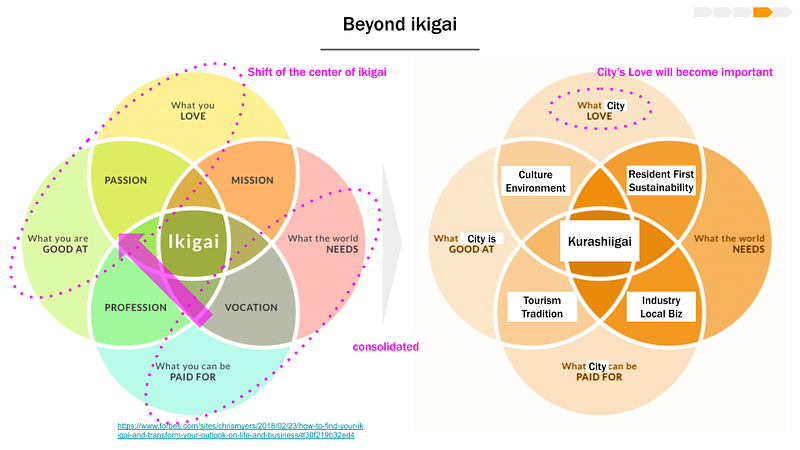
For example, using the figure of “ikigai” (Japanese term, the reason for being) buzzed a while ago, I thought how its valuable area will change. Furthermore, if I create the new word “Kurashigai” (the reason for living in the city) by raising the layer of the individual ikigai to the city, which spots must the city nurture? Who is doing that now? I think this is the first step of execution.
This is the end of the 10-week project in Kyoto.
Conclusion: What is a transition designer?
Finally, this is the final chapter and I thought again about the function of transition designer after the first practice in Japan.
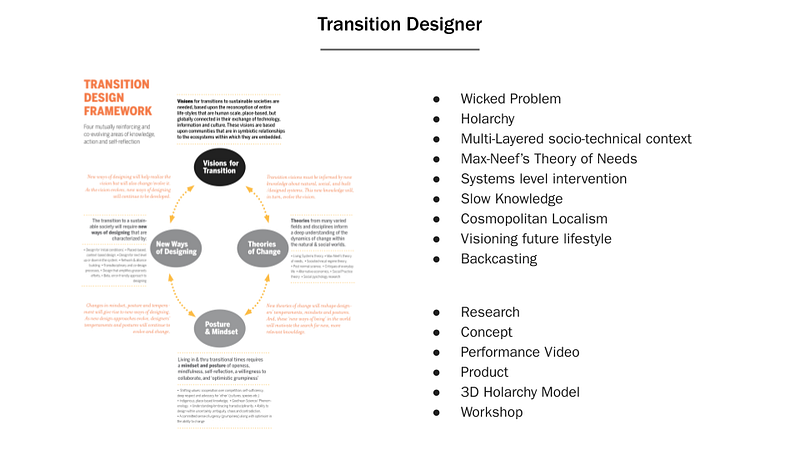
・ Analytical skill to go back and forth between ultra-macro and ultra-micro, interdisciplinary, multi-layered, and multifaceted perspectives for complex problems ・ Imagination skill to leap to the future from the past dynamically ・ Creation skill of future scenarios and tangible objects ・ Logical thinking skill to return from the dreamed future to the reality again ・ Management skill to proceed with and execute feasible projects
Transition Design is a super-comprehensive design that believes in human dreams and future, and it required all kinds of academic disciplines, creative skills, logical judgment, passionate will, and management skills. However, it is inevitable that these comprehensive skills will be required because the human’s problem is getting bigger, more complex and wicked.
- It will take decades to become a “superman designer” who can do all this. Is it possible to do by one person or divide roles with multiple people?
- If it will take decades to implement this in a project and see a long-term transition, how can we measure the outcome?
- Who is appropriate to execute a transition design project? Possibly is it the national level or higher?
During the final session in Kyoto, I was asked a question that I felt like my personal question while I was doing the project. Currently, people who have learned social-scale designs for a sustainable future, including Transition Design, are beginning to start practical projects, so it’s worth noting what will happen in the future. The transition design website and practical tools are also updated year by year through trial and error.
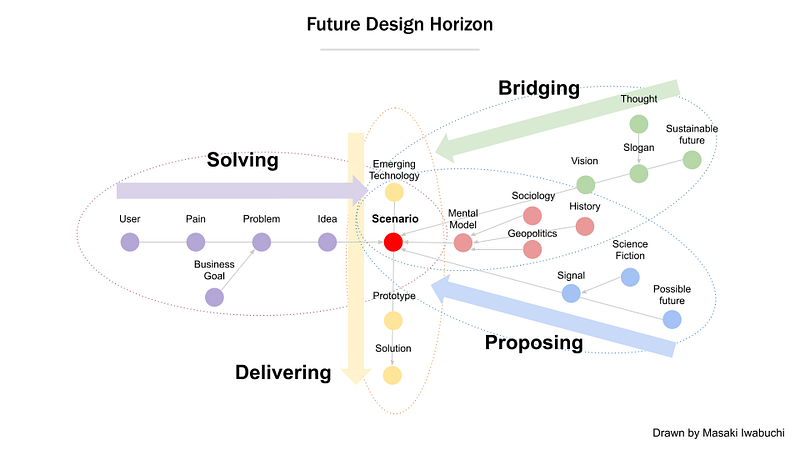
On the other hand, as a required skill as a designer, the ability to envision a scenario and visualize it is the common capability regardless of which design theory is applied. Input information varies project by project such as user research, a slogan of the future, however, designers need to convey how people’s experiences and values change with a lively resolution. I think this capability will continue to be a core skill that will not change even if the definition of the design is expanded.
I believe that designers in 22nd-century will skip this article as the common sense of the future. Thank you for associating with the long sentence so far.
I expressed the same contents in English as the last three-hour participatory session held at Kyoto Institute of Technology D-lab on August 8, 2019.
written by Masaki Iwabuchi, 2019 Design Researcher in Residence at KYOTO Design Lab, Kyoto Institute of Technology
Reference
- Carnegie Mellon University, “Transition Design Seminar 2019,” https://transitiondesignseminarcmu.net/. (Accessed August 26, 2019).
- Irwin, Terry & Kossoff, Gideon. Mapping Ojai’s Water Shortage: The First Workshop, January 2017.
- Irwin, Terry, Tonkinwise, Cameron, Kossoff, Gideon, Scupelli, Peter. Transition Design Overview, 2015
- Kossoff, Gideon, Irwin, Terry, Tonkinwise, Cameron. Transition Design: The Importance of Everyday Life and Lifestyles as a Leverage Point for Sustainability Transitions (presented at the STRN Conference, 2015, Sussex), 2015
- Tonkinwise, Cameron, Irwin, Terry, Kossoff, Gideon. Transition Design: An Educational Framework for Advancing the Study and Design of Sustainable Transitions (presented at the STRN conference 2015, Sussex), 2015
- Rifkin, Jeremy. The Zero Marginal Cost Society: The Internet of Things, the Collaborative Commons, and the Eclipse of Capitalism. New York: Palgrave Macmillan, 2014.
- Mason, Paul. 2015. PostCapitalism: a Guide to Our Future.
- Sanders, Elizabeth B.-N., and Pieter Jan Stappers. 2012. Convivial design toolbox: generative research for the front end of design. Amsterdam: BIS.
- 山口揚平, 新しい時代のお金の教科書
- 佐宗邦威, 直感と論理をつなぐ思考法 VISION DRIVEN
- 斉藤賢爾, 信用の新世紀 ブロックチェーン後の未来
- 佐藤航陽, お金2.0: 新しい経済のルールと生き方
- 堀江貴文, 落合陽一, 10年後の仕事図鑑
- OKWave, 感謝経済 https://thanks-economy.com/
- エストニアのe-Residency
- ポスト資本主義社会を目指すコミュニティ Next Commons Lab http://nextcommonslab.jp/
- 1Dayカンファレンス:貨幣の束縛 https://corp.netprotections.com/thinkabout/event/
- 久保田圭一, 究極の“コト消費”であるスポーツビジネス 成功のシナリオ
- 鈴木健, なめらかな社会とその敵
- GMOペパボ株式会社, ハンドメイドのクラフトマーケットminne
- 67andパートナーズ合同会社, 個人間でモノを貸し出すアプリ モノシェア
- SHIFFT株式会社, 余剰食品のシェアリングサービス Reduce GO
- 株式会社クラス, 家具のシェアリングサービスCLAS
- ラクサス・テクノロジーズ株式会社, 高級ブランド品のレンタルサービスLAXAS
- 株式会社スプレッドワン, いらないモノを譲るサービスgiftel
- 株式会社ストライプインターナショナル, 新品の洋服のレンタルサービスMECHAKARI
- セブン&アイホールディングス中期戦略: 地域に欠かせない社会インフラの提供 https://www.sej.co.jp/csr/feature/03.html
- 株式会社スペイシー, あらゆる空きスペースを借りれるサービスSpacee
- 株式会社アグリメディア, 農地のシェアリング シェア畑
- プライベートジェットのシェアリング JetSmarter
- PIAZZA株式会社, 街のコミュニティを数値化するアプリPIAZZA https://www.lp.piazza-life.com/cv
- 久保田圭一, 究極の“コト消費”であるスポーツビジネス 成功のシナリオ