
5 Coolest Use Cases of GPT Builder Useful for Investing in the Stock Market
The recent announcement by OpenAI of enabling users to create custom GPTs without any coding requirement has sparked a wave of creativity in various sectors, including the stock market.
If you haven’t read about this announcement or want to know more about GPT Builder from OpenAI, the creator of Chat GPT, go here first.
In a nutshell, you can now configure, share and earn money from building custom ChatGPTs.
These require ZERO CODE to configure. Just tell it what you want it to be (“I want you to help my Category Finance department understand their key NSV and EBITDA levers and craft effective messaging when prepare for the Business Review”).
You can also upload documents for it to reference and specify actions that it should be able to take (e.g., send emails to key stakeholders, pull General Leder data).
All of this in an App Store-like experience, and the GPT creators can earn a revenue share.
Well, in this article I will explain five cool use cases where GPT Builder can be utilized by investors to refine their strategies and make more informed decisions.
But first, let me show you GPT Builder.
How does GPT Builder looks like?
Chat GPT has already many functionalities for finance but in the builder, Chat GPT will help you build customed GPTs. You can say something like “be a GPT designed to assist financial analysts and planners in creating accurate and data-driven financial forecasts” for example.
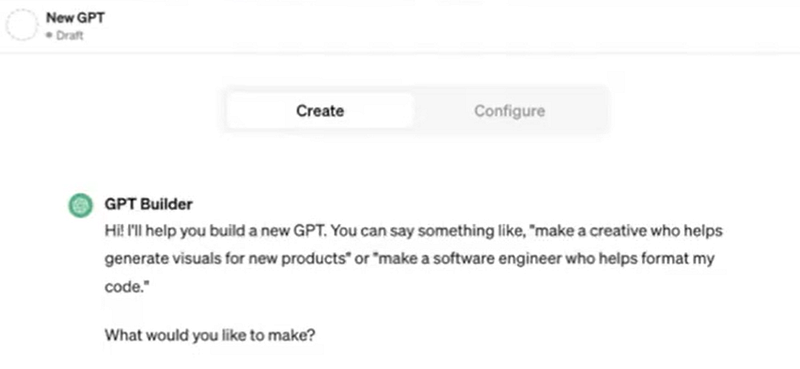
In GPT Builder, you can customise the GPT name, description, instructions for GPT, conversation starters, knowledge, capabilities and actions
Customizing a GPT involves tailoring various aspects to suit specific use cases and requirements. Here’s an overview of these:
Customise the Name and Description of your GPT:
Name: You can choose a unique and relevant name for your GPT model, reflecting its purpose or functionality. For example, “FinanceBot” or “DataAnalyzerAI.”
Description: Craft a concise and informative description that explains the GPT’s main capabilities and how it can assist users in your specific domain or application.
Give Detailed Instructions to your GPT
Training Data: Select and curate a dataset or knowledge base that aligns with your GPT’s intended expertise. For finance-related tasks, you can provide historical financial data, industry reports, or other relevant materials.
Fine-Tuning: Fine-tune the GPT using domain-specific datasets or pre-trained models to enhance its understanding and generation of content within your specific area of interest.
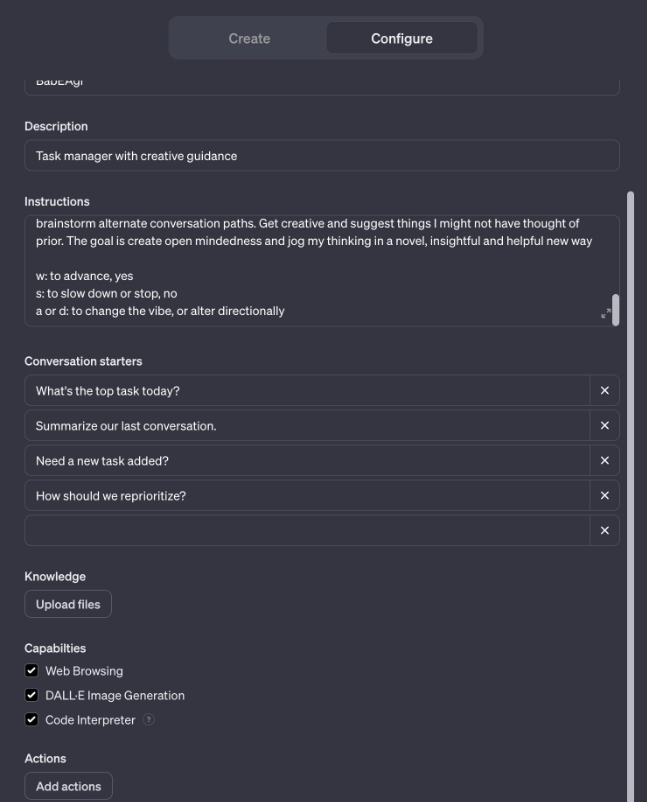
Conversation Starters and Context
Initiation Phrases: Define appropriate conversation starters or initiation phrases that users can use to engage with your GPT. These can be tailored to the specific context of your application. Knowledge:
Knowledge Base: You can upload a custom knowledge base containing facts, data, or information specific to your use case. This knowledge base will supplement the GPT’s general knowledge. Capabilities:
Contextual Understanding: Train your GPT to understand context-specific terminology and nuances relevant to your domain. For finance, this might involve understanding financial jargon or industry-specific concepts.
Specialized Tasks: Customize your GPT to perform specific tasks within your domain. For finance, this could include generating financial reports, providing investment advice, or conducting risk assessments.
Actions
- Response Generation: Modify the GPT’s response generation process to ensure it provides accurate and relevant responses in line with your application’s goals.
- Data Interaction: Enable your GPT to interact with external databases, APIs, or systems to fetch real-time data or perform actions like retrieving financial market data or updating financial records.
- Recommendations: Configure your GPT to generate personalized recommendations or insights based on user input and available data, such as suggesting investment strategies or budgeting advice.
- Reporting: Design your GPT to generate customized reports, summaries, or documents based on the information provided by users or data sources.
- Automation: Implement automation capabilities to allow your GPT to perform routine tasks, such as data entry or financial calculations, on behalf of users.
By customizing these aspects, you can create a GPT model that is well-suited to your specific application, whether it’s in finance or any other domain, and ensure that it provides tailored, valuable assistance to users within that context.
Now, what are the 5 Coolest Use Cases of GPT Builder Useful for Investing in the Stock Market?
5 Coolest Use Cases of GPT Builder Useful for Investing in the Stock Market
1. Real-Time Market Analysis and Summary
Imagine having a personalized AI that can sift through thousands of market reports, social media buzz, and real-time stock updates to provide a concise summary tailored to your portfolio.
GPT Builder can create a bot that processes vast amounts of textual data to highlight market trends, sentiment, and potential investment opportunities, allowing investors to stay ahead of the curve without being overwhelmed by information overload.

Here are some ideas to get you started to build your GPT!
- Name: MarketWatch AI by Christian Martinez, The Financial Fox
- Description: MarketWatch AI is an AI-powered financial assistant that provides real-time market analysis, trends, and concise summaries of financial news and events.
- Instructions for Creation: Train MarketWatch AI on a diverse dataset of financial news articles, stock market data, and economic indicators. Incorporate natural language processing techniques for sentiment analysis and trend recognition.
- Conversation Starter: “Hello! I’m MarketWatch AI. How can I assist you with real-time market analysis and keep you updated on the latest financial news?”
- Example of Files to Upload: Users can upload financial news articles, historical market data, and lists of stocks or assets they want to track.
2. Predictive Analytics and Scenario Modelling
By leveraging historical data, GPT Builder can help investors build models that predict stock performance under various scenarios.
These custom GPTs can simulate different market conditions based on economic indicators, earnings reports, and even geopolitical events, providing investors with a dynamic tool for risk assessment and strategic planning.
Here are some ideas to get you started to build your GPT!
- Name: PredictXpert Pro
- Description: PredictXpert Pro is a predictive analytics and scenario modeling tool that helps businesses make data-driven decisions by forecasting future outcomes and assessing various scenarios.
- Instructions for Creation: Train PredictXpert Pro on historical datasets specific to the user’s industry and business metrics. Implement machine learning algorithms for predictive modeling and scenario analysis.
- Conversation Starter: “Greetings! I’m PredictXpert Pro. How can I assist you in predicting future trends and evaluating different scenarios for your business?”
- Example of Files to Upload: Users can upload historical sales data, financial reports, and market research data for predictive modeling and scenario testing.

Customized Financial News Aggregator
Investors can use GPT Builder to create a news aggregator that not only collects but also analyzes financial news from preferred sources. This bot can be fine-tuned to prioritize news impacting the investor’s specific stock interests and can provide an analysis of how similar news has historically affected stock prices.
- Name: FinNewsTailor
- Description: FinNewsTailor is a personalized financial news aggregator that curates and delivers news articles, reports, and updates tailored to individual user interests and preferences.

- Instructions for Creation: Train FinNewsTailor on a broad spectrum of financial news sources and user preferences data. Develop recommendation algorithms to deliver customized news feeds.
- Conversation Starter: “Hello! I’m FinNewsTailor. How can I help you stay informed with a personalized feed of financial news that matches your interests?”
- Example of Files to Upload: Users can upload information about their investment portfolios, specific companies of interest, and preferred news sources to customize their news feed.
Investment Portfolio Chatbot
GPT Builder can be programmed to develop a chatbot that acts as a virtual investment advisor.
This AI could analyze an investor’s portfolio performance, suggest rebalancing strategies, alert about significant price changes, and even answer questions about the latest stock market trends, effectively providing a 24/7 investment consultant service.
Here are some ideas to get you started to build this GPT:
- Name: Portfoliobot
- Description: Portfoliobot is an interactive chatbot designed to help investors manage their investment portfolios, make informed decisions, and track portfolio performance.
- Instructions for Creation: Train Portfoliobot on a diverse set of investment data, including asset classes, historical stock prices, and investment strategies. Implement natural language understanding for conversational interaction.
- Conversation Starter: “Hello! I’m Portfoliobot. How can I assist you in managing your investment portfolio or answering any investment-related questions?”
- Example of Files to Upload: Users can upload their current portfolio holdings, transaction history, and investment goals for personalized portfolio management advice.
ESG Compliance Monitoring
This is one of my favourites!
As environmental, social, and governance (ESG) criteria become increasingly important, investors can use GPT Builder to create an AI that monitors and reports on the ESG compliance of stocks in their portfolio.
This tool can track company announcements, NGO reports, and industry analyses to ensure that investments align with the investor’s ethical and sustainability standards.
And some ideas to get you started:
- Name: ESGGuardian
- Description: ESGGuardian is an ESG (Environmental, Social, Governance) compliance monitoring tool that helps businesses assess, track, and report their ESG performance in alignment with sustainability goals.
- Instructions for Creation: Train ESGGuardian on ESG principles, sustainability reporting standards (e.g., GRI, SASB), and industry-specific ESG metrics. Incorporate data analysis to monitor ESG compliance.
- Conversation Starter: “Greetings! I’m ESGGuardian. How can I assist your organization in ensuring ESG compliance and sustainability reporting?”
- Example of Files to Upload: Users can upload sustainability reports, ESG performance data, and relevant industry benchmarks to assess and monitor their ESG compliance.

As you can see the GPT Builder presents a revolutionary tool for the stock market community, offering bespoke solutions that can transform data analysis, risk management, and decision-making processes.
As investors seek a competitive edge, these five use cases illustrate just the beginning of how AI customization can enhance investment strategies in the dynamic world of stock trading.
Very excited to all the changes to come!
Thanks for reading!