
5 Concepts of Great Power and Beauty from India
All eminently useful tools that should be in the toolbox of any writer or thinker
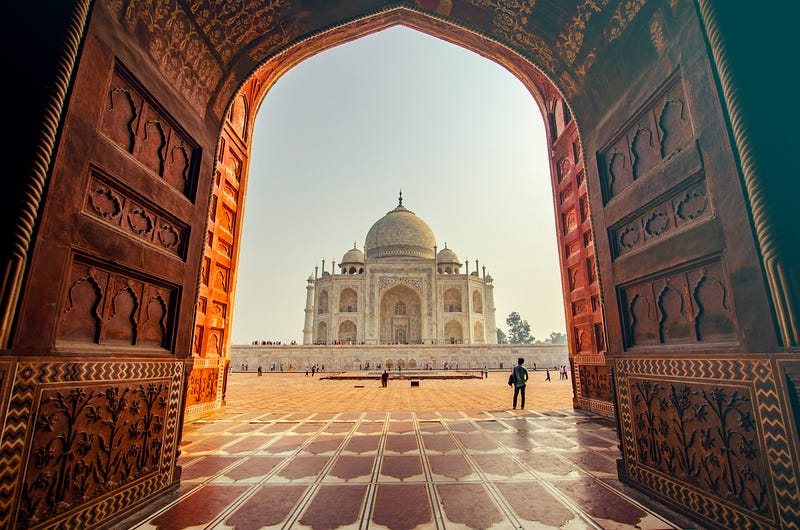
Bharata, Aryavarta, Jambudvipa, Mauryadesa, Tianzhu, Hindustan — India.
The many names for a land that lives far beyond anything that can be named rumble about the mouth, wrap around the tongue, and remain, but for a moment, preserved as a breath of pure possibility, before rolling forth in rivulets of rhythm, rhyme, and delightful musicality.
Given the present clime of world politics, and given my bent for the political, I write a great deal about Russia, the US, Ukraine, Palestine, Israel etcetera. If you know me, though, you will know that one of the countries that laps most vigorously at the foreground of my imagination is India. And it has done so since I became old enough to understand a little about what it is, or isn’t, or might be, or never was.
To call it a single country is a sin of scale and proportionality and an inaccuracy of the mile and metre of history. There are certain countries that merely masquerade as countries; they are, of course, civilisations. Think India. Think China. To a lesser degree, think America; think Russia.
India and China sprawl and stretch in a million directions, within themselves, without themselves, across themselves, and just so far back in time to some sort of hypostatic quintessence that swims throughout all their multifarious incarnations, connecting the dead, the living, and the as-yet-unborn.
The following are five concepts/words that swim about the vast oceans of the Indian mind, which can be tapped into, if only partially, by foreigners and can and should be used by anyone who holds language and thought in the highest regard.
1. Samsara
Samsara means something akin to ‘endless/perpetual wandering’ in Sanskrit. In religious terms it represents the karmic cycle of death and reincarnation that all individuals are fated to follow, with their forms and circumstances shifting according to how well or poorly they have lived and acted.
The wheel spins, and all must run the gauntlet, doing their utmost to ensure they are eventually granted release from the cycle by one or other of the highest of the Hindu deities (more on the liberation from the cyclicality of existence below).
Samsara is an extremely powerful concept that sits at the heart of not only Hinduism but also all the religions that splintered from it — Buddhism, Jainism, Sikhism.
Samsara is the cosmic roulette wheel of existence where the dice you roll are the way you live and the good deeds you do. The ultimate goal is to play well enough to no longer have to play the game.
Interestingly, and attesting to the eternal mutability of the immutable, samsara doesn’t seem to have featured much in the Vedas. It was more fully formulated in the Upanishads but only became fully fleshed out as a coherent and all-encompassing doctrine later on.
Samsara is the cosmic roulette wheel of existence, where the dice you roll are the way you live and the good deeds you do. The ultimate goal is to play well enough to no longer have to play the game.
Such an all-swallowing, self-differentiating, and endlessly wide and deep notion lends itself wonderfully to fiction and poetry.
Here is an example from my first and only novel, called Her.
Excerpt: The Flame is telling the nameless He of some of the various identities she has had.
‘Okay, let me see … Fatima, Dawn, the last standing demimonde of South County Dublin, lowly Nina and high-born Marie, Heracles and Hillary, Timur and Setanta. Samsara threading water and Sujata at the top of the hill; upon her wedding day and the triumph of morganatic ontogenesis may I add? There’s safety in numbers, so best to spread yourself fairly thin across the board. Anyway, more in a name than can ever be remembered and far too little to fear forgetting. Anyway, soon we will inherit identities worthy of our station.’
‘You were Heracles for a time?’
2. Rimjhim
As I write this line, I am listening to birds singing whilst relishing the cool breeze blowing. The rimjhim of raindrops is playing the most pleasing of ragas to soothe the most worried of minds. There has just been an explosion of rain in Madrid, a rare occurrence, and rimjhim is the wondrous sound that light rain makes as it plays upon disparate surfaces as it falls.
Think tapping. Think pitter-patter; a gorgeous term if ever there was one. Think of that feeling of rejuvenation and soul-soothing cool after a heavy downfall or summer storm.
And actually, as far as I am aware, the word rimjhim doesn’t only refer to the sounds and sensations, but also to the life-affirming feeling that accompanies these sounds and sensations.
Moscow has its best rimjhim moments in the summer after one of its seasonal storms swamps the city and everybody needs to swim to get where they’re going for a few hours.
In Madrid, rimjhim is a rare fellow to behold, sadly, but he makes you savour his arrival all the more when he deems you worthy of a visit.
In Ireland, well, rimjhim of one form or another will be your constant companion, for rain will be your constant companion.
But rimjhim is perhaps best experienced somewhere in North India during monsoon season, when a hard rain starts to subside and big fat droplets beat their brows off the roofs of corrugated iron and all breathe a collective sigh of relief from the unrelenting summer sun.
3. Moksha
We had the spin with samsara; now we have the release with moksha.
One spins around, cycling through as many lives as are required before the moment of liberation comes with moksha. I do not know anywhere near enough about Hinduism to know whereby which power one gets the chance to get off the celestial carousel.
The former is being in the abstract and imperceptible, the being behind being, the endless breathing that breathes life into every single breath.
I do know that we are all comprised of two modes of being, the Ātman and the Anātman. The latter is being particularised and inhered in a particular form that can be seen and perceived. In each life and with each spin of the wheel, we inhabit a unique form that will perish and deliquesce.
The former is being in the abstract and imperceptible, the being behind being, the endless breathing that breathes life into every single breath.
With each spin, we are given a chance to live a virtuous life and engage in good acts, but I do know how these are tallied up and when and how these become sufficient to give us the release of moksha.
Can Vishnu, Krishna or Shiva, or indeed other deities, decide on a whim to grant moksha to whoever they wish, however, and whenever they wish it? Or are even these limited by certain laws of the Universe that place restrictions on what they can and can’t do, much like the Olympian gods?
To be frank, I have no idea. If someone can enlighten me as to such quandaries in the comments, I would be very grateful.
Here’s an example of the beautiful word in action, from the same book and from the same writer.
‘Moksha, Jihad, Salvation; whatever big word takes your fancy. But not up there or in any old place at all, but rather in the reconciliation of the little and the big. Science brought the big back to Earth but got a little lost sifting through the details. God floated off afar, away into the vast bigness that knows no end. Freedom needs a human face as much as it needs a guiding hand. Science swims in all directions; God swims away. Reconciliation is the art of smooth swimming in the right direction.’
4. Sallekhana
This is the most immediately dark of all the ideas here written about. This is a Jainist practice, and it is a form of suicide.
Once again, I am not going to profess a deep knowledge of India or its religions. I have a superficial understanding that goes down deeper in a number of spots and am reasonably well acquainted with its geography, ancient civilisations, political history, and its food.
The last point, food and diet, is of especial importance to many religions in India, and this is most significant when we come to Jainism. Adherents of probably India’s most peaceful denomination see what one puts into one’s body and what one doesn’t put in one’s body as part of the path to living a good life and essential to gaining ground in the great game of spiritual enlightenment and liberation. The principle of ahimsa, non-violence, is the cynosure of the Jainist religion.
If you think about it, this couldn’t be more true in many senses. What you eat, what you don’t eat, and how much you do say a great deal about discipline, control, moral consistency, the firmness of the hand, and the foresight of the mind which guide us in our mortal coils. In parallel, the very same speaks volumes about how we regard the world around us, its many creatures, and its many practices.
It is thought that by taking the complete denial of the physical and the material to such lengths one can skip ahead in the cosmic balance and fast-track moksha.
One may believe that a human, being an omnivore, should eat meat. At the same time, one may believe that the meat industry is a crime of Dharmic proportions and an ongoing genocide that grinds up its victims every single day of every single year. The meat-eater who refuses to be complicit in such horror and sources their meat through alternate channels shows a great deal of character, control, and moral fortitude through their choices. I will concede that this also requires money, time, market availability, and a number of other things, which will make such a choice all but impossible for many meat-eaters.
The concept of sallekhana takes the repudiation of food in the name of a moral and spiritual crusade to the absolute extreme. It is a slow suicide by means of the total renunciation of all food. If one’s body is a temple, sallekhana sees the body become a shrine where none may enter. It is thought that by taking the complete denial of the physical and the material to such lengths, one can skip ahead in the cosmic balance and fast-track moksha.
There are several forms of ritual suicide from the East — sati, seppuku, sokushinbutsu—and I touch on them in my series on suicide in relation to religion, sallekhana included. It should also be noted that Jainists do not generally consider sallekhana to be suicide.
As one can imagine, such social practices sit rather uneasy with the rigours of state and secular life. As such, sallekhana was outlawed under Indian law, however, the ban was lifted in 2016, and it is at the time of writing legal as a religious rite in India.
5. Satyagraha
Satyagraha translates something akin to holding firm to the truth, and it connotes Mahatma Gandhi’s nonviolent resistance against the Raj and British occupation.
History is replete with antecedents which urged a similar form of peaceful protest in the face of great force and oppression, but in a modern context, it is Lev Tolstoy’s ideas put forward in his ‘My Religion’ and the social movement that developed based on such (Tolstovstvo/Толстовство) that provided the most powerful spark in fomenting a number of movements around the world, Gandhi’s Satyagraha and Martin Luther King’s Soul Force included.
The aforementioned idea of nonviolence, ahimsa, has a multi-millennial history in India and is etched into the cornerstone of all its faiths. Satyagraha draws its strength, in part, from this ancient lineage.
The concept may also seem to align closely with passive resistance, yet Gandhi saw the two as quite distinct, stating that passive resistance may admit of violence under certain circumstances and does not necessarily adhere to a singular principle of holding truth above all else. However, satyagraha categorically rejects the use of violence under all conditions and is ‘a weapon of the strong’, deriving its power and legitimacy from its unerring allegiance to the truth.
How successful the concept and movement of satyagraha was in breaking down Britain’s hold on India and will to remain is not easy to assess and not something that can or should be addressed in a few words. It is likely that it helped to give India’s struggle a cohesion and spiritual thrust and conviction which, when mixed with other social and geopolitical forces, provided the necessary weight to finally put the sword to hundreds of years of British subjugation and dominion, whether in the form of the East India Company or the Crown itself.
I hope that these concepts and words from India have been worth hearing about, and I hope that upon writing your next poem or prose piece, they may swim from your unconscious to lap gently at the banks of your frontal lobe; perhaps you’ll even make use of one or two.


