
5 Bitcoins Up For Grabs! — The First Bitcoin Faucet (2010)

Want to make 5BTC with just a few clicks? 11 years ago, this was possible.
Although the price of BTC a decade ago was just about one cent, with the Bitcoin network still in its infancy. Meaning, anything could go wrong.
Back in 2010, Bitcoin was known in only a small circle of tech-savvy libertarians and cypherpunks. It was the best bet for the foundations of a digital currency, a network nobody could control, with enhanced individual ownership rights.
Gavin Andresen is an early Bitcoin developer that wanted Bitcoin to succeed and become widely used P2P electronic cash.
Gavin developed a simple HTML website offering 5 BTC to anyone brave enough to download the Bitcoin software and create a Bitcoin address.
Subscribe (for free) to get email notifications whenever I publish:

The 2010 Bitcoin Faucet by Gavin Andresen
5 BTC today translates into $115,00.75. (*Edited July 22nd, 2022)
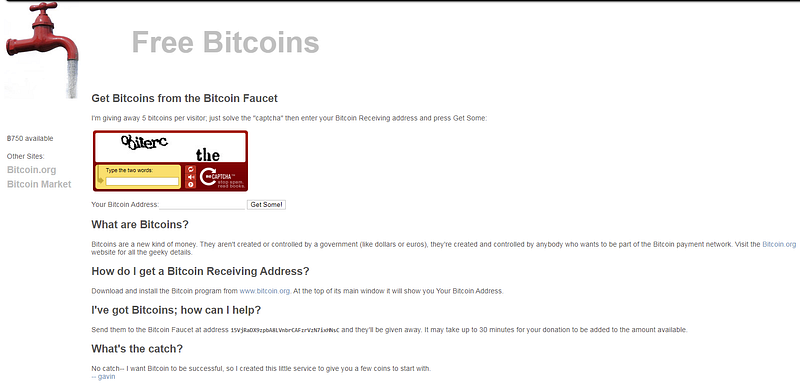
I’m not sure if Gavin attracted more users in Bitcoin with this approach since from what I’ve read, this faucet was quickly depleted and went offline after a while.
Bitcoin in the early days had a limited userbase and the early adopters of this financial revolution were trying their best to discuss Bitcoin and promote it in their circles.
Eventually, Bitcoin reached popularity when Silicon Valley execs in about 2011 began testing it and found it to contain a use-case that could attract millions of users.
Back in 2010, a 1MB blocksize limit was introduced by Satoshi for anti-spam and anti-DDoS reasons, as the founder of Bitcoin explained.
The Bitcoin community expressed the fact that it could be a problem to the scalability of BTC and Satoshi also acknowledged this fact, while also providing a solution to increase blocksize.

It was 2013 the first time I’ve read about Bitcoin in the news.
Yet, I had encountered Bitcoin before. The word wasn’t alien to me in 2013 when I read the first news article about it.
Although, I’m still not entirely sure where exactly I’ve first found it, just speculating since I was surprised to see the word Bitcoin again. Just thought of it as trying to exploit the BitTorrent scheme by having “bit” as the first component of the bitcoin name.
Perhaps I’ve encountered Bitcoin in the various BitTorrent websites I was heavily using since 2004, or maybe that “one time” I downloaded Tor and browsed just for a while, but I doubt it was Tor, I wasn’t using marketplaces and didn’t use the software too often.
I was testing any software I could find and often had to clean my system or perform a full format to clean the malware infections.
Maybe, though, I accidentally found Gavin’s faucet in 2010 after following a series of links I landed on a Free Bitcoins faucet webpage handing out 5 BTC. I’m not entirely sure, but I have a vague memory of having visited this page. Certainly, I skipped without giving enough attention.
It seems pointless to wonder, but there is a useful part in the conclusion of this story.
What Would We Have Done if We Found A Bitcoin Faucet back then?
As with thousands of more tech-related articles I was browsing, Bitcoin probably passed me and many more until we’ve heard this word a couple of times again.
If I encountered this faucet, I simply skipped it so it doesn’t matter. Yet, I kept thinking about the massive changes that apply with just taking a moment to test beta software.
Usually, doing something for no reason means it should at least be entertaining. The faucet by Gavin didn’t explain Bitcoin. It didn’t give a description of it having any value at all, probably because the value was pretty small. There was just the message about money that was not controlled by anyone, but this wasn’t attractive enough for me, either.
Those that entered Bitcoin so early profited, although most did not hold all the mined Bitcoins forever. Some used BTC as money, others held and many lost their private keys. Probably I would have been one of those miners with a burned and discarded HD looking for it at a landfill.
CPU hashrate was increasing since some folks were mining with hundreds of desktops and CPUs combined, and eventually ASICs were programmed to solve SHA256 exclusively, so the industrial era of mining began for Bitcoin.
It is all about wondering what if, yet what matters most is what about now?
In Conclusion: Bitcoin Cash
We notice in Bitcoin Cash today the same energy and same potential Bitcoin had until 2015 when the decision not to scale Bitcoin was forged, which also established the direction of two competing Bitcoin chains (BTC and BCH).
The difference is BTC attracted new users for investing and speculation purposes. The “price go up” narrative allowed those who entered Bitcoin early to give a sense of success when investing early.
The price of BCH will follow adoption, though, and success will be derived from the utility of the network.
BTC has a vast network of fund managers promoting it to various institutions as a high-reward exposure to modern financial technology. At least this is how institutional funds and wealthy investors understand Bitcoin, today.
Eventually, it will become obvious that Bitcoin Cash offers a lot more than BTC in terms of utility and as adoption increases, the funds will follow this trend.
Also Read:
My Platforms:
● read.cash ● noise.app ● CashRain ● Medium ● Twitter ● YouTube
Don’t forget to Subscribe and Like if you enjoyed this article!
Originally published at https://read.cash.


