
Bitcoin
The Bitcoin Wars
The Epic Battle For Peer-To-Peer Cash
Before disappearing in 2010, Satoshi included a 1MB limit to the size of each block as a measure to eliminate the possibility of spam in the blockchain.
However, Satoshi also left instructions on how to properly adjust the code to allow Bitcoin to scale when the time was right.
The Bitcoin wars begin with this comment by Satoshi Nakamoto:
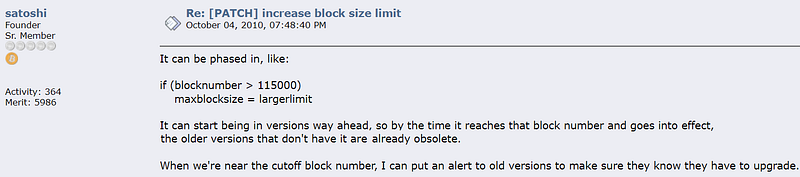
It can be phased in, like:
if (blocknumber > 115000) maxblocksize = largerlimit
“It can start being in versions way ahead, so by the time it reaches that block number and goes into effect, the older versions that don’t have it are already obsolete.”
“When we’re near the cutoff block number, I can put an alert to old versions to make sure they know they have to upgrade.”
The story on YouTube (hit play):
Subscribe (for free) to get email notifications whenever I publish:

The Schizm

Bitcoin was divided into two camps since as early as 2015.
The big blockers were the users and developers who wanted Bitcoin to succeed as digital cash.
To achieve scalability, the big blockers side proposed a hard fork that would increase the block size to 8 Megabytes.
Big blockers were early Bitcoin leading developers like Gavin Andresen, and Mike Hearn, and a considerable part of Bitcoin miners and users.
The other side was Blockstream, a for-profit company founded by Bitcoin Core devs and cryptographer Adam Back.
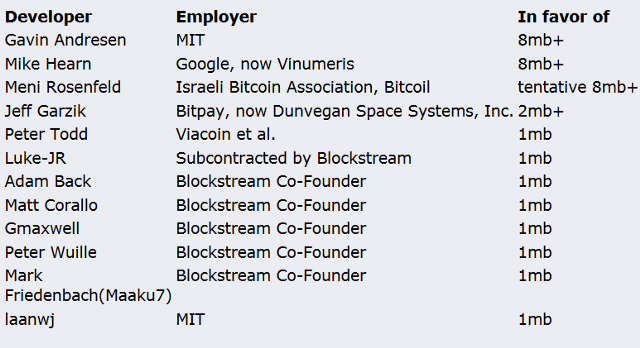
Interestingly, Blockstream received funding from Mastercard, AXA, and other financial institutions on several occasions. These institutions considered Bitcoin a competitor that was rising dangerously against their interests.
Blockstream argued that scaling was damaging decentralization and desired to keep the blocksize low, a move that was certainly going to increase fees and damage Bitcoin’s chances of mass adoption.
After the 2017 hard fork, two chains emerged: Bitcoin-BTC and Bitcoin Cash.
The winner of the Bitcoin civil war is the side that got to keep the Bitcoin logo, name, and the rest advantages.
Yet, we witnessed first a full-blown war, with Bitcoin Cash getting close to achieving what some considered impossible, as it flipped Ethereum for the second place in the market cap index.
An astounding success for Bitcoin Cash, if we also take into account how mainstream media and bankers were in support of BTC.
Still Bitcoin Cash did not win the war as the outcome was already decided by exchanges and miners.
Furthermore, most of the channels of communication were somehow in the control of one single anonymous person Theymos.
Bitcoin.org, bitcointalk, and r/bitcoin, were all controlled by this enigmatic individual who immediately resorted to censoring content related to upgrading Bitcoin and endorsed Blockstream.
BTC won a decisive battle, but not the war.
The part of the Bitcoin community that promoted scalability and delivered results offering censorship-resistant money features for the entire world was Bitcoin Cash.

The War For P2P Cash
Bitcoin was going to dominate the payments arena, as adoption was rising exponentially until 2017.
But the network effect stopped rising and adoption regressed to a point that not even Bitcoin-themed coffee shops, not even Bitcoin conventions or Bitcoin Pizza events accepted Bitcoin.
Bitcoin had disruptive potential.
Would competition allow a startup survive and grab a market share?
This is not how any industry works.
They always try to destroy competition when identified. They will try to buy your startup off or destroy it by any available means.
Bitcoin was compromised, perhaps some were promised a price pump and integration in finance as an ASSET.
Not as peer-to-peer Electronic Cash, but as a digital collectible.
The company Adam Back and Core devs created was funded by Bitcoin’s competitors. Doesn’t that ring a bell?
What you get today with BTC is an expensive digital trading card.
Bitcoin cash kept P2P Electronic Cash alive.
The same forces that were fighting Bitcoin until 2015, are today against Bitcoin Cash.
As Samson Mow (ex-Blockstream exec) once said that Bitcoin is not for the poor people, effectively excluding billions.
Clearly, it isn’t, since Blockstream is the main reason Bitcoin lost its positive disruption that was unleashing financial freedom to the world.
I remember Andreas Antonopoulos claiming how a kid in Africa could become his own bank with just a $50 smartphone and Bitcoin.
$50 is now where Bitcoin fees reach whenever adoption kicks in and Bitcoin devs are celebrating the financial exclusion of billions.
Gregory Maxwell is popping out champagnes after succeeding at excluding billions of people from what once was the money of the future.
The forces that destroyed Bitcoin with Blockstream and Core did not expect a reaction.
However, the honest part of the Bitcoin community kept the revolutionary flame alive.
The BTC version isn’t for people who live on less than $2 a day.
Bitcoin Cash is for everyone.
The rest of the world that CAN’T afford $50 fees will use censorship-resistant Peer-to-Peer Electronic Cash with instant transactions and fees lower than $0.01.
Bitcoin Cash is there not for just the 1% but for 100% of the population.
With instant transactions and fees lower than a penny, Bitcoin cash is the dominant peer-to-peer digital cash.
Bitcoin Cash is the scaling solution.
Decentralized, permissionless, censorship resistant. The best way to transact with anyone around the globe, at any given time, with any amount, without relying on a third party.
Bitcoin Cash remained committed to decentralization with several developers and node implementations presenting new ideas within the CHIPs process.
Developments rise with the latest CashTokens upgrade as Bitcoin Cash evolves into a peer-to-peer economy.
The overwhelming majority of the apps, wallets, and software support non-custodial features and decentralized procedures.
Crowdfunding platform Flipstarter ensures decentralized funding.
Online platforms like read.cash, noise, memo.cash, all include non-custodial wallets.
Bitgree allows Bitcoin Cash owners to buy anything from Amazon, Mercadolibre, and other e-commerce platforms, with no KYC and full support of self-custody.

In Conclusion
The whitepaper explains the exact value proposition, but is the whitepaper what the asset with the orange logo and the Bitcoin name follows today?
Bitcoin Cash proves that the blockchain scales to meet global adoption. The Blockstream arguments did not take into account the advance of technology.
Bitcoin Cash, achieves instant transactions with low fees, presenting a decentralized, secure and permissionless network.
The current market is just investors and very few users.
Investors predict and bet, and currently their bet is BTC.
Although, the real market is the people.
And the people just started finding out.
Suggested Reading:

- Cover picture source, other pictures on Pixabay
Also Read:
My Platforms:
● read.cash ● noise.app ● CashRain ● Medium ● Twitter ● YouTube
Don’t forget to Subscribe and Like if you enjoyed this article!


