
Author skills
Writing a Badass Beginning for Your Book
7 tips for crafting a powerful start in fiction

A strong start is important.
In sport, it can be the difference between winning and losing. In a career, it can affect the impression people have of you for years to come. And in a novel, it might determine whether people keep reading, or put the book down and forget about it.
You want a beginning to your story that hooks people in, and that keeps them reading long enough that they get totally gripped by the characters and the plot.
Because that’s not going to happen on page 1.
And after all, your work is not going to become anyone’s favorite book if they don’t get past the first page.
There are loads of first lines of books that stick in my head, and others that don’t. Consider, for example, The Tin Drum by Günter Grass. That novel begins with the following words:
Granted, I am the inmate of a mental hospital...
Wow! Bam… just like that, I’m hooked. I can’t think of a better way to tell the reader right from the get-go that the narrator is unreliable, and that some really weird stuff is going to happen throughout the story.
As a reader, I just have to know whats going to come next.
Beyond the first line, I can also think about a lot of times when I have been reading the first few pages of a novel, and even while reading, a part of me is thinking, “Phew, this is amazing stuff!”
It’s that feeling of excitement that rises in you as you realize that the author really knows what they are doing. That the story has depth and scope. And that you are about to go on an unforgettable ride.
All in all, it feels a bit like starting out on a rollercoaster, and seeing the enormous loops and drops up ahead of you.
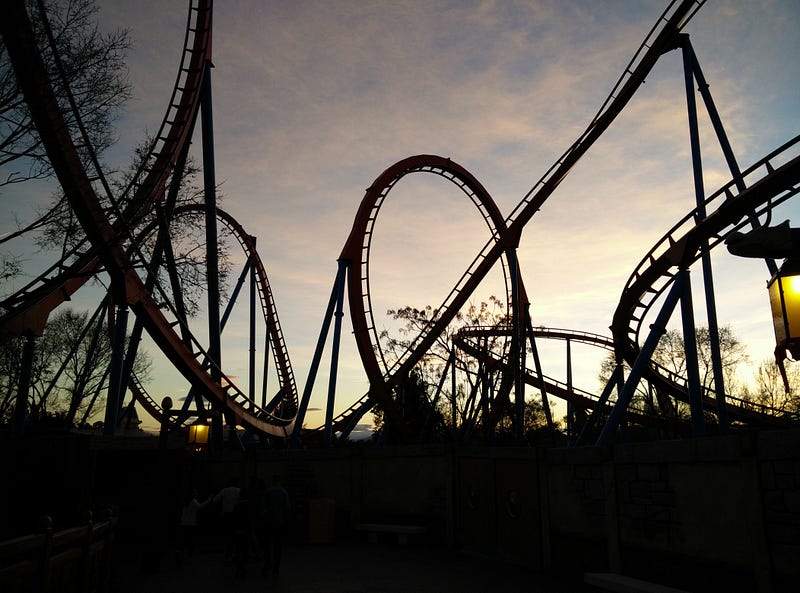
You might not be there yet, but you are sure as heck going to hang on tight and enjoy it when it happens!
Crafting a strong start
Writing a great first line is of course important, and you may need to write and re-write this several times.
Perhaps even more important, though, is a sense of where the story begins. You need to immerse your reader in both story and setting, and present engaging characters early on. Here are my tips:
- Consider how this would begin as a movie or video game. What would grab you about the scene? Noises? Smells? Other aspects of the setting? A sense of mystery? The way the video game Skyrim starts with the character being taken for execution and then escaping during a dragon attack is a great example of a very active and dramatic start.
- Where is the plot? I have read some great stories that build characters and describe settings beautifully… but after a while, you begin to ask yourself, ‘so what…?’ According to story expert Lani Diane Rich, a story only really begins when the protagonist and antagonist come into conflict. Don’t keep readers waiting too long for that to happen!
- Who are the characters, anyway? A difficulty that creative writers face is that we often get to know our characters as we write them (especially if we’re ‘pantsers’). But it is very important to present at least one person that the reader is going to care about — whether because they are scary, heroic… or just in a really shitty situation.
- Most stories begin too early. There is no need to give us every single detail about the background to your events, character life histories, or all of the things that happened in the weeks leading up to the key action. Begin when the story actually kicks off. Anton Chekhov suggested that after writing a first draft, most authors should cut off both the beginning and end, to get right to the heart of the story. (Admittedly, he mainly wrote short stories 😁).
- Do you really need a prologue? Fantasy and thriller authors love these, often showing a previous character or flashback, but as a reader, I tend to find them boring. I’d rather focus on the characters that the book is about. And yes, I include Wheel of Time in that – its start is much too slow! Another fantasy classic, Feist’s Magician, begins much more dramatically, with a lone boy travelling back late and getting caught in an unexpected storm. So, consider getting straight the point (or at least keeping the prologue very short!).
- Similarly, I’m sorry to say that I have read sci-fi novels where the first three or four chapters were all descriptions of previous world history up until that point. So dull! I understand why the authors considered this necessary, but really, we want to get to the action, please. It’s far too much “tell” and not enough show. Throwing us into the action might be a little disorientating, but it’s much more engaging. Credit your readers with being able to work stuff out for themselves. No lore dumps.
- If you do have vital information to tell to readers, consider doing it gradually, or via dialogue, rather than messing with the pace of your first chapter. I explain how here:
I hope that helps!
And as one bonus tip, don’t forget to share a draft of your first section/chapter with alpha or beta readers, or with a writing group. Getting early and honest feedback can make your writing much more successful in the long run.
Good luck!
p.s. you should get my posts direct to your inbox. Do that here! Also, if you’d like to experience Medium yourself, consider supporting me and thousands of other writers by signing up for a membership. It only costs $5 per month, it genuinely supports writers, and you have the chance to make serious money with your own writing as well! By signing up with this link, you’ll support me directly with a portion of your fee, it won’t cost you extra. If you do so, thank you so very much!


