
42 Fascinating Facts about the Roman Empire That You Probably Didn’t Know
Julius Caesar was not an emperor, the Colosseum was not called the Colosseum, divorce was widespread, urine was taxed, and much more
The Roman Empire is legendary and lasted in some form for close to 1700 years as such it has left an indelible mark on the entire world. Though considering that they invented concrete, newspapers, books and so much more, all of which the modern world is built upon, it is not hard to see why. Here are 30 facts about the Romans that you probably didn’t know.
In the year 133 BC, it is believed that Rome became the first city in the world to reach a population of over 1 million people. However, some dispute the timing but most accept that by the 2nd century A.D. Rome had a population approaching a million citizens. The next city to reach the same population number — at least officially — is Victorian London in the 19th century — that is 1,700-2000 years later.
Ancient Rome was the first society to offer Social Security-style government support. It has since been called the “grain dole.” This was a government program that offered a mixture of subsidised — in some cases free — grain to the citizens of Rome. It is estimated up to 200,000 of Rome’s adult male citizens were eligible for this form of support. It started as an emergency measure to help feed the rapidly growing population who were becoming increasingly indebted and dispossessed but it evolved into a permanent institution. The grain dole, which later became the “bread dole”, lasted until the fall of the Western Roman Empire in 476 A.D. After that point, the city’s population numbers began to plummet and so such a system ceased being viable or necessary.
The vast majority of ancient Rome is buried beneath modern Rome. A practice by the Romans was rather than knock a building down if they were done with it, they would simply fill it in and build on top of it. To go with this, once the majority of Rome was abandoned after its fall, the buildings started collapsing which released vast amounts of dust. This dust added to the dust from the elements added to the practice of building on top of old buildings rather than knocking them down added to the silt and mud from countless floods gradually over the years led to ancient Rome being completely buried. As such, tours to view ancient Rome involve going underground and there are places where you have to go as much as 30 feet or more deep to reach the old buildings. The ancient sewers are even further below ground. That means modern Rome is a city built upon a city.
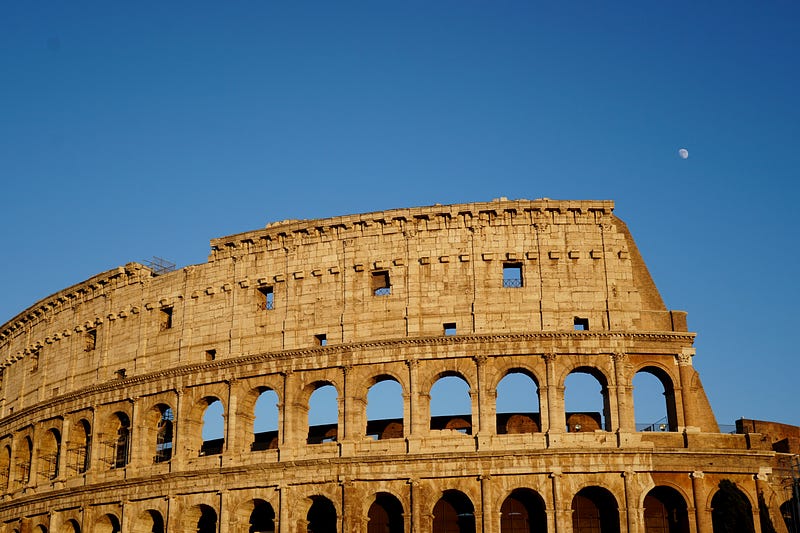
The Roman Colosseum, which was built in 80 A.D. was the largest of its kind ever built at the time. It took 8 years to build and at its peak, it could hold up to 85,000 spectators which means that it was larger than the vast majority of modern stadiums. However, it was not the largest arena the Romans ever built. That would be the Circus Maximus which was for chariot racing. The Circus Maximus at its peak is believed to have been able to hold upwards of 250,000 people. Legend has it it was originally laid out in the 6th century BC, though it did not take its most famous form until Julius Caesar’s reign in the 1st century B.C. and it couldn’t hold its maximum capacity until the 2nd century A.D.
It’s believed that upwards of 500,000 people died doing battle in Rome’s amphitheatres along with 1 million animals.
The games in Rome were so advanced that they would re-enact full-size naval battles with full-size ships. These games were called the Naumachia and Julius Caesar was the first to have such games. In 46 BC he ordered an enormous basin to be dug in the Campus Martius outside the walls of Rome and he had it filled with water. The event was to celebrate his recent victories and it involved an epic 6,000 prisoners who played the parts of soldiers and rowers. Basically, they told the story of his quadruple victory which united the Empire. It’s believed other emperors had similar games though they were very rare due to the extremely high cost. The most famous of the other ones were put on by Emperor Claudius in 52 A.D., it involved one hundred ships and 19,000 people — all of whom were prisoners who had been condemned to death.
The Roman Colosseum was originally called the Flavian Amphitheatre, it got its name because it was an amphitheatre and it was built and constructed by emperors of the Flavian dynasty. The reason its name was changed was not that it was colossal. Emperor Nero had a 30-metre tall bronze statue of himself built at the entrance of the Domus Aurea, which was the enormous palace he built for himself after the great fire of Rome. The statue was located near the Colosseum and was called the Colossus of Nero. It’s believed that the Colosseum is basically a nickname that became so often used it became its name. However, its use came mainly after the fall of Rome, it’s believed Romans themselves mostly would have called it the emperor's amphitheatre. Yep, that means that the Romans themselves — at least the ancient ones — likely never called it that, and the first written evidence of the name was Venerable Bede in the 7th Century CE — over 500 years after it was built.
Venerable Bede’s famous epigram about Rome, “as long as the Colossus stands, so shall Rome; when the Colossus falls, Rome shall fall; when Rome falls, so falls the world,” is not actually about the Colosseum — like in popular belief. It’s actually about the Colossus of Nero, so Nero’s statue, which at the time was one of the seven wonders of the ancient world. As everyone knows, the statue did fall and all that remains today are the ruins of the pedestal meaning he was right.
Gladiatorial combat in the Colosseum was ended in the mid-5th century by Emperor Honorius due to changing times and tastes. However, condemned criminals were still made to fight wild beasts for another century. By the late 6th century though the Colosseum was no longer used as an amphitheatre to entertain people. Instead, a chapel was attached to the building and the arena floor was used as a cemetery. On top of that, the vaulted spaces that were built under the seats and its arena floor were used as houses and workshops. This continued until the 12th century when it was taken over by the Frangipani family, a powerful Roman patrician clan from the time. They turned it into a fortified castle. It remained as this until 1349 when an earthquake seriously damaged the building and turned it into the ruins we know it as today — with the collapsed walls. It suffered further deterioration during the ensuing years when materials were salvaged from the building to use elsewhere, most famously, some of the marble that decorated its façade was used in the construction of St Peters Basilica. Thankfully enough of it survived until the 19th century when people began wanting to restore and preserve it.
The Colosseum attracts over 4 million visitors a year making it the most popular Roman attraction.
Tattoos were used by the Romans and were quite popular. They were mainly used by the military, where soldiers would get a tattoo on their right wrist and left forearm which would mark their rank, legion and date of enlistment. However, they were also used as a means of punishment or to mark a person out as a criminal, facial tattoos were a popular means of making this mark. Basically, certain tattoos were in effect life sentences to the people given them. When Emperor Constantine banned facial tattooing in 325 A.D., reasoning they were a mutilation of God’s image, it created a new problem for these unlucky people, they needed their tattoos — which marked them as criminals — removed to avoid breaking the law, but the majority of tattoo removal techniques were lethal.
At its peak in A.D. 117 the Roman Empire is estimated to have covered nearly 2 million square miles, and to have encompassed roughly 20 percent of the world’s population at the time — between 50 and 90 million people. The landmass stretched from Britain to Egypt and into North Africa.
It was believed by the Romans that Rome was founded on 21 April, 753 B.C. The legendary story of how it was founded is that Romulus and his twin brother, Remus, were suckled by a she-wolf as orphaned infants on the grounds that would become Rome. Nobody knows how Rome was actually founded but it is believed that the myth originated sometime in the fourth century B.C. It’s also believed that it was Roman scholar Marcus Terentius Varro who set the date for when Rome’s foundation was supposed to have taken place. The trouble is, he is reported to have done it in the first century B.C. This means that nobody really knows when Rome was truly founded and who founded it.
The consensus for how Rome came to be is actually believed to be a cumulation of events that cumulated in the 8th century BC. Basically, human activity in the region of the city of Rome has been traced back 14,000 years. It is believed that prior to the birth of Rome Latin settlers from various regions set up villages and outposts and eventually, due to an increase in agriculture which led to an increase in trade, those villages and outposts grew and united into one. Palatine Hill, which was the centre of ancient Rome, is believed to have been the village that became Rome. It’s believed the other villages built around it and eventually came together to create Rome.
It’s believed that the Roman Empire was founded in about 200 BC when the Roman Republic conquered the Italian peninsula. But they did not stop there, over the next few centuries they conquered Greece, Spain, the North African coast, much of the Middle East, modern-day France, and even Britain. However, they never conquered Scotland deeming it too cold and taking an extreme dislike to the “barbaric” guerilla tactics of the Scottish. So, instead of conquering them they built a wall to keep them out.
The Roman Empire lasted for about 600 years before eventually its size meant that it split into two, the East and the West. The Western Empire fell quite swiftly, with its end coming in 476 A.D. Germanic tribes were behind the Western Empire’s demise, with continued invasions proving too much. The eastern half, however, which is now known as the Byzantine Empire and had Constantinople as its capital, continued for centuries afterwards, not falling until 1453. It was the Ottomans who brought an end to Eastern Roman Empire after they stormed and conquered the capital, Constantinople. Sultan Mehmed the Conqueror is the man who led the army.
The Byzantine Empire was not known by those who lived in it or by those of the time anywhere in the world as the Byzantine Empire. It was not known as the Eastern Roman Empire either. It was simply known as the Roman Empire and the people who lived in it saw themselves as Romans and everybody at the time saw them as Romans. The reason that we now call it the Byzantine Empire is because historians needed to come up with a way to separate it from the ancient Roman Empire and the Western Empire which fell. The Byzantine Empire name was chosen because it was the name of the ancient Greek colony and transit point that eventually became Constantinople.
The city of Rome is the first city that had a truly complex sewer system and at its peak it could move millions of gallons of water a day. It was called the Cloaca Massima, and though it started in the 6th century BC as just an outdoor ditch that helped to drain the Roman Forum when there were floods, it was repeatedly rebuilt and scaled up as the city grew and at its peak it was able to take sewage and floor water from the majority of the city. This included palaces, bath houses, and even public lavatories. Though it did not include residential houses. Residential houses mostly used cesspits or chamber pots.
Not all palaces were connected to the sewerage system, many wanted to avoid the risk of vermin and the smell that came with being connected to the sewerage system, so they would continue to use cesspits and chamber pots.
Public toilets in Rome had no Booths, people would just sit next to each other and quite close at that. However, the Roman toga provided a good means to protect your modesty. The only problem was the bathrooms were not well maintained. This meant that the floors and seats were often soiled, and as there was little light and low ceilings it is believed the place would frequently absolutely stink. Yep, perhaps that’s why the lower classes more often wore darker coloured togas rather than the pure white adorned by the upper classes… It is also perhaps why women very rarely ventured into them unless they had absolutely no choice. Yep, there were no men’s and women’s back then.
Public bathrooms in Rome had clean flowing water which Romans would use as a means to clean their asses. Basically, as there was no toilet paper, they would use sea sponges which would be attached to a stick, so they would dip the sea sponges in the clean water and use them to wipe their asses clean. The sea sponges were called tersorium, which literally translates to “a wiping thing.” So, they were called “wiping things.” However, you did not get your own wiping thing… Yep, that means if one person had worms and wiped their ass every who used that wiping thing would get worms.
Because public bathrooms had direct holes to the sewerage systems there was a risk of spiders, rats and snakes paying you a visit while you were paying a visit. On top of that, due to the lack of treatment of waste product chemical reactions could occur which could literally light a fire under your ass. Yep, public bathrooms back then make modern ones look like sanctuaries by comparison.
The Romans created the first modern-style legal system. It was known as the twelve tables and was written in the 5th century BC. It was greatly expanded over the years with much bureaucracy created meaning the Romans basically invented modern bureaucracy.
It was possible to get divorced in Roman culture and was technically very easy to do so. Basically, to get a divorce one or both parties in a marriage simply had to consider themselves no longer married. The craziest thing about it was it was only deemed advisable that the divorcing party had to notify the other party of the divorce, meaning there was no legal requirement to tell your partner you had divorced them. That meant a man could decide to be divorced but not tell his wife or a woman could decide to be divorced and not tell her husband. It’s believed that this likely frequently happened when a man or woman was a long distance away from their spouse for whatever reason and came across a person they deemed a superior suitor. They would have got divorced and married that person and due to being out of communication range simply not told the now divorced partner of the divorce.
Divorces were relatively common and were not frowned upon — in fact, many believe they were accepted more back then than they are now. Basically, they were seen as internal family affairs which meant they were private business which meant people could do what they wanted and others would stick out of it other than a little bit of idle gossip. In terms of why they were common, especially amongst the elites, marriages were a great way to climb the social ladder and so elite men and women would frequently change husbands and wives as it suited them.
Emperor Nero allegedly took favour to a young man called Sporus and had him castrated and then married him. It’s believed that Sporus looked like Nero's deceased wife, Poppaea Sabina, and so Nero treated Sporus as if he was his deceased wife, even calling him by her name. It’s believed that he may have kicked Poppaea to death and that the marriage may have been his effort to escape his guilt by pretending she was still alive.
Emperor Nero is also believed to have married a man called Pythagoras, though likely in an unofficial ceremony. Pythagoras was a Freedman — a former slave who had either earned or been granted their freedom — and Nero dressed up as a woman and had a big ceremony and married him — allegedly.
Emperor Nero was completely nuts, some believe he was even behind the great fire of Rome, and that he may have had it started so that he could build his enormous palace — the Domus Aurea a.k.a. the Golden House of Nero. He may not have but the fact that people wondered whether he may have highlighted just how nuts people thought he was. Also, it’s believed his sexual depravity was on another planet. He raped vestal virgins — absolute sacrilege in Rome — he committed incest with his mother and sisters, and an infamous story has him being let loose from a cage wearing the skins of wild animals and violently attacking the private parts of men and women who had been bound to stakes.
The Romans were the first to create a dedicated Fire Brigade, they did this because the majority of their buildings were made using timber. In 22 BC Emperor Augustus created a force of 600 slaves to protect the city. However, though this worked for a long period it could not save Rome from the devastating fires which occurred during Emperor Nero’s reign.
The Romans built Europe’s first road, it was called the Appian Way and was constructed in 312 BC. It ran from Rome to Capua and was built to help facilitate the movement of soldiers and goods. By the end of the Empire, the Romans had built a vast road network that spread all across Europe and right round into North Africa. That meant a person could use a road to get from the furthest westward coast of the North African part of the Roman Empire to the furthest westward coast of the European part. Many of these roads still exist today. For example, in the UK there are believed to be as many as 55,000 miles of Roman roads still in use.
The Romans had a form of underfloor heating. No jokes, it was called the hypocaust system and worked by pushing hot air from a furnace underneath the floor using terracotta pipes. The system was mainly used in palaces and the best-known example of a system that remains is in the Domitian’s Palace.
The first aqueduct ever built was the Aqua Appia which the Romans built in 312 BC. It transported water into the city through an underground piping system. Romans became so proficient at building aqueducts that some transported water from as far away as 100kms, and in total there were eleven major aqueducts constructed to bring water into Rome, along with hundreds constructed throughout the empire for other cities. Many of these aqueducts still stand today even though they’re not in use.
Romans had a weird relationship with oral sex. It was perfectly acceptable for a Roman citizen to receive oral sex, however, paradoxically any person who gave another person oral sex would pretty much be treated from then on as a leper. This is likely for good reason, back then if you had any respect for your health the last place you’d want to put your head is between somebody’s legs. Hygiene was so bad — even though it was better than other places — that the odds of you not being infected with something after giving oral sex would be slim. In fact, it has not been safe to give oral sex until very recently when showers, soap, and genital shaving became easy and the norm. But even now, in many places around the world, it is not due to a lack of access to hygiene products.
The Romans laid the foundations for hygiene and were by far and away the cleanest civilisation of their day. This is because early on Romans realised that keeping cleanly related to good health. This is why they built bathhouses that were open to everybody along with the public toilets. They also built running water though the water systems were made using gravity, so the massive aqueducts they built to transport the water to the city worked through gravity rather than any pumping systems per se. Regardless, Rome’s obsession with cleanliness is what laid the foundations for baths, and modern spas.
Rome built large apartment blocks which were believed to be upwards of seven stories high. The ancient apartment blocks were called Insulas but unlike modern apartment blocks, you didn’t want to live at the top because they were the most cramped and also had the greatest fire hazards mainly because the apartments were made of wood. Also, there often were upwards of 200 steps to the top of the building.
Ancient Rome was filled with fast-food outlets. This is because the majority of the population lived in overcrowded accommodations which did not have cooking facilities. Because of this, the majority would frequently go to snack bars, known as a thermopolia, and purchase hot takeaway food. It’s believed that the popularity of these outlets is why the poor were far more likely to eat out than the wealthy.
Julius Caesar gave the world the modern calendar. While on a trip to Alexandria in 46 BC he decided he liked the idea that they used a calendar based on a solar year. Because of this, once he returned he created the Julian calendar which is 365 days a year with an extra day at the end of February every 4 years. After his death, a month was named after him to honour him, July. Originally, July was Quintilius. Though Caesar wasn’t the only one to have a month named after him, Augustus did as well. The Senate in 8 BC elected to change Sextilis into August.
The Romans invented palaces and ancient Rome was the first place of a palace. The first-ever grand houses were built on Palatine Hill.
Rome once had a urine tax. No jokes. Urine is a natural source of ammonia which is a natural source of bleach, as such Romans would use urine to bleach clothes clean. Emperor Vespasian realised that launderettes were collecting free urine by leaving chamber pots outside that people could pee in, and that people were selling their urine to launderettes. As such, he decided to introduce a tax on the sale of urine. The way the tax worked was that at public urinals, Roman lower classes would urinate into pots which would normally be emptied into cesspools before being dumped into the sewers, any person who wished to do otherwise i.e. sell it, had to pay tax on the sale.
Julius Caesar was never an emperor. That means he was not the first emperor of Rome. Augustus was the first emperor of Rome, and he was Caesar’s nephew who Caesar adopted as his son. Julius Caesar himself was actually just a very powerful and successful general who won a civil war against his rival Pompey which allowed him to become a dictator. The first dictator of the entire Roman Empire. So he was the first man to gain near enough sole control of the entire empire. As such, after his death, he was pretty much made into a God and his name became so synonymous with empire and the title emperor that many emperors used his name in their titles. So, a Roman Caesar is not a Roman emperor like many mistakenly believe, there is only one Caesar and his name was Julius Caesar. Julius Caesar was a military general who became a dictator by uniting the Roman Empire under his sole rule.
Julius Caesar’s uniting of Rome under his rule set the Empire on track for a period of relative peace and stability that lasted for over two centuries. During that period, the only real conflicts were of Rome’s own making where they were attempting to expand.
Julius Caesar disliked going bald so much that it is rumoured that he made it illegal for anyone to stand above him so that nobody could see his bald patch. If you were unlucky enough to look down and see his bald patch the penalty was death. Other less extreme measures he utilised to hide his bald patch were a standard comb-over and his iconic laurel wreath crown.
That’s all from me, thanks for reading! If you enjoyed this post, you may also enjoy the following:
18 Fascinating Facts About The Victorian Era That You Probably Didn’t Know
25 Random But Fascinating Trivia Facts That You Probably Didn’t Know
The Eight Greatest Acts of Revenge in Human History
To learn more about me see this link, to support me click the link below:
