avatarThe Modern Scholastic

Free AI web copilot to create summaries, insights and extended knowledge, download it at here

3883

Abstract

“the <b>eighty-minute discussion</b> provided by the ABC network on November 20, 1983, following its controversial movie <i>The Day After.</i></p><p id="305f">The programme had no musical theme. There were no commercials during the programme. (So in terms of the peripherals, the programme was like a funeral.)</p><p id="fe38">They invited as participants including Henry Kissinger, Robert McNamara, and Elie Wiesel, public figures of stature.</p><p id="f6e4">However, each of the participants only had 5 minutes to start with to say something about the subject. It was followed by a discussion among them.</p><p id="7d01">There was simply not enough time to respond to the others’ comments, and they ended up saying things that are less important, but leave a good impression on the audience:</p><ul><li>Kissinger informed the audience of “a book <b>he</b> had written, proposals <b>he</b> had once made, and negotiations <b>he</b> had once conducted”. (So not about his <b>arguments</b>.)</li><li>Mr. McNamara told the audience “that he had eaten <b>lunch</b> in Germany that very afternoon, and went on to say that he had at least fifteen proposals to reduce nuclear arms.”</li></ul><p id="8552">Compared to the crowd in 1854 who listened to Abraham Lincoln debate for 7 hours, a 5-minute speech simply would not cultivate a useful discussion. (See my summary of the debate <a href="https://readmedium.com/the-audience-who-listened-to-abraham-lincoln-for-7-hours-in-1854-3-things-we-can-learn-from-them-fc50dac9bd48">here</a>.)</p><p id="5e8c">Let alone 5 minutes of speech where the speaker had strong pressures to please a large audience.</p><p id="ef4c">If even the most serious TV programme had such limitations, how can we expect the rest to do any better?</p><p id="7f2a">TV does not lend itself to training our attention span.</p><h1 id="e681">3. It Desensitises Us to Facts</h1><p id="7018">The author quotes from a <i>New York Times </i>article in 1983, headlined: <b>REAGAN MISSTATEMENTS GETTING LESS ATTENTION</b>.</p><blockquote id="d007"><p>President Reagan’s aides used to become visibly alarmed at suggestions that he had given mangled and perhaps misleading accounts of his policies or of current events in general.</p></blockquote><blockquote id="1deb"><p>That doesn’t seem to happen much anymore. Indeed, the President continues to make debatable assertions of fact but news accounts do not deal with them as extensively as they once did.</p></blockquote><p id="01c5">The author also quotes Water Lippmannn, who said in 1920:</p><blockquote id="2c1f"><p>“There can be no liberty for a community which lacks the means by which to detect lies.”</p></blockquote><p id="f1a3">This is related to point 1 mentioned earlier. Impressions lead to less focus on the content.</p><p id="c794"><b>Also, TV clips are short. </b>The speaker can make assertions without a broader context.</p><p id="6d45">In a longer speech or text, people can hold the speaker to account. But when clips are reduced to soundbites, people focus on the sentence or two, rather than the whole text.</p><p id="f1e9">People become desensitised to contradictions and facts.</p><h1 id="2f95">4. It Hooks Us in with Entertainment</h1><p id="9176">TV in a Western setting is also an invitation to entertainment.</p><p id="f079">It’s used as a medium to grab the viewers’ attention. The author writes:</p><blockquote id="1ad8"><p>Entertainment is the supra-ideology of all discourse on television. No matter what is depicted or from what point of view, the overarching presumption is that it is there for our amusement and pleasure.</p></blockquote><blockquote id="5015"><p>That is why even on news shows which provide us daily with fragments of tragedy and barbarism, we are urged by the newscasters to “join them tomorrow.”</p></blockquote><p id="93ba">Good television becomes defined by pictorial qual

Options

ity rather than the verbal content.</p><h2 id="366c">Broader Western Culture</h2><p id="7cda">Such a focus on entertainment, however, is also due to our <b>broader culture</b>.</p><p id="cef0">A weakness of the book was how it seemed to place the blame on TV as a medium in and of itself.</p><p id="ed25">It didn’t point its finger at the broader cultural changes in the US which may have caused the TV.</p><p id="3843">There were some cultural shifts in the US in the 60s, right around when TV started to get popularised. I’ve covered some of those thoughts in this piece:</p><div id="c3e6" class="link-block"> <a href="https://readmedium.com/what-actually-happened-as-the-titanic-sank-ac7b97974bb6"> <div> <div> <h2>What actually happened as the Titanic sank</h2> <div><h3>“No woman shall be left aboard this ship because Ben Guggenheim was a coward”.</h3></div> <div><p>medium.com</p></div> </div> <div> <div style="background-image: url(https://miro.readmedium.com/v2/resize:fit:320/0*xhObACqiyx0Tizg9)"></div> </div> </div> </a> </div><p id="677b">Yet the book title “Amusing Ourselves to Death” sums it all quite well. Or maybe “entertaining ourselves to death”.</p><h1 id="a1da">How the Book Could’ve Been Even Better</h1><p id="b5b1">The author Neil Postman did mention his focus is on the West, and TV programmes as they are presented there. But an acknowledgement of the broader societal changes would make many of his arguments more convincing.</p><p id="994a">After all, he did mention that programmes which hone in on a speaker who makes a lengthy speech can achieve good results. Sustained, complex talk can be played. When:</p><blockquote id="ff69"><p>“the visual image is kept constant — as when the President gives a speech.”</p></blockquote><p id="48e9">He adds though:</p><blockquote id="44ce"><p>“But this is not television at its best, and it is not television that most people will choose to watch”</p></blockquote><p id="c93a">Still, it’d be <b>interesting</b> to think, had the TV existed back in Abraham Lincoln’s time, would people virtuously follow the programme only focusing on his arguments?</p><p id="5744">I think it would be possible.</p><p id="5696">So the TV <b>isn’t in and of itself problematic</b>. It’s what people and the times made it to be what it is.</p><h1 id="f0da">TV Today</h1><p id="7388">The book was written more than 30 years ago.</p><p id="a6ea">But it eerily presages how technology nowadays has inflated our entertainment culture to a greater extent.</p><p id="f218">This reminds me of an <a href="https://www.wired.com/story/artificial-intelligence-yuval-noah-harari-tristan-harris/">interview</a> historian Yuval Noah Harari did in 2017. He said:</p><blockquote id="ebba"><p>“I know those other times I end up watching two or three videos and I end up getting sucked into it, but this time it’s going to be really different. I’m just going to watch this one video and then somehow, that’s not what happens.</p></blockquote><blockquote id="b5c2"><p>You wake up from a trance three hours later and you say, “What the hell just happened?” And it’s because you didn’t realize you had a <b>supercomputer</b> pointed at your brain.</p></blockquote><blockquote id="6f47"><p>So when you open up that video you’re activating Google’s billions of dollars of <b>computing power </b>and they’ve looked at what has ever gotten 2 billion human animals to click on another video.” (Emphasis mine)</p></blockquote><p id="e684">The very survival of the medium, be it a TV programme or an app, depends on the viewers’ continued viewing.</p><p id="7c3b">But being aware of the risks already makes you <b>think twice</b>. It offers some degree of comfort.</p></article></body>

4 Things That the TV Does to Us — According to a Professor in Media Studies.

This is in part a review of a book I’ve just read.
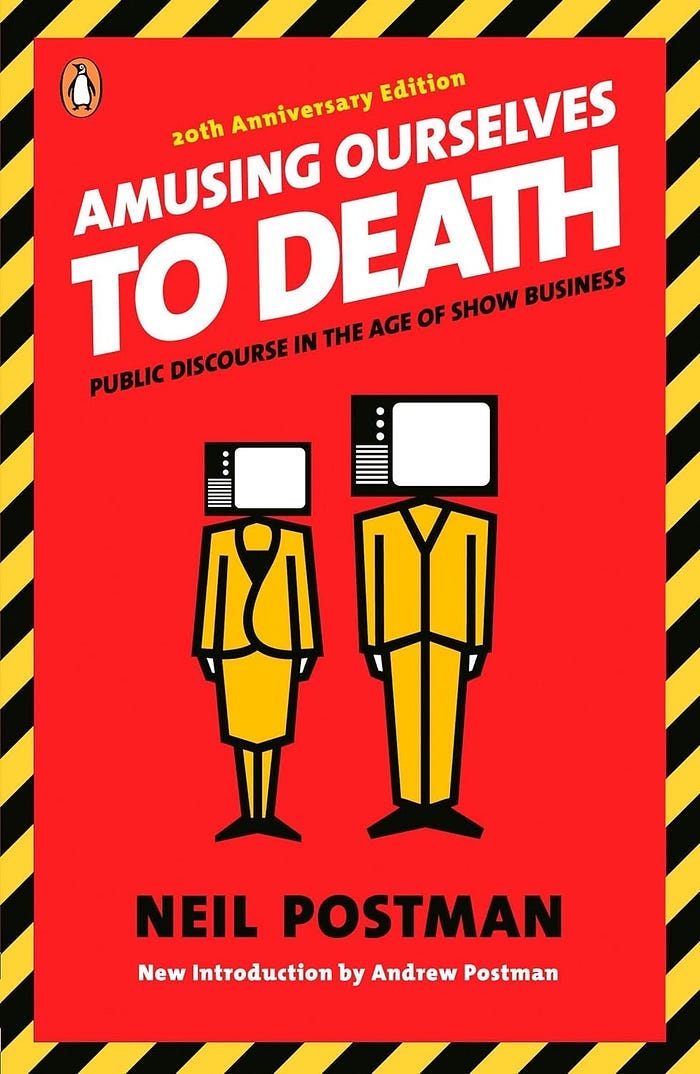
Reference: Amazon books

Amusing Ourselves to Death: Public Discourse in the Age of Show Business by Neil Postman.

As you can gather from the cover, this is a book about how our visual culture erodes the more serious aspects of society.

It had two parts, but Part II was the main burden of the book: it gave examples of how TV erodes thinking in politics, religion, the news, education, and so on.

Here are 4 such examples I can find in the book. I end with some reflections near the end about how the book could’ve been even better.

1. It Makes Us Think in Terms of Impressions

“The average length of a shot on network television is only 3.5 seconds.”

Photo by NordWood Themes on Unsplash

The author continues:

“…so that the eye never rests, always has something new to see. Moreover, television offers viewers a variety of subject matter, requires minimal skills to comprehend it, and is largely aimed at emotional gratification.

“Even commercials, which some regard as an annoyance, are exquisitely crafted, always pleasing to the eye and accompanied by exciting music.”

And there’s something yet that was very chilling from the book.

It made a comparison between George Orwell and Aldous Huxley.

Orwell famously wrote his 1984. But he also summarised his thoughts in an essay called “The Politics of the English Language”. He warned the reader against politicians who would use double-think, propaganda, and deceit.

However, in television, the first thing that comes to people’s minds are images. That’s the “political knowledge” people have.

When a culture slowly becomes distracted by trivia, then Big Brother doesn’t watch us. We don’t even need watching over.

Because we’re sufficiently distracted and uncertain about the facts, we don’t even form a credible source of threat.

I suppose that’s the extreme. But I definitely find such parallels in our world right now, especially when it comes to elections.

2. It Shortens Our Attention Span

TV, as Western culture has it, does not lend itself to training our attention span.

Photo by Wilhelm Gunkel on Unsplash

Even in serious debates. Because of how TV producers face pressure to compete with other programmes.

The book gave an interesting case study. It was “the eighty-minute discussion provided by the ABC network on November 20, 1983, following its controversial movie The Day After.

The programme had no musical theme. There were no commercials during the programme. (So in terms of the peripherals, the programme was like a funeral.)

They invited as participants including Henry Kissinger, Robert McNamara, and Elie Wiesel, public figures of stature.

However, each of the participants only had 5 minutes to start with to say something about the subject. It was followed by a discussion among them.

There was simply not enough time to respond to the others’ comments, and they ended up saying things that are less important, but leave a good impression on the audience:

  • Kissinger informed the audience of “a book he had written, proposals he had once made, and negotiations he had once conducted”. (So not about his arguments.)
  • Mr. McNamara told the audience “that he had eaten lunch in Germany that very afternoon, and went on to say that he had at least fifteen proposals to reduce nuclear arms.”

Compared to the crowd in 1854 who listened to Abraham Lincoln debate for 7 hours, a 5-minute speech simply would not cultivate a useful discussion. (See my summary of the debate here.)

Let alone 5 minutes of speech where the speaker had strong pressures to please a large audience.

If even the most serious TV programme had such limitations, how can we expect the rest to do any better?

TV does not lend itself to training our attention span.

3. It Desensitises Us to Facts

The author quotes from a New York Times article in 1983, headlined: REAGAN MISSTATEMENTS GETTING LESS ATTENTION.

President Reagan’s aides used to become visibly alarmed at suggestions that he had given mangled and perhaps misleading accounts of his policies or of current events in general.

That doesn’t seem to happen much anymore. Indeed, the President continues to make debatable assertions of fact but news accounts do not deal with them as extensively as they once did.

The author also quotes Water Lippmannn, who said in 1920:

“There can be no liberty for a community which lacks the means by which to detect lies.”

This is related to point 1 mentioned earlier. Impressions lead to less focus on the content.

Also, TV clips are short. The speaker can make assertions without a broader context.

In a longer speech or text, people can hold the speaker to account. But when clips are reduced to soundbites, people focus on the sentence or two, rather than the whole text.

People become desensitised to contradictions and facts.

4. It Hooks Us in with Entertainment

TV in a Western setting is also an invitation to entertainment.

It’s used as a medium to grab the viewers’ attention. The author writes:

Entertainment is the supra-ideology of all discourse on television. No matter what is depicted or from what point of view, the overarching presumption is that it is there for our amusement and pleasure.

That is why even on news shows which provide us daily with fragments of tragedy and barbarism, we are urged by the newscasters to “join them tomorrow.”

Good television becomes defined by pictorial quality rather than the verbal content.

Broader Western Culture

Such a focus on entertainment, however, is also due to our broader culture.

A weakness of the book was how it seemed to place the blame on TV as a medium in and of itself.

It didn’t point its finger at the broader cultural changes in the US which may have caused the TV.

There were some cultural shifts in the US in the 60s, right around when TV started to get popularised. I’ve covered some of those thoughts in this piece:

Yet the book title “Amusing Ourselves to Death” sums it all quite well. Or maybe “entertaining ourselves to death”.

How the Book Could’ve Been Even Better

The author Neil Postman did mention his focus is on the West, and TV programmes as they are presented there. But an acknowledgement of the broader societal changes would make many of his arguments more convincing.

After all, he did mention that programmes which hone in on a speaker who makes a lengthy speech can achieve good results. Sustained, complex talk can be played. When:

“the visual image is kept constant — as when the President gives a speech.”

He adds though:

“But this is not television at its best, and it is not television that most people will choose to watch”

Still, it’d be interesting to think, had the TV existed back in Abraham Lincoln’s time, would people virtuously follow the programme only focusing on his arguments?

I think it would be possible.

So the TV isn’t in and of itself problematic. It’s what people and the times made it to be what it is.

TV Today

The book was written more than 30 years ago.

But it eerily presages how technology nowadays has inflated our entertainment culture to a greater extent.

This reminds me of an interview historian Yuval Noah Harari did in 2017. He said:

“I know those other times I end up watching two or three videos and I end up getting sucked into it, but this time it’s going to be really different. I’m just going to watch this one video and then somehow, that’s not what happens.

You wake up from a trance three hours later and you say, “What the hell just happened?” And it’s because you didn’t realize you had a supercomputer pointed at your brain.

So when you open up that video you’re activating Google’s billions of dollars of computing power and they’ve looked at what has ever gotten 2 billion human animals to click on another video.” (Emphasis mine)

The very survival of the medium, be it a TV programme or an app, depends on the viewers’ continued viewing.

But being aware of the risks already makes you think twice. It offers some degree of comfort.

Book Review
Technology
Self Improvement
Productivity
Television
Recommended from ReadMedium