avatarThe Good Men Project

Free AI web copilot to create summaries, insights and extended knowledge, download it at here

2821

Abstract

scene in Russia (which included Azerbaijan), but all assets were nationalized after the Russian Revolution. But a new dimension was added to the region’s oil production in the 1930’s, when drilling began on long-known oil-bearing structures on the floor of the Caspian Sea — and so the offshore oil industry was born in Asia.</p><p id="b85e">This led to the gigantic offshore installation known as “Neft Dashlari”, the Oil Rocks. After surveys in the 1940’s revealed large oil deposits in the shallow center of the sea 55 km/34 mi from shore, the first platform — and first in the world — was built in 1949. In 1952 a trestle bridge was built, and a community started to support the increasingly large drilling activity. In the late 50’s large-scale construction began, using the hulls of sunk ships as foundations. Through the 60’s as many as 2,000 people lived there, with a school and a cinema. The installation is still in use, now built on piles and imported fill.</p><p id="39fd">Modern, independent Azerbaijan’s economy depends fully on the oil industry, which comprises nearly 87% of its exports. The State Oil Company of the Azerbaijani Republic (SOCAR) is run very opaquely. Azerbaijan’s commitment to democracy is questionable at best, so transparency is close to nonexistent in the company’s investment, assets, production and profits. The country’s undiversified economy is subject to the fluctuations of the global petroleum market. Attempts at economic reform since the 2000’s have mitigated but not solved this basic problem, faced by those countries which gain an energy windfall and fail to invest it in their citizens.</p><p id="79bc">Tomorrow: the Caspian Sea and the oil industry.</p><p id="7cac">Be brave, and be well.</p><p id="dfc3">Sources:</p><p id="a92b"><a href="https://en.wikipedia.org/wiki/Oil_industry">Wikipedia — oil industry</a></p><p id="f142"><a href="https://en.wikipedia.org/wiki/History_of_the_petroleum_industry">WIkipedia — History of the petroleum industry</a></p><p id="d3c7"><a href="https://en.wikipedia.org/wiki/Petroleum_industry_in_Azerbaijan">Wikipedia — history of the oil industry in Azerbaijan</a></p><p id="9b66"><a href="https://en.wikipedia.org/wiki/Neft_Dashlari">WIkipedia — oil rocks</a></p><p id="48e3"><a href="https://en.wikipedia.org/wiki/Baku">Wikipedia — Baku</a></p><p id="2d73"><a href="https://goodmenproject.medium.com/membership"><i>Become a Medium subscriber with our referral link</i></a><i> to support The Good Men Project — and gain access to all of our content, including our publications and thousands of authors on Medium</i>.</p><div id="733b" class="link-block"> <a href="https://goodmenproject.medium.com/membership"> <div> <div> <h2>Join Medium with my referral link — The Good Men Projec

Options

t</h2> <div><h3>As a Medium member, a portion of your membership fee goes to writers you read, and you get full access to every story…</h3></div> <div><p>goodmenproject.medium.com</p></div> </div> <div> <div style="background-image: url(https://miro.readmedium.com/v2/resize:fit:320/0*yclyJzEshQLc5Kco)"></div> </div> </div> </a> </div><h2 id="722c">Read more from The Good Men Project on Medium:</h2><div id="801a" class="link-block"> <a href="https://readmedium.com/the-mistake-smart-people-make-that-causes-divorce-and-other-miserable-things-7bbe58fa921d"> <div> <div> <h2>The Mistake Smart People Make That Causes Divorce and Other Miserable Things</h2> <div><h3>The reason we have conflict with the people we are closest to is because we’re smart. All of us.</h3></div> <div><p>medium.com</p></div> </div> <div> <div style="background-image: url(https://miro.readmedium.com/v2/resize:fit:320/0*7ICX6G9fys78THm_.jpg)"></div> </div> </div> </a> </div><div id="57e3" class="link-block"> <a href="https://readmedium.com/im-tired-of-taking-on-her-emotions-9d29629f0060"> <div> <div> <h2>I’m Tired of Taking on Her Emotions</h2> <div><h3>Do you ever wonder — “How’d we get here again?”</h3></div> <div><p>medium.com</p></div> </div> <div> <div style="background-image: url(https://miro.readmedium.com/v2/resize:fit:320/1*J69Zc7eIFId0k28c0kU6tg.jpeg)"></div> </div> </div> </a> </div><div id="bea8" class="link-block"> <a href="https://readmedium.com/why-is-it-so-hard-to-develop-intimate-relationships-f00e6f2ed96c"> <div> <div> <h2>Why Is It So Hard to Develop Intimate Relationships?</h2> <div><h3>A mystery meeting a mystery.</h3></div> <div><p>medium.com</p></div> </div> <div> <div style="background-image: url(https://miro.readmedium.com/v2/resize:fit:320/1*AjV0BXNiYRwNYpk32BHUTg.jpeg)"></div> </div> </div> </a> </div><p id="ee94"><i>The story was <a href="https://goodmenproject.com/featured-content/365-days-of-climate-awareness-298-azerbaijan-and-the-oil-industry/">previously published on The Good Men Project.</a></i></p><h2 id="57ce">About Michael Sutherland</h2><p id="eff9">Family man, scientist, singer, writer, dancer, and all-around lover of life.</p></article></body>

365 Days of Climate Awareness 298 — Azerbaijan and the Oil Industry

Azerbaijan now produces slightly less than 900,000 barrels of oil per day, ranking it 24th in the world.
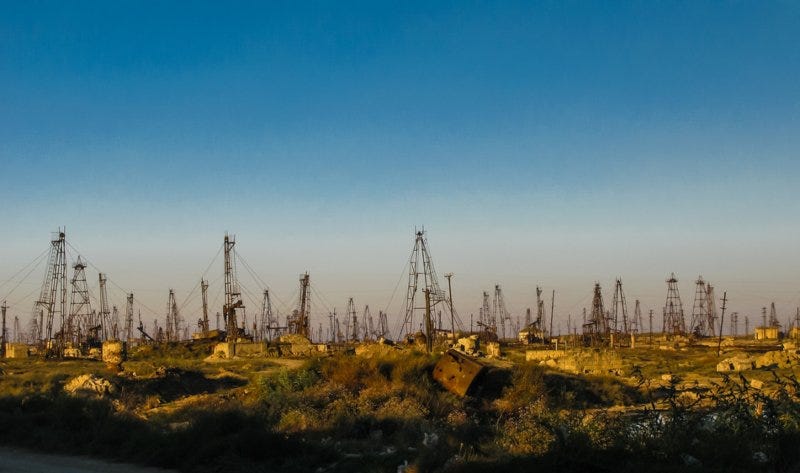
Photo credit: Shutterstock

By Michael Sutherland

Azerbaijan now produces slightly less than 900,000 barrels of oil per day, ranking it 24th in the world. However, like Britain, Azerbaijan’s, and more specifically, its capital city Baku’s current importance to the oil industry lies more in its prominence as a center for the regional Caspian Sea oil industry. Daily production from the Caspian is 2.6 million barrels, which would place it tenth, behind Brazil and ahead of Kuwait, were it a single country. So Baku might be better known for its place in the history of the oil industry, but it remains important today.

Petroleum has been known to humans for thousands of years, first in the form of natural oil and gas seeps. The oil was sometimes harvested for fuel and other applications. At least one of these seeps occurred near Baku, and Marco Polo described it. By the late 1500’s manual wells were being dug for it, and had become common by the next century. In the mid-1700’s that Imperial Russia began drilling for oil in modern-day western Siberia. They brought their operations down to modern-day Romania and Azerbaijan, both of which they controlled, in the 1800’s. The first drilled oil well in Azerbaijan was sunk in 1846, to a depth of 21 m.

Baku became the region’s oil capital under Imperial Russia, and has remained important for the industry to this day. Under Russian control, Azerbaijan and Romania were two of the world’s early centers for production and refining. Production was centered intensely around Baku, not unlike in the US were multiple wells were sunk very close to each other in an almost desperate rush to extract the oil. The principles of reservoir management were as yet undiscovered, and the Russians faced the same difficulties of well control which their American counterparts did, with frequent blowouts and gushers. At this time Azerbaijan produced more oil than the US did.

The region’s importance remained high throughout the 20th century. During World War II, the Germans sought to maintain control of the oil fields of Romania and the refineries of Ploiesti, and were intent on capturing Baku (as well as the rich fields of thee Mideast). Foreign companies had entered the scene in Russia (which included Azerbaijan), but all assets were nationalized after the Russian Revolution. But a new dimension was added to the region’s oil production in the 1930’s, when drilling began on long-known oil-bearing structures on the floor of the Caspian Sea — and so the offshore oil industry was born in Asia.

This led to the gigantic offshore installation known as “Neft Dashlari”, the Oil Rocks. After surveys in the 1940’s revealed large oil deposits in the shallow center of the sea 55 km/34 mi from shore, the first platform — and first in the world — was built in 1949. In 1952 a trestle bridge was built, and a community started to support the increasingly large drilling activity. In the late 50’s large-scale construction began, using the hulls of sunk ships as foundations. Through the 60’s as many as 2,000 people lived there, with a school and a cinema. The installation is still in use, now built on piles and imported fill.

Modern, independent Azerbaijan’s economy depends fully on the oil industry, which comprises nearly 87% of its exports. The State Oil Company of the Azerbaijani Republic (SOCAR) is run very opaquely. Azerbaijan’s commitment to democracy is questionable at best, so transparency is close to nonexistent in the company’s investment, assets, production and profits. The country’s undiversified economy is subject to the fluctuations of the global petroleum market. Attempts at economic reform since the 2000’s have mitigated but not solved this basic problem, faced by those countries which gain an energy windfall and fail to invest it in their citizens.

Tomorrow: the Caspian Sea and the oil industry.

Be brave, and be well.

Sources:

Wikipedia — oil industry

WIkipedia — History of the petroleum industry

Wikipedia — history of the oil industry in Azerbaijan

WIkipedia — oil rocks

Wikipedia — Baku

Become a Medium subscriber with our referral link to support The Good Men Project — and gain access to all of our content, including our publications and thousands of authors on Medium.

Read more from The Good Men Project on Medium:

The story was previously published on The Good Men Project.

About Michael Sutherland

Family man, scientist, singer, writer, dancer, and all-around lover of life.

Environment
World
Climate Change
Sustainability
Recommended from ReadMedium