avatarMarcus aka Gregory Maidman

Free AI web copilot to create summaries, insights and extended knowledge, download it at here

4606

Abstract

</h3></div> <div><p>medium.com</p></div> </div> <div> <div style="background-image: url(https://miro.readmedium.com/v2/resize:fit:320/1*gmkko_XEmMD0vydNYmCaYw.jpeg)"></div> </div> </div> </a> </div><p id="f11a">Those types of comments make my heart and the hearts of many other writers sing. AI cannot do that, even if it spits out words associated with emotion.</p><p id="e0b5">This morning, I read an informative post by <a href="undefined">Ulf Wolf</a>, <a href="https://readmedium.com/senses-61c862788b43"><b>Senses, </b><i>An Element of Fiction</i></a>, in which Ulf asks us, “Where do we get Details (<a href="https://readmedium.com/detail-dd93ddc57860">see last installment</a>) from? This is not a trick question, but one that writers should indeed ask, and often at that.” Ulf then says, “The answer remains obvious: through our senses.”</p><p id="5a7d">Ulf elaborates by assembling excellent writing advice quotes from the likes of Flannery O’Connor, Ursula K. Le Guin, and Stephen King (people love his advice — I often don’t — I’ll get back to that in a few moments) that amplify that simple answer — <i>through our senses</i>.</p><p id="be37">I responded with this comment:</p><p id="d84a"><i>“I once advised a mentee, don’t tell the reader that the character is scared. Describe what people seeing the character would observe through their senses to realize that the character is scared.”</i></p><p id="f0e7">Ulf also quoted one of my favorite authors, Don DeLillo (I highly recommend <i>Underworld </i>— one night eleven years ago, I read 150 of the 800 pages in one sitting — that’s how engagingly he writes), for this gem:</p><p id="7bf2"><i>“Taste and smell can safe crack memory in the shadow of an instant.”</i></p><p id="2093">That’s how Conni writes. She starts today’s essay with this work of art:</p><p id="9619"><b><i>“I once stood, mesmerized, at the edge of a high cliff </i></b><i>overlooking an ocean so vast and glorious it took my breath away. I specifically tried to burn it in my memory so I would never forget the way the light reflected off the sea as it undulated out to the endless horizon; the way the wind with its salty tang felt rushing past my face and how I felt. I wanted to save forever in my heart the way the surf boomed against the lava rock, throwing up spray that sparkled like diamonds, sounding like the very voice of God</i>.”</p><p id="ed28">Absolute fucking masterpiece. Moreover, Conni did not use passive voice at all. Not once did she employ a conjugate of the verb, <i>to be, </i>such as <i>are</i>, <i>is</i>, <i>was</i>, <i>am</i>, or <i>were</i>, 1) as a helping verb (aka an auxiliary verb) in conjunction with a past tense or gerund of another verb; or 2) unnecessarily to describe what she observed (<i>the way the light reflected off the sea as it undulated out to the endless horizon)</i>.</p><p id="e675">Simple examples of active versus passive voice:</p><figure id="2928"><img src="https://cdn-images-1.readmedium.com/v2/resize:fit:800/1*ATGFFL8N9jttJQwGSij6tA.png"><figcaption>Screenshot of a table I created</figcaption></figure><p id="5fc1"><b>Passive voice, not adverbs, Mr. King, fills the cemetery where good writing goes to die.</b> (Apparently, he agrees with me on writing in the passive voice — see <a href="undefined">Scott Ninneman</a>’s article, <a href="https://readmedium.com/the-frustrating-struggle-to-stop-writing-in-passive-voice-916f904fcaf8"><b>The Frustrating Struggle to Stop Writing in Passive Voice, </b><i>How I’m learning to change the way I write</i></a><i> — </i>King and I disagree about adverbs, but I’ll prudently save that for another post).</p><p id="1891">Observe and enjoy a similarly appealing and short introductory paragraph from <a href="undefined">Toni The Talker</a>’s history lesson about an impressive and not well-known female Black sculptor that I read just minutes before Toni got unjustifiably ensnared in the new spam filters (thankfully, a week later, Medium restored her account):</p><p id="0091"><i>“Enraptured by a likeness of Benjamin Franklin on public display in 1864 awakened a dormant instinct. A spiritual spark would grow into a fire that lit artist Edmonia Lewis from within.”</i></p><p id="bec4">That drew me in and made me want to read the rest of Toni’s <a href="https://readmedium.com/edmonia-lewis-serendipitously-sculpting-her-story-425d8251f7b8"><b>Edmonia Lewis: Serendipitously Sculpting Her Story, </b><i>Showcasing Neoclassical stone statues depicting Black an # Options d Indigenous American Heritage set the stage for success.</i></a></p><p id="f6c6">Speaking of those ineffective spam filters, did y’all see that the scammers cloned Buster Benson? I rarely delve into humor or satire, but I found that too deliciously ironic to resist. Please enjoy my playful ribbing (of Buster and Medium) and ode to <a href="https://youtu.be/64Ba1OX4IM4">Bugs Bunny and Elmer Fudd</a> cartoons of my youth presented in the form of a Shakespearean sonnet:</p><div id="af78" class="link-block"> <a href="https://readmedium.com/catch-us-if-you-can-bf087354e4a5"> <div> <div> <h2>Catch Us If You Can!</h2> <div><h3>A sonnet of scammers have Medium playing whack-a-mole</h3></div> <div><p>medium.com</p></div> </div> <div> <div style="background-image: url(https://miro.readmedium.com/v2/resize:fit:320/1*ykNQMR10jV35KxBAxPJGMw.jpeg)"></div> </div> </div> </a> </div><h2 id="91f8">A Note on Tanka Poetry</h2><p id="4b80">While the reader may expect a tanka to consist of five lines with 5/7/5/7/7 syllable counts, with the third line pivoting from the upper poem to the lower poem, the most traditional form of tanka contains 31 syllables in an unbroken line. See, <a href="undefined">Brett Christensen</a>’s <a href="https://readmedium.com/tanka-poetry-a-brief-introduction-11f2aabef214">informative story</a>.</p><p id="b19c">I usually write the five-line variety, or I often employ that variety in one poem containing a series of tanka stanzas.</p><p id="4073">Fans of the <i>Yellowstone </i>prequel <i>1883 </i>may appreciate this tanka series,</p><div id="ee93" class="link-block"> <a href="https://thetaoist.online/of-pioneers-and-spiritual-journeyers-f6ca423436ea"> <div> <div> <h2>Of Pioneers and Spiritual Journeyers</h2> <div><h3>undefined</h3></div> <div><p>undefined</p></div> </div> <div> <div style="background-image: url(https://miro.readmedium.com/v2/resize:fit:320/1*Tu2F8SH-qB780Glf-wIQ_A.jpeg)"></div> </div> </div> </a> </div><p id="cc55">Inspired by the scene in which they prepare to get the wagons across the river, Sam Elliot’s character instructs the German immigrants to unload all unnecessary weight from their wagons. He finds one wagon filled with musical instruments, including a piano. The owner says if he has to leave the implements of his life’s work behind, he’ll end up being a beggar. Elliot’s character responds that to complete their journey, they can no longer think of themselves as carpenters, blacksmiths, or musicians — just pioneers.</p><p id="4061">I leave you with two more of my unbroken line tankas:</p><div id="c6d5" class="link-block"> <a href="https://readmedium.com/the-illusion-of-death-84c4c250df80"> <div> <div> <h2>The Illusion of Death</h2> <div><h3>A traditional 31-syllable tanka plus an educational discussion about the art form and how it differs from haiku</h3></div> <div><p>medium.com</p></div> </div> <div> <div style="background-image: url(https://miro.readmedium.com/v2/resize:fit:320/1*xCWRwPngxG-U5YrFhmP8nw.jpeg)"></div> </div> </div> </a> </div><div id="d1e8" class="link-block"> <a href="https://readmedium.com/gratitude-sparks-my-everyday-of-life-5d2663c98465"> <div> <div> <h2>Gratitude Sparks My Everyday of Life</h2> <div><h3>That for which I am grateful via a traditional unbroken line tanka — the ultimate expression of connection</h3></div> <div><p>medium.com</p></div> </div> <div> <div style="background-image: url(https://miro.readmedium.com/v2/resize:fit:320/1*gNimr3LaekHYVCRfLd0iUQ.jpeg)"></div> </div> </div> </a> </div><p id="bed6">In <a href="https://readmedium.com/i-speak-to-god-and-god-speaks-to-me-23bff8ec2274">Rama</a> I create, with soul energy surging through my body, inspiring me and breathing wind into my sails,</p><p id="f1e9"><a href="https://marcus17043.medium.com/"><b>Marcus</b></a><b> </b>(<a href="https://readmedium.com/meet-gregory-maidman-83c00746a191">Gregory Maidman</a>)</p></article></body>

Poetry | Tanka | Writing Advice — Engage Our Senses and Avoid Passive Voice

31 Syllables of Meaningful Engagement for Writers and Readers

A tanka poem on and discussion of the difference between organically and emotionally created comments versus those written by AI

Writers contemplate their craft with the hope that their words beat like a heart delivering life-sustaining blood to a human in need, while soulless content mill robots churn our replies devoid of emotional connection. Image created by jules - Miz Mindful without my input other than she read the draft. jules uses Canva Pro to create her artwork.

My Tanka

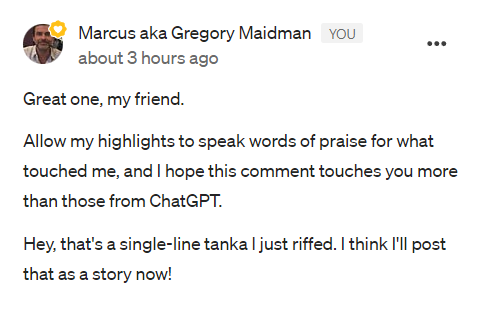
Allow my highlights to speak words of praise for what touched me while I hope this comment means more to you than those from ChatGPT.

Apart from slight editing for this post, I riffed that tanka in one of the three comments I left today on another of Conni Walkup Hull’s stunningly spectacular presentations of poetically procreated prose. If you haven’t already, please read it. You’ll be missing out if you don’t.
Writer’s screenshot

(For posting it as a poem, I didn’t like how I used “touched me” and “touches you” so close together. I played with changing the first to “impressed me,” but that lacked feeling. Then I landed on changing “touches you more” to “means more to you.” I also replaced the “and” conjoining those phrases with “while.” I don’t like using conjunctions in syllable-limited poems that don’t serve more purpose/convey additional meaning.)

Many of us find AI-generated comments insidious — you know, the ones that read like an abstract of the entire post. Some of the many of us still thank the “writer.” Generally, I ignore them entirely. Fresh in my mind sat this comment on Conni’s piece that I found suspicious, and to which Conni replied with gratitude.

This is how I picture the reader who leaves an AI-generated comment. File ID: 429797090 by BiancoBlue licensed from depositphotos.com

Sometimes I have some fun with accounts devoid of soul, replying in a way that expresses some thanks but also in a sarcastic manner that says, I see through you. If I receive a reply, I can see further through the veil by how it replies — I can discern whether the account holder has read and replies itself with some understanding of my retort, or merely copy-pasted my response into ChatGPT and spit back that output.

Readers, you don’t need to impress us writers with the depth of your understanding of our work. Don’t worry if your English is not great or even bad and whether or not it’s your native language. Be yourself. Tell us what touched you. How it made you feel. How it helped you.

Those types of comments make my heart and the hearts of many other writers sing. AI cannot do that, even if it spits out words associated with emotion.

This morning, I read an informative post by Ulf Wolf, Senses, An Element of Fiction, in which Ulf asks us, “Where do we get Details (see last installment) from? This is not a trick question, but one that writers should indeed ask, and often at that.” Ulf then says, “The answer remains obvious: through our senses.”

Ulf elaborates by assembling excellent writing advice quotes from the likes of Flannery O’Connor, Ursula K. Le Guin, and Stephen King (people love his advice — I often don’t — I’ll get back to that in a few moments) that amplify that simple answer — through our senses.

I responded with this comment:

“I once advised a mentee, don’t tell the reader that the character is scared. Describe what people seeing the character would observe through their senses to realize that the character is scared.”

Ulf also quoted one of my favorite authors, Don DeLillo (I highly recommend Underworld — one night eleven years ago, I read 150 of the 800 pages in one sitting — that’s how engagingly he writes), for this gem:

“Taste and smell can safe crack memory in the shadow of an instant.”

That’s how Conni writes. She starts today’s essay with this work of art:

“I once stood, mesmerized, at the edge of a high cliff overlooking an ocean so vast and glorious it took my breath away. I specifically tried to burn it in my memory so I would never forget the way the light reflected off the sea as it undulated out to the endless horizon; the way the wind with its salty tang felt rushing past my face and how I felt. I wanted to save forever in my heart the way the surf boomed against the lava rock, throwing up spray that sparkled like diamonds, sounding like the very voice of God.”

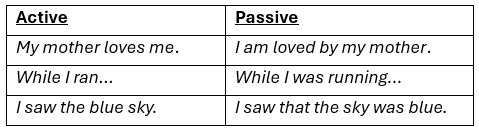
Absolute fucking masterpiece. Moreover, Conni did not use passive voice at all. Not once did she employ a conjugate of the verb, to be, such as are, is, was, am, or were, 1) as a helping verb (aka an auxiliary verb) in conjunction with a past tense or gerund of another verb; or 2) unnecessarily to describe what she observed (the way the light reflected off the sea as it undulated out to the endless horizon).

Simple examples of active versus passive voice:
Screenshot of a table I created

Passive voice, not adverbs, Mr. King, fills the cemetery where good writing goes to die. (Apparently, he agrees with me on writing in the passive voice — see Scott Ninneman’s article, The Frustrating Struggle to Stop Writing in Passive Voice, How I’m learning to change the way I writeKing and I disagree about adverbs, but I’ll prudently save that for another post).

Observe and enjoy a similarly appealing and short introductory paragraph from Toni The Talker’s history lesson about an impressive and not well-known female Black sculptor that I read just minutes before Toni got unjustifiably ensnared in the new spam filters (thankfully, a week later, Medium restored her account):

“Enraptured by a likeness of Benjamin Franklin on public display in 1864 awakened a dormant instinct. A spiritual spark would grow into a fire that lit artist Edmonia Lewis from within.”

That drew me in and made me want to read the rest of Toni’s Edmonia Lewis: Serendipitously Sculpting Her Story, Showcasing Neoclassical stone statues depicting Black and Indigenous American Heritage set the stage for success.

Speaking of those ineffective spam filters, did y’all see that the scammers cloned Buster Benson? I rarely delve into humor or satire, but I found that too deliciously ironic to resist. Please enjoy my playful ribbing (of Buster and Medium) and ode to Bugs Bunny and Elmer Fudd cartoons of my youth presented in the form of a Shakespearean sonnet:

A Note on Tanka Poetry

While the reader may expect a tanka to consist of five lines with 5/7/5/7/7 syllable counts, with the third line pivoting from the upper poem to the lower poem, the most traditional form of tanka contains 31 syllables in an unbroken line. See, Brett Christensen’s informative story.

I usually write the five-line variety, or I often employ that variety in one poem containing a series of tanka stanzas.

Fans of the Yellowstone prequel 1883 may appreciate this tanka series,

Inspired by the scene in which they prepare to get the wagons across the river, Sam Elliot’s character instructs the German immigrants to unload all unnecessary weight from their wagons. He finds one wagon filled with musical instruments, including a piano. The owner says if he has to leave the implements of his life’s work behind, he’ll end up being a beggar. Elliot’s character responds that to complete their journey, they can no longer think of themselves as carpenters, blacksmiths, or musicians — just pioneers.

I leave you with two more of my unbroken line tankas:

In Rama I create, with soul energy surging through my body, inspiring me and breathing wind into my sails,

Marcus (Gregory Maidman)

Poetry
Writing Tips
Reading
AI
Poetry Writing
Recommended from ReadMedium