
3 Secure Trading Strategies for 2024
This year I backtested dozens of trading algorithms, spanning across fundamental, news, and technical analysis. With the help of many books and GPT-4, I’ve been able to find patterns in historical data and actually implement some successful strategies.
Keeping in mind your risk tolerance and ability to make frequent trades, I’ve come up with the top 3 strategies which give consistent and reliable returns while mitigating losses. In order from most intensive to most hands-off, the strategies you should consider using in 2024 are:
- Day trading based on premarket levels
- Selling covered call options on bullish stocks
- Longing stocks which pass O’Neil’s CAN SLIM tests
Let’s go over each of these strategies in detail.
Day Trading on Premarket Data
If you’re reading this, I’ll assume you have already either attempted to make high-frequency day trades, or have avoided doing so because a majority of day traders lose and give up within a year or 2. While my day trading strategy has yet to be implemented across several years, I have been able to make short-term profits with relative ease (around 80% accuracy, generating 10% return in the past week with less than 5 hours of total exposure). Whether it’s beginner’s luck or some actual validity to my strategy, I’ll be riding this day trading wave until I find it to be no longer profitable. For now, I’m clearly labeling this as the most risky method.
UPDATE: This remains a market-beating strategy. In fact, I’ve seen higher returns in the past 2 months than S&P 500 has in the past year by diversifying my positions and holding them for only a few minutes a day.
If you’re able to maintain the margin account minimum and run daily stock screens, you should be able to replicate my results. My strategy is essentially as follows:
- Collect a list of tickers with relatively high liquidity, meaning high availability to trade on any given day. S&P 500 stocks are a good start, but you can broaden your scope to include mid-cap S&P 400 and small-cap S&P 600 tickers. Very few of these stocks (if any) would be considered speculative or pennystocks, and most (if not all) have a reasonable daily trading volume — so you can ensure you’ll actually be able to trade these stocks when you’re ready.
- Fetch as much 1-minute data as your provider will allow. Be sure to include pre- and post- market prices. I’m finding that even just the past month of data is enough to determine which stocks have the most predictable movements, as long as we consider support/resistance levels set in the premarket prices.
- The screening itself is pretty straightforward. Keep the stocks which have substantial data from 9–9:30am, or at least from 9–9:15am (since many providers don’t report premarket prices in the 15min before the regular session opens). Every day in your simulation, determine S/R levels for each stock by finding the min/max prices at which the stock has traded in the premarket session. When either level is broken during the regular session, you have found an apparent trading signal — long if a current price is greater than the max premarket price, and short if the current price is less than the min.
- Set a standard 2:1 profit-to-loss ratio for each of these trades, or choose what works best for you. The idea here is that, even at random chance, you should gain more than you lose in the long run. Some stocks won’t reach your profit/loss levels by the end of the day, so be sure to simulate closing the position before 4pm if it has not already been closed.
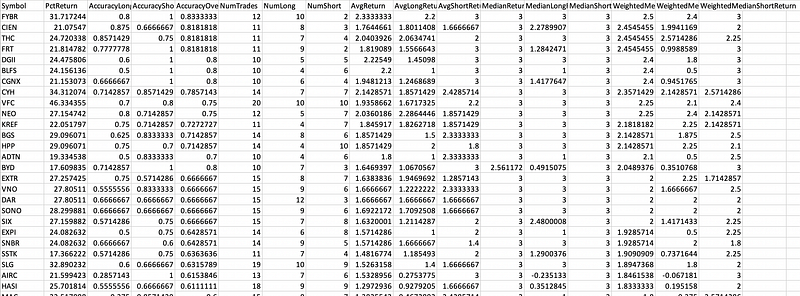
- Determine which stocks show the highest returns, with the highest accuracies in the data you collected. You’ll find that many stocks do adhere by the premarket prices, but some much more frequently than others. To further ensure consistent returns, consider multiplying the median (rather than the mean) returns for the entire time period by the accuracy and then sorting by this weighted median.
- Keeping only the stocks which show frequent trades in the backtest, your sorted and filtered tickers might look something like this:
7. Finally, it’s time to look for openings in real-time data! Whether you choose the stock(s) with the highest return, highest accuracy, or highest return weighted by accuracy, is up to you. Just wait for your S/R levels to be exceeded, use limit orders to guarantee the desired prices are met, and trade away. Record your trades in a journal and re-run your screen daily.
Keep in mind that historical returns aren’t necessarily an indicator of future success. This strategy simply finds the stocks which, in the recent past, have been predictable. But yes, so far I’ve found that trends do often continue, and many stocks do remain predictable :)
Day Trading: Caveats
- As previously mentioned, you will need to maintain a minimum balance in your margin account to avoid violating the Pattern Day Trading rule. You can avoid this by making less than 4 day trades in a rolling 5 day window, or by limiting yourself to long trades in a cash account. By doing this, you won’t need to maintain the $25k minimum.
- Taxes on short-term trades are calculated at the same rate as your income bracket, so they may be higher than the taxes you’d pay on long-term capital gains. Keep this in mind if you’re a billionaire or something.
- The Wash Sale rule defers your ability to deduct a loss if you have repeatedly traded a “substantially identical” asset (i.e. the same stock or its derivative options, futures, etc.) within 30 days. That is, you can deduct a loss once per asset per month, but any further losses within 30 days are deferred to your next trade. This can reduce your taxable gain or increase the loss when you eventually close your position outside of the wash sale window. Avoid this by simply rotating stocks frequently.
Writing Covered Calls
Trading options, like day trading, gets a bad rap due to the majority of investors who lose money in the process. The key here is that when selling covered (rather than naked) calls, you already own the underlying stock and therefore are only risking your position in that stock — instead of an unlimited potential loss. This is actually a rather conservative, tried-and-true method to generate additional returns on a long position which you’re already holding, and it’s my recommendation to those on a stock purchase plan who wish to mitigate losses with relatively low effort.
Since I didn’t come up with this strategy from scratch, I’ll leave some of the research to you. But here’s the rundown:
- Assume you’ve been holding 100 or more shares of a stock, and maybe have already gotten positive returns on those shares. Maybe you’re ready to sell and take your profit, but maybe you still believe in the bullish trend and would like to continue holding it for awhile. Either way, selling a covered call will allow you to collect a premium for offering these shares at a later date and at a specified strike price. (You won’t actually be required to sell your shares — simply the act of “promising” them at a later date will earn you a premium).
- Determine when you may be willing to sell these shares, and at what price. This strike price will be higher than the current price. The closer your strike is to the current price when you write the contract, the higher your premium payout will be, but the higher the likelihood the actual price will exceed your strike price when the contract expires.
- If the actual price is greater than your strike price upon contract expiry, your shares will be sold at the strike price and you’ll receive the full payout (in addition to the premium you received when you wrote the contract). This means you won’t benefit from any additional gains above your strike price, but since you’ve already determined you’re willing to profit at your price, this shouldn’t be an issue. Your profit, plus the premium, go directly into your pocket.
- If you would like to continue earning premiums without actually selling your shares, you are able to rollover your contract — that is, buy back the option you initially sold and sell it again at a higher strike price and an even later date. Assuming you do this before your initial expiration date, you will keep your shares and continue making premiums!
While covered calls are conservative, they are neither foolproof nor risk-free. Keep the following points in mind before writing options.
Writing Covered Calls: Caveats
- As previously mentioned, selling covered calls may limit your upside in the event that your underlying stock experiences a massive price surge. So it’s best to write covered calls on stocks which experience slower, more consistent growth — generally large cap stocks.
- If, on the other hand, your underlying stock experiences a massive price dip, you may find that the premium earned was not enough to offset the losses. While the premium may mitigate the loss somewhat, it might be better to avoid writing an option altogether and simply short the stock to buy back at a later date (after the dip). Of course, this requires that you were able to predict such a decline in the first place, which is generally impossible. So while not perfect, covered calls will reduce losses while allowing you to continue riding the waves of your underlying stock. You can always rollover your option with a new expiry and strike price to recover from price depreciation, as this is better than just holding the stock long-term and making no premiums.
- The complexity of this method lies in your ability to make substantial premiums while continuing to benefit from price appreciation. This takes practice and some knowledge of market trends. It also requires an understanding of your specific investment goals, which may be different from mine.
Fundamental Analysis with CAN SLIM
For those who have been reading my posts all year (thanks mom!), you’ll know that O’Neil’s CAN SLIM strategy has the fewest caveats and the lowest risk in the long run. I’ve already covered it extensively here and in last year’s stock picks, so I’ll be brief here and just provide my current analysis.
CAN SLIM is intended to find the stocks poised to lead a bull market. While the S&P 500 chart has been showing strong growth these past couple of weeks, I’m hesitant to take a strongly bullish position until a) the short-term, 20-day moving average crosses well above the 50-day MA, and b) there is at least 1 sector with several companies showing a high return on equity (ROE), strong sales growth, etc. These signals, paired with extensive chart-reading, allowed me to predict Nvidia as a leader in the 2023 bull run. I’ll continue waiting for clear bullish signals before making any more recommendations based on fundamentals.
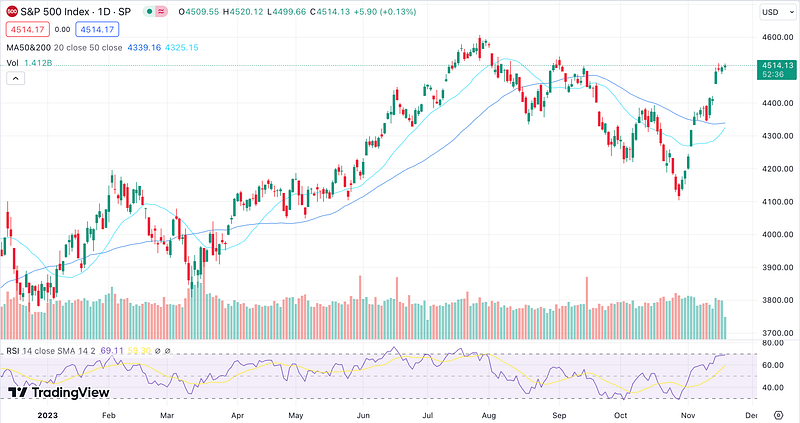
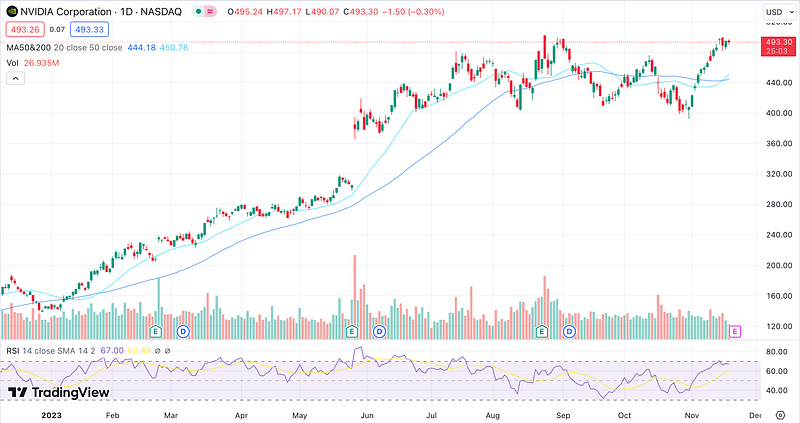
The above charts clearly show a significant slowdown in growth since the end of the summer. Running my stock screener on the 1500 stocks listed in S&P 400, 500, and 600, I found that only 2 companies actually satisfy all 7 requirements which O’Neil recommends to test against. (As usual, most companies which passed 6/7 tests failed to report sales growth of at least 25% in this past quarter.)
The 2 companies currently passing CAN SLIM — Costco (COST) and Silgan Holdings (SLGN) — are in completely different sectors, and do not show any interesting breakout patterns right now. While it’s likely that retail will partake in a Santa Claus rally to end 2023, this is by no means reason to hold any of these positions far into the new year. You’ll know when it’s time because I’ll probably be talking about it.
Conclusion
Thank you for making it through this hefty post. I sincerely hope to help traders like myself find success in the coming months, but it goes without saying that today’s volatile market takes from retail investors more than it gives. Trade with discipline and set limits to prevent any major losses.
Follow for more, and have fun profiting in the new year!


