

3 Mental Hacks To Instantly Unlock More Success in Your Life
Use these research-backed models to rapidly change your thinking and transform your results
Do you ever feel like you’re capable of more, but something is missing?
We all have untapped talent. The problem is, we’re also very good at self-sabotaging it.
Can you relate? How often do you find yourself 100% clear on what to do before losing yourself in a flood of self-doubt or confusion? We all do — it’s human.
One of the key ways around this is developing mental models. These are quick frames you can use to snap out of distracting stories and get focused on what matters.
As a coach, I make a living off helping people change. Unlike faceless social media accounts, I need to know a technique will work. Over the years, I have collated a select few I teach clients. Each is backed by research and has been tested successfully on myself.
Today, I want to share some of these with you. In this post, we’ll look at three research-backed mental hacks that can genuinely transform your life.
So, if you’re interested in proven strategies to shift your mindset, let’s dive in.
1 — Focus on Habits, Not Goals
One of the biggest mistakes I see people make is obsessing over goals.
I should know — I spent five years telling anyone who would listen about my plans to quit and become an entrepreneur. Sadly, the action was severely lacking…
Anyone can set big, lofty goals, but how many will build excellent habits?
Now, I want to be clear — goals aren’t inherently bad.
Having some target helps with direction and staying on track.
The danger is that we now know you get a dopamine hit from setting goals, even if you haven’t done anything to achieve them.
Thanks to research from experts like Professor Robert Sapolsky (Stanford) and Anna Lembke (author of Dopamine Nation), we’ve learned that dopamine can rise in anticipation of a reward — not just receipt.
More simply — we can feel great by thinking about something happening without ever having to do the work. You don’t need the entire reward to get a dose of that intoxicating chemical.
You probably already know how social media is turning us into notification-obsessed creatures. That’s why I firmly believe that everyone needs to rewire how they get their dopamine.
Here’s a simple formula we can all aspire to:
Goal → Do work → Get reward → Feel good → Repeat
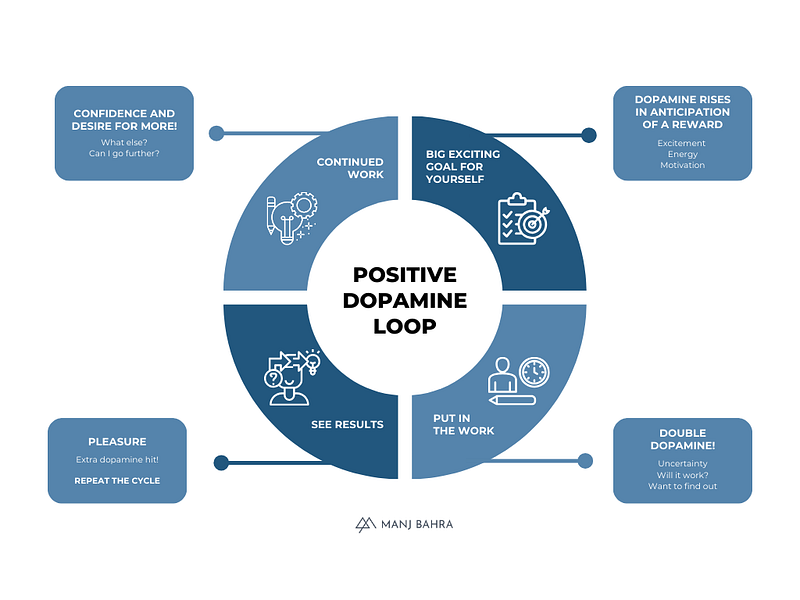
This is where habits come in.
The bible of this subject is “Atomic Habits” by James Clear. I won’t plagiarise that — read it. However, I will say that learning to get your dopamine from building and adhering to habits will completely change your life.
What’s the evidence?
Numerous studies illustrate the effectiveness of habits over goals, and the best places to review this evidence are The Power of Habit: Why We Do What We Do in Life and Business by Charles Duhigg and Atomic Habits by James Clear.
So, rather than rehash their work, let me share my experience.
From 2013–2021, I worked in Investment Banking. From year 1, I realised I wanted to be an entrepreneur. I hated having limited days off, requesting permission, and being dictated to on things I already hated.
I did what any “motivated” person would do — I set goals. I created a SMART plan to build my business by X time so I could leave by age 25.
Do you know what happened? NOTHING.
Well, not nothing. I set goals very well. I felt great about them. I told everyone about them. I just didn’t do anything about them.
It took some honest reflection on my progress to finally accept my approach wasn’t working. I then turned my focus to habits.
When I switched to building a habit of writing every day, everything changed. My posts started getting traction, and the results motivated me more. Within a few months, people wrote to me asking if I offered coaching. A few more months after that, I had multiple clients. The results kept compounding until I eventually built an entire business with enough of a platform to make the jump I always wanted.
Maybe you can relate. Perhaps there’s something you want to build, a move you want to make, anything.
When in doubt, remember that habits automate success; goals are just things you’re not doing.
Takeaway: If you have a change you want to make, stop thinking about the outcome and get clear on the process. What must you repeatedly do to achieve it? Focus on building those habits, and the rest will come.
2 — Ask: “Who am I being right now?” (Escaping the Drama Triangle)
In 1968, psychologist Stephen Karpman introduced the “Drama Triangle” concept. Fifty-five years later, it remains one of the simplest yet completely relatable models of human behaviour.
The triangle is a dysfunctional dynamic where people alternate between three positions: Victim, Rescuer, and Persecutor. In this model, everyone is trying to make themselves a victim. This leads to constant manipulation and ineffective communication that results in unnecessary drama.
You will see this game being played in all areas of your life — dating, family, career, and even within your mind.
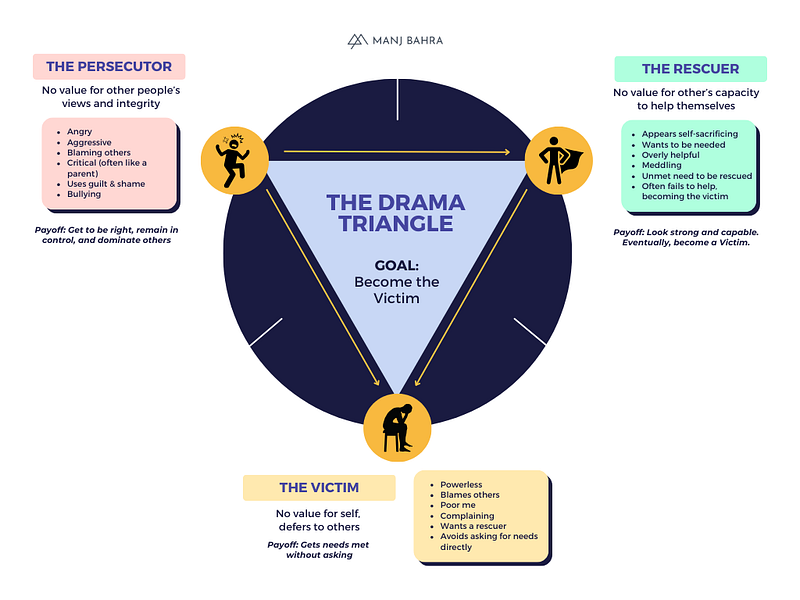
The simplest way to get out of this is to ask yourself two questions:
- “Who am I being right now?”
- “How do I be responsible?”
The first question quickly helps you to see if you’re in a victim, rescuer, or persecutor mode. The second question allows you to refocus on an action that escapes the triangle.
For example, let’s imagine you were rejected by someone you liked.
- A victim — “Why does this always happen? Love will never work for me.”
- A persecutor — “How dare they reject me? Do they know what they’re missing?”
- A rescuer — “It’s OK, let’s go and get shitfaced, and it will all feel better.”
- A responsible mindset — “Fair enough, I’ll allow myself to process my emotions and refocus on my life. I will keep myself open to dating and learn from this experience.”
What’s the evidence?
This is also backed by research. A study by Gilbert, P., & Procter, S. (2006) showed promising results in the model’s ability to help reduce shame, self-criticism, and depression. Studies have also highlighted practical applications in coaching, including this integration into Rational Emotive Behaviour Therapy and models such as Co-Active Coaching and The Empowerment Dynamic by David Emerald.
Now, admittedly, some critics find the model reductive and overly simplistic. Everyone is entitled to their opinion. I prefer to focus on what works for me and my clients.
In my experience, simply understanding the triangle and spotting the roles can be extremely powerful.
Takeaway: If you are stuck in drama, ask yourself, “Who am I being right now, and how can I be responsible?”
You can read my in-depth article on the Drama Triangle below:
3 — Challenging Binary Thinking
How often do you view situations as binary?
- Either/or
- True/false
- Right/wrong
- Yes/no
- All or nothing
Although this style of thought feels natural, it also causes us to distort reality and limit our view of the truth. When you constrain yourself with binary, it reduces options and often discourages you from taking action.
For example:
- You might want to start a business, but think it’s that OR your 9 to 5.
- You might want to lose weight, but think you need to cut all your favourite foods.
- You might want to move on, but think this person was the only person for you.
Challenging binary thinking is an essential mental hack that helps us break free from rigid thought patterns and embrace the complexity of the world around us.
One of the easiest ways to do this is by adding the word AND.
- Can I start a business AND maintain some security with a job?
- Is there a diet that lets me lose weight AND enjoy foods I love?
- Maybe this person was right for me, AND there is someone else out there
What’s the evidence?
Thankfully, this is another concept that has been repeatedly studied.
An excellent paper by Staudinger and Gluck presented research that challenging binary thinking is linked to better mental health, emotional regulation, and problem-solving abilities. It also suggested that people who engage in this nuanced approach have higher levels of wisdom.
It’s also important to note that challenging binary is associated with engaging System 2 thinking as described in Daniel Kahneman's best-selling book “Thinking, Fast and Slow”. System 2 thought is nuanced, non-reactive, and thoughtful compared with our default System 1 judgment. The skill has also been linked to greater empathy and the ability to handle uncertain situations (Furnham & Ribchester, 1995).
Aside from academia, challenging binary thoughts is extremely useful in opening up new possibilities. The simple addition of “AND” has consistently helped me see new ways forward and create more win-win situations.
Takeaway: Scan your thoughts for binary thinking. Is there a way for you to add the word AND and completely change your perspective?
Final Thoughts
These three research-backed mental hacks can transform your life.
- If you emphasise habits, you’ll automate success.
- If you understand who you are being, you’ll avoid the Drama Triangle.
- If you challenge binary thinking, you’ll break through restrictive thinking and see new avenues you can explore immediately.
As mentioned, I’ve repeatedly used these in my life and with clients, both with excellent results.
Give these a try and see how they work for you.
If you’re unsure how to start, pick one and try it for a few days. Or if you need guidance, don’t hesitate to drop me a line, and we can go through it together.
Make it happen!
Facing a challenge or chasing a big dream?
I specialise in using neuroscience and psychology to help clients finally create the change they desire. I’ve helped 100s of clients and would love to help you.
If not now, then when? Book your FREE Breakthrough Call, and let’s see how we can make it happen.


