

The Ultimate Guide To The Drama Triangle
A framework for understanding and escaping toxic relationships
Do you ever find yourself in unhealthy relationships?
Perhaps it’s a repeating pattern in dating — always attracting the same person with different faces. Maybe it’s a tense relationship with a close family member. Or it could even be a toxic situation in your career.
Most of us have a dynamic we want to change. The trouble is we don’t always know how to do that.
Throughout my coaching career, I’ve seen tons of self-help techniques come and go. One that has stood the test of time is the Drama Triangle. Whilst there are no shortcuts in life, this model has repeatedly proven effective in my life as well as helped many of my clients transform their personal relationships.
If you’re interested in a tool to help unravel complex interpersonal dynamics, shed light on destructive communication patterns and guide you towards more fulfilling interactions — this is the post for you.
In this comprehensive guide, we’ll dive deep into the Drama Triangle, exploring its origins, the roles it encompasses, and, most importantly, how you can use it to transform your relationships for the better.
Let’s get into it.
Drama Triangle 101
The Drama Triangle was first introduced in 1968 by psychologist Dr Stephen Karpman. The idea is a part of “Transactional Analysis” (TA), a school of thought created by Eric Berne.
In TA, it is presupposed that most social interactions appear honest but secretly have an ulterior motive/hidden transaction. This is known as a payoff, and it’s what everyone is searching for in their interactions.
Karpman developed the Drama Triangle to illustrate some of the most dysfunctional dynamics in everyday relationships — particularly conflicts.
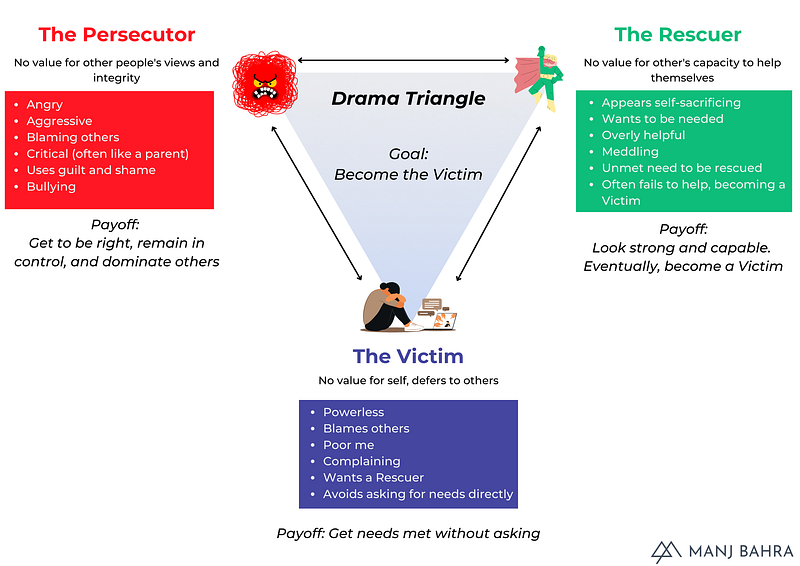
Participants rotate between three roles: Victim, Persecutor, and Rescuer.
The game’s ultimate goal is to become the Victim so you can get your needs met without asking directly.
When in full swing, people rapidly shift between the roles. The Victim can quickly become the Persecutor, and a Rescuer can instantly become a Victim. This leads to a cycle of negative behaviour, manipulation, and unproductive communication that keeps everything going.
It sounds silly, but we all get involved at some point.
In fact, it’s often called “the only game in town” because you’ll see it everywhere!
Here are some typical scenarios:
- Dating: A common example is one partner playing the Victim while the other alternates between the Rescuer and Persecutor roles. This may result in a cycle of codependency and power struggles.
- Workplace: The triangle can emerge in professional settings, leading to office politics, passive-aggressive behaviour, and conflicts among colleagues. For example, a manager may play the Persecutor role with an employee, who then takes on the Victim role, while another coworker steps in as the Rescuer.
- Family: Within families, the Drama Triangle can result in dysfunctional dynamics and recurring conflicts. Parents and children may alternate between the roles, with one person feeling victimized, another trying to fix the situation, and a third person causing distress.
- Within your head: We all have an inner victim (inner child), persecutor(parental voice), and rescuer (go-to way of feeling better). This can perpetuate repetitive behaviour such as self-loathing, turning to a vice (e.g. alcohol), and then blaming everyone else for what happened.
The Roles in Detail
Now you have an overview of the triangle, let’s explore each of the roles in more detail. With each one, see what resonates with yourself or some of the people in your life.
The Victim
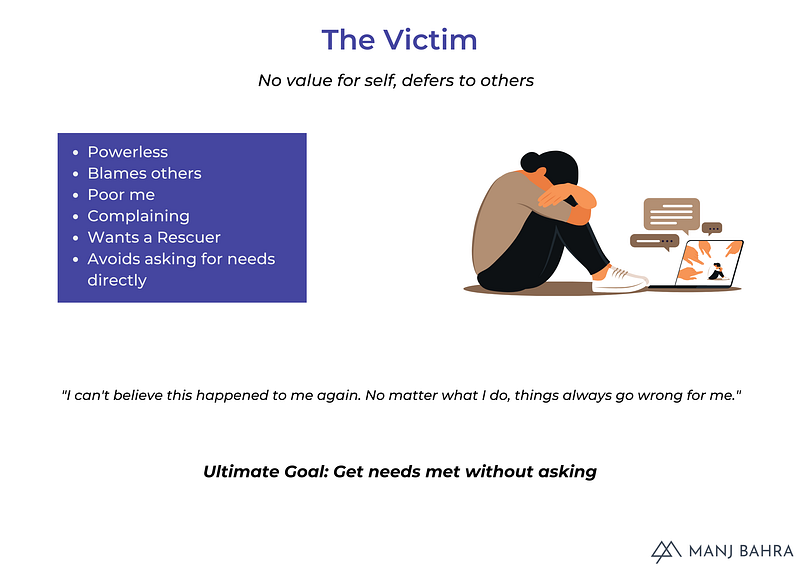
Everyone playing the Drama Triangle is competing to be the Victim. The competition for this role is what keeps the game going. It is the ultimate goal for everyone, as this is where you get all your needs met without asking or taking responsibility.
There are two types of Victims:
- The Pathetic Victim Plays one-down games, holds pity parties, displays woeful “poor-me” facial expressions and body language, and one-down verbal language.
- The Angry Victim Pretends to be powerful, using guilt and shame to make others feel sorry for them. Generally, the underlying motive is revenge.
Both types want to blame someone for feelings and troubles. There is also a desire to attract a RESCUER who will take care of them.
Typical Characteristics:
- Feels victimised, oppressed, helpless, hopeless, powerless, ashamed
- Looks for a Rescuer to help perpetuate negative self-beliefs
- Uses the victim role to avoid making decisions, solving problems, and taking responsibility
- Embraces or creates conflict situations as an opportunity to play Victim
- Slouched & dejected posture
- Operates from I’m not OK/bad, you’re OK/good position
Ultimate Goal: Getting their needs met without asking. There is also a particular class of Victims called Martyrs — escalating into hysteria and high drama to get what they want. This group may even blame god or forces beyond them.
The Rescuer
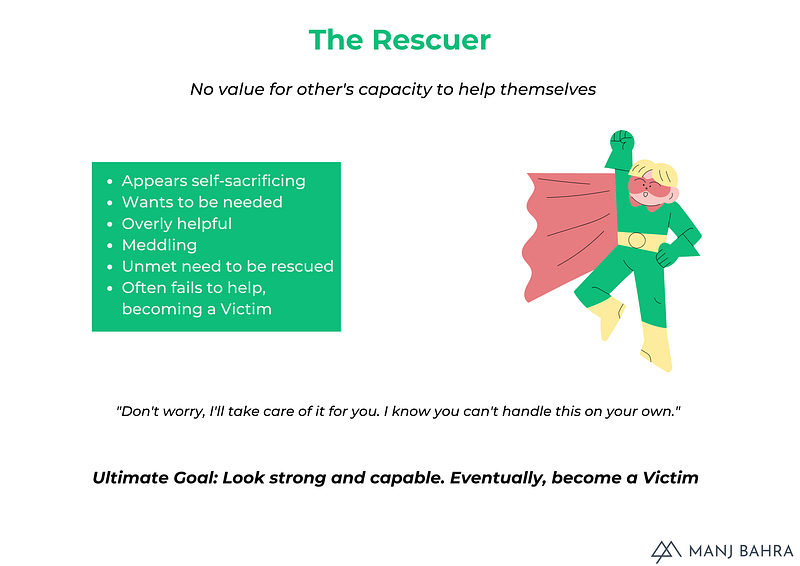
This is the super-hero role — the person who looks to save everybody and feels great about themselves doing it.
People who fall into rescuer mode are concerned with looking important, competent, and superior. They often come across as self-sacrificing.
This role tends to befall those with a secret need to be saved, often from something they didn’t get growing up (e.g. validation).
Usually, the rescuers fail to save a Victim, permitting that person to become angry (Persecutor) while they switch into the Victim role — “I was only trying to help you”.
Typical Characteristics:
- Obligated to rescue, often really not wanting to
- Do things for others they don’t ask for and can do themselves
- Feels guilty if they don’t help
- Sounds like an authoritative parent, keeping the Victim dependent
- Supports the Victim’s perception of being weak and a failure
- Expects to fail
- Avoids conflict and drama (people-pleasing)
Ultimate Goal: Look strong and capable, and be one-up on everyone else. Eventually, they become a victim when their attempts to help others fail.
The Persecutor (or Blamer)
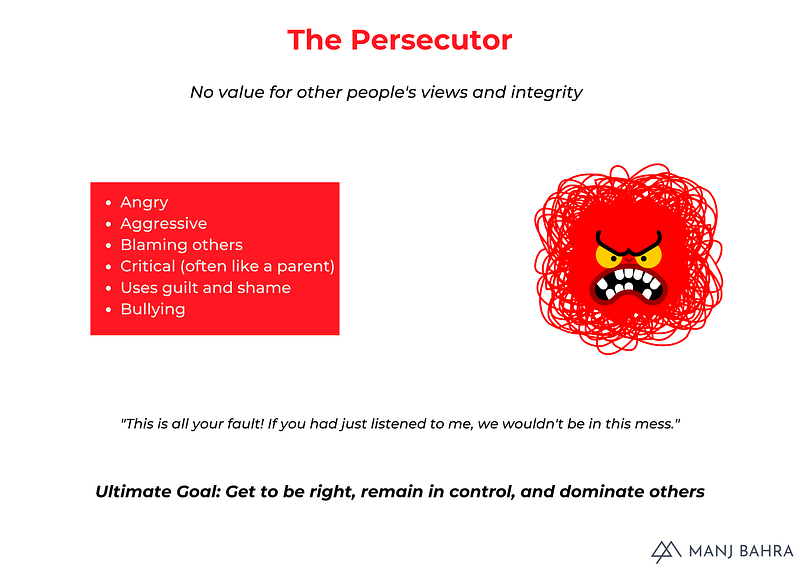
This role is focused on finding a justification to vent emotions such as anger and rage. Many individuals need an excuse or permission to express these feelings and seek situations where being the Persecutor can be rationalised as warranted.
Typical Characteristics:
- Set unnecessarily restrictive rules and limits
- Blames others for whatever happens
- Criticise actions of others (resembling a parent)
- Keeps Victim oppressed
- Expresses justified and righteous anger
- Uses guilt and shame to put another person down
- Provokes conflict and drama
- Comes from an I’m OK/Good you’re not OK/BAD position (binary)
Ultimate Goal: Being right and having a justification or releasing pent-up emotions. The Persecutor also benefits from remaining in control and dominating others. When someone rejects their response, they can shift into the Victim role.
Negative Consequences of The Drama Triangle
At this stage, it’s important to understand why any of this matters. Repeatedly becoming absorbed in this game can have a severe negative impact on you. Here are some of the consequences:
- Unresolved conflicts: When people are caught up in the Drama Triangle, conflicts tend to remain unresolved as the focus is shifted away from finding constructive solutions to problems.
- Dysfunctional communication: The roles encourage poor communication patterns, making it difficult for individuals to genuinely listen and understand each other’s perspectives.
- Emotional distress: Being trapped in the triangle can lead to increased emotional distress, such as feelings of helplessness, anger, resentment, or guilt, depending on the role one assumes.
- Reinforcement of negative self-concepts: Without awareness of the game, it’s easy to identify with roles, such as seeing oneself as powerless (Victim), controlling (Persecutor), or overly responsible for others’ well-being (Rescuer).
- A cycle of codependency: The Drama Triangle can contribute to unhealthy codependent relationships, with individuals becoming overly reliant on each other to fulfil specific roles. This can lead to repeating patterns in dating that are familiar yet unhealthy.
- Inability to be authentic: Playing the game leads people away from directly voicing their needs and being honest about who they are.
Using the Drama Triangle as a Tool for Growth
So far, we’ve covered what the game is, how it works, and why it matters. Now, let’s talk about how you can use it for personal growth.
Many coaches and therapists (including myself) use the Drama Triangle as a mental model that helps clients quickly shift away from certain behaviours and alter toxic relationship dynamics. When you can spot the game and refuse to play, you are able to avoid a lot of unnecessary grief.
This is also backed by research. A study by Gilbert, P., & Procter, S. (2006) showed promising results in the model’s ability to help reduce shame, self-criticism, and depression. Studies have also highlighted effective applications in coaching, including this integration into Rational Emotive Behaviour Therapy and models such as Co-Active Coaching and The Empowerment Dynamic by David Emerald.
Now admittedly, there are critics who find the model reductive and overly simplistic. Everyone is entitled to their opinion. I prefer to focus on what works for me and my clients.
In my experience, simply understanding the triangle and being able to spot the roles can be extremely powerful.
It will allow you to instantly withdraw from childish interactions, spot your own tendency to interfere, and actively break toxic loops. This is an invaluable mindset tool for evaluating relationships without letting emotion overrule you.
And that’s only scratching the surface…
Five Steps To Escape The Triangle For Good
You can also escape the Drama Triangle for good if you are willing to follow five specific steps.
These are pillars of development that will help you to avoid the dangers of this game and then attract higher-quality relationships (win-win).
Here are the steps:
1 — Commit to getting your needs met by asking directly: Remember, the game is built around people not asking for their needs directly. If you are willing to ask, you go a long way to escaping the drama.
Developing this skill will also help you become less dependent on what others think. You’ll also be amazed that when you master this, people will be happy to give you what you want.
2 — Refuse to rescue others: This is a very difficult one for many to accept. Don’t do anything unless someone has asked or given you permission. If you decide to go against this, do it with no expectation of a thank-you or reciprocity.
3 — Learn to recognise and reclaim your projections: Look at your judgements of others to see if they might represent things you don’t like about yourself. For example, you might notice other people being a victim because you unconsciously recognise the behaviour in yourself.
Check out this article if you want to explore this concept further:
4 — Recognise and heal your developmental traumas: Notice your triggers and what causes reactions greater than the situation calls for. This is an indication of unhealed wounds. For example, if you find yourself constantly wanting to rescue others, there may be something to work on with your own self-love and validation.
5 — Learn to express your thoughts and feelings authentically: Show your emotions as they happen rather than saving and dumping them. If you don’t express your feelings when you first feel them, they tend to come out more strongly and less authentically later, potentially leading you into the triangle.
When you execute these five steps, you will have conducted more deep inner work than most people will in a lifetime.
A Quick Hack: Three Phrases To Immediately Escape Drama
The previous section gave some longer-term solutions that I highly recommend you invest in.
With that said, I know that everyone needs something useful they can start using today.
If you ever find yourself being drawn into the Drama Triangle, here are three phrases that can keep you from falling in:
1 — “Is there something you want from me?”
This question is for when someone is trying to drag you into their drama. It requests clarification of needs and provides the opportunity for them to ask directly.
2 — “Thank you, I am aware of that”, or “Thank you, I wasn’t aware of that.”
A response for when you are being blamed or suckered into a narrative. Instead of hitting back with a statement of your own, you accept their view and diffuse the bomb.
3 — “Who am I being right now? How do I be responsible?”
This a great question to ask yourself when you might be in your own triangle. It helps you refocus on what needs to be done to move forward.
Putting It All Into Practice (Right Now!)
As always, the key to creating change is practical application. Here are a few steps you can take today to start escaping the triangle and creating healthier relationships.
- Map out your internal drama triangle — How do you blame yourself, self-loathe, or try to comfort with some external means (e.g. alcohol, food etc.) You can’t unsee this!
- Assess your relationships — What, if any, Drama Triangle dynamics take place? Does someone always try to rescue? Does your boss play the blamer? Do you become a victim?
- Identify your responses — Notice how you respond by default. Do you end up in the game? What could you do differently?
- Start implementing the three most important phases today — Pick a context and use the three phrases as a starting point. Notice how things quickly go in a new direction. What becomes possible now?
Once you’ve been through this cycle, take note of your learnings, assess and repeat.
This is just the beginning, and your entire world can change when you stop getting involved in drama and start focusing on being responsible.
Final Thoughts
The Drama Triangle is one of the most useful mental models I’ve encountered for transforming personal relationships.
Many ideas come and go in self-help. This one has continually served me personally and with my clients. Whether it’s dating, family or career, the three roles are ever-present.
Applying the concepts we’ve discussed will give you a strong chance of escaping unhealthy dynamics, avoiding toxic situations, and attracting the rewarding relationships you deserve.
All that remains is to give those practical steps a go.
Make it happen.
Fed up with repeating patterns in dating? Or perhaps you’re ready to attract the love you deserve.
I’ve helped 100s of clients crush overthinking, heal the pain of rejection and become their most attractive selves.
If that sounds interesting, why not book a FREE Breakthrough Call — let’s see how we can make it happen.
You can also pick up a copy of my FREE eBOOK, “Three Essential Keys To Move On From Heartbreak”, here.