
3 Major Reasons Why Vitamin K2 Is Extra Vital for the Older Adults
Unfolding structural, cardiovascular, and cognitive aspects of this crucial vitamin
Recently, my article titled “The Vital Role of Vitamin K2 in Health and Disease” made waves on popular platforms and went viral on one of them. Drawing from my decades of experience, I touched on nine crucial aspects of this essential vitamin at a high level in that article.
What surprised me, however, was the overwhelming interest it garnered, coupled with the revelation that many readers were unfamiliar with vitamin K2. Even more intriguing were the accounts of older people whose doctors had mainly discussed vitamin K1 with D3. They wanted to know the special significance of K2 for them in their comments and emails.
You may ask why I focus on the elderly in this story. In my previous stories, I have highlighted the three significant health challenges facing the aging population: structural issues (bone, muscle, and fat), cardiovascular concerns, and cognitive decline. They are inevitable as we age.
Vitamin K2 emerges as a pivotal player in addressing these issues. Hence, I aim to highlight its importance in this story, using clear language and insights gleaned from years of dedicated research on this vital nutrient.
To highlight its importance, as documented in this paper, vitamin K2 activates essential proteins crucial for various biological functions, including bone health, vascular health, endothelial function, dental strength, brain development, joint health, and weight management.
However, as researchers highlighted, shifts in dietary habits, particularly in developed countries over the past fifty years, have led to a decline in vitamin K intake, especially vitamin K2. This decline poses significant health risks, emphasizing the importance of addressing vitamin K2 deficiency to mitigate potential health implications.
Despite its discovery by Nobel Laurette Dr. Henrik Carl Peter Dam in 1929, Vitamin K2 remains relatively less recognized than other essential vitamins.
An Overview of My Experience with Vitamin K2
Reflecting on my journey with Vitamin K2, I recall relying solely on Vitamin D in my younger days as I had its deficiency. I was unaware of the significance of Vitamin K2 (menaquinone) compared to the more commonly known K1 (phylloquinone) for its relation with Vitamin D.
My introduction to Vitamin K2 came from a family physician who recommended it when my Vitamin D levels fell below the normal range. Prescribed 90 micrograms of Menaquinone 7, I supplemented my regular Vitamin D3 intake with separate Vitamin K2 tablets.
Later, it became a simplified practice with combined D3 and K2 supplements readily available over the counter. Nowadays, although my food has K2 in sufficient amounts, I still supplement it in low doses for additional benefits with no side effects.
As medical discourse increasingly emphasizes the health benefits of Vitamin K2, I have investigated its many benefits. Beyond its well-known contributions to bone, joint, and cardiovascular health, I have used Vitamin K2 to strengthen dental health and cognitive well-being through dietary adjustments and targeted supplementation.
What is vitamin K2?
Vitamin K has been known for around 80 years for its crucial role in blood clotting. Recently, the discovery of various forms of Vitamin K has shed light on its significant roles beyond just blood clotting. Emerging evidence shows Vitamin K2’s protective role in multiple organs, addressing various health conditions and preventing associated deficiencies.
Vitamin K2 is a fat-soluble vitamin that plays a crucial role in various physiological processes within the body. Unlike its counterpart, vitamin K1, which is primarily involved in blood clotting, vitamin K2 is mainly associated with bone health and cardiovascular function.
One of its key functions is to regulate calcium metabolism by activating proteins that help direct calcium to the bones and teeth while preventing its accumulation in soft tissues like arteries and joints. This vital role in calcium regulation makes vitamin K2 essential for maintaining strong bones, reducing the risk of osteoporosis, and promoting cardiovascular health.
While numerous clinical trials have shown promising results with Vitamin K2, there remains an ongoing quest to comprehend its precise mechanisms within the body. As mentioned in this paper, global health entities like the WHO, FDA, and EFSA have set recommended Vitamin K intake levels primarily based on K1’s clotting function, potentially overlooking the distinctive attributes of K2. Many scientists in the field are adamant about changing this practice.
Vitamin K2 primarily contributes to Vitamin K’s functions beyond blood clotting. While K1 and K2 were traditionally linked, they have distinct bodily roles. Acknowledging the disparities between K1 and K2 is vital for global health authorities and warrants continued exploration. Yet more research is required to delve deeper and make necessary dietary recommendations.
Among various types of Vitamin K, MK-7 stands out for its superior absorption and bioavailability. In a study comparing K1 and MK-7 intake, both were absorbed within 2 hours, but MK-7 showed notably higher blood concentrations, around ten times greater than K1.
Compared to MK-4 and longer chain menaquinones (MK-8 and MK-9), K1 demonstrated more significant variation in individual blood concentrations and was less absorbed. Meanwhile, MK-7 and MK-9 remain in the bloodstream longer than K1, allowing for an extended presence in various body tissues.
Yet, not all types of menaquinones are absorbed equally. MK-4 doesn’t raise serum levels, unlike MK-7, which elevates and maintains higher levels for several days, contributing to overall Vitamin K levels in the body. MK-9, despite its prolonged half-life owing to its affinity for lipids, isn’t absorbed efficiently due to its high lipophilicity (fat-solubility).
Why does Vitamin K matter for everyone?
For everyone, regardless of age or health status, ensuring an adequate intake of vitamin K2 is essential for overall well-being and disease prevention. Inadequate levels of vitamin K2 may lead to impaired bone density, increased susceptibility to fractures, and heightened risk of cardiovascular issues such as arterial calcification and heart disease.
While vitamin K2 is naturally synthesized by certain bacteria in the gut and is found in foods like fermented dairy products, organ meats, and certain cheeses, many people may not obtain sufficient amounts through diet alone. As documented in this paper, vitamin K2 needs an RDI separate from vitamin K1.
Therefore, considering dietary supplements or fortified foods containing vitamin K2 can help bridge the gap and support optimal health outcomes. I emphasize that vitamin K2 is a vital nutrient with far-reaching implications for skeletal integrity, cardiovascular health, and cognitive function.
3 Major Reasons Why Older People Need Optimized Vitamin K2
Based on my studies and personal experience, I firmly believe that vitamin K2 is particularly important for the aging population for several reasons that I cover under three headings to make this piece easy to understand.
1 — Structural Needs: Bone, Joint, and Dental Health
As documented in this paper, “vitamin K2 in the form of MK-7 has been shown to be a bioactive compound in regulating osteoporosis, atherosclerosis, cancer, and inflammatory diseases without risk of negative side effects or overdosing.”
As people age, bone density tends to decrease, leading to conditions like osteoporosis and an increased risk of fractures. Many studies in the 1990s said that Vitamin K2 was crucial in bone metabolism and helped maintain bone density.
Osteoporosis is a widespread issue for aging people. This review paper informs that “supplementation with phytonadione (K1) and menaquinone-4 (K2) reduces bone loss. In the case of the latter, there is a strong effect on incident fractures among Japanese patients.”
Vitamin K2 helps activate osteocalcin, a protein involved in bone mineralization, thereby promoting bone strength and reducing the risk of fractures in older adults. For example, this study mentioned that:
“Vitamin K2 increased Gla-containing osteocalcin, which accumulated osteocalcin in the extracellular matrix and facilitated mineralization in vitro. Vitamin K2 also enhanced the 1,25(OH)2D3-induced osteocalcin mRNA level, but vitamin K2 alone did not show osteocalcin mRNA expression.”
Vitamin K2 may also support joint health by promoting proper calcium utilization and preventing the calcification of soft tissues around the joints. This may help reduce the risk of osteoarthritis and joint stiffness, common concerns among aging individuals.
Emerging research suggests that vitamin K2 may contribute to dental health by endocrine impact, supporting proper tooth mineralization and preventing dental cavities.
We can benefit from adequate vitamin K2 intake to maintain optimal oral health and prevent age-related dental issues. For example, after optimizing my vitamin K2 levels in my 40s, my dental health significantly improved. Before, I used to visit the dentist frequently.
2 — Cardiovascular Health
Cardiovascular diseases, especially heart disease and stroke, affect the lives of millions. Studies indicate that vitamin K2 may contribute to cardiovascular health by preventing the calcification of arteries. Arterial calcification is a common problem among aging individuals and is associated with an increased risk of heart disease and stroke.
This paper concluded that “In people with type 2 diabetes, a coronary artery calcium score of ≥ 10 predicts all-cause mortality or cardiovascular events, or both, and cardiovascular events alone, with high sensitivity but low specificity. Clinically, the finding of a coronary artery calcium score of <10 may facilitate risk stratification by enabling the identification of people at low risk within this high-risk population.”
As mentioned in this paper, “the coronary calcium score is a strong predictor of incident coronary heart disease and provides predictive information beyond that provided by standard risk factors in four major racial and ethnic groups in the United States.” Literature indicates that one of the key functions of K2 is to prevent calcification.
A paper titled A high menaquinone intake reduces the incidence of coronary heart disease concludes that “a high intake of menaquinones (MK-7, MK-8, and MK-9) could protect against coronary heart disease. However, more research is necessary to define optimal intake levels of vitamin K for the prevention of coronary heart disease.”
As documented in this paper, “An adequate intake of vitamin K2 has been shown to lower the risk of vascular damage because it activates matrix GLA protein (MGP), which inhibits calcium deposits on the walls. Vitamin K, particularly as vitamin K2, is nearly nonexistent in junk food, with little being consumed even in a healthy Western diet.”
This 2019 review informed that vitamin K2, especially in the form of MK-7, has long-term benefits against calcification, reducing the risk of heart disease. It’s been found to even improve the elasticity of blood vessels and reduce the stiffening of arteries. Surprisingly, only vitamin K2, not K1, has effectively improved heart health. Ongoing research worldwide is further exploring the role of vitamin K2 in heart disease, with promising results expected.
3 — Cognitive Function and and Neurological Health
Some studies have suggested that vitamin K2 may have neuroprotective effects and could help preserve cognitive function in older adults. Research in lab settings has shown that Vitamin K2 has a protective effect on brain cells. For instance, MK-4, a type of Vitamin K2, boosted energy production and rescued a mutation associated with Parkinson’s disease.
A 2021 review titled “Vitamin K2 Holds Promise for Alzheimer’s Prevention and Treatment” investigated many studies. Despite finding many links, researchers were surprised there were no clinical trials, so they highly recommended it.
As the paper is very comprehensive in MDPI’s Nutrients journal, and you can read it from this publicly accessible link, I provide an informative chart to show which aspect of cognitive health vitamin K2 might affect within the context of Alzheimer’s disease.
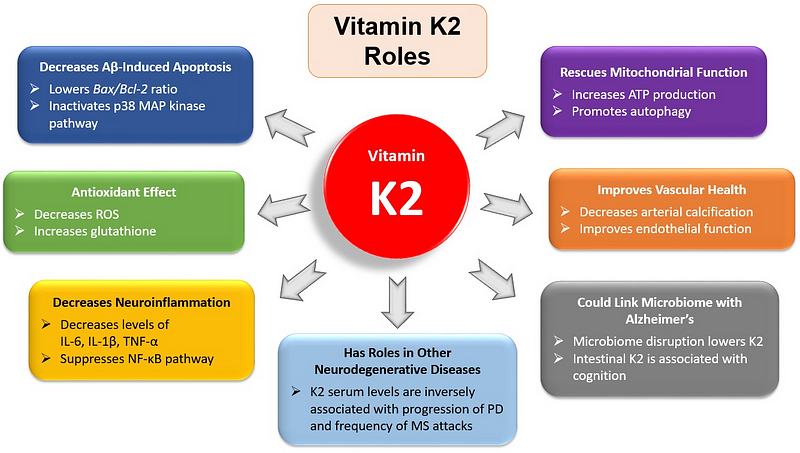
The most important aspects for me are lowering neuroinflammation, which I covered in another story, and rescuing mitochondrial function.
Recent research has identified a new way Vitamin K2 shields neurons: through a unique P38 MAP kinase pathway. Additionally, different forms similar to Vitamin K2 have been found to play a significant role in the development of nerve cells.
For example, this 2019 review paper summarized that certain enzymes related to vitamin K2 are highly present in the brain and have been linked to protecting neurons. In studies conducted both in vitro and in vivo, vitamin K2, particularly MK-4, has shown promising results in enhancing energy production and addressing mutations associated with Parkinson’s disease.
The review informed that recent findings also highlight how vitamin K2 protects neurons through a unique pathway involving the P38 MAP kinase pathway. Additionally, research indicates that various forms of vitamin K2 play a crucial role in promoting neuronal differentiation.
They also mentioned that initial studies exploring the relationship between vitamin K2 and neurological function, such as in multiple sclerosis patients, suggest that vitamin K2 levels may influence neurological health and disease progression, pointing to a potentially significant role for vitamin K2 in brain development and function.
In a first-of-a-kind study, researchers examined Vitamin K2 in nerve activity in a group comprising 45 multiple sclerosis (MS) patients and 29 healthy individuals. They discovered significantly lower levels of K2 in MS patients compared to age- and gender-matched controls.
Moreover, the levels of K2 correlated with neurological symptoms and damage to the optic nerves. These emerging findings indicate a potentially crucial role for Vitamin K2 in developing and managing neurological conditions.
Although more research is needed in this area, vitamin K2’s role in supporting overall vascular health may indirectly benefit brain function by maintaining adequate blood flow to the brain. As I mentioned before, the heart and the brain are tightly connected.
How about side effects?
While there is little information about the side effects of vitamin K2, in general, Cleveland Clinic informs that “Vitamin K supplements are relatively safe, and many people take them.”
They inform that “people taking blood-thinning drugs, such as warfarin, should not take vitamin K without consulting their doctor because vitamin K can reverse the effects of these drugs.”
In terms of toxicity, this NHI book states, “Currently, there is no known toxicity associated with high doses of vitamin K1 or vitamin K2. Therefore, there is no designated upper intake level. Despite this, an allergic reaction is possible with either version of vitamin K.”
The book mentions that “Vitamin K toxicity is extremely rare. The only reported toxicity comes from menadione, which has no use in humans. Its toxicity is thought to be associated with its water-soluble properties. When toxicity does occur, it manifests with signs of jaundice, hyperbilirubinemia, hemolytic anemia, and kernicterus in infants.”
Conclusions and Takeaways
Ensuring adequate intake of vitamin K2 through dietary sources or supplementation can benefit the aging population. It can support bone health, cardiovascular function, cognitive function, joint health, and dental health as we navigate the aging process. In addition, vitamin K2 has promising effects on kidney disease and cancers.
There was a clinical trial in 2010 called Vitamin K2 and Vessel Calcification in Chronic Kidney Disease Patients. But I couldn’t find the results. I believe it might be related to this 2015 paper titled “Effect of vitamin K2 on the progression of atherosclerosis and vascular calcification in non-dialyzed patients with chronic kidney disease stages 3–5.”
In terms of cancers, I found a 2006 study that investigated hepatocellular carcinoma as liver cancer. Findings of this study on ACS suggest that “menatetrenone (a vitamin K2 analog) may have a suppressive effect on the recurrence of hepatocellular carcinoma and a beneficial effect on survival, although a larger, placebo-controlled trial will be required to prove these effects.”
In addition to reading many scientific papers, I also read several books. One of the more informative ones by Kate Rheaume-Bleue, titled “Vitamin K2 And The Calcium Paradox: How a Little-Known Vitamin Could Save Your Life”, was featured in Goodreads in 2011. Kate wisely mentions that:
“While millions of people take calcium and Vitamin D supplements thinking they’re helping their bones, the truth is, without the addition of Vitamin K2, such a health regimen could prove dangerous. Without Vitamin K2, the body cannot direct calcium to the bones where it’s needed; instead, the calcium resides in soft tissue (like the arteries) — leading to a combination of osteoporosis and atherosclerosis, or the dreaded calcium paradox.”
I also watched several presentations on media by healthcare professionals introducing vitamin K2. I found two videos particularly clear and valuable. The first one is by Margaret Martin, a physical therapist. It is titled Vitamin K2 and Bone Health. The second one is by Dr. Rhonda Patrick, who highlights that “vitamin K2 plays a central role in calcium metabolism.”
Thank you for reading my perspectives. I wish you a healthy and happy life.
To inform my new readers, I wrote numerous articles that might inform and inspire you. My topics include brain and cognitive function, significant health conditions, longevity, nutrition/food, valuable nutrients, ketogenic lifestyle, self-healing, weight management, writing/reading, and humor.
I publish my health and wellness stories on EUPHORIA. My posts do not include professional or health advice. I only document my reviews, observations, experiences, and perspectives to provide information and create awareness. 100+ Insightful Life Lessons from My Circles for the Last 50+ Years
If you are a writer, you are welcome to join my publications by sending a request via this link. I support 26K+ writers who contribute to my publications on this platform. I also have another profile to write and curate tech stories.
Importance and Value of Medium Friendship for Writers and Readers


