
3 Easy Ways to Get More Sleep
And the quick and dirty science of why they work
I love sleep. For a long time, I loved it unrequited, wherein longing is more familiar than satisfaction. It lured me along on a long line, baited with savory dreams. Some nights it gave me a taste, right on the tip of my tongue. But all too often I lingered in limbo, arms empty, dim oblivion just out of reach.
It wasn’t until a few years ago that I discovered a few quick and simple ways to tumble into sleep much sooner after tumbling into bed. Much, much sooner.
I won’t tell you what you already know about optimizing your sleep. You know you need more exercise, fresh air, and sunshine. You know you need less caffeine and screen time, especially before bed. But making these changes are not always easy or possible, depending on your circumstances. I don’t need to explain your own challenges to you, so I’ll say straight up this article does not expect you to make any radical or time-consuming changes.
Instead, let’s start somewhere simple: get a little more sleep, build some momentum. Believe that it’s possible to sleep well, and you’re already half-way there. Altogether, the ridiculously easy suggestions I offer here could take less than ten minutes of your time — roughly how long it takes to read this article. Those bigger changes will (hopefully!) come in time, but for right now, here are three things you can do today to help you fall asleep when you curl up under the covers.
Set a Consistent Wake-up Time
It’s counter-intuitive, but waking up at the same time every day — even if it is hard at first — is one of the easiest ways to get more sleep. For the first week or two, you may find yourself short on sleep, especially if you’re used to banking sleep on weekends (or whenever it is, you have a little extra time). But keeping a consistent wake time is far easier than trying to establish a consistent bedtime, and (most) bodies need to establish a circadian rhythm to fall asleep promptly.
I didn’t fully realize the effectiveness of this approach until I had to help my toddler get better and more consistent sleep. By setting a routine of waking up, her body (and mine!) fell into a more predictable pattern, and that made it much, much easier when it came to naps and bedtime for both of us.
Why it works:
Viewed from the time-scale of human evolution, electric lights and cell phones don’t even register as a blip. Hell, fire hasn’t even been around that long relative to our pineal gland, which evolutionary scientists consider an adapted sense-organ, one that used to tell our way (waaaaay) back ancestors when it was light and when it was dark. Almost from the very beginning of life, bodies evolved to respond to regular light-dark cycles that our shiny new technologies have smashed all to bits.
Fortunately, our natural circadian rhythm is pre-built to fit into your run-of-the-mill, 24-hour-a-day cycle. So we can use this regularity to help reset our biological clocks as long as we stick to a routine for waking. Over time, our energy levels (affected by blood sugar, adrenaline, etc) sync up with our sleep-wake cycle (regulated with melatonin). It’s often simply that these two different systems are trying to DJ two different songs at the same time that get us into trouble.
Here are a few other great ways to reset your circadian rhythm if you’re struggling with this part.
Go Upside Down For At Least 5 Minutes Before Bed
This one works the absolute best if you also have time for stretching too — even 10–15 minutes beforehand — but it is effective on its own. The basic idea is that shortly before you get into bed you increase the blood flow to your head, specifically your aforementioned pineal gland, where your body produces melatonin: a.k.a. that hormone responsible for your sleep-wake cycle.
There are a few variations you can take for a test drive to see what you like:
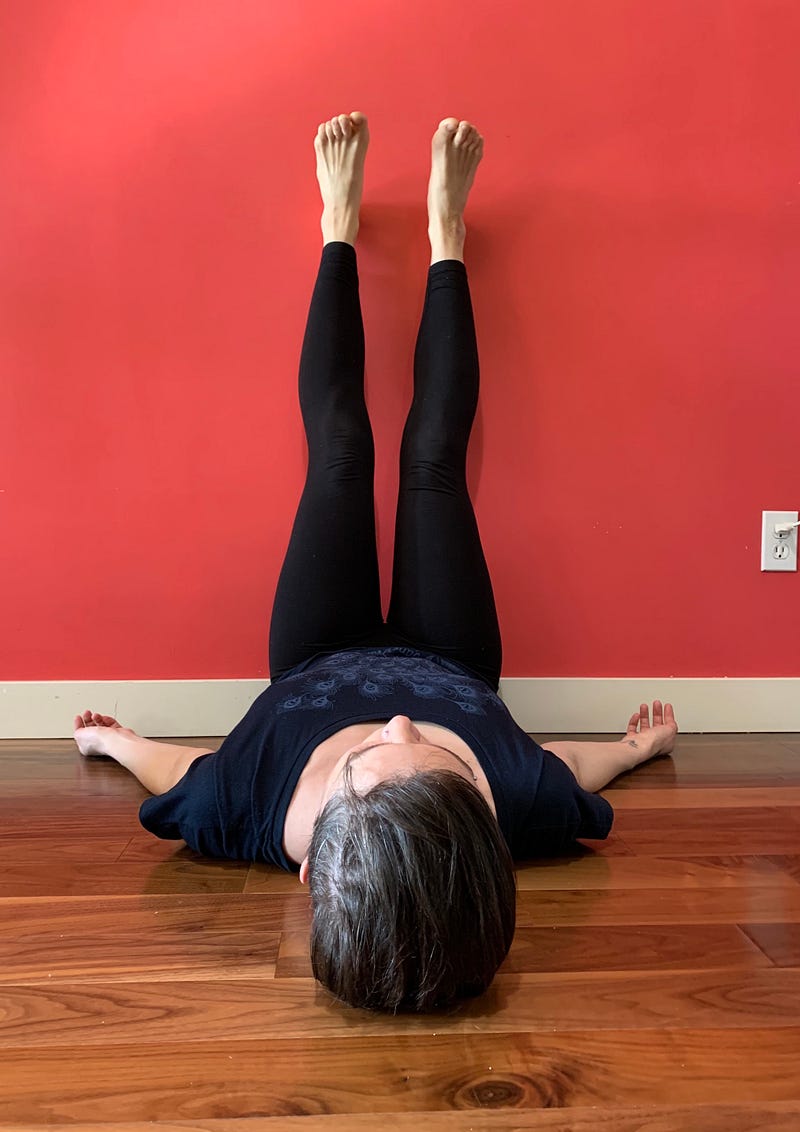
1. Put your legs up the wall
A staple of restorative yoga classes, legs up-the-wall is easy to do for most bodies, highly adaptable, and deeply relaxing.
Tips:
- Lie on your back, close to a wall with enough empty space that you can stretch your legs up and make an L-shape.
- Since you ideally do this for at least five minutes, make sure you are comfortable: wear loose clothing and lay down some padding if you’re on a hard floor.
- Then relax. You might do some slow deep breaths into your belly. You might listen to an audiobook or some music. Whatever feels a little like unwinding, without any pressure to get it perfect.
- It’s even a good idea to keep a notebook beside you while you relax, so you can jot down ideas or your to-do list. That way when you finally do climb into bed, you’ve cleared out some of your cache, so to speak.
- To exit (which isn’t always graceful), deeply bend your knees and roll to one side. You can rest on your side for a few breaths while your body finds a new equilibrium.
If you find this position is difficult — either because the back of your legs are tight or it irritates your low back — you can try resting your hips a few inches higher on a cushion, bending your knees slightly, or shifting your hips further from the wall. You can even use a chair or a bed instead of a wall, so your knees are bent and your calves rest on the seat.
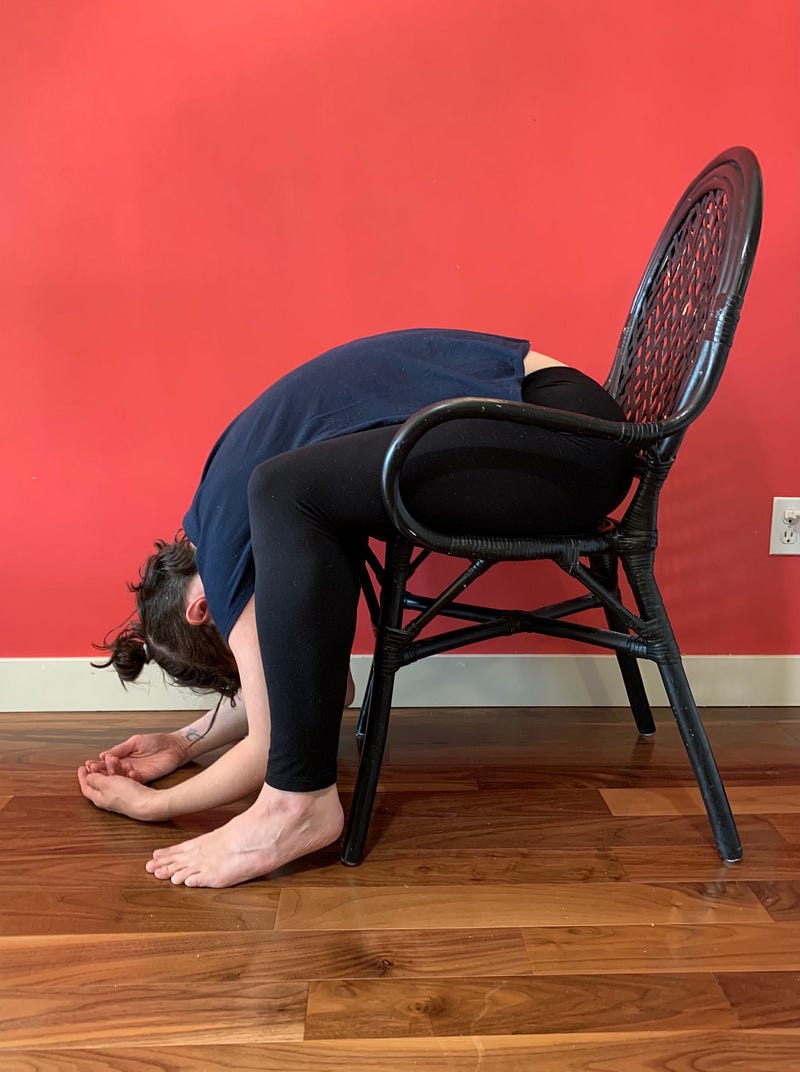
2. Sit on a chair with your knees wide and bend forward, letting your head hang between your knees
This is an inversion that is slightly less accessible depending on your body (size, mobility, pregnancy) but easier to use anywhere. You might be in a hotel room without the space to lie down or preparing for a long flight and want to wind-down while you wait to board the plane.
Tips:
- It will increase the blood pressure in your head more than legs-up-the-wall because your head is now below your torso, so pay attention and stop if you start to feel light-headed by slowing coming back up to sit.
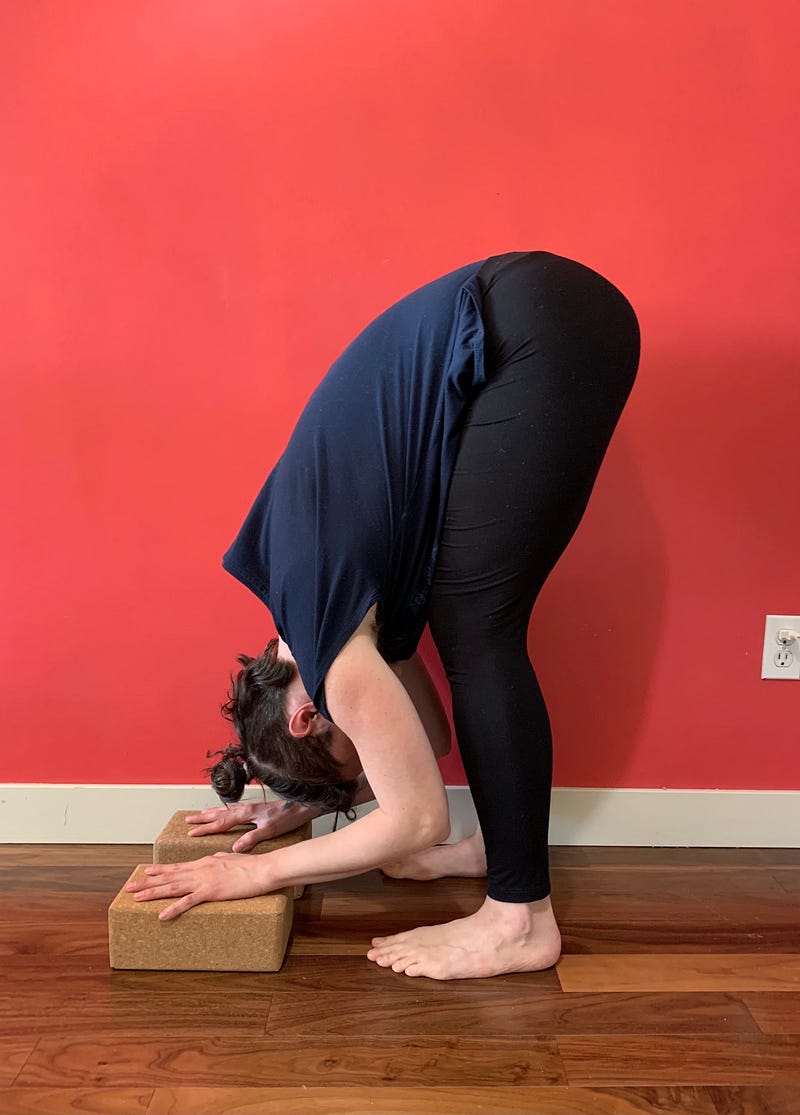
3. Slowly fold forward from a standing position with your knees slightly bent
This inversion is the most intense of the three I recommend, and you will definitely feel the increase in blood pressure if you hold it for five whole minutes. It’s the least relaxing if you’re not used to it and can be challenging (if not downright impossible) if you have a tight back, hips, or hamstrings.
Tips:
- You can try bending your knees if there is too much tension or resting your hands on a support, such as a stack of books.
- Breathe slowly and deeply, and pay attention to your belly as it expands against your legs.
- Rise up slowly when you are done and feel free to use your hands for support.
Why it works:
As experts in biomechanics such as Katy Bowman have shown, the heart is only part of how our bodies developed to circulate in nutrients and oxygen, around hormones and other vital elements, and out waste materials such as carbon dioxide. The other essential piece is movement, which acts like a pump to get materials around our bodies and in and out of individual tissues and cells.
Inverting your body increases the blood pressure on your pineal gland, which produces melatonin from the happiness hormone, serotonin. This extra pressure means increased bioavailability of everything the gland needs to work.
Then, when we return to our normal orientation, the lowered blood pressure helps waste, as well as melatonin, to circulate away. As mentioned above, melatonin helps regulate your sleep, which is why it is now available as a supplement and even proscribed for people who have conditions such as ADHD. Inversions are simply a natural and easy way to encourage your body to produce enough melatonin on its own.
Mimic the Breathing You Do When You Are Asleep
I’ll admit, this one sounds the hokiest and can take some practice to fully implement, but it is still helpful even during the learning stage. The basic idea is that you breathe as though you were already asleep, and this tricks your body into falling asleep.
If you’ve already practiced meditation or particular breathing techniques, some of this will be familiar, but we’re putting it together in a specific way.
How to do it:
- Once you’re ready to drift off, lie in your bed comfortably. It can help to rest one hand on your belly to start, because that’s where you’ll be directing your breath.
- Inhale slowly, to a count of five. If it feels strained at all, it’s too slow. Feel your belly rise and inflate, then let your breath go in a whoosh, as though you’re letting your body collapse into your bed.
- Slow breath into your belly, fast whoosh out. Make sure not to push your breath out, just let all your muscles go and your lungs will deflate on their own.
- Once you establish a good pace, it can help to count the breaths themselves. Start with ten breaths this way. It can be surprisingly hard at first to do ten breaths without interruption, so if your mind wanders off or you lose count, start over.
I was taught this technique at a yoga training by one of my teachers, the irreplaceable Jess Robertson. I made it to about 20 breaths before falling asleep. Even if it doesn’t work for you right away, you will almost certainly feel more relaxed, more peaceful. Don’t worry about it too much. Try again tomorrow and enjoy the relaxation for now.
Why it works:
I’ll try not to get too involved with this explanation, but there’s a lot going on. Our breath is linked to our autonomic nervous system, which essentially runs the behind-the-scenes show, the things that function without us having to think about them. This includes our circulation system, sweat glands, digestion, etc. Most of the time our breath is on autopilot, speeding up when we need more oxygen because we’re running or stressed and slowing down when we’re relaxed or sleeping.
But, as H. David Coulter writes in his Anatomy of Hatha Yoga, “our ability to control respiration consciously gives us access to autonomic function that no other system of the body can boast” (90). To a certain extent, with our breath we can hijack body processes that normally run all on their own. In this case, breathing deliberately into your abdomen stimulates your parasympathetic nervous system, which is responsible for rest and recovery. This allows us to relax.
When we sleep, we take slow inhales because our diaphragm actively descends, creating a vacuum in our chest that fills with air. When our muscles let go, the diaphragm returns to its relaxed position and the air is expelled. By simulating the breathing we do while we sleep, in some sense our bodies begin to act as though we already are asleep.
If you’re not yet convinced, try the opposite. When we do something very active, such as running, most of us will breathe big and fast into our upper chest. Try this for a minute and see how you feel. Energized? Almost caffeinated? Hyper and alert? You’ve just stimulated your sympathetic nervous system, your flight-fight-faint response. Aren’t bodies cool?
All on their own, these three techniques probably aren’t going to revolutionize your sleep patterns forever, particularly if you have a sleep disorder. Our bodies are incredibly intricate systems shaped over countless millennia to thrive in environments wildly different from modern life. But they are also highly adaptable, so the more we learn about them and how they work, the better we are able to tap into the awe-inspiring abilities our bodies already possess.
Good luck and sweet dreams!
For those of you who give these a try, I’d love to hear back! Did they work for you? What did you discover? If you get frustrated or it doesn’t work immediately, maybe it’s time to work on practicing (see my link below).