
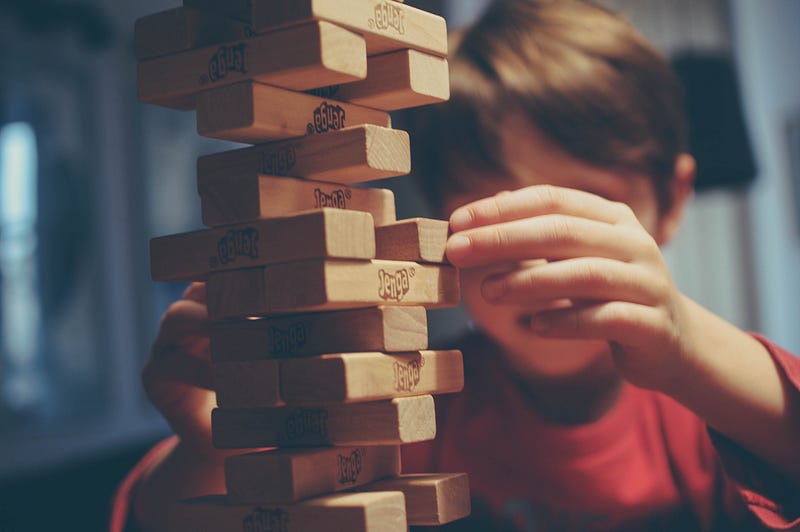
Reminding Myself that I’m Practicing Helps Me Try New Things
It’s hard to be curious, creative, and right at the same time
A few days ago I submitted my first article to Medium. I’d been working on several different exciting ideas during the tiny pieces of time I’m not chasing after my rambunctious toddler, but I kept hitting the Goldilocks Problem and couldn’t seem to finish any. One felt too combative. Another too timid. A third felt like an over-share for my very first attempt and a fourth too stodgy and academic.
Why is finishing one little article so hard?? I wondered. I’ve written endless essays and conference papers during my years in academia. I’m the Game Master for a roll-playing game with my friends, for which I write hours of content nearly every week. I’ve taught at a University and as a yoga instructor for well over a decade, so I am in no way shy to speak out publicly.
This should feel old hat, I lamented. But it didn’t. And so I got stuck, because I was trying to pretend it was a familiar scenario with a set of skills I had already mastered and a language in which I was already fluent.
The power of becoming a beginner
My breakthrough came when I realized I wasn’t and didn’t need to be an expert. In fact, I was practicing a whole new combination of skills, like being a total maestro at the tango, but then trying to waltz and finding you have two left feet.
In order to move forward, I needed to practice a beginner’s mindset.
You may have heard of it. You may have already practiced it. But like me, you may need a reminder. Even though it’s an approach I use all the time, it’s easy to forget and so I need to remind myself over and over and over . . . well, you get the picture.
It’s a powerful concept that I’ve taught numerous times in the yoga classes I’ve lead. I use it when I get stuck and with my toddler when she gets frustrated over not being able to do things like put on a mitten or open some buttons.
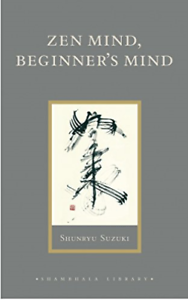
Like lots of great ideas, this one is very old. Zen Buddhist Shunryu Suzki brought it to America and, if you’re curious, I highly recommend his classic book Zen Mind, Beginner’s Mind whether or not you are a practicing Buddhist. I read it cover-to-cover on a flight back from Costa Rica after a training I attended there. In the very first line he highlights this core teaching: “In the beginner’s mind there are many possibilities, but in the expert’s there are few.”
In a yoga room, you can look around and tell who the beginners are primarily because, even though they are trying out the same pose, it looks different. Awkward. Their arms are at wacky angles. Their feet are far too close together. Their necks are cranked uncomfortably. But these beginners are always learning something new, because they don’t assume they already know.
You can also tell who the intermediate students are, because their pose looks Instagram perfect but they hold it rigidly. I’m doing this pose the right way, their bodies seem to say. Rigid in body, rigid in mind, they come to class day after day and rarely learn anything. And the only way they have fun is when they do it just right.
The students who are familiar with the poses but know they are practing them — experimenting, exploring, discovering — are evident because they don’t hold the pose: they play with it. It is dynamic, vibrant, alive. The pose is rich with possibilities, sometimes even more possibilities than the total beginner, because their bodies and their minds are working together to invent something new. Something now.
Practice lets us be more compassionate
I like to use the phrase, “I’m practicing,” because it’s easy to finish the thought with whatever it is you are exploring at the moment. As in right now, “I’m practicing writing from my body’s wisdom, accumulated from thousands of hours on my yoga mat.” To get over my writer’s anxiety, I can practice trusting that you’re here to learn how to be a better human, the same as me.
It’s also very easy to share this practice with my toddler. Or, say, a skeptical partner. I can say to her, “Let’s practice putting your blocks away,” and she’s (usually) on board. This puts the two of us in a very different relationship than if I direct, “Put your blocks away now!” Or complain, “Ugh, you never clean up after yourself.” Framing it in this way, I can witness and enjoy how she’s practicing expressing her boundaries right now, sometimes very vocally, without expecting her to get it right. (I know I sure as hell don’t.)
I find more compassion for those around me when I see that they, too, are practicing. I don’t get things right the first time. I don’t even get things right the 50th time. Maybe, just maybe, there isn’t actually A Right. Maybe there are simply many possibilities? I’m not always great at expressing this compassion in the moment, but I’m practicing.
“I’m practicing” might not be the phrase that you chose to remind yourself to use a beginner’s mindset, particularly if you spent a lot of time drilling away at an instrument or a sport when you were a kid. At the heart of practicing is an element of spontaneous levity, so you might try, “I’m experimenting” or “I’m exploring”. Whatever words give you the space to wonder about what is really going on. Whatever words free you from the pressure to get that gold star right now or else.
What does the awareness that “I’m practicing” look like?
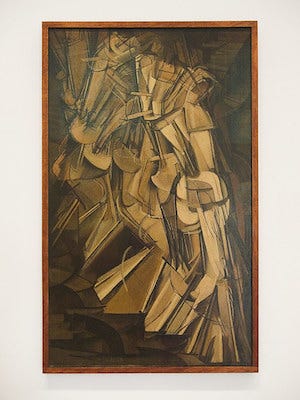
It looks like Josephine Baker and her improvised dances. It looks like Marcel Duchamp, experimenting with motion in Nude Descending a Staircase. It looks like children playing: utterly serious, focused, free, messy, inventive as they boldly create mash-ups of things you probably wish they didn’t put together quite like that but . . . well here we are. And that is exactly how they learn more, and faster, than any adult.
It often looks like what is easy to discard or write off as a mistake. But as the ever-so-experimental writer James Joyce reminds us, “Mistakes are the portals of discovery.”
It looks like the courage to be tentative, uncertain, and unauthoritative — which can be scary whether you are a writer appealing to an audience or a mom trying to co-create boundaries with a toddler. Harvard psychologist, scientist, and painter Ellen J. Langer in her brilliant and vulnerable book On Becoming an Artist argues that, contrary to popular belief, those people we often identify as experts or talented or successes rarely if ever move forward from a place of confidence or certainty. In fact, she writes, “the real difference between those we think of as talented and ourselves may be nothing more than their willingness to go forward in the face of the uncertainty”.
Putting it into practice
More specifically — what this might look like for you, today, is playing a game of tennis with that friend who always beats you. Instead of trying so hard to win, you choose to focus on practicing your serve. Each one, a new chance to experiment and play.
If you’re a writer, it might mean learning one new rhetorical trick to practice in your next article. Or exploring writing ten sentences with ten different sentence structures. Or writing something silly when you are always serious or becoming stentorian if you find yourself constantly hedging. Whatever form of practice leaves you feeling a little more playful in your work and compassionate towards yourself.
It can be something very specific that you decide to practice, but it doesn’t have to be. It is often enough, when I get frustrated or stuck just to recognize that here I am, a human. Practicing.
Are there other mindfulness techniques that you find helpful? Are there any specific areas of your life that you feel need more space for practicing? Experiementation? Playfulness?
Where do you get stuck, in your life or your work, and what are your strategies for getting un-stuck?