
24 Hours in Topeka, Kansas Taught Me About Hate
And a total eclipse of the sun
The capital of Kansas, Topeka, wasn’t even on my radar.
It was the summer of 2017. I love to travel, and my boyfriend at the time didn’t. Our relationship was nearing its end. He never cared much about travel. Had no wanderlust. And I suffered from it. That should have told me it wouldn’t work. We’d show up for command performances, like weddings and funerals. How fun is that? By this late stage in the game, I'd be going alone if I wanted to go somewhere. To make matters worse, I was working for an international airline. We could have gone anywhere for practically nothing.
By that point in my life, I’d been to most of the major tourist attractions in the country, except for all of the contrived venues in Florida. I'm not too fond of Florida. I don’t think it’s particularly pretty, I don’t care for their politics, and humidity and I don’t get along.
I refused to take my kids to Florida and go into massive debt at DisneyWorld and all of those other “worlds of fun.” Ugh. More kids. Fun?
However, as a kid who grew up in Southern California, I went to Disneyland seven times, one time with the kids. That would have been in 1990. It just happened to be, at the time, the hottest day in Orange County’s history.
That was IT! I was DONE with Disney!
I had always wanted to go to the Flint Hills of eastern Kansas. One of the reasons was its solitude — I love quiet places. I also love rock collecting. And I wanted to start chipping away at the “B” list of the nation’s sites to see.
While that was my ultimate destination, I wanted to make a week or so of it. Since I’m a Route 66 buff, I decided to start the trip at the corner of Michigan Ave. and Adams St. — the beginning of Route 66.
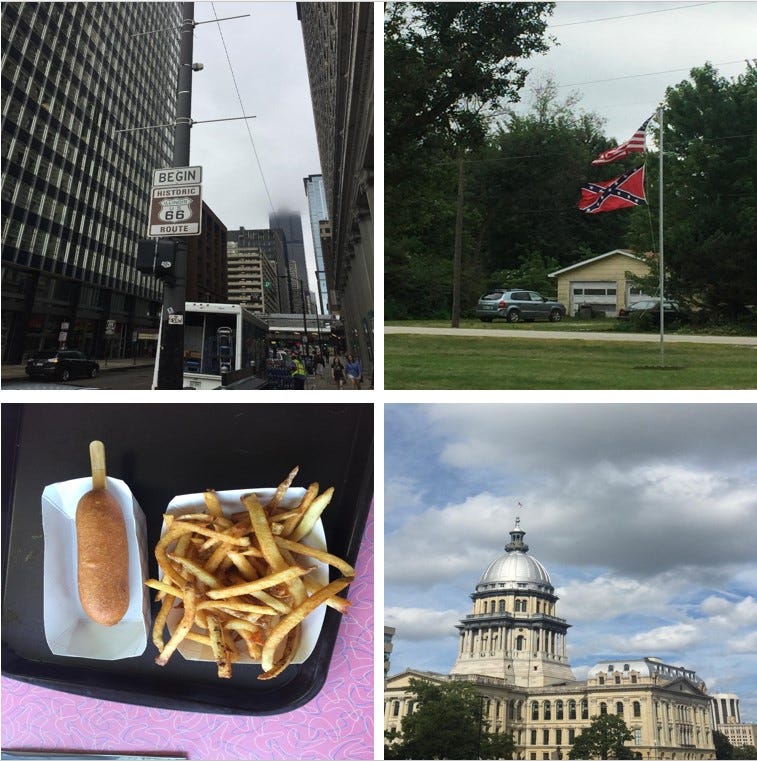
Since the present I-55 parallels the old Route 66 in Illinois and many segments remain, I used it wherever possible to get from town to town. Each one was somewhat nondescript but proclaimed it was the best of this-or-that. Just quaint little villages with lots of “shoppes.” It did help break up the monotony of hundreds of miles of corn fields. Driving in Illinois is excruciatingly dull. There is only one drive that is worse.
That first night in Rolla, Missouri, is when I was reminded of the total solar eclipse of the sun that would extend from the Pacific Northwest through the Heartland and onto the east. It would occur in three days! Not that I had a grand plan, but I decided I’d head in that direction in the coming days. I looked at possible routes to get me to an area of totality.
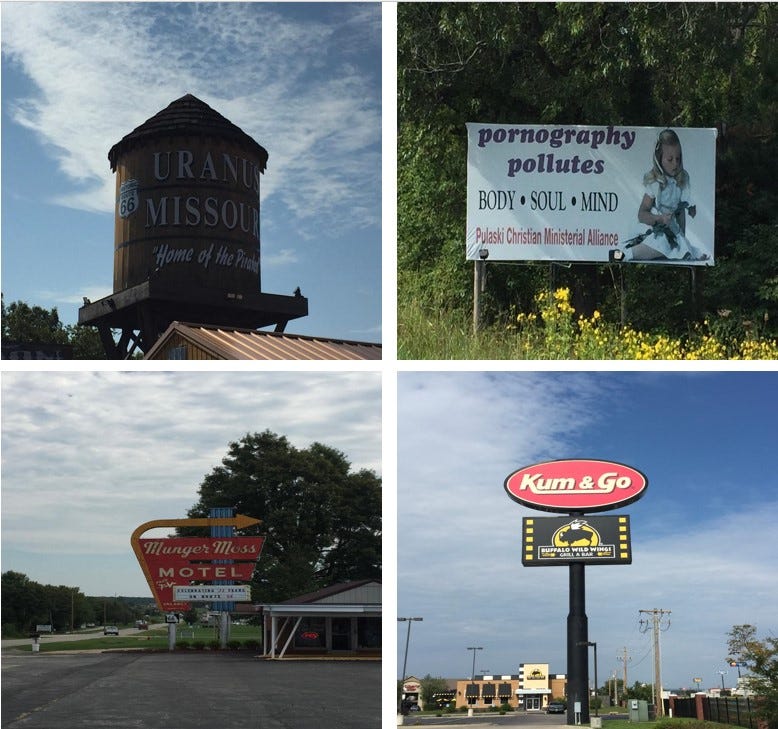
The next day, somewhere before Springfield, I stumbled onto the tiny hamlet of Uranus. It was so small it wasn’t even on the map. From the interstate, it was not hard to see, so I stopped to investigate. I think it’s a village of a lot of guilty Baptists seeking to repent. But then why did they have a fudge “shoppe” in what was a one-strip-mall town?
I continued on I-44 towards Tulsa, but again, since Route 66 ran concurrently, I knew if I looked hard enough, I could find something really old and unique. While on the interstate, I saw what I thought was an old gas station and a little “village” overgrown with vegetation, and I set out to locate it taking the next exit. It took a while to find, and I had to wander on country roads, using my keen sense of direction. (I’m not kidding about that!)
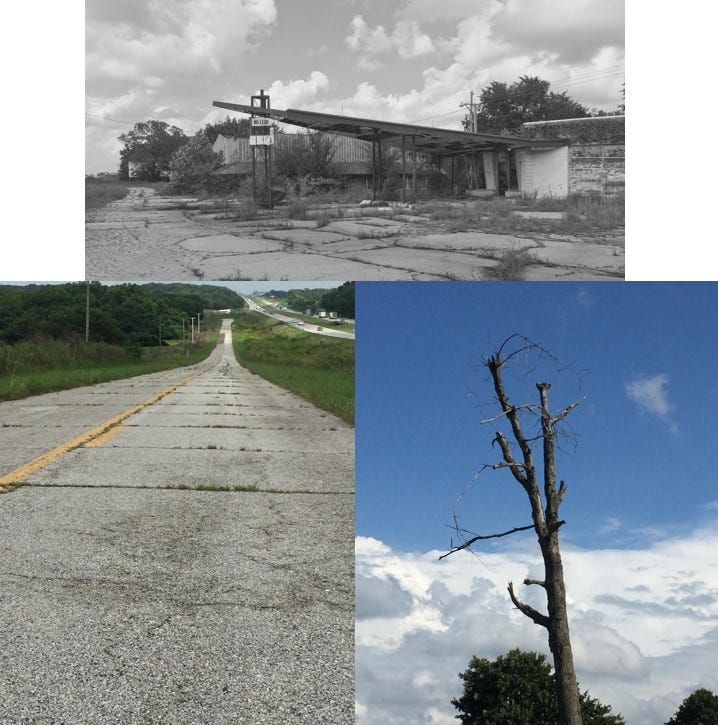
Afterwards, I wanted to see what the aftermath of a tornado looked like. In 2011, an EF5 tornado struck the southern part of Joplin, Missouri, killing 158 people. Though it was six years later, the scars remained. You could see tall trees standing on the north side of town which was barely touched. Those on the south side were little, with the trunk of older, dead trees remaining. There were slabs of concrete here and there. From an elevation, you could see clear across the city.
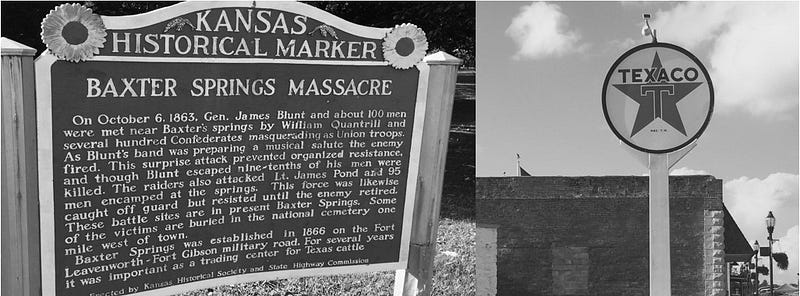
It only spans twelve miles in Kansas, but I found that leg of Route 66 to be the most charming. The interstate it bypassed was miles away, and it seemed like a trip back in time. It celebrated the highway in a big fashion, and historic Baxter Springs had all the trappings of an old town, kept alive only by tourists’ dollars.
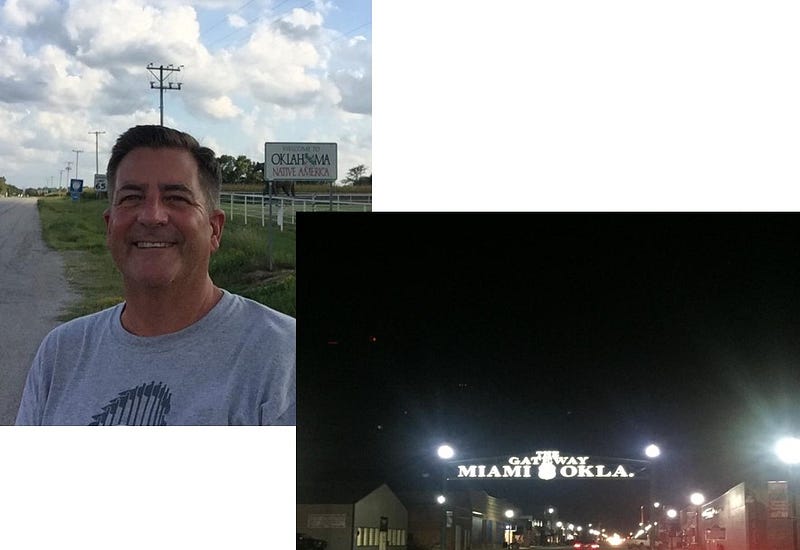
Overnighting in Miami, Oklahoma, another Route 66 hot spot, I headed north to the Flint Hills. It’s a large area, but the 45-mile drive between Cassoday and Council Grove goes right through the heart of it. You’ll drive mile after mile over undulating hills thick with longstem grasses. A visitor’s center with trailheads will take you to where the bison roam. Of course, I endured the 95° heat just to hear the quiet. Nothing. Complete silence, save for the rustling of grass. Finally, I found what I was looking for.
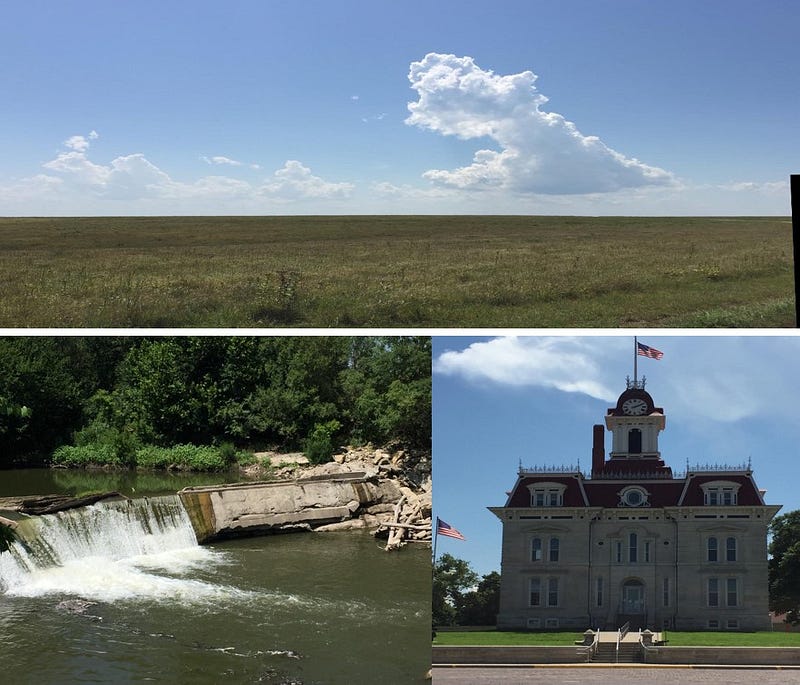
After crossing The Santa Fe Trail twice, it was onward to Topeka. Its population of 125,000 really hasn’t changed since 1970: no contraction, but no growth. I chose this city to kill time for the day before the eclipse.
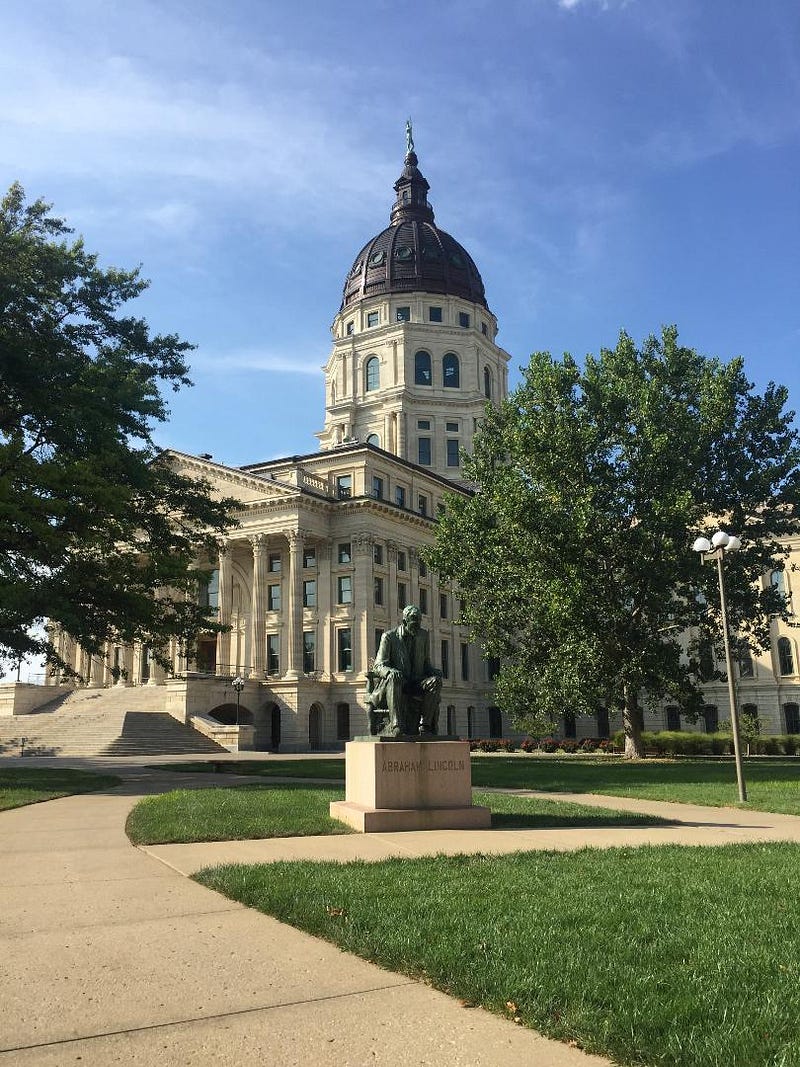
I have a geeky interest in state capitol buildings. Thirty-nine of the state capitol buildings have domes like this and are designed similarly to the U.S. Capitol in Washington, D.C. That’s just a fun little factoid you may need someday!
When I first got to Topeka, I had enough daylight left to see Kansas’. It is quite lovely, lush and maintained, and has plenty of tall shade trees and benches. A few snapshots were all I needed.
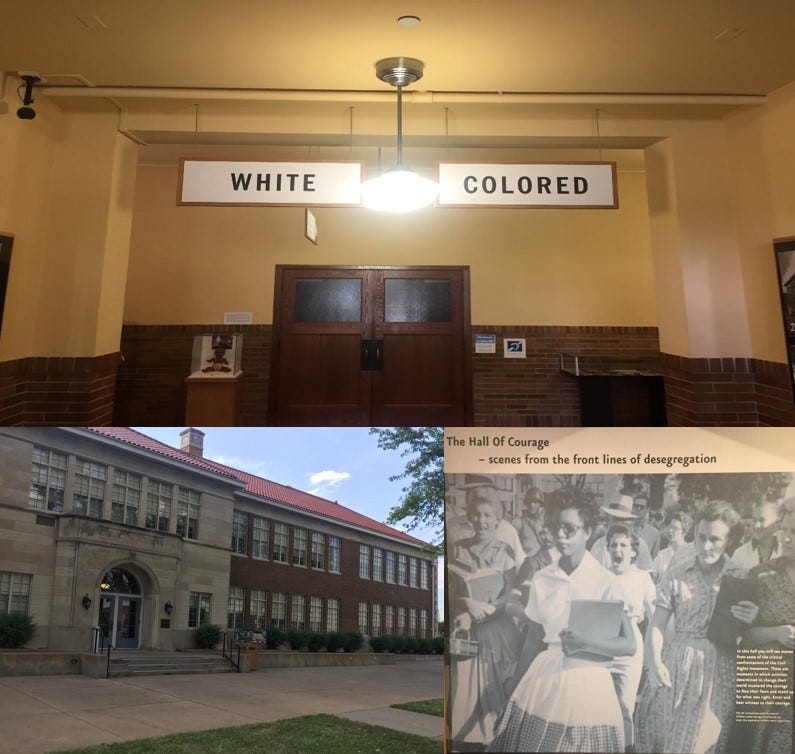
It was the next day that I encountered the unexpected. I knew the basics of the Brown v. Board of Education story but didn’t realize its importance in history until I toured the school that was the subject of the case.
While Kansas entered the Union as a free state, the conflict over slavery continued into the Civil War. “Bleeding Kansas” was the division of thought and the resulting clashes between anti and pro-slavery forces. The atmosphere in the late 1850s was as violent here as anywhere in the country.
Brown v. Board of Education is now a National Historical Park operated by the National Park Service. “Separate but Equal” was the law of the land in the 1950s, and so it went with Topeka’s segregated schools. The school, the park, and the court case began with a little Black girl named Linda Brown.
She lived just four blocks from an elementary school but could not attend because it was for whites only. Instead, she had to take a long walk to a bus that would take her across town to the all-black Monroe School. Her father brought forward the court case. The Supreme Court ruled that school segregation violated the equal protection clause of the 14th Amendment. This set the stage for skirmishes at schools all over the South in the years to come.
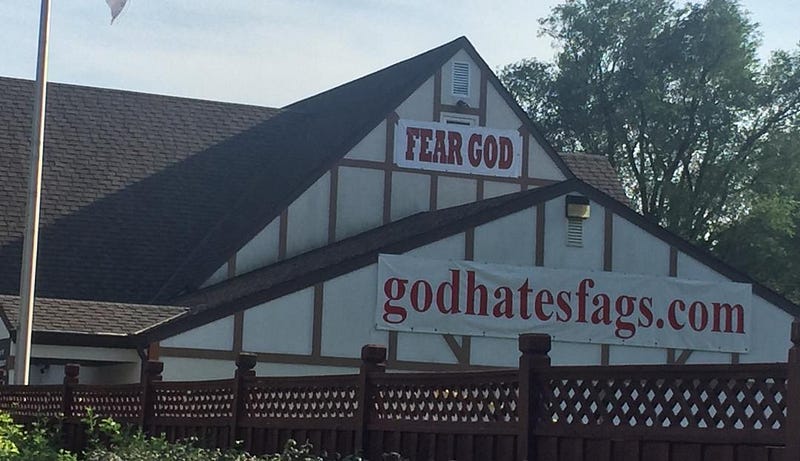
After pondering that struggle, I went to see another shrine of hatred and prejudice that lives to this day — the Westboro Baptist Church. It is labeled a hate group and is well-known for its homophobic and anti-American stance. Founded by Fred Phelps in 1955 (ironically just a year after Brown v. Board of Education), the church also dishes out hate speech against atheists, Jews, Muslims, transgender people, and even other Christian denominations.
Phelps passed in 2014; by 2016, the church was thought to have only about 70 members. But they were a vocal bunch protesting at pride events around the country and at funerals for people who died from AIDS. In addition, the church blamed homosexuals for the 9/11 terrorist attacks.
In a Fox News interview, Margie Phelps, Fred’s daughter, claimed that Barack Obama would “absolutely” be going to Hell, and that his presidency was a sign of the Apocalypse. Protesters from the church referred to Obama as the anti-christ.
The property is heavily fortified in a residential section of the city. I couldn’t see how to gain entrance, probably due to the threats against the church. However, across the street was a rather interesting sight.
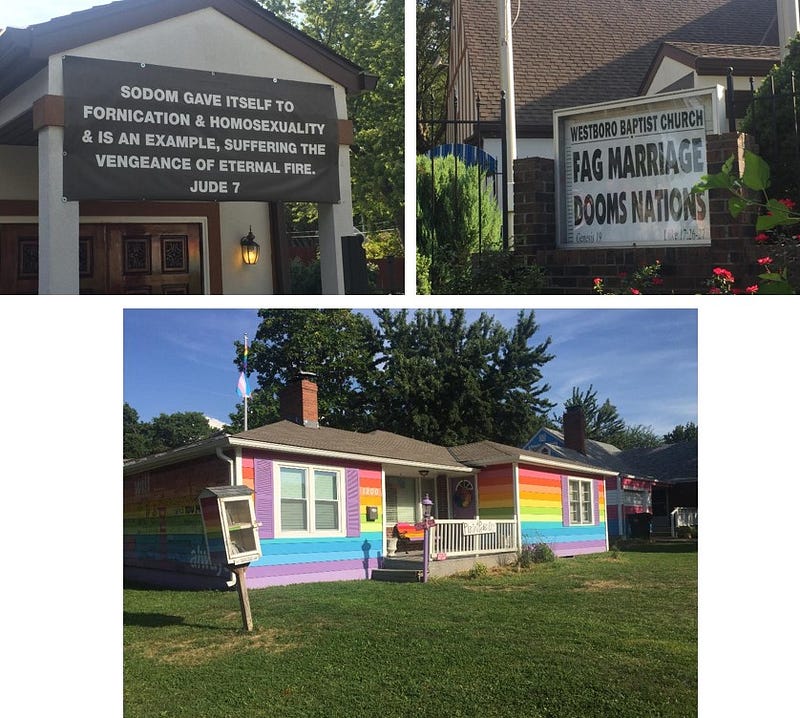
The Equality House was purchased by the founder of the nonprofit organization Planting Peace, a humanitarian organization founded for “spreading peace in a hurting world.” Their causes include sponsoring orphanages in Haiti and India, rainforest deforestation, and anti-bullying programs.
So there. Give peace a chance.
For the total solar eclipse, I decided on Falls City, Nebraska. It was just outside the Kansas state line, a town of 4,325. Unfortunately, it was a mostly cloudy day, so the eclipse was not as spectacular as it might have been. All that mattered was that I was there. Afterwards, I attended the town’s festival, had burgers and hot dogs, and talked to some Husker folks. It’s where I went to college, and I still think they’re under a spell with their losing football team!
This trip included pop culture (Route 66), natural beauty (the Flint Hills), history (Topeka), and ecliptic fun in a small town. It was a road trip I’ll never forget.
My thanks to the folks at Wikipedia for filling in some of the details I had forgotten. After all, it’s been five years, and I’m now a senior citizen!
Other stories by Arthur Keith:
Like what you’re reading? Consider subscribing to Medium. For the price of a monthly magazine ($5/month), you’ll have access to all of my stories and thousands of other writers. And I’ll get a wee bit! Just click the link below.