
22 Fascinating Facts about Genghis Khan That You Probably Didn’t Know
He suffered many defeats on his way to victory, nobody knows where he is buried, nobody knows how he actually died, he went missing from history for 10 years, and much more
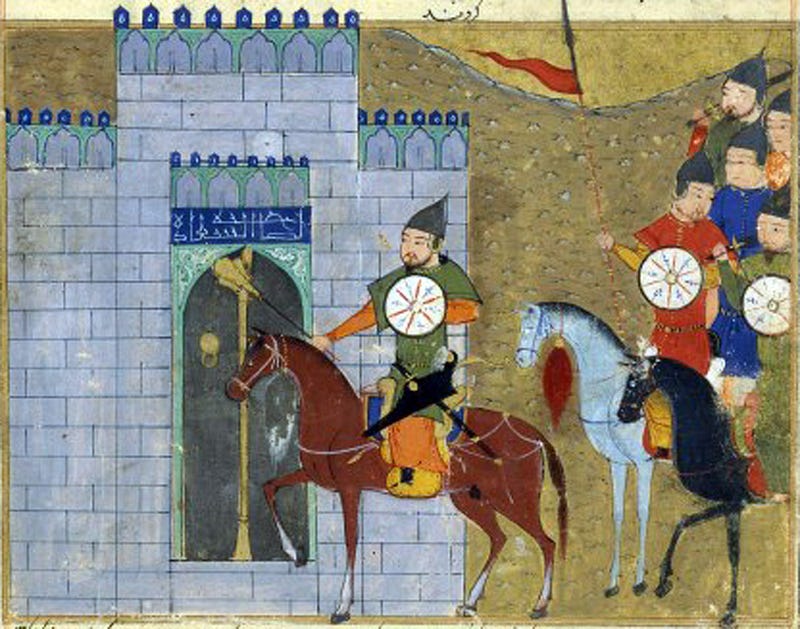
Genghis Khan is a legendary conqueror who conquered more land in a shorter time span than anyone in history. He was also well ahead of his time when it came to things like meritocracy, and religious freedoms amongst other things.
However, he was accountable for the deaths of upwards of 40 million people, which at the time equated to 11 percent of the population. His lust for slaughter was such that in Iranian history for example, the period of Mongol rule is known as the Mongol catastrophe, and it’s believed that between 10 and 15 million people were slaughtered on the Iranian plateau over a 200-year period of Mongol rule. So, Genghis Khan’s rule and legacy are a mixture to say the least.
Here are 22 fascinating facts about him that you probably didn’t know.
He was born Temujin, and after his father was assassinated, his youth was spent in poverty
The boy that would become Genghis Khan is believed to have been born in 1162 — though the date is hotly debated. He was named Temujin, and was the son of the Mongol chieftain of the Borjigin tribe, Yesugei Baghatur, who was also a major Chief of the Khamag Mongol confederation — a confederation of the top tribes which many see as the precursor to the Mongol Empire. However, his rise to power was not straightforward.
He was given away to a family of the Olkhonud tribe at the age of 9 for marriage, his father leaving him at the home of the family. However, his father was assassinated as he made his way home — under the guise of hospitality, the Tatars tricked him into eating poisoned food.
This led Temujin to immediately return home and claim his father’s chiefdom. His claim was rejected, and he and his family were in effect kicked out, as such he spent the rest of his childhood in poverty, with his mother being left to raise him along with his six siblings on her own.
His mother is believed to have been his most important teacher and influence
His mother, Hoelun — who was highly intelligent — is believed to have taught him a lot about the politics of the tribes, and why they couldn’t stop fighting with each other.
She especially is believed to have taught him about Mongol politics and how it worked, and as part of this, she taught him about the lack of unity between the tribes and the reasons for the lack of unity — including stealing women from each other to take as wives (she herself had been stolen by Genghis Khan’s father).
She also is believed to have taught him about the power of arranged marriages to create stability between tribes. Not just that, but she became one of his most trusted advisers and it is believed that her knowledge of battle — she was said to have been a great and highly respected warrior herself — helped lay the foundation for Genghis Khan’s successes on the battlefield.
All these teachings are believed to have helped play a part in his uniting of the rival tribes into one nation. That’s how important and influential she was, and she would remain for the duration of her life one of his most important and closest confidants.
In his mid-teens he was captured by his father’s former allies and enslaved, but he escaped
At the age of 14, he is believed to have killed his older half-brother, Behter, in a dispute over food. This led to him becoming his father’s successor while also boosting his standing amongst his tribe — which he and his family were still in effect cast outs from.
However, his slight increase in standing did not last long and threatened to be finished for good because just a year later, he was captured by his father’s former allies, the Tayichi’ud, who enslaved him and legend has it locked him in a cangue — a form of portable stocks.
Somehow though he managed to make a daring escape — the details of how are unknown. But the fact he did manage to escape is believed to have further enhanced his standing amongst his tribe, bringing him yet closer still to gaining their respect.
His wife was kidnapped, and he took an army to get her back
Börte was kidnapped by the Merkits — a rival tribe. Börte was the woman his father had arranged that he should marry. She was a year older than him and despite him having left her the moment his father died to return to his mother, at the age of 17, to the delight of Börte and her family, he returned for her and they got married.
However, in 1184 she was kidnapped by the Merkits — a rival tribe. Genghis Khan — still known as Temujin at the time — had allied himself with his father’s blood brother, Toghrul — Khan of the Keraites. He had done this at great cost, he had given the entirety of Börte’s dowry to Toghrul in return for him adopting him as his son.
It proved a smart move, he pleaded with Toghrul to be allowed an army to reclaim his kidnapped wife. He was granted 20,000 men and with the support of childhood friend and blood brother Jamukha, and another ally, Wang Khan, in a daring raid, he managed to get his wife back.
The story goes that he nearly didn’t find her, but as his men rampaged and pillaged their way through the town, he was calling out her name. She was in the back of a cart fleeing with all the others, but she heard him and came running.
It was this victory that set him on the path to unifying Mongolia as it allowed him to prove his military prowess. That means if it was not for his father being murdered, he himself being kidnapped, and then his wife being kidnapped, he would likely never have become Genghis Khan. That’s the power of fate.
He suffered many defeats on the way to unifying Mongolia
In 1187, his friend Jamukha, who also wanted to unite the Mongol tribes and become the universal leader, started to feel threatened by the rise of Temujin and so launched an attack against him. This battle was the first battle where Temujin had the sole lead of an army and he lost — resoundingly.
The defeat was so resounding that it would take Temujin until 1197 to even regain a position of power.
However, Jamukha’s actions in victory — legend has it he boiled 70 captured Princes alive — and general behaviour along with the fact that he was a strong proponent of the Mongolian aristocracy and didn’t believe in a meritocratic system, which Genghis Khan did, meant that by 1206 the war was over and Temujin had become the universal reader.
There was no battle which led to it directly, Jamukha’s supporters had simply grown sick of him and so turned him over to Temujin.
Temujin killed those who did this act — he was against disloyalty — but then that was that. He was universal leader. It should be noted that he then offered his hand of friendship to Jamukha, but it was rejected with Jamukha reportedly saying that “there could only be one sun in the sky.” He then asked for death, and on his death, Temujin’s rise to power was complete and now completely beyond reproach.
He didn’t become Genghis Khan until his 40s
It wasn’t until the age of 44 that Temujin would become Genghis Khan — though dependent upon disputes over his birthdate, he may have been a little older or a little younger. One thing people are fairly certain of is the year. 1206. After a two-decade-long struggle, in 1206, after Jamukha’s end, he was given the title of Chinggis Khan (pronounced “Genghis Khan” in English and meaning “universal ruler”) in a ceremony at Blue Lake in Mongolia.
With his status of universal leader now set, he set about consolidating his position and his borders by first conquering the Jin Dynasty of Northern China, and then heading west. It wasn’t until 1219, when he was 57, that he finally started heading east. This means the majority of his biggest conquests came when he was in his 60s.
There is a period of 10 years where no one knows for certain what he was doing
Between the years 1187 and 1197, Genghis Khan effectively disappeared from history. Many historians believe this is because, after the defeat by Jamukha, he ended up taking refuge at the home of his mortal enemy, the Jin Dynasty.
It’s believed that he likely, due to shame, made certain that this was never mentioned in his history.
Some even claim he was likely ineffectively enslaved by them during this period. Whether this is true or not, nobody knows, but it is believed that he likely had to first submit to the leadership, at the time Emperor Yong, and then the price of his being allowed to stay was likely him paying a yearly tribute and aiding them on raids, possibly against the Mongols. He also likely had to help them fight off raiders — possibly Mongols.
Whatever the price, it worked out well for Genghis Khan in the end because he had the majority of his children over this period, and as such was able to safely raise them, and it is believed that this period of relative calm in his life played a big hand in what was to come. For example, it’s believed he used this period of exile to hone his military leadership skills, and also to build up connections, connections that would play a large part in his rise to power.
His most important connections from his exile are believed to have been the Khitans
The most important connection Genghis Khan likely built up during his 10-year exile is believed to have been with the Khitans — who the Jin Dynasty had conquered earlier in the century and had absorbed into their Empire.
When Genghis Khan elected to invade the Jin Dynasty in 1211, many of the Khitan commanders defected to his horde — along with many Han Chinese commanders as well.
The worst thing for the Jin Dynasty was that the invasion was likely the fault of their leader. After the death of Emperor Jing in 1208, his son Emperor Yongi, became worried about the rise of Genghis Khan and so planned to kill him.
After regaining power in 1197, and even after becoming universal leader in 1206, Genghis Khan had continued paying the yearly tributes to the Jin Dynasty. He may have continued doing so indefinitely had Emperor Yongi not come to the decision to kill him, planning to ambush him when Genghis Khan came to pay him tribute.
Fortunately for Genghis Khan, he learned of the plan, and retaliated as Genghis Khan always does, by annihilating his enemy, which he did using the full knowledge and connections he had gained while there.
He was a big fan of engineers and artists
Genghis Khan would make certain that engineers and artists would be spared from massacres and taken to places to work within the Empire where they would be allowed to continue their work — this practice continued long after his death.
It also helped the Mongol Empire become not just a great multicultural power, but a leading innovator.
Nobody knows what he looks like
All the images we have of Genghis Khan were made after he died. Despite most leaders liking nothing more than to have monuments of them made, Genghis Khan was different.
While alive, he refused to allow anybody to produce his image, so there were no sculptures, paintings, or anything that would show anybody what he looked like.
It’s believed he did this to try to protect himself from assassination i.e. if there were no images of him, his enemies would not know what he looked like and so it would be harder to assassinate him.
Nobody knows how he died
It’s widely accepted that he most likely died eight days after setting off for his final campaign against Western Xia, which would put the date at the 18th of August 1227. However, nobody knows for certain how he died, the Secret History of the Mongols reports that he fell off his horse and died as a result of the injuries and this is the most commonly accepted reason for his death.
But there are other claims, one being that he died from malaria, another being that it was an arrow wound to the knee that became infected, there is also a claim he was killed in battle by the Western Xia. Also, a more recent claim comes from a 2021 study that postulated that he died as a result of the plague — which they claim his army was showing signs of suffering at the time.
There is even a more outlandish theory that he was murdered while trying to force himself on a Chinese princess — she is purported to have hidden a small dagger and either stabbed or castrated him. However, this came from the 17th century and has zero sources to back it up, meaning it is likely made up.
As such, most believe the Secrets of the Mongols told the truth and that he fell off his horse and died from the injuries. Some argue he may have fell off the horse because he was suffering from the plague, but regardless, most accept him falling off his horse as the most likely reason for his death.
Nobody knows where he’s buried
In an effort to protect himself in death, he went to extreme lengths to ensure his burial ground was secret. Though there are ideas about where he is buried, the consensus is the most likely place is on or around a sacred Mongolian mountain called Burkhan Khaldun.
But whereabouts on this mountain there are so many stories it is crazy. For example, one legend has it that a river, some postulate the Onon, which originates from the Burkhan Khaldun mountain, was diverted to flow over his resting place.
Other legends have it that horses trampled over the burial ground to conceal it. Another legend is that trees were planted to keep it hidden. Nobody has a clue which legend if any is accurate. But one legend from ancient Chinese text has it that he was buried with a young camel, and that young camel’s mother 30 years later was found weeping at the grave of its young, which showed the Khan family the way to the grave.
In terms of why the Khans didn’t know where the grave was, one belief is that they did not attend the burial because all that did would be slaughtered. The legendary historian of the time Marco Polo claimed the funeral procession was made up of 2,000 slaves who were slaughtered by the soldiers sent to guard them, those soldiers legend has it, were then killed by another group of soldiers.
Those soldiers had killed everyone they had crossed past with on the way to the burial site, and with everyone dead who knew the location, Polo claims that they killed themselves so that the location would be forever secret.
However, nobody has any clue whether this is accurate or not, all that is known is that he went to extreme lengths to make certain that those who buried him would keep his burial location secret. They did just that, that’s all we know for certain.
He was very popular amongst the poor
Genghis Khan was highly popular amongst the poor, mainly because he exempted them from taxes. He also promoted literacy and wanted everyone to become literate, but the difficulties in making this happen meant that his drive to improve literacy only reached as far as those in positions of power.
He was the driving force behind Mongol Scripture
It was Genghis Khan through commissioning Uyghur scribe Tatar-Tonga that Mongolian script, also known as Mongol Bichig, was created. He did this as part of his literacy drive in an effort to improve innovation and livelihoods across his growing empire, but also to try to create a universal language to connect everyone through.
He was exceptionally loyal to his wife
In the Secret History of the Mongols, the legendary text written in 1227 after the death of Genghis Khan, and the text that through much of his history is known, it is written that the chieftains of the conquered tribes pledged allegiance to Genghis Khan by proclaiming:
“We will make you Khan; you shall ride at our head, against our foes. We will throw ourselves like lightning on your enemies. We will bring you their finest women and girls, their rich tents like palaces.”
It’s believed that they were true to their word, not only did they conquer unprecedented amounts of land with him at the head, but they are also believed to have brought him unbelievable amounts of women.
Genghis Khan’s Harem alone was believed to be filled every year with 30 new virgins, and it was said that he had an insatiable sexual appetite. It is argued by some that he likely had more sexual partners than anyone in history.
Whether that is accurate or not is impossible to say, but a study from 2003 postulated that there were likely 32 million people who were direct descendants of Genghis Khan, and 10 percent of them lived in Mongolia. This translated to 1 in 200 people at the time of the study’s publication.
Yet despite all of this womanising, it is believed that he was exceptionally loyal in every other way to his wife, Börte, who was one of his most loyal and respected and entrusted confidants. Behind his mother, she is believed to have been the single-handed greatest influence on his life. So, he clearly was a complex man.
He was a proponent of religious freedom
Genghis Khan was well ahead of the time when it came to religious freedom, as such his Empire was the first to properly adopt a form of religious freedom and multiculturalism.
He did this because he realised that rather than trying to change people, the best way to conquer them was to allow them to retain their own religions and important cultural beliefs and habits because that way they would be less likely to resist.
He was right, many did simply agree to join his growing empire by choice, the benefits of being protected by the Mongol horde and of increased trade by being a part of his growing empire, simply outweighed the risk of being slaughtered by resisting. Especially as he offered them the chance to basically stay as they were with the only price being they had to pledge allegiance to him.
He allowed conquered people to retain their own leadership and identity — treating them as in effect equals
Genghis Khan typically treated all conquered people as equals and as such allowed states to continue to be governed by their own people — so long as they pledged allegiance to him. He even set up a tax system which allowed conquered people’s priests to benefit from tax reductions.
Not just that, he even had his mother take in orphaned children from conquered lands and raise them as her own to further provide proof he saw them as equals.
These factors, when added to the fact that the poor were exempt from tax and Khan promoted literacy across his empire, made many happily join his empire. Especially when added to the fact that they would be annihilated if they did not.
He understood the importance of trade when it came to retaining power
Genghis Khan early in his reign realised the benefits he could gain from taking control of the Silk Road — the main trade route that operates between Asia and Europe. However, because it is 4,000 miles long, and because it’s a road — an undeveloped one at the time — conquering it and keeping it under control was out of the question.
This was why he decided to utilise a different tactic, he elected to destroy every single settlement on the road until every city and oasis for the entire distance had either submitted to his rule, or had been destroyed.
Because the road was so long, Genghis Khan did not live to see his plan come to fruition, but it did succeed, his children carried on what he had started and eventually gained full control at which point it became one of the Mongol Empire’s best sources of income.
The road was kept open to all trade, but people had to pay tolls and taxes which all went straight into the coffers of the Mongol Empire. It remained this way and under Mongol control until the 15th century.
He split his empire up to stop his children from fighting over it
To try to avoid the collapse of his empire after his death, Genghis Khan split his empire up into four separate states and gave one to each of his four favoured sons.
The tactics worked, the Empire remained together and continued to expand, with the Mongol armies reaching as far as Poland and Hungary and even stretching down to Egypt.
His first son was not his own, but he treated him as if he was
Genghis Khan’s first son, Jochi, was supposed to be his successor. However, there was doubt over his paternity mainly because he was born not long after he had managed to save his wife after she had been kidnapped.
She had been held captive for 8 months at the time, and her captor had taken her as a wife. The doubts over Jochi’s paternity meant his brothers would not accept him as leader, and so Genghis Khan left his empire to his four other sons.
However, because Genghis Khan had always treated him as his own son, Jochi did eventually become a leader, once the Empire started to fragment further in 1259, he managed to gain control of a north-western corner which was called the Golden Horde.
He knew the power of divide and rule — at least when it came to his military
Rather than allowing people of the same tribe to form units in the military, Genghis Khan made certain to ensure that each unit was made up of a mixture of people from different tribes.
This was done to ensure that they would have loyalty to the unit and Genghis Khan rather than their tribe. This practice was retained near enough throughout the whole Mongol era, and was known to be one of the most important tactics for keeping cohesion in the Mongol military.
His belief in meritocracy gave him a significant advantage over others of the time
The most common system of the time was aristocracy, but this put rivals of Genghis Khan at a disadvantage because Genghis Khan always made certain that he had the best people around him i.e. he believed in meritocracy. The best example of this comes from the fact that some of his most trusted generals were former enemies.
For example, in 1204 during the Battle of the Thirteen Sides — which was fought against the Taijut tribe — Temujin was hit in the neck by an arrow. Through the hands of fate, he got a lucky escape and avoided death thanks largely to the aid of Jelme — a loyal confidant and top general of his, who was also the older brother of Subutai, Khan’s greatest general. Jelme cared for him during the battle.
After the battle was won, in the aftermath, the story goes that Temujin addressed the Taijut prisoners and demanded to know who was responsible for firing the arrow — which he claimed had hit his horse in the neck in an effort to conceal the fact that he himself had been hurt.
Legend has it, a soldier named Jirqo’adai stood up and admitted to it having been him, and then pledged if he was allowed to live, that he would serve Temujin.
Impressed by his bravery and ability, instead of killing him, Temujin instead gave him a new name, Jebe, which means arrow, and then made him an officer in his army, an officer who went on to become one of his greatest field commanders.
It should be noted that another account of the story is that Jirqo’adai managed to escape, and was later pursued by Temujin and his men, during which he managed to kill Temujin’s horse. Then when he was finally caught, he pleaded for his life and promised to provide many horses for his new master, after which he was made an officer in his army.
Whichever story you buy into, and whichever is accurate, the outcome is the same. The man who nearly killed Genghis Khan was made an officer by Genghis Khan, an officer who became one of his most trusted and important field commanders. The power of meritocracy for you.
That’s all from me, thanks for reading! If you enjoyed this, you may also enjoy the following:
38 Fascinating Facts about the Mongol Empire That You Probably Didn’t Know
30 Fascinating Facts about Ancient Egypt That You Probably Didn’t Know — 2nd ed.
17 Of The Best Riddles That Will Test Your English Language Skills To The Limits
To learn more about me see this link, to support me click the link below:



