
2023 Facebook Lawsuit, Cambridge Analytica, & Trump’s Win
Your posts, personal habits, and interests are at risk. How, and what to do.
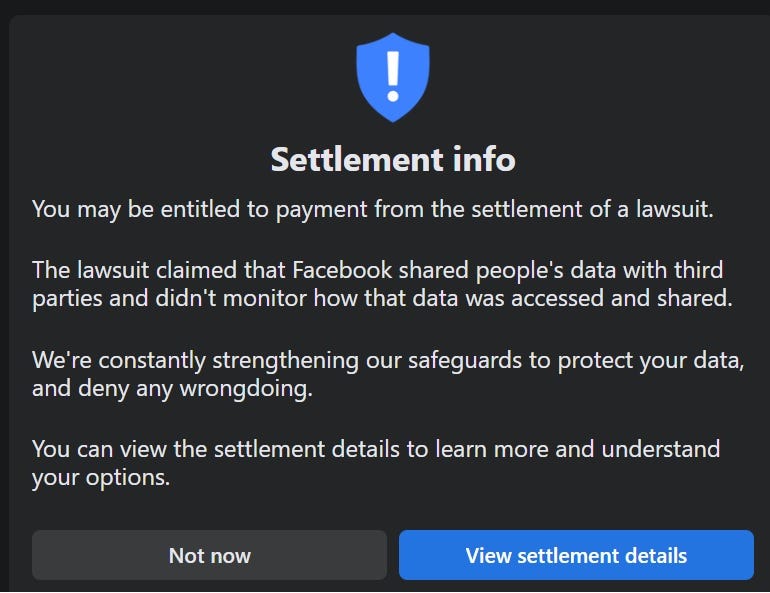
Facebook has been ordered to inform US users that they’re eligible to be paid if active between 2007 and 2022. The Cambridge Analytica case has been settled.
As a business and systems analyst with a background in tech, I promise you — data sharing, theft, and sales have been going on since before you ever uploaded your photos and family’s personal details.
After a long court battle, Facebook has been ordered to inform the social media platform’s users — you — that you are now eligible to join in a class action lawsuit settlement agreement which will pay damages for not protecting your data.
This piece addresses the following questions:
- What and who is Facebook?
- What is the lawsuit about?
- How does it relate to the Trump / Clinton election?
- How was Facebook at fault?
- How can you protect your private information on Facebook?
- How much will this settlement pay me, and how?
[pardon me… Please scroll to the bottom so the writer gets credit for the read. If you listen to this piece, please leave the original work open and scroll to the bottom to acknowledge the writer’s contribution. The author regrets the need for this commercial break and will now fade into the background, gracefully.]
What and who is Facebook?
Facebook is the largest social media platform in the world, with billions of people using it monthly. This means roughly 37% of the world’s population are Facebook users. While America and Canada represent the largest source of revenue, other countries have the most users. According to Meta Reports Fourth Quarter and Full Year 2022 Results, the US and Canada account for just a small fraction of Facebook users compared to those in the Asia Pacific, Europe, and the rest of the world.
“Our community continues to grow and I’m pleased with the strong engagement across our apps. Facebook just reached the milestone of 2 billion daily actives,” said Mark Zuckerberg, Meta founder and CEO. “The progress we’re making on our AI discovery engine and Reels are major drivers of this. Beyond this, our management theme for 2023 is the ‘Year of Efficiency’ and we’re focused on becoming a stronger and more nimble organization.”
Facebook makes money by selling ads, data, and is reportedly pursuing a paywall with monthly subscriptions.
Media has a significant impact on American’s opinions as it plays a crucial role in shaping the way people perceive events and issues. According to a survey conducted by Pew Research Center, 65% of Americans get their news from social media platforms such as Facebook and Twitter, and 55% from television news.
Content originating anywhere may turn up on Facebook. This includes clips from Fox News, Twitter postings, Instagram, and stories published elsewhere. Facebook and its parent company Meta are responsible for the content and any potential harm to users.
While Facebook appears at first glance to be a fun socializing opportunity, it’s a company dedicated to shareholders expecting a profit.
As Facebook account holders, you’re users, not customers. Advertisers and those who pay for data access are paying customers.
In 2022 Facebook Statistics shows annual revenue dipped for the first time in the company’s public history, dropping from $117.9 billion to $116.8 billion. Facebook has 2.9 billion monthly active users. For the first time since it launched, user growth stalled in Q4 2021.
What is the lawsuit about?
California-based Meta, the parent company of Facebook and Instagram, has the world’s largest number of active accounts on social media platforms. The Silicon Valley tech giant is responsible for keeping your data safe. After Europe, California has led the way in e-commerce regulations, privacy laws, and data security initiatives.
A class action lawsuit was initiated after Cambridge Analytica obtained Facebook user data that was used as part of the 2016 Presidential election.
Since Facebook’s inception, they’ve shared users’ data, had it hacked, and sold it. This breaks the law and puts customers at risk of identity theft and other cybercrimes.
According to California court’s Second Amended Consolidated Complaint in 2018, journalists uncovered that Cambridge Analytica, a British political consulting firm, paid a Facebook application developer to collect and analyze the content and information of approximately eighty-seven million Facebook users (the “Cambridge Analytica Scandal” or “Scandal”). Cambridge Analytica then used this data during the 2016 election season to target voters and lobby them, both on and off Facebook, with messages about political candidates.
How does it relate to the Trump / Clinton election?
Conservative philanthropist Rebekah Mercer joined a number of other Republican strategists hoping to help Donald J. Trump in his 2016 election bid for President. She had helped organize and fund a super PAC organized to promote the Republican candidate earlier.
How One Family’s Deep Pockets Helped Reshape Donald Trump’s Campaign (Published 2016) discloses:
Mr. Trump’s new campaign manager, Kellyanne Conway, is a veteran Republican pollster who previously oversaw a super PAC financed by the Mercers. Mr. Bannon oversaw Breitbart, an outlet that has often amplified Mr. Trump’s message and attacked his perceived enemies. Mr. Mercer reportedly invested $10 million in Breitbart several years ago, and most likely still has a stake: A company sharing an address with Renaissance Technologies, the hedge fund Mr. Mercer helps lead, remains an investor in Breitbart, according to corporate documents filed in Delaware.
Mr. Trump is also relying on Cambridge Analytica, a voter data firm backed by Mr. Mercer, whose staff members are working with Mr. Trump’s vendors to identify potential Trump supporters in the electorate, particularly among infrequent voters. A Mercer-backed super PAC supporting Mr. Trump is now being shepherded by David Bossie, a conservative activist whose own projects have been funded in part by the Mercers’ family foundation, according to tax documents.
Following his investment in Breitbart, Robert Mercer invested another $15 million in London-based voter-profiling company Cambridge Analytica. The New York Times piece from March 17, 2018, reported:
The firm had secured a $15 million investment from Robert Mercer, the wealthy Republican donor, and wooed his political adviser, Stephen K. Bannon, with the promise of tools that could identify the personalities of American voters and influence their behavior. But it did not have the data to make its new products work.
So the firm harvested private information from the Facebook profiles of more than 50 million users without their permission, according to former Cambridge employees, associates and documents, making it one of the largest data leaks in the social network’s history. The breach allowed the company to exploit the private social media activity of a huge swath of the American electorate, developing techniques that underpinned its work on President Trump’s campaign in 2016.
How was Facebook at fault?
By law, Facebook is required to keep people’s confidential information private. In addition to the networked posts you may recognize as semi-public, Facebook keeps private details about each person who has an account.
As a default, Facebook collects data including names, phone numbers, email addresses, people and groups you follow, those who follow you, group affiliations, what you buy, the videos you watch, and websites you’ve visited.
Other social media platforms, as well as various websites, gather and may share personal data related to site visitors. While illegal, it’s a nasty little well-known secret that customer lists are shared, stolen, and sold.
Michael X. Heiligenstein reported in the Firewall Times on April 6, 2023, Facebook Data Breaches: Full Timeline Through 2023, the company has experienced multiple data breaches of hundreds of millions of people over the years. Founded in 2004, the $5 billion fine represented bad or negligent acts dating back to 2007.
In 2019 Facebook was fined a $5 billion penalty by the Federal Trade Commission for deceptive practices involving the use of cookies and Privacy Restrictions dating back to 2007. This was a separate investigation from the Cambridge Analytica inquiry.
How can you protect your private information on Facebook?
Everything you do online is tracked by Facebook using cookies and other advertising tools such as Beacon.
Don’t panic — by law you have the right to control what tracking takes place. On Facebook, you can change online tracking by modifying Privacy Settings.
You can access your Facebook and Instagram (Meta) data, make changes, and clear your history by going to settings.
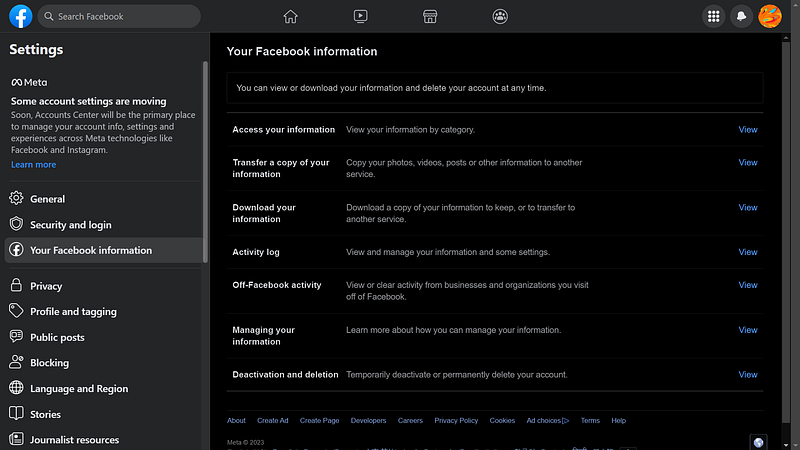
After changing your privacy settings, check your Activity Log and clear the data being stored.
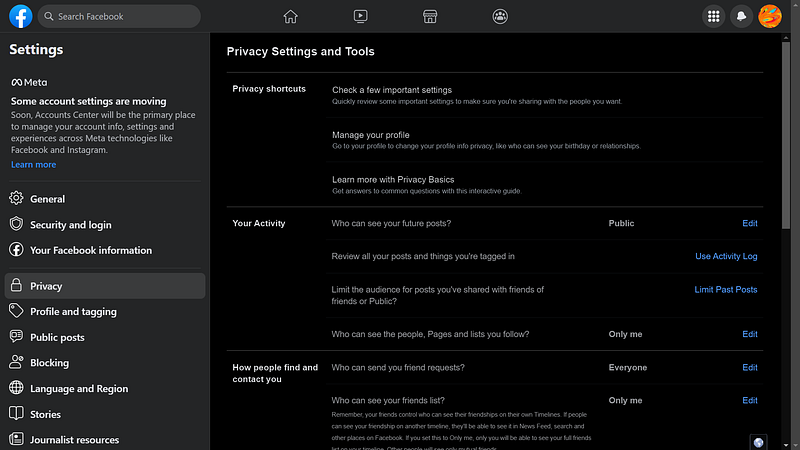
Since Meta owns both Facebook and Instagram, changing settings for both platforms can be accomplished via the Facebook windows shown above.
You should also take time to update the privacy and activity logs kept under your browser. Both Chrome (Google) and Microsoft (Edge) use cookies and other methods (aka Beacon) to track online activity and link your phone, banking information, and other browser information.
Each website visited stores cookies on your browser that can be cleared all at once, or individually.
How much will this settlement pay me, and how?
In theory, if every eligible Facebook user submits a claim, each person would likely get less than $5. While the settlement is large, so is Facebook’s user base. In a 2021 Pew Research Center survey, 69% of U.S. adults answered “yes” when asked if they ever use Facebook.
As the FTC has demonstrated the government is willing to fine the world’s largest social media platform in a big way. In 2019 a $5 billion fine — over 20 times the amount ever awarded before was levied.
The fine and settlement amounts are not linked. The settlement amount owed is around $760 million.
If you want to get in on the action, you can go to the claim website to fill out your claim, or print out the claim and mail it to this address: Facebook Consumer Privacy User Profile Litigation, c/o Settlement Administrator, 1650 Arch Street, Suite 2210, Philadelphia, PA 19103.
The Claim Form must be submitted no later than August 25, 2023.
Thanks for reading!
Join Medium for a low $5 monthly fee, a small portion of which helps me meet monthly expenses at no cost to you. @pmemphis5421/membership
And, some silly stuff to make you smile.


