
AI Detection: 12 Ways to Identify Machine-Written Student Essays
How to distinguish human writing from ChatGPT
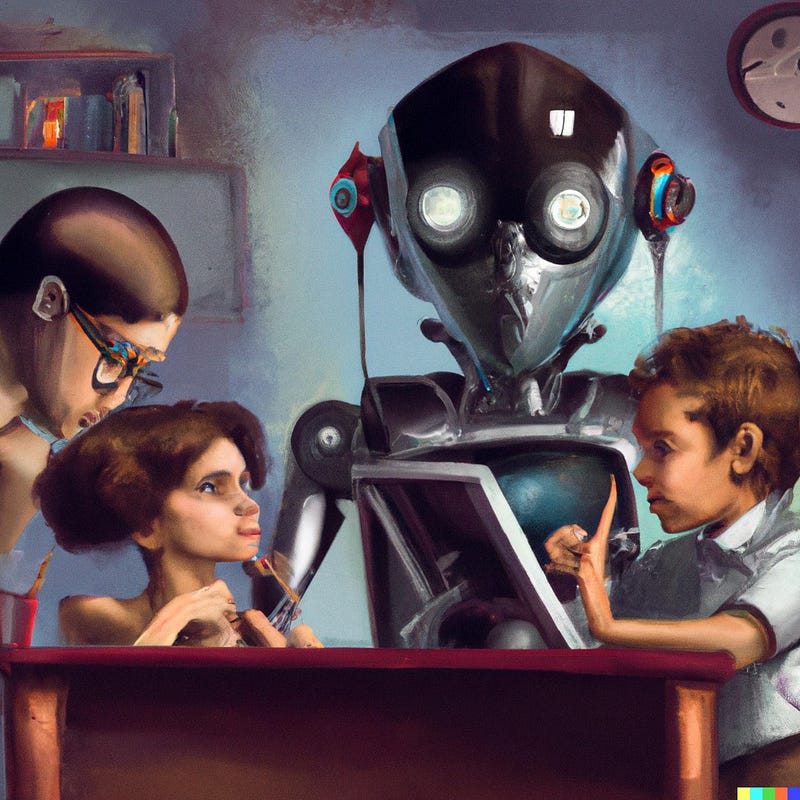
An educational tool to help parents and teachers detect the use of AI-generated text in schoolwork using critical thinking. I also introduce AI detection software.
[Updated 5/28/23 to reference Google’s SGE (Search Generative Experience AI) instead of Bard]
For discussion purposes, ChatGPT refers to the Artificial Intelligence tools in version 4 and lower, available through OpenAI, Google’s Experimental Search Generative Experience, and Microsoft Bing.* While all three tools use similar design structures and processes, the application results will vary.
A number of ChatGPT AI tools have been released to the general public since the end of 2022, to both great acclaim and great concern. I’m in both camps—thrilled at the prospect of advancing access to knowledge, dismayed over the possibility kids won’t develop the intellectual tools needed to succeed in life if they don’t have to study and learn.
Caregivers and teachers should familiarize themselves with the latest AI text generation tools. Becoming familiar with ChatGPT will help you recognize the style, evaluate the content, and see what’s missing in the writing you’ll be checking.
The only foolproof way to prevent kids from cheating on assignments using AI is to prohibit them from accessing the tools. Keeping them off the internet is impossible, so we need to turn to AI text detectors and look at student study habits and behaviors.
Surreptitiously checking over your student’s shoulders to see if they’re using a search engine like Google or Bing rather than parked on the ChatGPT website isn’t enough. The AI tool has been integrated into or replaced some search engines as of May 2023.
Google’s early release of SGE is incorporated into the search engine, so it may not appear different than a standard Google search.
Good news, there’s AI-inspired competition!
Most computer scientists are clever, creative, and competitive people. Like small children, we love building systems, but sending them crashing to the ground is satisfying, too. The more assertive software engineers push one another for bragging rights. Challenges such as, “If you can make it, I can break it.” and “I can make it better, faster, cheaper.” abound. If one group builds it, another will be competitive in breaking it down, or at a minimum, result in marking and unmasking.
AI-generated text detectors
There are a number of websites offering the cut-and-paste capability for testing text to determine if it’s likely AI-generated, but as of this writing, most are primarily structured for earlier versions of GPT. For that reason, I’ll just mention the two I’ve worked with and believe in.
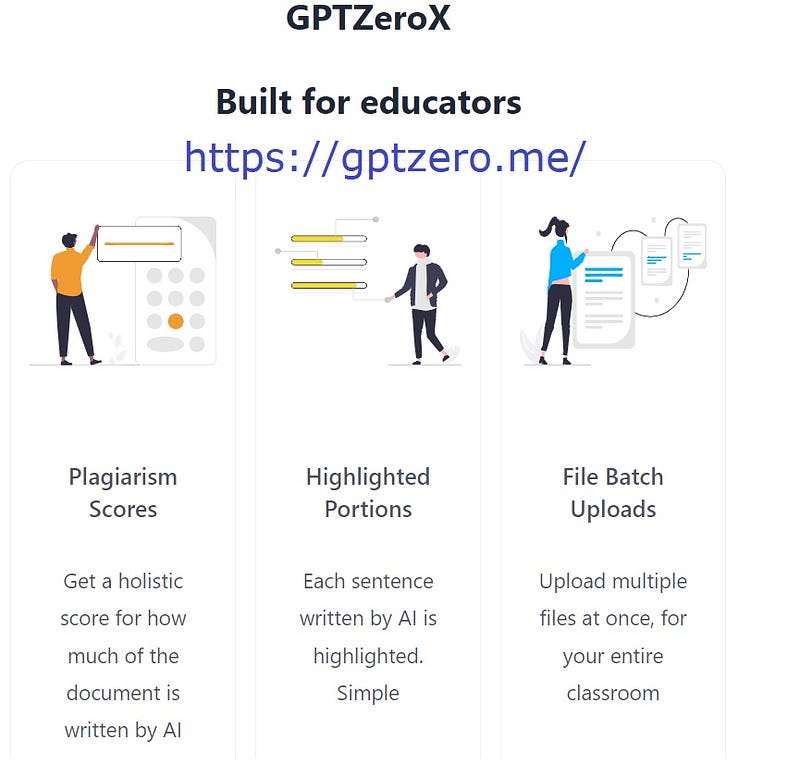
GPTZero is the world’s leading AI detector, developed specifically for educators. It’s an attractive site and company, but I have some hesitation to recommend it due to its privacy protection policy. I’d like clarification on “Cookies and other data collection methods”, which are used for advertising, tracking, and website analytics. The website doesn’t offer easy opt-out options, a legal requirement in California and Europe.
While simple testing of the GPTZero classifier is free, more advanced options are not. (https://gptzero.me) Leading the effort to provide a valuable tool in times of social change or upheaval is desirable, but the company doesn’t appear to have the necessary administration, yet.
edit 5/29/23: I’m following this company’s progress with interest, and see they’re partnering with other companies and hiring people who will help make the future of this company more secure. Cookies, privacy policy, and contact information now appear on the website.
Microsoft has added a plug-in to Word allowing access to GPTZero through an add-on in their Marketplace.
GPTZero announced the availability of a Google extension as well.
OpenAI, the developer of the popular tool ChatGPT, has its own team of developers writing and testing tools designed to detect the AI-generated text that fellow employees fine-tune down the hallway.
Testing the tools
Copy 1500 words (this document is around 1800) and try out the classifier.
In my tests, I prompted ChatGPT to discuss future AI development projects.
After copying the original AI-generated results and pasting them into the test detector, the verdict was yes, the content is most likely AI-generated.
Back at the ChatGPT prompt, I typed, “Again, in the style of George Carlin.”
I copied the amusing response and pasted it into the detection tool.
OpenAI’s classifier returned the result "unclear", meaning it couldn’t tell.
Well, crap. That didn’t take a lot of effort to fool.
Surely, teachers and parents would notice if their kid turned into a potty-mouth version of George Carlin doing AI standup.
Unfortunately, the results from ChatGPT were pretty impressive when I modified the prompt to get results that sounded like they were from an eighth-grader.
It’s my opinion that the mimic feature should be disabled in this release of the software. I write about that in another post.
[Follow-up. During the May 2023 Senate hearing on AI Rules & Regulations with OpenAI’s CEO Sam Altman, the mimic feature came up as a copyright infringement on original content creators, like recording artist Garth Brooks, whose work was used to train AI. Written works, social media content, and images are also an issue.]
Look for What’s Missing to identify AI content.
To identify AI, look for what’s missing in a person’s writing. The AI tool was designed to use language to impart knowledge. Without human characteristics, it won’t make human mistakes.
ChatGPT is not going to perform as a person with a personality, unlike your child or student. Consider the authoritative tone of work — does it reflect your student’s shy or confident nature? Is it compelling and detailed, or more generalized? AI tools tend to generate 4 to 7 paragraphs of generalized overview.
Consider the age and normal skills of a child in this year of school. Errors are to be expected.
- AI won’t go into the weeds on tangents. It's purpose-driven, unlike kids with wandering minds. Fragmented thoughts and unexplored red herrings are human features.
- AI won’t include personal anecdotes. It’s basically a machine and has no physical or sentient experience. I recommend encouraging personal knowledge or experience related to a subject being studied.
- AI won’t tell you how it feels about a subject. While ChatGPT holds no opinions and lacks personality, it does insert a somewhat preachy “In conclusion, it’s important to remember that all people deserve to be treated with respect…” “Empathy” comes up a lot. Any perceived “equanimity factor” can be a clue that your still-developing-a-conscience seventh-grader used AI.
- AI isn’t a creative writer. You’re not likely to see alliterations or clever phrasing. “Cunningly cute”, and “Her eyes were like two shimmering pools of emerald,” may show up on junior high papers, but not if they’re written by AI. Similes and metaphors are for humans.
- AI won’t incorporate images. The current version of ChatGPT doesn’t support image processing. No interesting photos, drawings, or graphs. So, have your students include them. Maybe a logo or brand?
- AI maintains its tone of voice. When someone tries to incorporate AI-generated text into their piece, it’s usually pretty obvious. Identify changes in communication style when reading papers. Phrasing inconsistency is a big tell that AI text is being merged.
- AI won’t be sloppy. Whole thoughts, subjects, and reasons are presented throughout a piece, consistently. Or, they’re omitted throughout. AI is consistent in tone and won’t appear to rush toward the finish line. They don’t get sick of writing and decide not to put in point number 7.
- AI doesn’t normally source information. ChatGPT is designed to work by conveying information in a relaxed, conversational style. Despite trying, it’s hard to pin down a source of information, even “according to US Census Reports”. Bing’s version is better than OpenAI’s, but still doesn’t directly point to authoritative sources. Ask the kids for references and to source information.
- AI repeats strings of words used in prompts. AI tools incorporate prompt phrases into the response, repeatedly. For example, I asked for information on “the future of AI technology”. Those 5 words in that exact order show up repeatedly in the explanation. A person would switch the words around throughout a piece, but AI does not.
- AI won’t make normal errors: While AI tools are usually quite accurate in spelling and grammar, they can still make mistakes. You’re unlikely to see typos and transpositions. Lkie this is a human error.
- AI won’t always pay close attention to the content: AI tools are designed to generate text based on specific prompts or keywords. A clumsy prompt, like “I want to know about AI. Tell me about that.” may result in a response sprinkled with “about that”. Sometimes, when I’ve prompted using three keywords and two of those words typically go together when referencing x, I might get an explanation for x instead of y — which would have been appropriate had it considered all 3 keywords. If you notice a piece of writing is very focused on a particular topic or set of keywords to the exclusion of all else, it could be an indication that an AI tool was used.
- AI doesn’t process statistics well: As of this writing, ChatGPT is still getting things wrong when presented with constants like text and static scores and is asked to sort based on one or more numeric values. So, if the discussion is about the disparity in education funding, have kids include a list of the top and bottom 10 states based on Federal dollars invested in each student, with a graphic also showing the state economy and population. Sort based on investment per kid. Today, AI would fail in this.
- Bonus: ChatGPT often includes sentences beginning with “However,” and “Secondly,” ending with “In conclusion,”. Rarely do people speak or write this way. However, several months of intense interaction with a Large Language Model (LLM) can have an influence.
- Bonus #2 and warning: Despite the seemingly authoritative, trustworthy tone, ChatGPT makes a large number of mistakes about people, places, and things. Use reliable websites to fact-check. Recently, the AI tool twice created a summary of 5 fun things to do in a tiny town in Alabama with a population of 600, including shopping, dining, and hiking at a park. None of those things exist. When I challenged the response, it was regenerated naming the correct city. Wrong answers are common, so spot-check facts.
In conclusion, teachers need to include mixed media in lesson requirements. Ask for statistics, graphs, images, and discussion.
Ask students to summarize their papers. Throw in some “yes, and” prompts to get them to demonstrate they know more than what’s on the page. Ask them what their thoughts were when they wrote Sentence Number 7, the one right after the Battle of the Bulge. (Oh, oops — there is no Battle of the Bulge.)
Know that AI tools don’t produce the same results twice, so copying and pasting with a Google search, or comparing your student’s work to that of another to determine originality won’t work.
Conclusion
Identifying content generated by an AI tool can be challenging.
Dedicate some time and become accustomed to the tool(s) yourself, so you know what to expect.
View work while asking yourself, “Stripped of exclamation points, is this impersonal enough to qualify as a dictionary, encyclopedia, or Wikipedia entry?” AI responses, though designed to appear eager to help, ie, “Sure! I can do that!” are pretty easily identified once you’re familiar with the tool and recognize standard salutations and closings.
Monitor your children’s assignments, processes, and output. Strong deviations may suggest starting or stopping engagement with AI.
Keep in mind that your student/child is expected to make mistakes. It’s suspicious when they don’t.
Utilize AI detection tools when you’re not sure.
When ChatGPT was asked about the potential dangers of AI, the response included the reliance on AI for answers, the manipulation of public opinion based on AI bias, and a dependence on AI reducing the development of critical thinking and decision-making skills.
Because ChatGPT and other Large Language Models frequently produce errors, it’s important to use it as a preliminary research tool and not rely on it for advice, information, or direction.
Thanks for reading!
If new AI tools had personalities, they’d probably be rude, but funny.


