
20 Golden Tips on Writing by William Faulkner
“Don’t be ‘a writer’ but instead be writing.” From basic to advance about writing..
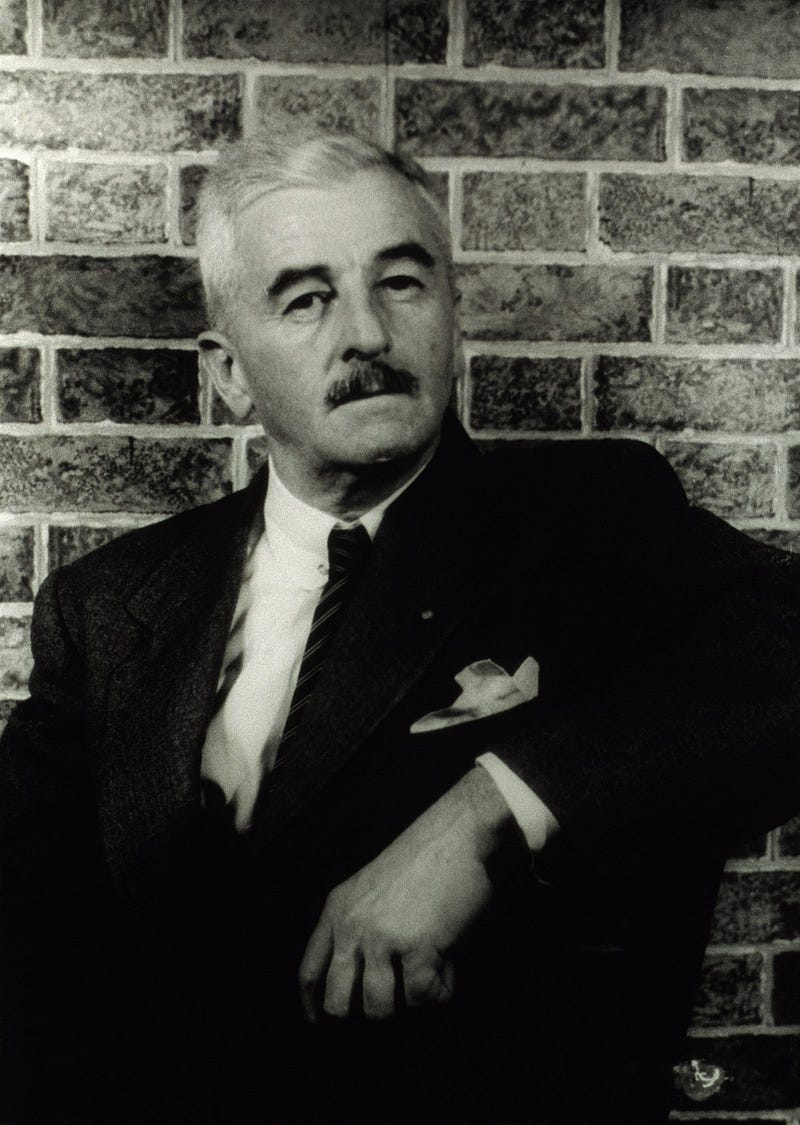
Who is William Faulkner?
Before seeing William Faulkner’s advice on writing, let’s find out who he is. If you want to learn just his important tips, you can pass here..
Willian Faulkner was an American writer born in 1897 in the state of Mississippi. His family was a traditional southern family of five children of whom William was the oldest.
His childhood was spent in the small town of Oxford, and the presence of that North American South, through his characters, his way of being, speaking and thinking, will later be noticed in all of the writer’s works.
During the First World War he joined the Royal Air Force as a pilot, but there are many doubts as to what his role was during the war given Faulkner’s natural tendency to fable.
His first jobs were in the bank of his grandfather, then as a painter (of walls) and then as a postman. In time Fulkner got jobs more related to literature, the first as a journalist in New Orleans.
His first novel, Soldiers’ Pay, was published in 1926. Later, he made a trip to Europe where he met, among others, his admired James Joyce.
When he returned to the United States, his next novels were set in Yoknapatawpha, a fictional territory created by the writer, which has inspired writers such as Onetti (to create his Santa María), García Márquez (his Macondo) and many others. .
The first novel that takes place in Yoknapatawpha was Sartoris in 1929, but it was followed by many other works (novels and short stories) in whose pages the lives of its imaginary inhabitants mix and mingle again, where paths cross and gazes multiply.
From the publication of The Sound and the Fury, Faulkner was considered a teacher. Meanwhile, he had married Estelle Oldham, with whom he moved to the small town of Oxford.
It must be said that although he was able to edit his works, he was never a writer too well known by the general public, and even today the average American does not know who Faulkner is.
For the next several years he made a living as a screenwriter in Hollywood, until in 1949 he received the Nobel Prize for Literature.
In his works the extraordinary command of language and technique stands out. The most conspicuous example of this is his lengthy sentences, sometimes three or four pages long, with numerous digressions, parentheses, and subordinate phrases. But the leaps in time and alternations in the narrator’s point of view are also dazzling.
In a way, his style was opposed to Hemingway’s style and his characteristic short phrases. They say that Hemingway sent him a telegram that said:
“I will change one of your long phrases for two of my short phrases”
However, other things united them: alcohol, the life they dedicated to writing, in addition to being and thinking like Americans.
Faulkner continued to write (and his production was very rough) until he died (until he returned to the land of that south that he loved so much) in 1962.
William Faulkner’s Tips
These recommendations are not only about writing but also about life.
1. Being a Writer
“Don’t be a writer, write. Being a writer is a state of motion and no progress. Writing includes movement, activity and life. The moment you stop moving, you die. It’s never too late to start writing; you can read as soon as you take it off. “
2. How Should We Write?
“Do it unprofessionally. Write for pleasure, not for money. Writing should be fun and exciting. Maybe you may not feel something while writing, but you should feel excitement and passion after your work is finished. Of course, this does not mean to be arrogant and to take devilish pleasure from the work that comes out while sitting at his head. This means you’re doing your best. Your next piece will be better. “
3. Technique on Writing
“If the writer is interested in technique, let him perform surgery, let the bricks knit. There is no mechanical or shortcut to writing. Young writers are foolish if they try to follow a theory. Educate yourself with your mistakes; People can learn something only by making mistakes. A good artist believes that no one is good enough to give him advice. He has great pride and arrogance. No matter how much he admires the old writers, he always wants to beat them. “
4. What’s The Best Way to Start to Write A Story?
“I would say the best start for this is to portray the character in your head. Once you have portrayed the character in your head, and the character is realistic and correct, then he will do all the work himself. After that hour, all you have to do is run behind him, write down what he did and what he said. So first you stomach the character, then you give birth. You must know your character. You have to believe him. You have to feel that he is alive and then choose some of the actions he can do that suit his character and feel comfortable with. After that, putting all this on paper is mechanical. Before you touch the pen on the paper, most of the article you want to write has already been lived and designed in your head. But the character must be true to your insight, ideas and experiences, and as I said earlier, this includes anything you read, imagine, hear, and give you the chance to measure the imaginary character you create. Once it comes alive and it feels realistic and important to you, it will not be that difficult to put it on paper. “
5. What Makes a Good Writer-Novelist?
“Ninety-nine percent talent… ninety-nine percent discipline… ninety-nine percent work. A good novelist should never be satisfied with his work. It can never be good enough. Imagine more than you can always get up and further engagements. Do not tire yourself to be better than your predecessors or your competitors. Just be better than yourself. An artist is a creature set in motion by his demons. He never knows why demons chose him, and he is always too busy to wonder about it. Subject work ethic when it comes to completing the definition does not recognize; until you complete the job can rob any, may request a loan from someone, beg or player, because it is a major responsibility of the author’s own art. If he is a good writer, he will be completely brutal. Do not forget that he has a dream. This should get rid of her so that her suffering is taken. Until then, he will never find peace. Honor, pride, kindness, safety, happiness, everything is thrown aside until you complete your book. He even steals from his mother if necessary, because “Ode on a Grecian Urn” (a famous poem by John Keats) is worth all old women. “
6. When Should We Stop Working During The Day?
“The only rule I have on this is to quit working while it’s still going very well. Never exhaust yourself. Leave it when you are always doing well, have ideas yet, and are not tired. Thus, it is easier to reconsider and write. If you tire yourself, then you will be caught in a death spell and you will be in trouble. What did they say, “Leave them while they still look good.”
7. Working on The Dialect and Accent
“I think it’s best to use as few dialects and accents as possible, otherwise people who are not used to them will get confused. No one should allow his character to speak entirely in the accent of where he belongs. It is best to reveal it in a dialect or accent that everyone can understand, with small touches scattered here and there.”
8. About Character
“Truth comes from the heart of man. Do not try to present your own ideas to the reader. Instead, try to describe your characters as you see them. Take any feature from someone you know, take another feature from another, and create yourself a third person that people can see and understand when they look at it. ”
9. Ages of The Target Audience
“The best writing age for the novel is from thirty-five to forty-five. Your life energy has not been used that much yet, and you know a lot more. Editing a novel is a slow process. The best age for poetry is seventeen to twenty-six. Writing poetry is like a rocket flying into the sky, and you have to use all of your life energy to take that rocket up into the sky. ”
10. Writing Style
“I did not develop my own style. I think the thing called style is just one of the tools in our profession. I think writers who spend most of their time finding, developing, or following a style don’t have much to say. They know this, are afraid of it and thus develop a style, an extraordinary treasure. Then they become a Walter Pater, which is beautiful but not much in it. I think style is simply one of the tools we use in making this craft. The story you are telling dominates its own style, so if one writing style is good for today, another will be better for tomorrow. I would also say you should be ready to imitate like a good carpenter… but I think the style is pure coincidence. ”
11. Writing The Truth
“The tragedy of our time is a general and universal physical fear that has existed for so long that we are all able to bear it. There are no mental problems anymore. There is only one question; When will I explode? That is why all young writers, male or female, have forgotten the problems of the human heart that are in conflict with itself.
However, all of these can create a good summer on their own, and they can produce works that are worth your pain and the sweat you spill.
The person who wants to write must learn them again. He must teach himself that fear is at the heart of everything. After achieving this, the human heart should be able to forget everything but the truths and truths forever, and leave no room for anything else in the study room.
He should know that a story that is not made up of universal truths is doomed to be short-lived and to die: love and honor, pity and arrogance, compassion and sacrifice. He works under a curse until he finds out. It talks about lust, not love; writes defeats in which no one loses anything of value; writes hopeless victories, and worst of all, there is no mercy or mercy in his work.”
12. How Should We Choose The Title?
“I’m not sure if there are any rules about long titles. I think the short of everything is acceptable. I think stories often give their own names. Yes, the shorter the better. “
13. About Failure
“We’ve all been unsuccessful in trying to achieve our perfect dream. So I judge us with the magnificent failure we have experienced while trying to achieve the fundamentally impossible. If I could rewrite all of my works, I’m sure I could do better, which is the healthiest situation for an artist. This is why it keeps working, trying again; believes that he can succeed, overcome this time, every time. It cannot achieve this, of course, this is what makes this situation healthy. Once he succeeds, once he brings the work at hand to the perfection of his dreams, all he has is an imaginary knife cut in his throat. He jumps down from the peak of perfection, he commits suicide. I am a failed poet. Perhaps all novelists want to write poetry at first, but realize they can’t. Then they try to write short stories, which is the genre that requires the most experience and skill after poetry. They try to write a novel only and only after they fail him.”
14. When Inspiration Strikes, You Should Write at That Moment
“You can always find time to write. Anyone who says he has no time to write is deceiving himself. Of course, this depends on inspiration. Don’t wait. If inspiration comes, write. To capture that moment again and to improve and decorate your writing, do not leave this work for later or a time when you have more time, because you may never capture that moment and its vitality again.”
15. What Are The Needs of A Writer?
“The environment that an artist needs should be a place where he can experience all kinds of peace, all kinds of solitude and meet all kinds of pleasures without paying too much money. A wrong environment raises blood pressure, spending most of his time full of frustration and anger. In my experience, all I need is paper, cigarettes and some whiskey. The writer does not need economic freedom, all he needs is paper and a pen. I’ve never seen anything good written with the money donated to you. A good writer does not apply to any foundation or organization. He’s already too busy writing. If he is not a first-class writer, he will deceive him with excuses such as economic freedom or not enough time. Thieves, smugglers or even horse thieves can make good art. People are really afraid to see how hard or poverty they can take. They are afraid to learn how tough they are. Nothing can destroy a good writer. Death is the only thing that can destroy a good writer.”
16. What is The Most Important Need of The Author?
“A writer needs three things; experience, observation and imagination. Two of these, or sometimes one, can make up for the absence of others at some moments. For me, a story usually begins with a picture, an idea or a memory that I envision. Writing the story is simply telling what happened or what caused it, what caused the event. A writer tries to create characters (human-like, detailed, changing) as much as possible in convincing and ongoing situations. It is clear that one of the tools he should use while writing is the places he knows. Since it is one of the oldest experiences in human history, I would say that music is the easiest way to convey feelings. However, since my talent is about words, I must clumsily express in words the feelings that pure music can express to a person much better. “
17. Being Unlimited
“There should be no limit to what a writer tries to write. He should write the subject as far as he knows. In other words, he can write things outside of his experience, but what he knows is still limited by his experiences and what he observes. But there should be no limit to what you can and cannot try. The higher the target, the better. If he wants to fail, at least let him be a good failure; pathetic, not a little one.”
18. Small Changes on Writing
“You may have added a few extra words with the fire of writing. If the words still seem right to you when you go over them, just leave them alone.”
“Probably not worth writing any story that cannot be told in a single sentence or at least a paragraph. Passing over, cutting out… -at least in my case, which I am lazy. Since I do not like to work, I do things in my mind as much as I can and think thoroughly before I take the job of crushing paper with that hard, hateful pen … I think that it is often necessary to revise what you have written because when you finish writing, the work you are writing is still far from where it should be, this So you can revise it, edit it, try to bring it closer to the ideal perfection that it should be, so no matter what you do, you won’t be able to do it. What I’m trying to say is that revising a work is more important for the author himself than for the reader as the editor revises.”
19. Read Other Posts First Before Writing
“Read, read, read. Read everything; trashy books, classics, good and bad works. See how they are written. While a carpenter develops his talent, he does this by observing others. Read on! You will absorb. In summer. If it’s good, you already know that. If it’s not good, throw it out of the window.”
20. Finding a Job
“Don’t make writing your business. Find another job so you have enough money to buy the things you want in life. It doesn’t matter what you do unless you rely on money and have a deadline for your writing. No matter how long your job takes, you will find a lot of time to write anyway. I have never known anyone who has not had enough time to write what he wants to write.”
While writing these recommendations, i added some additions and deletions to explain them better. Which advice did you like the most? Write it down on a piece of paper and paste it on your desk..
Source: 1 2 3 4 5 6 7 8 9 10 11 12 13 14 15 16 17 18 19 20 21 22 23


