
2 types of product managers — experimental or follower — Google vs. Apple
All successful product managers use data to make decisions — some are just better at calling it vision and intuition
A while back, I hired a new product manager to my team.
She had a strong sales background and in the interviews, she proved strong product sense and a good understanding of what she will be taking on if she took the new role.
After she joined, I asked her to build her first business case for a new feature we were thinking about —the business case should have data, assumptions and a model (actual projections).
“But how do I know the potential takeup rate for this feature?” — She asked.
“Use a proxy. A similar feature we offer or someone else in the market offers and extrapolate from that” — I answered.
“But this feature is very innovative, I don't have any proxy, what do I do?” She replied.
“Congratulations, you found where you need to find more data, you found where you need to test and experiment — once you have enough data so not to just guess, the case is probably ready” — I answered.
Then, I took her through the simple concept of de-risking an idea by learning more.
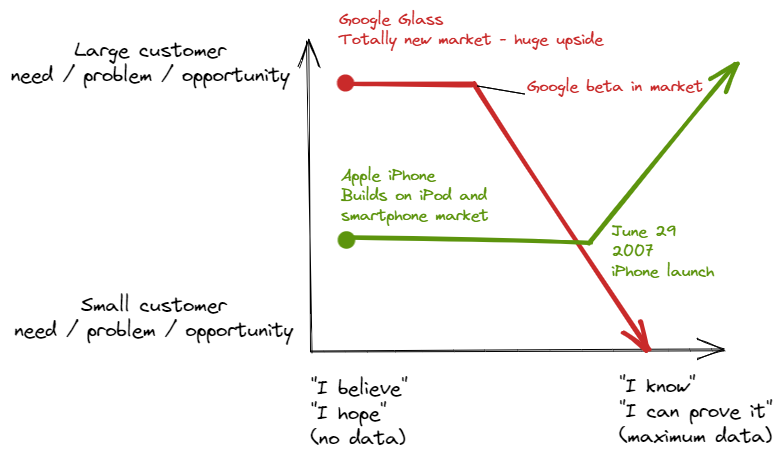
You start with a hypothesis on how well the customer will accept the new feature and test till you get enough certainty to push it forward.
By collecting data and information (tests, surveys, prototypes, proxies, interviews etc.), you de-risk your idea. Either you learn it works and you build and accelerate, or you find that it does not and you cease and desist progress.
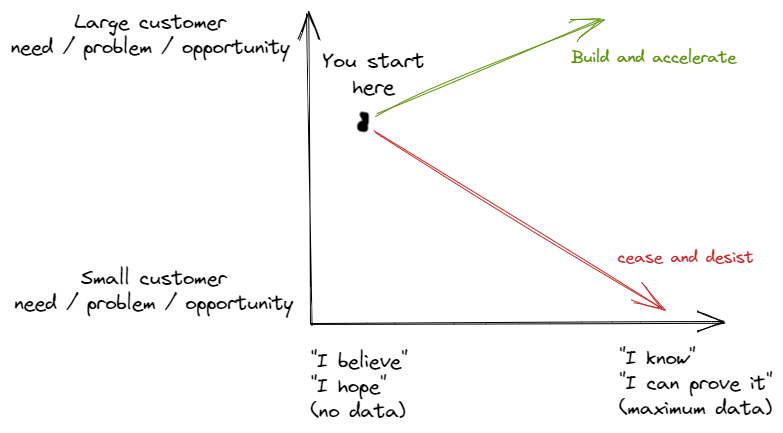
The more you move from the left side of “I believe” (huntch, opinion, bias) to the right side (“I know”, “I can prove it”) the more certainty you have, the more you de-risked your product.
Product management is a function meant to integrate new information and make decisions based on it
Product managers exist to make decisions and facilitate their implementation.
Decisions are made based on information and data. The information and data can be an opinion and hunches (i.e. biases) or actual data and information.
If an organization does not have access to a lot of information and data, it operates based on opinions and hunches. The more data and information an organization has access to, the more decisions need to be made.
The more decisions need to be made, the more product managers an organization will need (or choose not to use the information and ignore it — that is also a decision).
No product person is superhuman to routinely project where the market is going and what customers need in absence of hard data.
Even Steve Jobs failed before succeeding with the iPod, iPhone and others (Next computer, Apple III computer, Pixar Image Computer to name a few).
So how do product managers get this data and information to make proper decisions?
There are two ways to get more data:
- Learn from others (Proxy)
- Learn yourself (Experiment)
Most successful “Learner from others“— Apple
Apple has been following the market with most of its big reveals and launches — the two most famous are the iPod and the iPhone.
For both products, due to confidentiality and overall Apple’s marketing brilliance, no customer testing was done.
Apple followed the market by launching the iPod in 2001, four years after the first MP3 player was already out.
Apple launched the iPhone in June 2007, at least 5 years since a smartphone was already in the market as Blackberry already launched in 2002.
Steve Jobs and his Apple team had plenty of opportunities to see what was working in the market, and mostly, what was not — they used other companies' moves to let them gather the data.
At a certain point, a new feature was hypothesized to solve a problem Steve Jobs and his team identified with the existing products in the market. The feature was developed and a new product was born.
— in the case of the iPod it was the “hold 1,000 songs in your pocket”, intuitive design and large capacity. The iPod’s technology was not revolutionary and was merely competitive with the existing MP3s in the market — the design of it made the difference.
iTunes did not launch with the iPod in 2001 and was launched two years later. When iTunes came out it started the revolution of the music industry and drove the iPod to be remembered as a massive success. But even iTunes was not a new idea — it followed Napster.
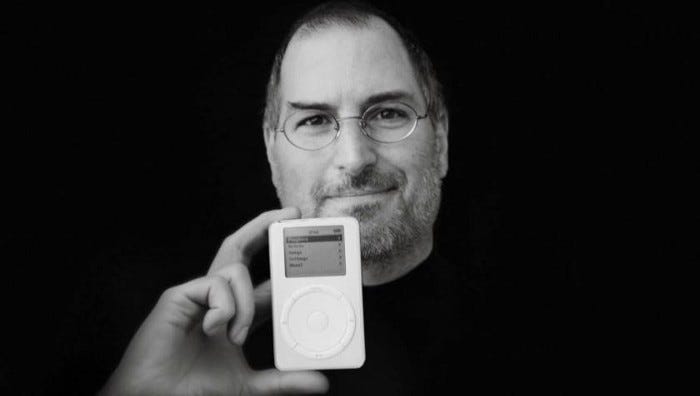
— in the case of the iPhone it was the combination of both the iPod and a smartphone with the removal of a physical keyboard all in one device.
Meaning, take 2 concepts that are already working in the market (smartphone and iPod), put them together and bet on one thing — the touchscreen keyboard.
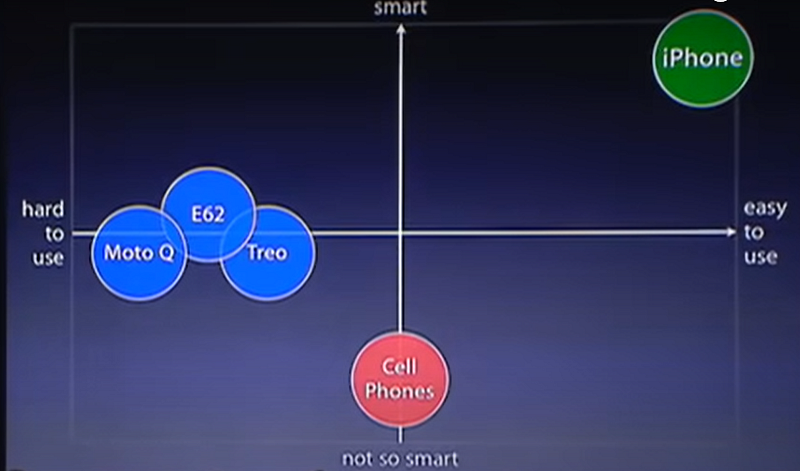
In other words — use data that the two products work and put a bet on an additional feature. When it worked, we got the iPhone and the iPod. When it didn't work, we got the Next computer, Apple III computer, Pixar Image Computer.
Steve Jobs was a master marketer and drove significant hype into the product — but both the iPhone innovation and the iPod innovation were incremental, i.e. take something someone else did and make it better.
“Does it live up to the stratospheric hype? Not so much. Don’t get us wrong, the iPhone is a lovely device with a sleek interface, top-notch music and video features, and innovative design touches.… But a host of missing features, a dependency on a sluggish EDGE network, and variable call quality — it is a phone after all — left us wanting more. For those reasons, the iPhone is noteworthy not for what it does, but how it does it.” — CNET, 2007 original iphone review
iPhone was developed with no customer testing — did Apple need a Product Manager?
If you take a closer look at how the iPhone was developed, you see no customer testing was done. The use of data to make decisions was based on:
- Steve Jobs's opinions (not customer data)
- Existing market data and technology expertise (Smartphone and iPod)
As described before, the product manager’s role is to make decisions.
Decisions are based on information and data. But in the case of the iPhone, the information and data were existing market data (iPod, Smartphones) and Steve Job’s opinions.
As no customer data was being captured beyond that, there is absolutely no need for a full-time product manager.
There were no product managers associated with the iPhone development.
The product management function was split among the team and mostly Steve Jobs.
As Apple did not do customer testing, its derisking was limited to the internal people of Apple. This means that Apple made small bets based on large market data (other companies' experience) and then used its marketing brilliance to succeed.
Meaining, if you cannot use customer feedback directly, you rely on other companies’ customer feedback and cannot make large bets.
The “Experimental” tester — Google
In absence of market precedent, the only way to actually win is to test yourself.
If Apple and Steve Jobs had the benefit of watching successes and failures for years before they made one bet (and we can argue how big that bet was), Google and its Google-Glasses didn’t.
So what did Google do? What Google does all the time — Beta it.
Launch a prototype and test it out. Why? Because there is no other way to progress across the “data axis” or to de-risk the product.
The only problem with products that cross into the physical world, is that experiments are rather expensive.
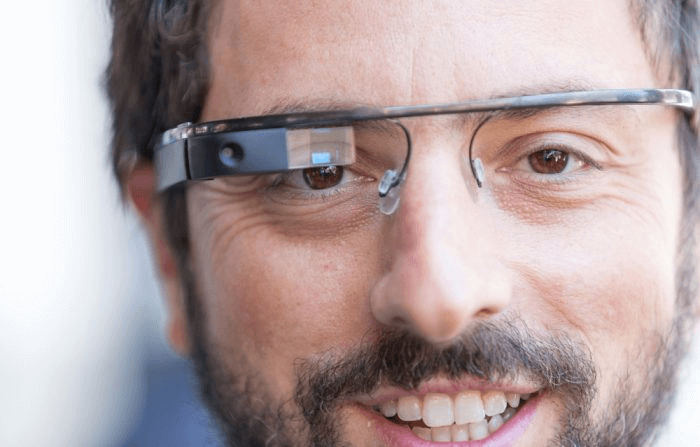
Google experiment of the Google Glass failed but there was no way to tell it will happen before the test.
Any tech or digital product manager has experienced it — it is just bigger and more expensive when done with hardware.
If you don't use either of the methods, you are a gambler and the house always wins
You are using money to build your product.
If you make decisions based on “vision” without a true base in reality (data), you are essentially gambling money.
It is true, that some gamblers win in casinos and then they are celebrated as testimonials for the casino to attract more gamblers that will lose. These gamblers are the exception to the rule — in a similar manner you will not recommend for someone looking to become a millionaire to play the lottery as their best option.
Vision tells you where you want to go — data tells you how to get there.
If you found this post useful and you are a Medium member, please clap to it — the algorithm loves it and I appreciate it very much
Author
Yaniv Nathan is a transformational product leader that has launched at least three product shelves, and multiple features and successfully filed for patents in financial services and blockchain. He helps existing businesses transform their digital channels, their processes, and their product management practices.
Twitter: @PM_isBusiness| LinkedIn: Yaniv Nathan |Follow me: Yaniv Nathan


