
5 pieces of advice for a salesperson moving to a product role
Your people skills are a must, but your experience is also a liability — avoid common pitfalls

Breaking into product management can be hard.
Most entry positions for product management require “1–3 years of experience in product” which is not possible if you are not already in product.
There is no uniform path into product management roles, but three main talent pools usually transition into them:
- Designers
- Developers
- Salespeople
While the first two are accustomed to project-based, matrix-based and even agile scrum-based work, the salespeople are not.
If you are a salesperson and want to transition to a product management role, your job will be different from what you are doing now, with a few common challenges to all those moving from sales into product management.
Acknowledging these challenges in an interview can be very helpful to communicate you understand the product manager’s role.
From a single interaction model to constant context-switching
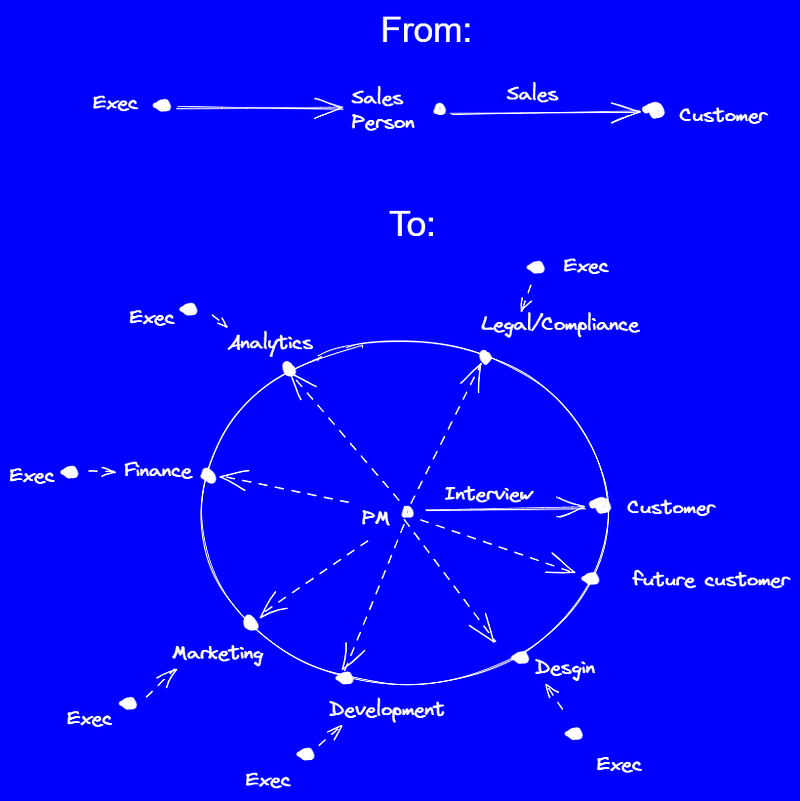
When you work in sales you deal with one customer at a time.
You get a first-hand view of all the current customer problems and you have deep knowledge of the current product.
This focus allows you to provide great value to the customer, one at a time.
Your team members are also doing the exact same thing — each of them with a single customer in every interaction. You are the product SME (subject matter expert) for the customer.
It does not matter how many salespeople are in your team — when interacting with the customer, it is almost always a 1x1 interaction — other salespeople will seldom join you.
This one-to-one relationship transforms into one-to-many on your first day as a product manager. This is referred to as “context switching” — you move from one type of internal customer to another, back-to-back, all day.
From one customer problem to everyone’s problems
The product you sold solved the customer’s problem. You were pitching one solution to one customer.
As a product manager, your day consists of pitching a vision and path forward to multiple people with multiple different problems.
Each of your stakeholders has its own boss. Each of them is measured differently. For each of them, the language of influence is different.
What works with your exec won’t work with the development exec or the finance exec as an example.
What works with your development team won’t work with the design team.
What works with your design team won’t work with your marketing team.
and so on…
You switch contexts all the time and you need to learn how your partners are measured and address that.
Simply identify their needs, as you did with customers, and address them.
When you start, interview your partners and understand what are their priorities and how are they measured — these are “the internal customers’ needs”
Your experience built your EQ but also your biases
When you interact with existing and prospective customers with today’s product, you learn how to best interact with people and strengthen your EQ.
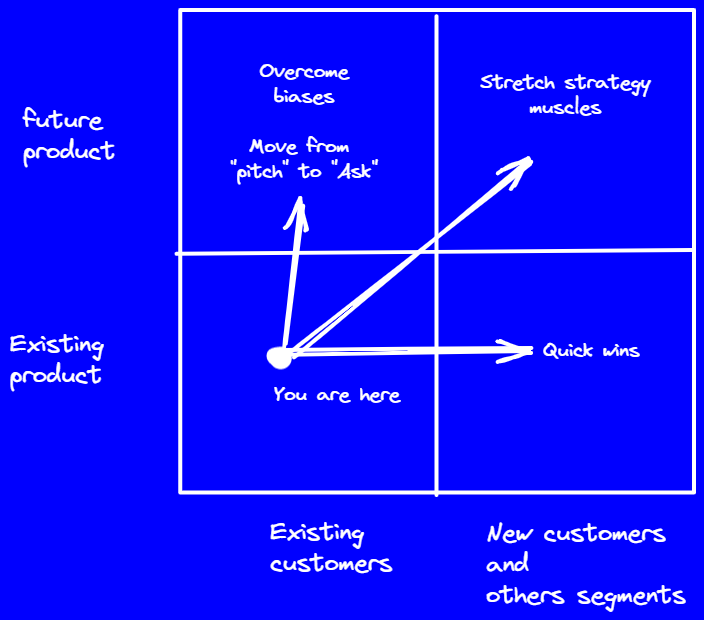
As a product manager, you will be engaging with multiple stakeholders, heavily leveraging that EQ capability to persuade and build relationships.
Your customer experience and knowledge can add immense value to the team in the short term and give you quick wins — albeit short-lived.
Your knowledge is a short-lived advantage because:
- You have built unconscious biases
- Market shifts fast and your past experience becomes stale
Engaging with customers on the existing product gives you an indication of how a few segments of customers interact with an existing product. This means it creates tunnel vision.
You are in essence, a one customer-survey with a biased selection of customers (selection bias by region, by industry, by age, by affluence or by the way leads were provided to you).
You have a rear view mirror as you experienced only existing and past products. Now you will need to look to the future as well.
In addition, your past emotional response to some customers (usually those with significant objections) will strongly bias your views as your memory will be formed based on it (see If memories can be engineered, so to can your annual performance reviews for the way memories are formed).
This means your view will skew towards some of the loudest customers.
Be aware of it.
To overcome that, your design team and research team can pull you up. Try to avoid defaulting to your knowledge as fact and position it more as a question or hypothesis. Train yourself to say:
“My hypothesis for this segment is ….. based on my experience”
If you position it like that, you are much more likely to be open-minded and win over your design and research team.
Your memory and experience will become stale very quickly as the market shifts and you will be much more reliant on the design and research team over time.
Your calendar invites are now sent to interviewees, not prospects
You are versed in managing a sales pipeline and you book meetings well in advance to cultivate a relationship and close deals.
You did most of the talking in those meetings. Now the opposite occurs.
Read Talking to Humans and pick up open-ended questions. Move from providing a solution (product) to finding the customer’s problem.
You knew the product well before — you were the expert. Now, the customer is the expert as they are the only ones who know their problems.
From easy-to-measure success to hopes, dreams and grit — welcome to ambiguity
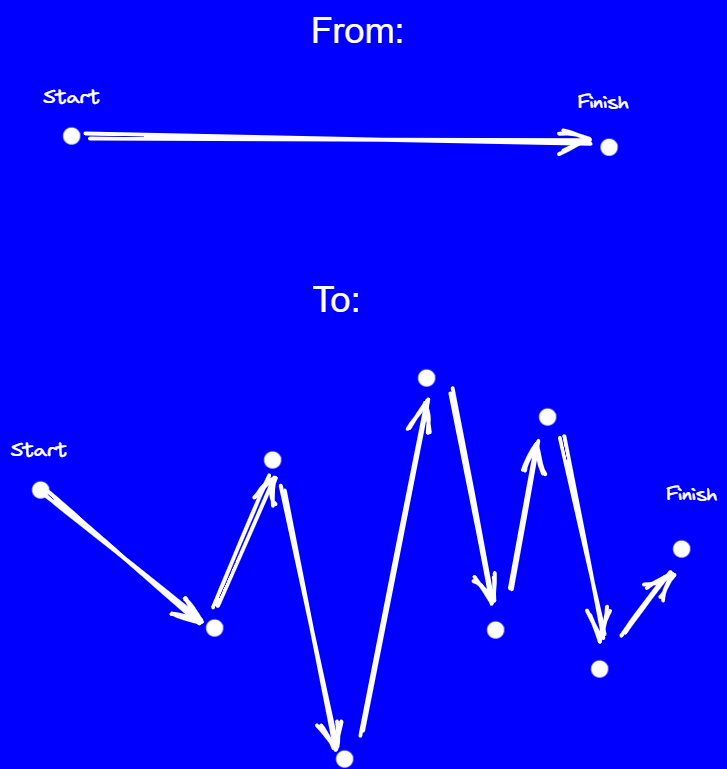
As a salesperson, you can count your inputs and outputs almost daily.
You have your pipeline of future sales and can easily count your meetings and advancement towards sales (inputs).
You have your closed sales and interactions (output and outcomes).
You can check your progress daily, weekly and monthly. You can easily benchmark yourself on the leader board against other salespeople and impress the boss with your results. Performance reviews are a breeze.
As a product manager, you operate in the exact opposite.
The only frequent measure you have for outputs is what was accomplished in the last 2-week sprint and that is not a very useful measure (measures “I was busy” not “I was impactful”).
Customer acquisition and retention cannot be attributed solely to you and you cannot easily point to them as your success.
Launching features is not the goal but solving customer problems.
Solving customers’ problems is very difficult to measure as it is in the eyes of the beholder.
If you launch a feature and get significant adoption, success will now be attributed to the entire team and not just you, if attributed to you at all — you need to get comfortable with that.
If you launch a feature and it fails — you own it. That’s the job.
If objection handling was the toughest part of your job as a salesperson, objection handling is your job as a product manager.
You will find yourself handling objections to every new idea that pops up and your internal customers are proposing to put in the backlog or prioritize.
You will be pitching the vision constantly and handling objections in group settings, not one-on-one.
Like it was with the customer, you have limited authority to “put your foot down”. It is an influencing game, not a command and control one.
You will have to handle friction when you pivot and keep the team engaged and happy. Your strategic influencing, charisma, and people skills will be stretched to the max.
Should you move from sales to a product manager role?
Yes.
There are very few jobs out there that wake you up in the morning with a sense of purpose as much as a product job.
You get to work with the smartest people there are.
You get to learn something new every day.
You get to impact thousands if not millions of customers.
Your job matters.
If you keep that in mind, all those challenges will actually be enjoyable — like a string of problems to solve.
Measure yourself by solving a problem each day
Problems can be simple:
- “This person does not understand that, I will teach them”
- “I need to learn what customers think about that”
- “I need to update this and that exec”
Take small steps each day to solve a large customer problem.
If you found this post useful and you are a Medium member, please clap to it — the algorithm loves it and I appreciate it very much
Author
Yaniv Nathan is a transformational product leader that has launched at least three product shelves, and multiple features and successfully filed for patents in financial services and blockchain. He helps existing businesses transform their digital channels, their processes, and their product management practices.
Twitter: @PM_isBusiness| LinkedIn: Yaniv Nathan |Follow me: Yaniv Nathan


