
2 Psychological Advantages Determine Your Success as a Freelance Writer
Most writers fail because they’re missing these two things.

Statistically, you can’t be a freelancer because most people don’t have what it takes.
While you swallow that one, here’s another hard dose of reality: most people don’t actually want to be freelancers. They just think they do.
Freelancing may have charmed you with its promises of unrivaled flexibility, autocratic independence, and boundless creativity. You can “be your own boss” and “work from wherever, whenever.” You can build a renowned brand, establish predictable income streams, and rake in ridiculous wealth. You can turn your passions into your career and finally feel like you have a purpose. At least, that’s the vision we’re sold, right?
In reality, that’s the shiny exterior of self-employment. It’s an outside-looking-in perspective that ignores the often emotionally crippling struggles and financial hardships.
The flexibility can be a veil. The independence can feel suffocating. Creativity isn’t guaranteed to pay the bills.
Freelancing is not easy. It’s not a one-size-fits-all solution to your problems.
It’s not a get-rich-quick scheme. It’s not even guaranteed to be a make-a-livable-wage scheme.
Even if you recognize these facts, you — more likely than not — won’t succeed because you need two vital psychological advantages.
If you don’t, freelancing might eat you alive.
You Need Nearly Impenetrable Self-Esteem
I’ve written about the preparatory steps people should take before transitioning to full-time freelance writing. Compiling samples and a portfolio to share with potential clients. Building a website to establish credibility. Saving a year of runway to maximize your chances of success. Landing a client to smooth the transition. None of these fully mitigates the biggest risk: emotional erosion.
Freelance writing is not for the faint of heart — your self-esteem needs to be nearly impenetrable. Here’s why:
Constant rejection
For starters, rejection isn’t just part of being a freelancer, it’s the norm. If 10% of your client pitches just get a reply, that’s considered pretty good. On the flip side, 90% of the prospects you email or message won’t bother responding to your pitches. Reading that fact might not deter you. Living it is another experience altogether.
Why? Beyond the obvious reason of “it sucks to get ignored or straight up denied,” there’s a time element you can’t simulate in your mind. You can pour hours into sending hundreds of personalized pitches, only to hit send and eagerly wait for a reply.
Except the reply doesn’t come. Days pass. You send a follow-up email, just in case your initial pitch was buried in a busy inbox. Sure, it happens.
Days pass. Nothing.
Weeks pass. Nothing.
Meanwhile, while you constantly check your inbox for that coveted reply, you either have to (a) keep pitching or (b) steep to insultingly low rates on platforms like Upwork just to make ends meet.
Sure, some writers get lucky. Other writers have distinct advantages going into the process — like work experience and network contacts in a well-paying niche. But, for the majority of writers, rejection is the rule, not the exception.
Imposter syndrome
I’m willing to bet the earnings of this article (which, full disclosure, probably won’t be more than a few dollars) that every full-time writer experiences some sort of imposter syndrome at least once, if not regularly. I’ve been doing this for years now, and I still slip into a maelstrom of self-doubt from time to time.
The worst part is that you can’t see it coming. It sneaks up and preys on you when your defenses are down. Imposter syndrome unleashes a barrage of self-defeating questions.
What if people hate my writing?
Why aren’t editors responding to my pitches?
What if I let my family down?
What if my clients see right through me?
Why haven’t I made more money yet?
Even if the questions are unfair and unjustified, you’ll wonder whether you know what the hell you’re doing.
Unrealistic expectations
It’s very easy to fall short of unrealistic expectations. Progress can take much longer than you anticipate. This, in turn, can contribute to the aforementioned internal avalanches of self-doubt. I’ll give you an example.
I set six goals for 2020. I accomplished two of them, but not for lack of trying.
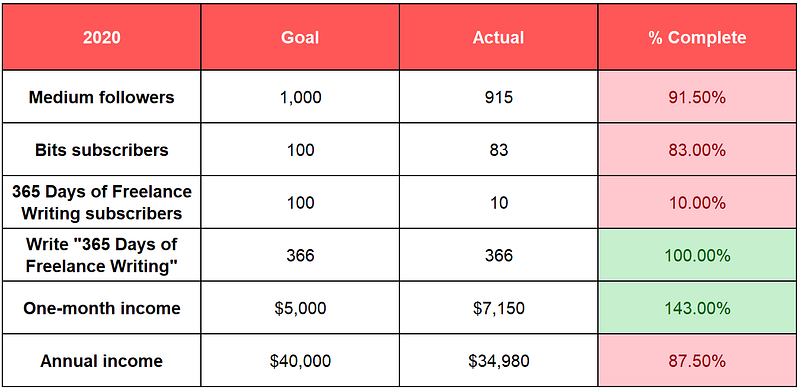
I managed to write a book last year, which is about the day-to-day life of a freelance writer (hence, the goal of 366 daily entries). Much to my surprise, I also surpassed my one-month income goal of $5,000 when I made $7,150 in October. That’s when I discovered how lucrative copywriting can be.
Other than those two wins, I fell short of my other goals. Partially because freelancing goals can easily contradict one another. For instance, I wanted to reach 1,000 followers on this platform in 2020. I nearly succeeded (I crossed four figures in January), but this goal was counterproductive to my income goal. Yes, this platform does allow us to earn money but often not enough to make a living. And if you compare the time input versus the payout, it can be pretty disheartening, especially when you know that time and energy could have been applied to finding paid client work. There was a point last year when my per-word rate on this platform was $0.05, which included two viral articles.
It’s very easy to be at odds with yourself as a freelance writer. You want to set lofty goals that would, if achieved, catapult you to financial stability and freedom. You also want to write about topics that stimulate you — topics that scratch your creativity itch — but you also have to pay the bills and there’s only so much time in the day.
You Need to Be Indefinitely Self-Motivated
Countless people have told me they couldn’t be self-employed. They admit that they need structure and external motivation to get out of bed in the morning. Honestly, I think people underestimate the ass-to-the-fire approach. Needing to find ways to make money in order to live is pretty motivating.
That said, if you aren’t self-motivated, you’ll struggle because freelancers are responsible for A LOT. And many of these responsibilities are time-consuming, unintuitive, and don’t contribute to your business’s growth or income — they’re just necessary to survive as a business.
Speaking of income, there’s an obvious concept that goes over a lot of people’s heads when they imagine what it’s like to freelance: money doesn’t appear out of thin air.
You have to figure out how to position yourself to land clients (a struggle in and of itself) and then gradually build income streams. It’s not like a corporate job — you don’t start with a base salary that increases with promotions and bonuses. It’s more akin to a real-life game of Chutes and Ladders. You start at $0, pick up a client or two, earn $1,000, get ghosted by a client, fall to $500, find a client that underpays, make $600, catch a break, get a well-paying client with a big content need, make $2,000. It’s up and down and up and down.
Moreover, there isn’t a Freelancer Manager that checks in to see how you’re doing and if you need any help finding clients. There isn’t a Freelancer Human Resources to complain to when a random stranger maliciously tears your writing to shreds for no apparent reason. There isn’t a Freelancer Accounting Team that shows you how to run your business’s finances — or dispute the IRS’s claim that you underpaid your taxes. Sure, there are other freelancers and companies who fill these roles and provide these services to solopreneurs, but you can’t exactly snap your fingers and solve your problems.
You are solely responsible for your success. If you don’t do anything, you don’t make money. If you decide to sit in bed all day, your business doesn’t keep chugging along — it sits still.
Freelancing Is Not For Everyone
I’m a confident person, and it takes a lot to rattle me. I’m also my biggest cheerleader, which helps when freelancing inevitably wears on my psyche. Because, yeah, it still sucks when some random asshat calls my writing crap, but freelance writers have to be able to bounce back.
There’s nothing wrong with falling down — it’s expected. But you have to know how to stand back up and learn from the experience.
I’m not saying any of this to brag — I just want to paint a realistic picture of freelance writing. Honestly, my accomplishments to date aren’t that brag-worthy anyway. I mean, you can see how much I made last year.
I’m still proud that I’m here. I love what I do, and I want to help others determine if that sentiment would apply to their lives too.
But freelancing just isn’t for everyone.
If you’re confident, self-motivated, enjoy writing, and crave entrepreneurial adventure, it might be for you.
What’s it like to write for a living? Let me show you.