
How I Quit My Steady Job and Pursued My Entrepreneurial Dreams
A step-by-step guide to bridging the divide between conventional and unconventional careers

The divide between a traditional career and an unconventional one isn’t as wide as you’d think.
And that holds true on either side of the “valley.”
If you’re tired of climbing the corporate ladder, jumping into the world of entrepreneurship isn’t unrealistic. If the struggles of self-employment create more problems than you can handle, joining the world of stable salaries and defined work-hours is not too tall of a task.
For me, it was the former. I’ve always been fascinated with entrepreneurs — their ideas, approaches, and lifestyles. But I never really considered the possibility that I could be one too. For the longest time, despite having no idea what I wanted to do, I figured I’d stroll down the well-traversed corporate path. It was stable, predictable, and everyone else was doing it — so, hey, why not?
Until I walked the path myself…
…and realized I hated it.
A brief summary of my journey to self-employment
Don’t worry, I’ll keep it short. I know hearing people complain about their jobs, bosses, coworkers, schedule, etc. gets old fast.
I started out in banking, a role that was as corporate as they come. Cubicles, unnecessary meetings that could’ve been emails, unending policies, painfully tedious admin work that has nothing to do with your job whatsoever — you know, all that good stuff.
Within the first month, I knew it wasn’t a long-term position for me.
It didn’t feel right, but it’s not like I knew what else was out there. Plus, I was still grinding through a steep learning curve, which kept me challenged and stimulated. So, it wasn’t a pressing concern.
I didn’t start exploring other options for another 16 months. Not that I was actively looking to leave, I just wanted to see what was out there. But other potential roles and fields just sounded like the same old story. Nothing appealed to me. Nothing piqued my interest.
So, I gave my imagination a chance and explored unconventional careers.
That’s when I stumbled across freelance writing — a field I didn’t even know existed.
Let me get this straight, it’s not like I’ve always had a love for writing. I never journaled or wrote anything beyond what was required of me at school. That being said, I’ve always considered myself to be a decent writer. Nothing extraordinary, but decent.
The biggest draw was the thought of running my own show. Writing was just the vehicle that let me do so.
Little-by-little, I explored freelance writing. Over a year and nine months, I researched successful freelancers, read a couple of books, took a couple of courses, created my own website, produced a few samples, and landed a few guest posts.
Once I felt comfortable enough and took the necessary steps to transition from corporate to self-employment (which I’ll explain shortly), I quit my job to pursue freelancing full-time.
The divide between these two worlds isn’t as wide as you’d think. It’s not a bottomless canyon — it’s more like a wall with a hidden door. You just have to find the door.
Of course, you have to want to be on the other side of the proverbial canyon. If you’re happy strolling down the corporate path, power to you. If you’re braving the world of entrepreneurship and don’t plan on stopping, power to you.
But, if you’re itching to carve your own entrepreneurial path, here’s how you can bridge the not-so-wide divide (based on my experience).
Do your research
You don’t know what you don’t know. Without looking into alternative careers and paths, you won’t be able to identify other opportunities. You won’t know what’s out there.
But “research” is a broad term. By research, I mean simple Google searches, which might bring you to websites, videos, podcasts, etc. for you to explore. So, what should you be researching?
A precise answer depends on your preferences and goals, but here are a few examples of possible searches. Start by looking into options based on your lifestyle or work preferences. Here are a few search examples:
- “Lists of remote jobs”
- “Careers that let you travel full-time”
- “The most flexible jobs”
- “The most profitable startups”
The idea is to craft your search around a desire — like working remotely or being able to travel. Then, you want to match potential careers with existing or obtainable skills.
In my case, while looking into entrepreneurial routes, I stumbled upon freelance writing. I knew I wanted to start a business and work for myself, but I didn’t know which type of business. I’ve always considered myself to be a good writer, but it’s not like it was a hobby or passion. It’s just a skill that I realized I could monetize and start a business with.
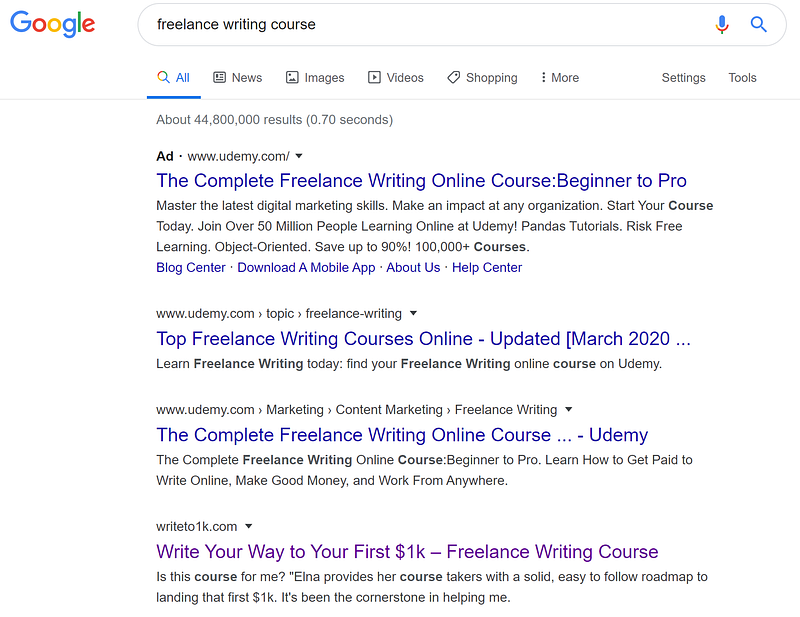
Once I discovered freelance writing, I looked up guides and courses. And BOOM — there was a course designed for beginners (Write Your Way to Your First $1k).
Study experts in your field
If you want to be successful, it helps to learn from successful people — experts that have already been in your position and excelled.
Study everything about them — from their website’s about page to the services they offer to the social media platforms they’re active on. You want to use their stories and business models to form your own.
Do they have a website? What does it include?
How do they target and connect with people? What buzzwords do they tend to use? What topics do they focus on?
What kind of services do they provide? Are they bundled? How much do they charge?
It’s all about asking and answering as many questions as possible.
Many successful entrepreneurs share content and resources that explain how they were able to succeed. Sometimes these materials are free (e.g. blog posts), sometimes they aren’t (paid courses).
Every entrepreneur’s path is different, but that doesn’t mean you can’t learn from someone else’s achievements and mistakes.
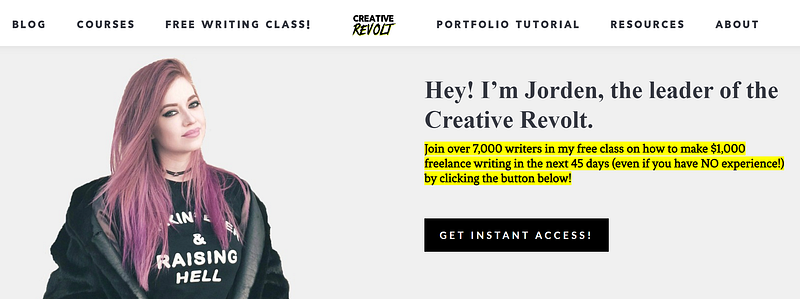
I was fortunate to stumble across Elna Cain and Jorden Makelle, two successful freelancers who’ve established well-known brands and valuable products/services. By consuming their content and advice, I was able to develop my writing skills and create my brand.
If you happen to be interested in freelance writing, I recommend Elna Cain’s freelance writing course — Write Your Way to Your First $1k. It covers everything you need to know to get started and succeed in the beginning stages of freelance writing. Without her course, who knows, I might never have gained enough confidence to pursue freelancing.
Dip your toe in
Assuming your full-time job runs on a typical schedule (like 9:00 am to 5:00 pm), your free time is on weeknights and weekends. Factor in meals, exercise, and social life, and your free time is pretty minimal.
It’s hard to throw a lot of hours at an entrepreneurial endeavor when you don’t have much time to give. On top of that, you’ll burn yourself out if you grind every hour of every day. So, ease into your side gig. Dip your toe in.
For me, I wasn’t just learning about writing styles or types of content — but also how to organize my “work station” on Google Drive, how to communicate with potential clients, how to pitch publications, how to create task lists that kept me accountable, and so on.
It’s like starting a new job all over again. It’s a steep learning curve because you have to construct new processes and workflows.
If you jump from corporate to self-employment without feeling things out, you risk overwhelming yourself. Instead, set small goals with lenient deadlines. For example, focus on getting one client or creating a few samples. Give yourself three or four weeks to accomplish them.
Baby steps.
As I mentioned earlier, I moonlighted as a freelance writer for a year and nine months before making the switch. To do so, I set goals in two to four-week increments — like creating a website, writing a post, pitching to smaller blogs in my niche. I gave myself plenty of time to accomplish them.
It would have been impossible otherwise.
Quantify your confidence
This step will vary from person-to-person. The idea is to figure out what will give you enough confidence to not only quit your job but also maintain peace-of-mind during your transition.
My biggest concern was having enough runway to get my business off the ground. I wanted to avoid financial stress, so I worked until I had saved 12 months of expenses, which would serve as my runway. In other words, theoretically, I could run my business for a year without making any money.
That gave me plenty of cushion to set a routine, land clients, and establish reliable income.
I also wanted to ease into self-employment by landing a steady client first. That relieved the pressure of not making any money. I didn’t need to be a client dolling out multi-hundred dollar projects left and right. I just needed a base, a foundation — something to build off of.
By the time I got my first client, I had…
- 12 months of runway
- 8 posts in my portfolio
- A website
- A semi-decent writing process
Most importantly, I had confidence in my writing and my ability to turn a side-hustle into a full-time career.
I was prepared. It wasn’t a speculative risk anymore — it was calculated. By taking these steps and setting these preliminary goals, you reduce some of the risks of entrepreneurship.
Take the leap
You can research, study, save, and prepare for months — but, at some point, you need to take the leap. The divide between conventional and unconventional may be small, but you won’t bridge that gap until you take this final step.
I was a nervous wreck when I quit my banking job. When the day finally came, I had to step outside before my meeting with my manager.
Pacing back and forth, I rehearsed what I was going to say. I took a deep breath, went back inside, rode the elevator to my floor (slowest elevator ride of my life), and walked into his office.
I sped through my speech, trying to preserve a sense of confidence (and hide my anxiety). I voiced my frustrations and my ultimate decision. I laid my proverbial cards on the metaphorical table.
He said, “Okay, I’ll let HR know and start the process.”
And that was pretty much it.
It was the least climactic conversation I’ve ever had. I spent days worrying about this moment, and it wound up being so mundane.
When I walked out of my office for the last time, it still hadn’t fully registered. It took a few days to sink in.
But, once it did, a wave of relief washed over me. Sure, I was a little nervous too — but mostly excited to get to work.
Quitting a job (especially a well-paying one) is always a tough decision — but, if you know you’d rather be doing something else, don’t let fear stop you. I came close to caving, I almost decided against quitting.
But I would have always wondered “what if?”
If you know you want something — and you’re prepared, take the leap.


