
Photography, Nature, Hummingbirds
Coming In for a Landing
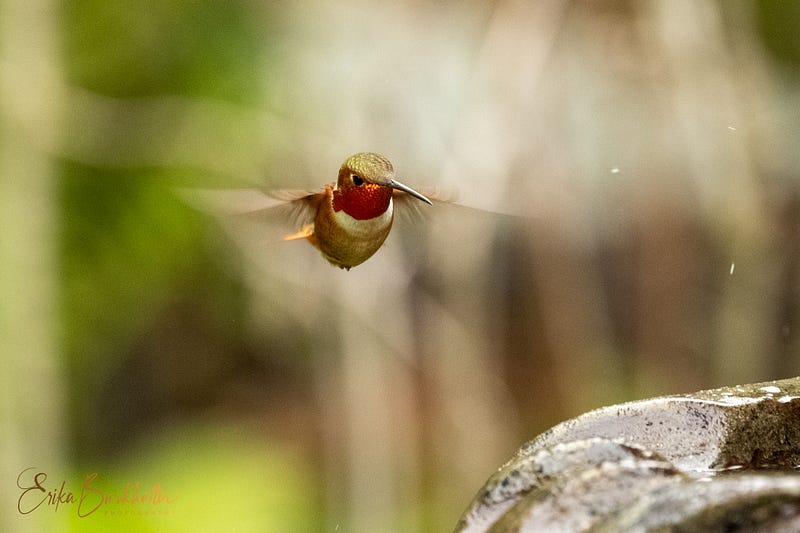
Einstein, the hummingbird, at my fountain. Zooming in this little jewel with my new Nikon 100–400mm (ƒ4–5.6) VR S lens
I hear those little screeches and hollers all day long as “Einstein” and “Big Red” battle for dominance at my backyard fountain. Fortunately, Big Red tends to like to patrol the right side of the garden, from the orange tree to the top tier of the fountain, while Einstein likes to hang out near the camelia bush on the left hand side of the yard.
I recently purchased the brand new Nikon 100–400mm f/4.5–5.6 VR S lens and I’ve been testing it out on some of my favorite subjects — my backyard birds.
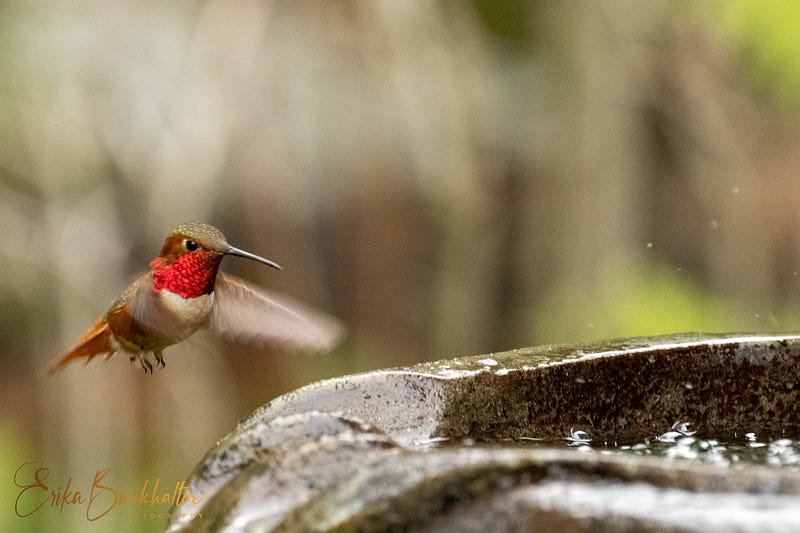
Hummingbirds are particularly tricky to photograph because they move so incredibly fast. Half the time, I’ll think I have my camera focused on one of those little flashing jewels, but by the time I press the shutter release, I’ve taken a photo of empty air.
Hummingbirds’ wings rotate in a figure-eight pattern between ten and eighty times per second during flight. But, during courtship dives, their wingbeats can reach up to two hundred flaps per second.
You’ve probably heard that shrill squeal they make when trying to impress a female or to run off another male. What you might not have realized is that the noise comes from the way they angle their wings and tail feathers during those sharp descents.
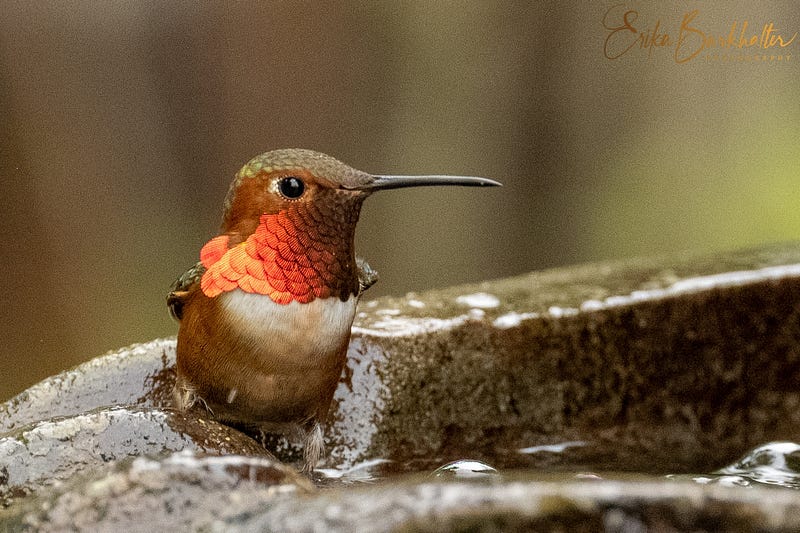
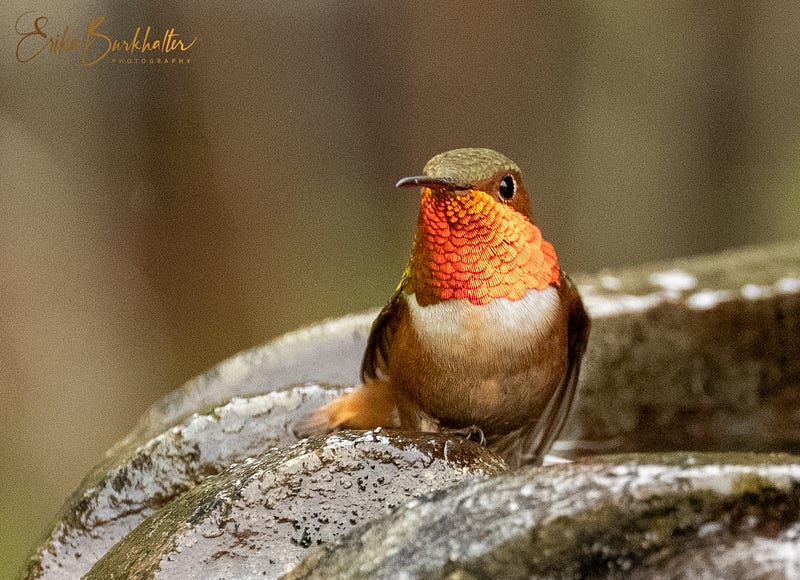
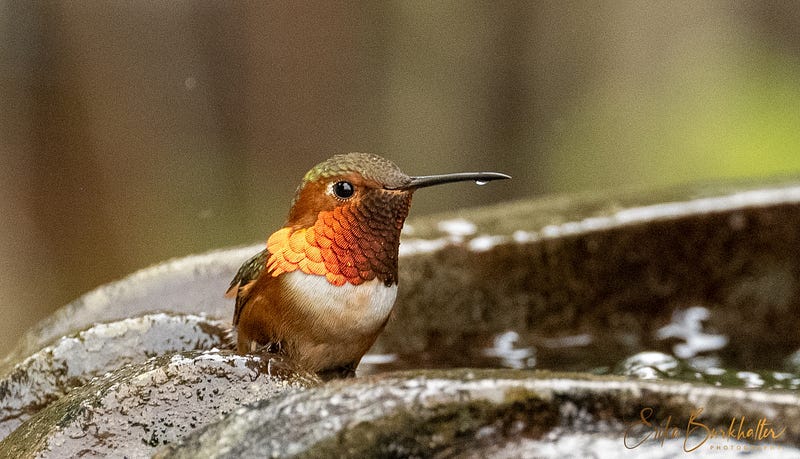
As you can see in these photos, Einstein is “dressed to impress” in his full red gorget. He’s an Allen’s Hummingbird. Although we do get migratory hummingbirds here, in Southern California, he’s part of the tribe which resides in my yard all year long.
Allen’s Hummingbirds are coppery orange with green backs. Adult males have a coppery tail, eye patch, and belly that contrasts with their bronze-green back and deep reddish orange gorget. Females and immatures are a bit paler, with bronze-green above coppery sides. The females and the immature males will have little bronzey-red spots on their throats. As the boys mature, those spots fill in to create that glorious ruff.
Interestingly, the hummingbird’s hippocampus (the brain region which deals with memory and spatial locations) is significantly larger, relative to telencephalic volume, than any bird examined to date. This is likely because they need to know precisely which flowers they have already visited to collect nectar.
They also need to remember the quantity and quality of nectar from each flower, when they last visited the flower, and where it is located.
This is because they have the fastest metabolism in the world and, in order to keep it fueled, hummingbirds need to eat — a lot! They eat half their body weight in sugar daily through meals every ten to fifteen minutes. They also eat tree sap and insects. A hummingbird can eat hundreds of fruit flies each day. If an average-sized man had a hummingbird’s metabolism, he’d need to eat two hundred and eighty-five pounds of meat a day.
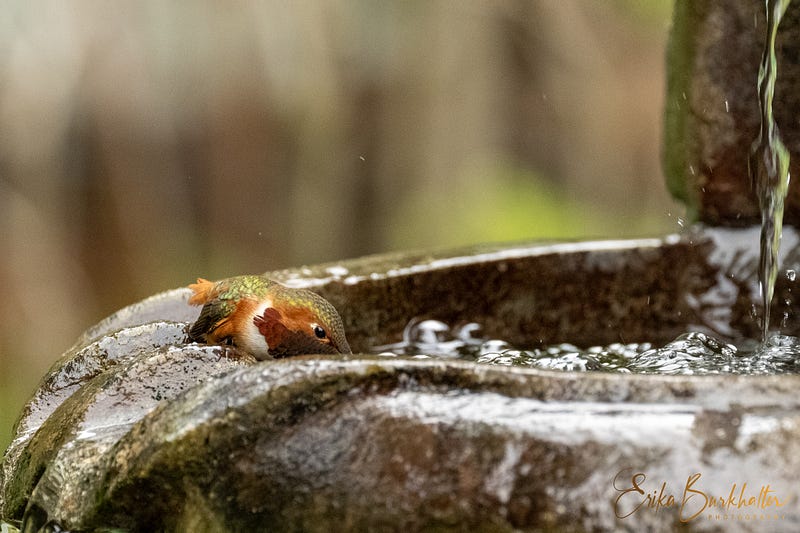
Hummingbirds’ feet are tiny and they only use them for perching, scratching, and nest building. Instead of using their feet to launch into flight, the wings do all the work. Their order name, Apodiformes, meaning footless, makes sense when seeing a hummingbird in flight. Their feet are nearly invisible. While they do have feet, they do not have knees.
Ralph Waldo Emerson, in his essay, “Circles” spoke about how we tend to draw circles around what we perceive and then not look any further than the horizon of that circle. It’s fascinating to look beyond the circle of our own visual perspective then to realize that hummingbirds see many colors that are invisible to humans because they possess an additional cone in their eye.
This gives them the ability to see UV wavelengths and nonspectral colors, which we cannot see. The birds use this vision to locate nectar, navigate, and judge mates.
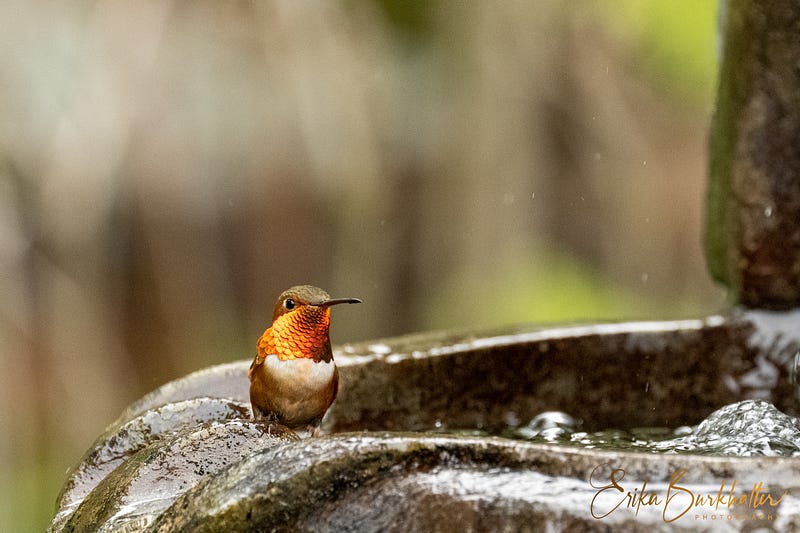
Einstein tends to swoop in while Big Red is cruising the skies, chasing away other males or trying to impress the girls. And then, Big Red does the same when Einstein is away. Between the two of them and their antics, they keep me quite entertained throughout the day.
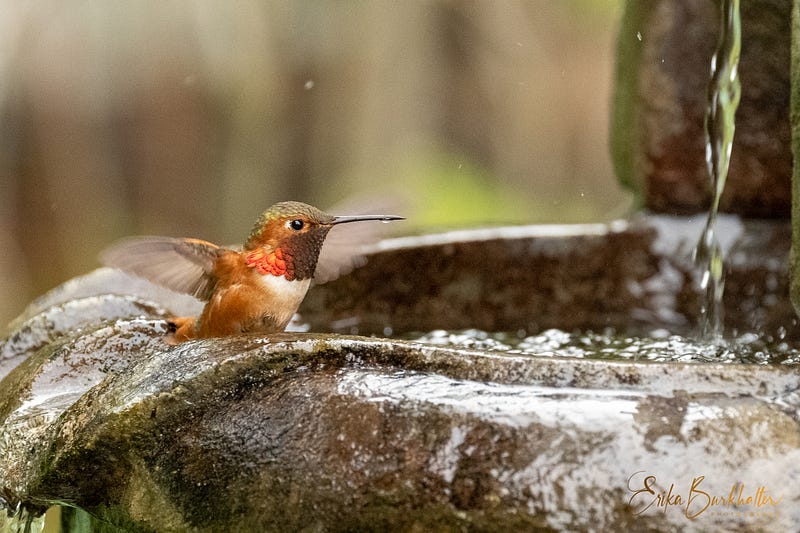
I hope you enjoyed this little foray into the world of hummingbirds. If you’d like to read more about (and see some photos of) Big Red, you might like this:
Erika Burkhalter is a yogi, neurophilosopher, cat-mom, photographer, and lover of travel and nature, spreading her love and amazement for Mother Earth’s glories, one photo, poem or story at a time. (MS Neuropsychology, MA Yoga Studies).
You might also enjoy:
If you’re interested in keeping up with my poems, photos and musings, you might consider subscribing to my stories.
While I do normally post my stories with free “friends” links on social media, if you enjoy reading on medium, you can help the many talented writers here by joining. It helps to support the arts and to keep us writing!
And, because I’ve had a few people asking lately, if you’re ever interested in purchasing a photo, just leave me a note. I’m working on a limited edition of bird prints on metallic paper right now and I am quite excited about how they are turning out.
Story and photos ©Erika Burkhalter. All rights reserved.


