
18 Stock Market Investing Myths — Debunked
Don’t be fooled by these common mistakes.

The stock market is full of myths of all different shapes and sizes.
To a new investor, many seem like they could be true, until you really unpack them.
Here are the most common myths that hold people back from investing or cause them to make painful mistakes:
- Investing in Stocks Is Like Gambling
- It’s Impossible to Beat the Market
- Stock Market Investing Is Too Complex for the Average Investor
- You Can’t Invest Unless You Have a Lot of Money
- Brokerage Trading Costs Are Expensive and Eat Away at Profits
- Stock Market Investing Will Take Too Much Time
- You Don’t Actually Lose Money on a Stock Unless You Sell It
- You Can Live off Stock Market Profits
- Follow Your Instincts When Investing
- A Low Stock Price Means the Stock Is Undervalued
- If a Stock Has Sold off a Lot, It’s Now Undervalued
- It’s Easier for a Low-Priced Stock to Double
- Good Product = Good Company = Good Stock
- Fast-Growing Companies Make Great Investments
- You Should Buy What’s in the News
- Famous Blue-Chip Stocks Are Always a Safe Bet
- Your Money Is Always Safe With an Investing Pro
- Mutual Fund Fees Are Too Small to Hurt My Profits
Stock Market Myth #1: Investing in Stocks Is Like Gambling
This one is very common among people who know nothing about stocks. Because they know so little about the stock market, they choose to believe it’s random, unpredictable, and dangerous.
But in reality, stocks are not a random game of chance in which the long-term odds are stacked against you. Actually, it’s quite the opposite!
There are many strategies that have been proven, through extensive research, to boost investing profits over the long term.
And there has never been a 15-year stretch since 1926 when the stock market (S&P 500) didn’t deliver a profit. And it has delivered a profit in 94% of 10-year periods, and 86% of 5-year periods, since 1926.
How many Vegas casino games do you know with a long-term win rate between 86% and 100%?
However, like many myths, sadly there’s a tiny kernel of truth to the idea stocks are like gambling.
Here’s why:
If you take your money and spread it recklessly around a bunch of penny stocks without doing any research and you’re just hoping to somehow get rich quick, that’s kind of like gambling.
Or, if you put all your money into a single red-hot “can’t lose” stock plastered all over the news headlines, that’s similar to gambling.
Saying investing in stocks is like gambling is sort of like saying, “Driving a car is incredibly dangerous.”
I mean, sure, if you drive backward down a one-way street at 90 miles per hour with a blindfold on, you’ve got a death wish.
But if you drive the car safely and properly, following common traffic rules and avoiding well-known risks, it’s not that dangerous. In that case, driving a car provides a ton of value in your life and comes with an acceptable level of risk.
It’s the same idea with stocks. If you do it wrong, it can be incredibly dangerous to your wealth. But if you do it right, it can provide you with a ton of value for an acceptable level of risk.
Stock Market Myth #2: It’s Impossible to Beat the Market
Some investors are fond of saying, “It’s impossible to beat the market. So don’t even try.”
I’d like to draw a big line between “impossible” and “challenging.”
Is it easy to beat the market?
No. It takes discipline, patience, and research. But it can be done.
There’s an abundance of research on investing strategies that have beaten the market for the last 100+ years. Some are complex, but many are simple.
Value investing is a good example. Over time, a well-executed value investing strategy has a very good chance of beating the market.
I’ll cover these strategies in other articles. But for now, just keep in mind that beating the market certainly takes time and skill, but it’s not impossible.
Stock Market Myth #3: Stock Market Investing Is Too Complex for the Average Investor
It’s true that the average investor tends to make common mistakes that hurt his returns.
And some investors would be better off simply buying a passive index fund that tracks the S&P 500.
But that doesn’t mean the average investor should give up on buying stocks.
Yes, like anything in life, being a successful investor takes time, research, patience, and discipline. But I believe the long-term rewards make it worth it.
I would never recommend jumping into the stock market blind and hoping for the best. That’s a risky strategy.
But, if you’re committed to learning about what works and what mistakes to avoid, I think you can benefit a lot from being in the market.
Stock Market Myth #4: You Can’t Invest Unless You Have a Lot of Money
This myth plays on the idea that the stock market is only for the rich and that you need a lot of money to get started.
You can start investing with as little as $1 in many passive index funds and can start buying your own stock portfolio with as little as $1,000.
Yes, there are certain stocks with high prices you’d want to avoid until you have more money. But there’s no reason you can’t start investing now and add to your positions over time.
Another common myth is that if you don’t have a lot of money to invest, brokerage trading fees will eat away at all your profits. I’ll tackle that next.
But for now, don’t let the fact you have a small amount of investment money discourage you from getting into the markets (safely).
Stock Market Myth #5: Brokerage Trading Costs Are Expensive and Eat Away at Profits
In the past, there was some truth to this myth. Paying $30 in trading fees to buy and sell $100 worth of stock would’ve destroyed your profit.
But nowadays most brokerages charge trading fees of just $5 — $7. And there are several reputable brokerages that charge $0 per trade.
But for now, just keep in mind you shouldn’t be paying more than $5 — $7 per stock trade. If you’re investing a decent amount of money using a good strategy, that shouldn’t hurt your long-term returns.
And if you’re investing a very small amount of money, you may want to consider a broker with zero trading fees.
Stock Market Myth #6: Stock Market Investing Will Take Too Much Time
Many new investors imagine that to invest in the market, they need to act like a day trader and be glued to CNBC and place trades 24 hours a day.
That’s definitely not the case.
While it does take some time to invest in the stock market (especially if this is your first time getting in), it doesn’t need to be a huge time investment going forward.
If you wanted to do all your own stock research by hand, I think you could manage your own portfolio by investing 2–10 hours per month.
And if you wanted to be even less involved, you could follow an investment newsletter (where experienced investors send you their high-quality stock research and buy/sell recommendations) and reduce your time investment to 1–2 hours per month (and likely improve your profits as well).
Or, you could simply put your money in a passive index fund and check it once a year for 10 minutes.
How much time you invest is up to you. But don’t believe the myth that investing in stocks is a full-time job.
Stock Market Myth #7: You Don’t Actually Lose Money on a Stock Unless You Sell It
Some investors who are down on a stock believe that they haven’t actually lost money until they “lock in” the trade by selling.
In some sense, it’s sort of true. If you could be sure the stock was going to go back up and waited for it to return to a profit, and then sold, you wouldn’t lose money on the investment.
But the reality is that once your investment in a stock has declined, that’s how much your share of the company is currently worth.
If you choose to leave your money in the stock, that’s fine. But you’re essentially making a passive choice to keep your money allocated towards that same position.
And if you decide to sell, that’s fine too. You’re making an active choice to reallocate the money to a new position.
Regardless of what you decide to do, you only have the buying power that’s invested in the position today. Maybe you started with $10,000 in that position and now you have $9,000 after the decline.
It doesn’t matter whether or not you sell that stock and “lock in a loss” — your $10,000 of buying power has already become $9,000 of buying power, regardless of where you allocate it.
Stock Market Myth #8: You Can Live Off Stock Market Profits
This is a simple one to debunk.
Can you live off stock market profits? It depends on how much money you have to invest and how much you need to live.
If you have a ton of money to invest and don’t need much to live, then sure, you can probably live off the profits.
For example, if you invest $1,000,000 in a dividend stock portfolio with a 4% dividend yield you can collect $40,000 per year in steady income (plus possible price gains). Is that enough to live on? Depends on your lifestyle.
But if you don’t have millions to invest, even if you earn fantastic returns in the market, you probably can’t quit your job yet.
Here’s some simple math you can do to find out.
Take however much you can invest in the market and multiply it by 3% — 5% to see what you could earn annually from bonds or dividend stocks.
Or, take your total investment amount and assume you can grow it by 7% — 10% per year (over the long term), and then assume you have to take money out for capital gains taxes each year.
You can make a lot of money in the stock market over time. But unless you’re starting with a lot, you probably can’t live off the profits.
Stock Market Myth #9: Follow Your Instincts When Investing
In life, we learn to trust our instincts and they usually serve us pretty well.
But investing is a whole different story.
Making money with stocks is more of an analytical game than a gut game. In fact, there are MANY psychological biases that play tricks on our mind and cause us to make bad investing decisions.
You can read more about them here:
Just remember the stock market isn’t a place to make financial decisions based purely on gut instincts.
Stock Market Myth #10: A Low Stock Price Means the Stock Is Undervalued
The price of a stock, on its own, doesn’t tell you anything about the value of the stock.
Remember, a stock price is a cost to buy a tiny share of ownership in a company. Value is determined by how much profit the company provides you compared to the cost of buying a share.
A $5 stock could be massively overvalued (imagine an unprofitable company with legal troubles) and a $10,000 stock could be wildly undervalued (imagine an incredibly successful company with fast growth that just declined 25% on news they’re delaying a new product release by 30 days).
To analyze valuation, you need to look at how much in sales, earnings, cash, and other financial metrics you get relative to the cost per share.
The price of the share on its own doesn’t mean anything.
Stock Market Myth #11: If a Stock Has Sold off a Lot, It’s Now Undervalued
This is similar to the myth that a low stock price somehow means the stock is undervalued.
Investors are often taught the simple mantra, “Buy low, sell high.”
So, when they see a stock that has sold off, they assume it has to be undervalued and therefore a good investment.
Sometimes this is true, and the market has excessively punished a good company that’s now undervalued.
But often the stock has sold off for good reason: something is wrong with the underlying business.
Looking for stocks with large recent declines can be a good place to start.
But investing isn’t so simple as buying stocks that have sold off (“buy low”) and waiting for them to go back up (“sell high”).
Stock Market Myth #12: It’s Easier for a Low-Priced Stock to Double
This myth sounds like it should be true. But once you think it through, it doesn’t make sense.
People sometimes say, “Well, this stock is trading for $5 per share, so for your investment to double it only needs to go up $5 per share!”
Again, remember that a single share of any stock represents a tiny piece of ownership in a real-life company.
So, for a $5 stock to double to $10, that means the market value of the entire company has to double in size.
Now, it’s probably easier for a small cap stock to double in size (because they’re a small company with lots of room for fast growth) than for a large cap company to double in size (Apple is currently worth $1 trillion — I don’t see that doubling anytime soon).
But a small cap company doesn’t automatically have a low stock price and a large cap company doesn’t automatically have a high stock price (either could be high or low).
While it’s great to look for a stock that could double your money, it’s not so simple as grabbing a low-priced stock.
Stock Market Myth #13: Good Product = Good Company = Good Stock
We investors are also consumers, meaning we buy products and services like everyone else.
When we see a great product or service that catches our eye, it’s tempting to assume the stock is a great investment.
Sometimes, this is true.
But there’s much more to investing than just products. Not every good product belongs to a well-managed company with executives focused on maximizing value for shareholders.
And not all good companies make good stocks. Some are in industries facing major headwinds, such as expanding regulation or rising commodity prices.
While a great product is a solid place to start your investment research, it’s important you also examine the underlying company and stock before investing your hard-earned money.
Stock Market Myth #14: Fast-Growing Companies Make Great Investments
There’s a tendency for new investors to assume that if a company is growing really quickly, it must be a great investment.
The logic certainly makes sense on its surface.
However, there are many more things to consider than just sales and earnings growth when buying a stock.
For starters, fast-growth companies have a tendency to be overvalued as excited investors bid up their share price. 100+ years of history suggests that buying overvalued stocks is a horrible strategy.
In addition, there’s research that shows big jumps in sales growth are actually a bad thing for stocks because they tend to perform poorly in the following years.
Growth is great. But it has to be considered in the context of many other factors, especially valuation.
Ultra-fast growth does not automatically make a stock a good investment.
Stock Market Myth #15: You Should Buy What’s in the News
Similar to buying fast-growth companies, buying hot stocks that are in the news is not always a good investment strategy.
Hot stocks with lots of investor buzz are often overvalued, as everyone is trying to buy their shares. Over the long term, they have a tendency to come crashing back down to reality.
While it’s fine to get stock ideas from the news and then conduct further research, it’s not wise to follow the crowd and pour money into the company everyone wants a piece of.
Stock Market Myth #16: Famous Blue-Chip Stocks Are Always a Safe Bet
Some famous blue-chip stocks are great investments. Companies like Apple (AAPL), Verizon (VZ), and Walgreens (WBA) are well-known because their underlying business is so successful.
But it’s a big mistake to just look for company names you know and like and assume your money will be safe there.
How many investors assumed Kodak was a safe bet before they collapsed?
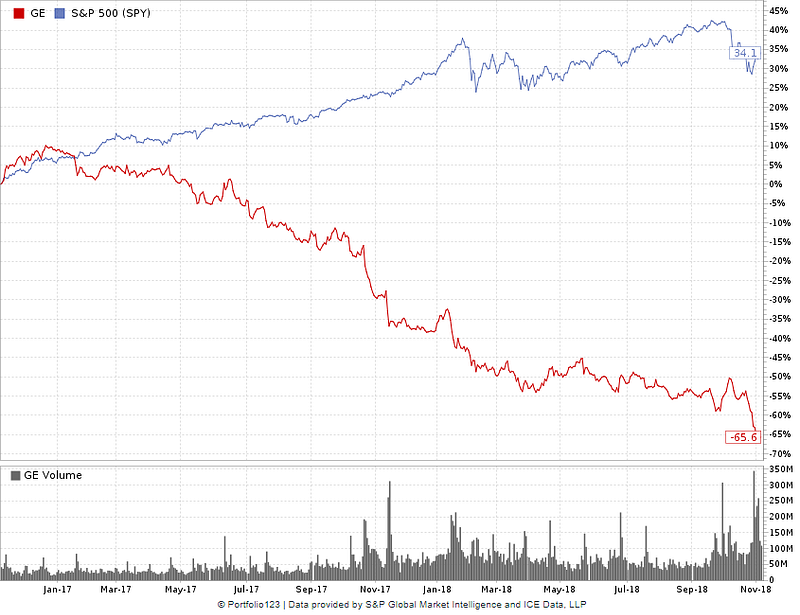
A more modern example is General Electric (GE). Many investors hear GE and automatically think of words like “steady,” “trusted,” and “time-tested.”
Well, their stock has declined a stunning -66% in the last two years. All while the S&P 500 has gained 34%. Plus, they’ve slashed their trusty dividend several times to conserve cash.
Or, look at investors who blindly held shares of Lehman Brothers stock in 2008, when the market was crashing. The company had been around since 1850 and was a pillar of Wall Street. But behind the brand was a toxic balance sheet.
This is similar to my myth above about “trusting your gut” in the stock market.
Our gut likes General Electric because it’s a famous and historic company that’s been around forever.
But that doesn’t automatically make it a good investment.
Stock Market Myth #17: Your Money Is Always Safe with an Investing Pro
Like many things in life, some pros are great at what they do and some pros probably shouldn’t hold their title.
Stock market investing is no different.
Don’t assume that every mutual fund, investment advisor, and investment newsletter will make you money.
Investing in the stock market is an uncertain game (especially in the short term), and not every professional will be successful.
So use your best judgment, just like you would with any mechanic, dentist, repairman, doctor, or accountant. If an investment professional or their products don’t seem credible, then exercise caution.
This is one place where it’s actually good to trust your gut.
Plus, many pros charge fees, which can eat away at the profits they help you earn.
This leads us to our last myth.
Stock Market Myth #18: Mutual Fund Fees Are Too Small to Hurt My Profits
Some investors believe that the fees charged by an actively-managed mutual fund (where pro investors try to beat the market) are small enough that they don’t really matter.
This is far from true. Over time, fees of 1% — 3% will reduce the amount of capital you have invested and hurt your long-term returns.
And keep in mind that you’re charged those fees every year regardless of whether the fund makes money or loses money.
If you find an actively-managed fund that can consistently beat its benchmark by a healthy margin over the long term — even after considering fees — then it could be a great investment for you.
But keep in mind that most research suggests a fund that matches that description is hard to come by.
NOTE: I get a lot of reader emails asking how to invest, so I thought I’d post my answer here:
The best way to learn investing is to get real-life, hands-on experience. There’s simply no replacement for buying and selling your own stocks.
If you need a place to start, there are two tools I recommend to all new investors:
#1) The Motley Fool is a stock recommendation service. Every month they share their top stock picks, along with a detailed research report. They recommended mega-winners Disney, Netflix, and Amazon over 10 years ago. I learned how to invest from The Motley Fool. It’s a superb place to get quality stock ideas. Motley Fool offers a 30-day guarantee.
#2) TradingView is a charting tool. It’s an absolute must-have for deciding when to invest. I use it every single day and I never buy or sell anything without analyzing the chart first (for example, Apple). I’ve tried all the charting tools out there, and this is the best. Plus their community is overflowing with ideas. You can use TradingView 100% free.
Here’s what I recommend: Take stock picks from The Motley Fool and then research the best time to buy them using TradingView. That way you combine fundamental research (what to buy) with technical research (when to buy) to find the best stocks to buy now.
If you join either service, I may receive a commission for referring you.
Give Motley Fool and TradingView a try — I guarantee they’ll make you a better and more profitable investor.
Disclaimer: This article is provided for informational or educational purposes only and is not any form of individualized advice. All information is obtained from sources believed to be reliable but cannot be guaranteed for accuracy or completeness. Use this information at your own risk.