
1783: General George Washington Intervenes Against The Newburgh Conspiracy
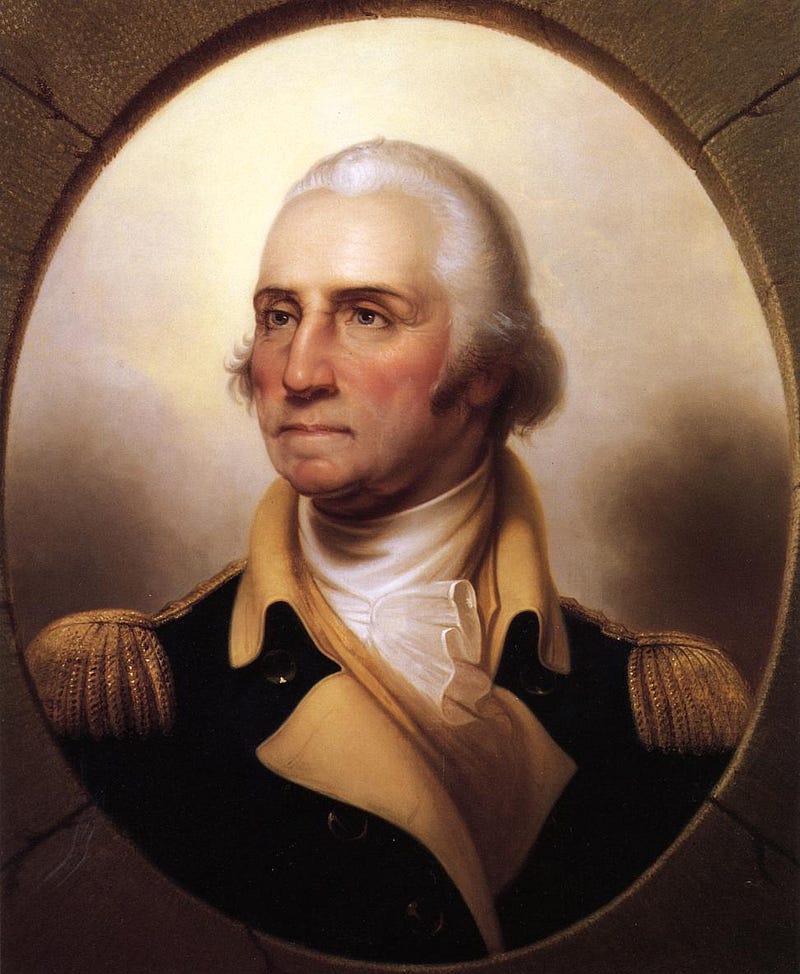
In the closing days of the American Revolutionary War discontent seized a number of soldiers in the victorious Continental Army. By this time, many soldiers were unhappy that they had not been paid for quite some time, since early 1782 in fact when stopped by Financier Robert Morris, and worse, that the pensions that they had been promised were at this point still unfunded. Uncoordinated grumblings might have turned into an organized conspiracy following the circulation of an anonymous letter supposedly from Congress on March 10, 1783. There has since been some speculation that it might in fact have been written by Major John Armstrong, the aide to General Horatio Gates, though this is still a matter of some debate by scholars.
The letter itself pushed for disgruntled soldiers to take some unspecified action against Congress to resolve these issues. It was not difficult to get the ball moving, since many soldiers were worried that, with the war ending, Congress would not meet its previous promises of back pay and pensions. This was a significant amount of money the soldiers would be losing, as officers in the Continental Army alone were promised a lifetime pension of half their pay following their discharge from the Army.
The provision of this money to soldiers was a topic of hot debate in Congress during 1782, and despite numerous letters sent from soldiers based in the Army camp of Newburgh, the debate itself was not measurably affected. The situation got so tense that a number of officers followed the lead of General Henry Knox, who drafted a memorandum to be sent to congress expressing the general unhappiness with the lack of pay and concern that the half pay pension that had been previously offered would not materialize. The memorandum continued by offering that officers would accept a lump sum payment instead of a lifetime half pay pension as a way for Congress, and the fledgling country, to save money over the long term. It concluded with a warning, even the threat, that Army was beginning to lose its’ patience over the matter. Given that the memorandum was signed by a significant number of general officers, the problem and the threat could not be cast aside as the work of a few malcontents.
Following meetings with Congress, a number of attempts were made to settle the issue but no agreement was quickly reached. This resulted in a heightening of tensions and even some concern by several individuals that the threat of a military coup might become possible. On February 13, on the same day that rumors of an initial peace agreement were reached in Paris, Alexander Hamilton wrote to George Washington, urging him to intervene and prevent the situation with the Army from spiraling out of control. George Washington replied that he sympathized with both the Army and Congress, but also that he refused to use the Army to pressure Congress, as that violate the principles of republicanism for which they had all fought.
The situation escalated again on March 10 when an unsigned letter was circulated around the Army camp at Newburgh calling attention to the condition of the camp, a lack of support from Congress, and pressed for an ultimatum to be sent. It ended with a call for a meeting of all the present field officers the next morning at 11:00 am.
Early on March 11, George Washington reacted quickly, objecting to the nature of the anonymously called for meeting and instead stated that there would be a general officers meeting on March 15th instead. Rather than having the impact he wished, another unsigned letter appeared in the morning of March 12th that suggested George Washington’s order was support for their position, which influenced the atmosphere of the meeting that occurred on March 15th.
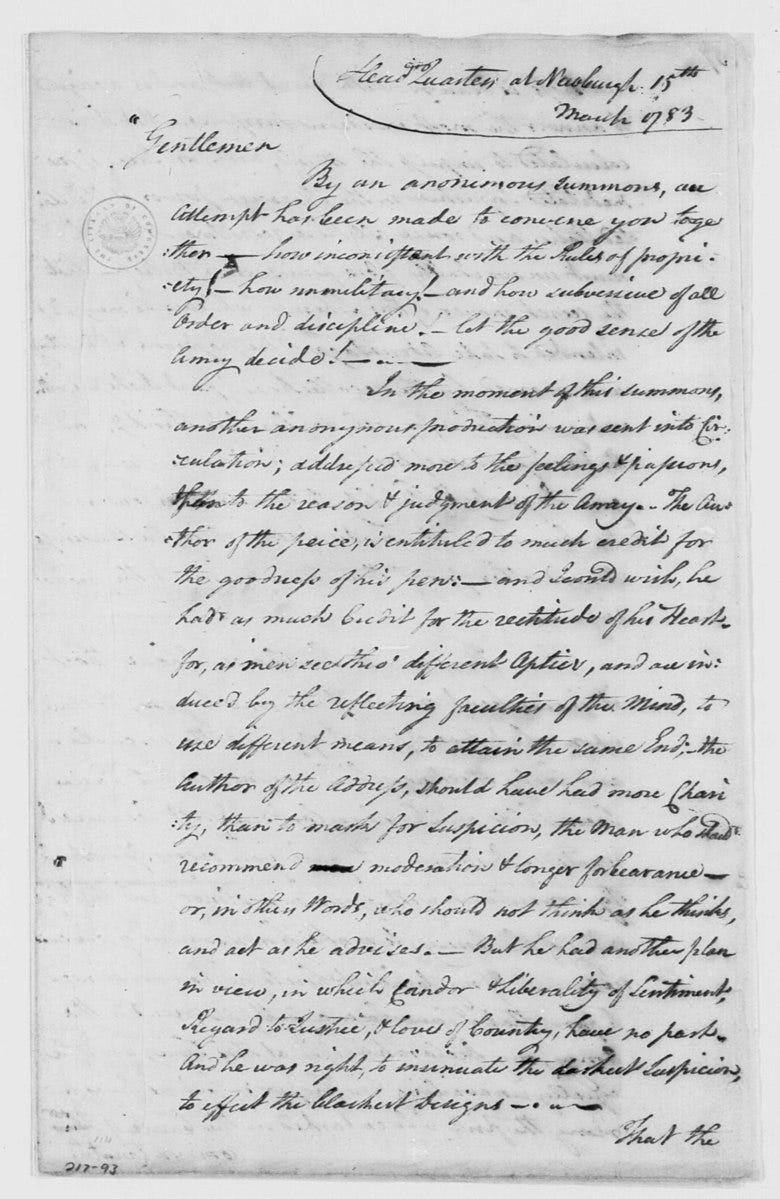
Held in a building in the Newburgh Camp, General Gates opened the meeting but was surprised, along with everyone else present, when General Washington himself entered and asked to speak with the officers. Given the general mood of discontent at having not been paid for some time, it was noted that many did not show the respect or deference they generally showed to the esteemed general in the past. What followed was one of the most important speeches George Washington gave during his time as the head of the Continental Army. The text of his speech is thus:
Gentlemen, —
By an anonymous summons, an attempt has been made to convene you together. How inconsistent with the rules of propriety, how unmilitary and how subversive of all order and discipline, let the good sense of the army decide.
In the moment of this summons, another anonymous production was sent into circulation, addressed more to the feelings and passions than to the reason and judgment of the army. The author of the piece is entitled to much credit for, the goodness of his pen; and I could wish he had as much credit for the rectitude of his heart; for, as men see through different optics, and are induced by the reflecting faculties of the mind, to use different means to attain the same end, the author of the address should have had more charity than to mark for suspicion the man who should recommend moderation and longer forbearance, or, in other words, who should not think as he thinks, and act as he advises. But he had another plan in view, in which candor and liberality of sentiment, regard to justice and love of country, have no part; and he was right to insinuate the darkest suspicion to effect the blackest design. That the address is drawn with great art, and is designed to answer the most insidious purposes; that it is calculated to impress the mind with an idea of premeditated injustice in the sovereign power of the United States, and rouse all those resentments which must unavoidably flow from such a belief; that the secret mover of this scheme, whoever he may be, intended to take advantage of the passions, while they were warmed by the recollection of past distresses, without giving time for cool deliberative thinking, and that composure of mind which is so necessary to give dignity and stability to measures, is rendered too obvious, by the mode of conducting the business, to need other proof than a reference to the proceeding.
Thus much, gentlemen, I have thought it incumbent on me to observe to you, to shew upon what principles I opposed the irregular and hasty meeting which was proposed to have been held on Tuesday last, and not because I wanted a disposition to give you every opportunity, consistent with your own honor, and the dignity of the army, to make known your grievances. If my conduct heretofore has not evinced to you that I have been a faithful friend to the army, my declaration of it at this time would be equally unavailing and improper. But as I was among the first who embarked in the cause of our common country; as I have never left your side one moment, but when called from you on public duty; as I have been the constant companion and witness of your distresses, and not among the last to feel and acknowledge your merits; as I have ever considered my own military reputation as inseparably connected with that of the army; as my heart has ever expanded with joy, when I have heard its praises, and my indignation has arisen when the mouth of detraction has been opened against it, it can scarcely be supposed, at this late stage of the war, that I am indifferent to its interests. But how are they to be promoted? The way is plain, says the anonymous addresser. “If war continues, remove into the unsettled country; there establish yourselves and leave an ungrateful country to defend itself.” — But who are they to defend? Our wives, our children, our farms and other property which we leave behind us? or, in this state of hostile separation, are we to take the two first (the latter cannot be removed) to perish in a wilderness with hunger, cold and nakedness? “If peace takes place, never sheath your swords,” says he “until you have obtained full and ample justice.” This dreadful alternative of either deserting our country in the extremest hour of her distress, or turning our arms against it, which is the apparent object, unless Congress can be compelled into instant compliance, has something so shocking in it, that humanity revolts at the idea. My God! what can this writer have in view, by recommending such measures?. Can he be a friend to the army? Can he be a friend to this country? Rather is he not an insidious foe? Some designing emissary, perhaps, from New York, plotting the ruin of both, by sowing the seeds of discord and separation between the civil and military powers of the continent? and what a compliment does he pay to our understandings, when he recommends measures, in either alternative impracticable in their nature? But, here, gentlemen, I will drop the curtain, because it would be as imprudent in me to assign my reasons for this opinion, as it would be insulting to your conception to suppose you stood in need of them. A moment’s reflection will convince every dispassionate mind of the physical impossibility of carrying either proposal into execution. There might, gentlemen, be an impropriety in my taking notice, in this address to you, of an anonymous production; but the manner in which that performance has been introduced to the army, the effect it was intended to have, together with some other circumstances, will amply justify my observations on the tendency of that writing.
With respect to the advice given by the author, to suspect the man who shall recommend moderate measures and longer forbearance, I spurn it, as every man who regards that liberty and reveres that justice for which we contend, undoubtedly must; for, if men are to be precluded from offering their sentiments on a matter which may involve the most serious and alarming consequences that can invite the consideration of mankind, reason is of no use to us. The freedom of speech may be taken away, and, dumb and silent, we may be led, like sheep, to the slaughter. I cannot, in justice to my own belief, and what I have great reason to conceive is the intention of Congress, conclude this address, without giving it as my decided opinion, that that honorable body entertain exalted sentiments of the services of the army, and from a full conviction of its merits and sufferings, will do it compleat justice: that their endeavours to discover and establish funds for this purpose have been unwearied, and will not cease till they have succeeded, I have not a doubt.
But, like all other large bodies, where there is a variety of different interests to reconcile, their determinations are slow. Why then should we distrust them, and, in consequence of that distrust, adopt measures which may cast a shade over that glory which has been so justly acquired, and tarnish the reputation of an army which is celebrated through all Europe for its fortitude and patriotism? And for what is this done? To bring the object we seek nearer? No, most certainly, in my opinion it will cast it at a greater distance. For myself, and I take no merit in giving the assurance, being induced to it from principles of gratitude, veracity and justice, a grateful sense of the confidence you have ever placed in me, a recollection of the cheerful assistance and prompt obedience I have experienced from you, under every vicissitude of fortune, and the sincere affection I feel for an army I have so long had the honor to command, will oblige me to declare, in this public and solemn manner, that in the attainment of compleat justice for all your toils and dangers, and in the gratification of every wish, so far as may be done consistently with the great duty I owe my country, and those powers we are bound to respect, you may freely command my services to the utmost extent of my abilities.
While I give you these assurances, and pledge myself in the most unequivocal manner, to exert whatever ability I am possessed of in your favour, let me entreat you, gentlemen, on your part, not to take any measures, which, viewed in the calm light of reason, will lessen the dignity, and sully the glory you have hitherto maintained. Let me request you to rely on the plighted faith of your country, and place a full confidence in the purity of the intentions of Congress; that, previous to your dissolution as an army, they will cause all your accounts to be fairly liquidated, as directed in their resolutions which were published to you two days ago; and that they will adopt the most effectual measures in their power to render ample justice to you for your faithful and meritorious services. And let me conjure you, in the name of our common country, as you value your own sacred honor, as you respect the rights of humanity, and as you regard the military and national character of America, to express your utmost horror and detestation of the man, who wishes, under any specious pretences, to overturn the liberties of our country; and who wickedly attempts to open the flood-gates of civil discord, and deluge our rising empire in blood.
By thus determining, and thus acting, you will pursue the plain and direct road to the attainment of your wishes; you will defeat the insidious designs of our enemies, who are compelled to resort from open force to secret artifice. You will give one more distinguished proof of unexampled patriotism and patient virtue, rising superior to the pressure of the most complicated sufferings: and you will, by the dignity of your conduct, afford occasion for posterity to say, when speaking of the glorious example you have exhibited to mankind — “had this day been wanting, the world had never seen the last stage of perfection to which human nature is capable of attaining.”
In a bit of masterful action, Washington concluded with a letter from a Congressman to read to the officers, at which point he fumbled with it and took out reading glasses from his pocket. To the officers this was a new development, as few had seen him wear them. He simply stated:
“Gentlemen, you will permit me to put on my spectacles, for I have not only grown gray but almost blind in the service of my country.”
Realizing that the venerable General had sacrificed as much as, if not more than, the officers present, many of those present were moved to tears. What followed was the collapse of the conspiracy and the drafting of a new resolution of loyalty and unshaken confidence in Congress. The threat of a military coup to the fledgling country was ended.
Where To Learn More About George Washington
Books
- The American Revolution: A Visual History: Provides illustrated accounts for every major military action and comprehensive timelines for each stage of the war.
- 1776: A masterful work on the human story of those who marched with George Washington in the year of the Declaration of Independence.
- Washington: A Life: One of the best comprehensive biographies of this great figure from the history of the United States.
- Washington (History TV Series): In depth examination of the man from being a loyal subject, to rebel commander, to ultimately the father of his country.
- John Adams (HBO TV Series): A seven part series on the American Founding Father, John Adams, portrayed by Paul Giamatti.
Want to learn more about history? Check out these recent articles:
Want to learn more about war, history, and/or art? Follow this publication to get regular updates on new articles:
This article contains some affiliate links to books that serve as references to the American Revolutionary War. If you choose to purchase these books or resources via my affiliate links, you will help support my writing and research at no additional cost to you.


