
Education
17 Fascinating Facts About Bees
Appreciating nature’s fuzzy little wonders!
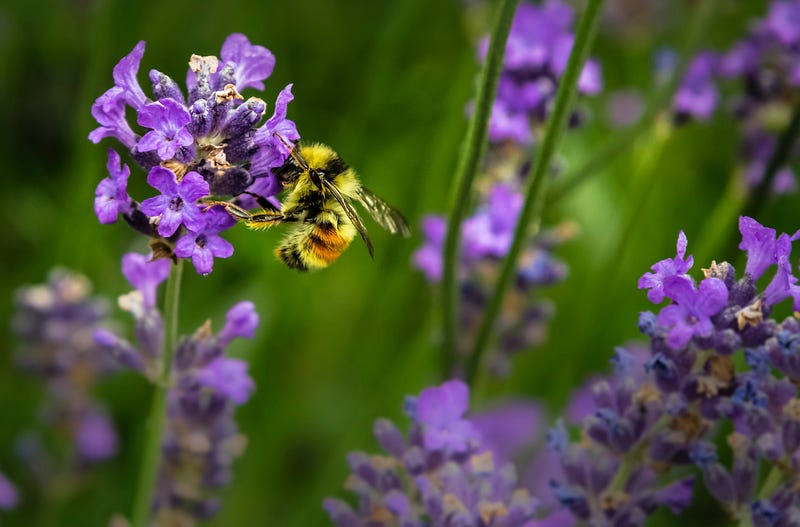
My first time in the osteopath’s waiting room found me surrounded not by magazines, racks of leaflets, and an anatomical skeleton model, but by attractive jars of homemade honey and rolled beeswax candles of all colours. Wtf?
It turned out he was quite the hobbyist beekeeper. In his garden, five large honey bee hives house around 250,000 bees. He’s known locally as ‘the bee guy’ as much as he is ‘the osteopath’, often removing unwelcome nests from gardens, no charge — and humanely, I might add. Remarkably, he tells me, he is rarely ever stung.
Crazily, my back pain sparked my appreciation of bees. Hopefully, this sparks yours.
There are roughly 20,000 known bee species.
Honey bees represent only a tiny fraction of that number with only seven recognized species. Amazingly, the whole of Europe is home to just one.
Up to 60,000 bees in a single hive.
Many bee species are solitary. Bumblebee colonies peak at around one-hundred-strong, and a typical wasp colony at around two thousand. But a strong honey bee colony, at its peak, is far greater, numbering around sixty thousand.
One queen rules them all.
In the height of summer, a honey bee colony can have over fifty thousand female workers, three thousand male drones, and yet just one queen. Interestingly, she has a smaller brain than a worker bee.
A honey bee colony is a super-organism.
Honey bees have an incredibly organized system of job allocation. When a bee is born its first job is to clean out the cell in which she was born. From then on jobs are allocated according to age, including feeding larvae, producing wax, building comb, removing dead bees, guard duties, and finally (the ultimate aspiration!) collecting pollen, nectar and water.
Honey bees are polyphasic sleepers.
Many people think that bees don’t sleep, but research shows they actually do seem to. They don’t sleep for one long period but instead have a polyphasic sleep pattern of multiple naps throughout a twenty-four-hour period. They even seem to take naps inside flowers whilst ‘on the job’.
They are nature’s most efficient builders.
Honeycombs are one of nature’s most geometrically efficient structures. The closed ends of honeycomb cells are trihedral sections of rhombic dodecahedra, and the walls meet at precise 120-degree angles, minimizing the surface area for any given volume. One structure then backs on to another for even further efficiency. I know, right?!
They fly more like a helicopter than a plane.
It’s often said that bees violate the laws of aerodynamics, however, they only violate the laws of fixed-wing flight. Bees wings are not fixed, they can both flap and swivel, creating vortices that give them lift, much like a helicopter. Their wings can flap up to 230 times per second, much faster than other insects of their size.
They can fly up to 20mph.
This, of course, depends on various things such as the temperature, the type of bee, whether they’re laden with pollen, etc.
They can fly up to 30 metres high.
Even higher if carried by warm thermal currents.
They can fly all the way to the moon!
Well, sort of. Usually, a bee travels about a mile for food but will go up to about five miles if need be. A large colony covering their maximum distance can, therefore, travel the equivalent distance from the Earth to the moon every day. Quite incredible!
They make honey while the sun is shining.
Most bees live in small colonies that hibernate over winter, so only make honey to feed themselves during summer. Honey bees, however, live in massive colonies of up to sixty thousand and don’t hibernate, so they have to make enough honey in summer to sustain thousands of mouths all through winter. Playing it safe, they produce two to three times more than they need. Show me the honey! It is this excess that beekeepers kindly put in jars for us.
One teaspoon of honey takes twelve bees.
A group of about twelve bees will work their entire combined lifetimes to produce just one teaspoon of honey.
A million trips.
One average-sized bee colony will collect about 20kg of pollen every year. That’s a million pollen loads at 20mg a go.
A million miles.
An average-sized colony can produce around 11kg of honey in one year. To do this they may fly well over a million miles.
A hundred million years.
Fossil records indicate bees have been on Earth for over a hundred million years… industriously doing the same job, in the same way, that whole time.
“Ouch!” and “Ahhh…”
It is estimated that 1,100 honey bee stings are required to be fatal to an adult human (allergies aside, of course). It’s not without irony then, that their honey is also a natural anti-septic.

It’s nice to bee home.
Even a hobbyist bee-keeper, like my osteopath, can easily house an amazing quarter-of-a-million bees in just an average-sized garden. So it’s definitely something you can consider doing — if you’re interested, your local beekeepers’ association is a good place to get some guidance. Thousands of amateur beekeepers all over the world play an essential role in the survival of honey bees, providing safe and suitable hives to house bees in exchange for their excess honey. There are, however, many other easy ways you can help bees that require much less commitment.
I hope this has increased your appreciation of these truly fascinating fuzzy little wonders. The world of bees is a massive subject, and I’d definitely encourage anyone interested in finding out more to do so.