
15 Years Later: Remembering the Queer Masterpiece That Helped Me Out of the Closet
On August 22, 2003, I spoke the words “I’m gay” out loud for the first time. Perhaps it seems weird to some that I remember the exact date. But it makes perfect sense to me. I actually remember every detail.
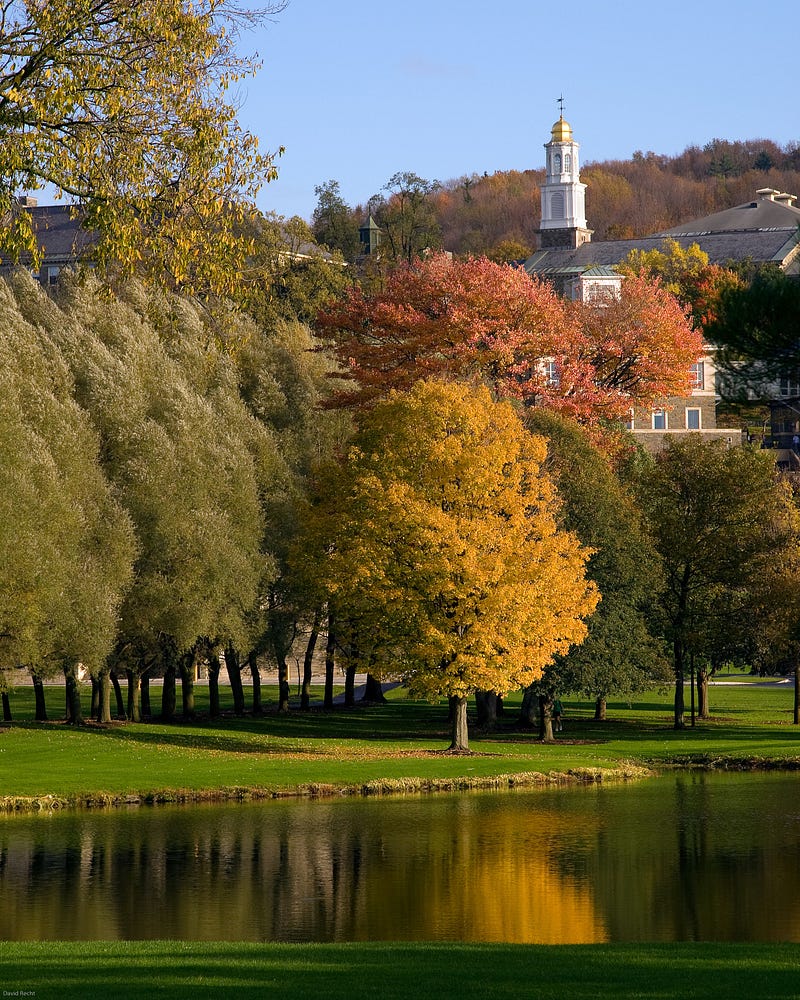
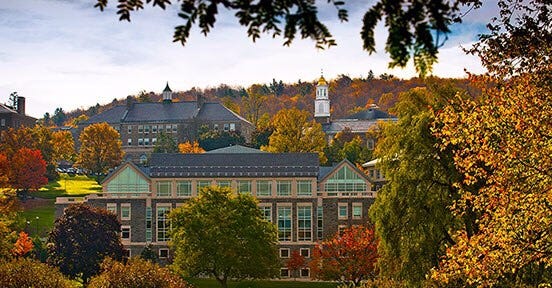
I had just returned to Colgate University for my sophomore year. I had arrived several days early before the rest of campus to undergo Resident Advisor orientation. I was hanging out with my fellow aspiring RA Rizwan in his new dorm room in East Hall. There were only a few dozen students on campus at this point and I remember thinking I had never experienced such quietness and solitude on the campus. I could hear my heart pounding through my chest. (I could also hear the bat that had somehow made its way inside the building with us, but I was too preoccupied to be as concerned about that as I probably should have been.) Prior to returning to college that year, I decided I had to come out and that I had to do it right away. I couldn’t take another day of hiding.
After 18 years growing up in a predominantly Catholic, military, and Republican small town, I had found my first year at Colgate University to be profoundly jarring. It was only 35 miles away from the house I grew up in, but it felt like another world. Sure it had its fair share of issues with misogyny, racism, homophobia and the like, but the very fact that these issues were openly discussed and resisted felt liberating. I met people from all over the world, was challenged to critically examine everything I had ever been taught, and for the first time got a taste of what true acceptance felt like.
Nevertheless, my first year was not an easy one. I was carrying a ton of emotional baggage from high school and to say that I didn’t adjust well when all of my friends started pairing off in opposite-sex pairs like they were marching off to Noah’s Ark would be quit the understatement. It was that same friend who I first came out to that had noticed I was struggling and encouraged me to go the campus counseling center. After a couple months of profoundly impactful sessions, my therapist suggested that maybe I was struggling with a concealed sexual identity. I knew right then and there that she was right, but I was not yet ready to name it, let alone own it.
Fast forward three months and there I was, ready to finally share the shameful secret I buried so far deep down that until recently I didn’t actually realize I was keeping it. After several false starts, I finally uttered the words. And much to my surprise his response was…
Irrelevant.
***
Actually his response was supportive and empathic and accepting and profoundly impactful. But when reflecting on my 15 year coming out anniversary — which I am in the midst of as I write this — I am startled to realize how much of the narrative surrounding my identity as a gay man is dominated by the reaction of other people to it. What would my family think? Would my friends still want to hang out with me? Is that why the kids in school bullied me the way they did? Could I ever go back to church (and did I want to)? Would people on campus treat me differently once they knew? Will other gay people like me and want to be my friend? Would anyone ever be willing to date me?
In the previous articles I have written about the intersection of my gay identity and milestones in LGBT representation in the media (see links below), questions of this nature have loomed so large. But what about me?
Read “Taking Mom and Dad to a Gay Cowboy Romance in Bush Country”
What was the impact of finally having an explanation for why I always felt like such an outsider? How did it feel to own my identity and declare it to others? What was it like to succeed at the single most terrifying challenge that had ever been placed before me? How did it feel to know that the romantic future I had thought was unattainable for me was suddenly a reality (albeit not as I had envisioned)? What did it mean to me to finally be free?
These are questions I have asked myself too rarely over the past decade and a half. Much of the time, I have been so preoccupied with other people’s acceptance and rejection of me that I have become distracted from the journey of developing my own identity as a gay man. But that’s not to say I haven’t explored it. I have grappled with the questions about what it means for me to be a gay man since I first had an inkling that the label might apply to me. My decision to come out at all and the big questions I grappled with on my (still ongoing) journey to self-acceptance were heavily influenced by a film that I came across six months prior to coming out.
***
At the very end of 2002, acclaimed director Stephen Daldry’s adaptation of Michael Cunningham’s Pulitzer Prize-winning novel The Hours hit theaters. By the time it reached a theater near me it was well into 2003 and it had already received nine Oscar nominations, including Best Picture (it would go on to win one — Best Actress for Nicole Kidman). Like the source novel it closely follows, the film concerns three separate storylines that are interconnected in ways that continue to confound and surprise up until the credits roll.
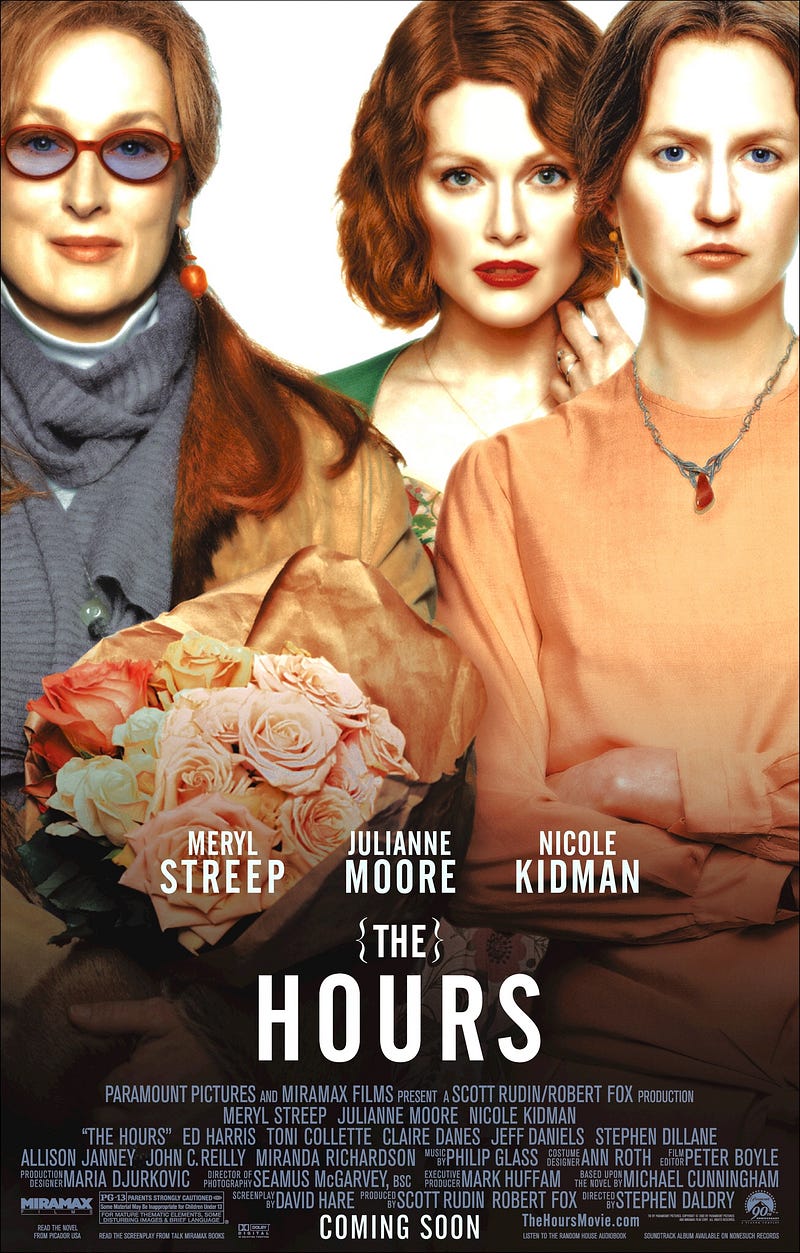
In 1923, legendary author Virginia Woolf (Kidman) immerses herself in writing Mrs. Dalloway while confined to the English countryside by her husband and doctors following a psychotic episode. In 1951, dissatisfied Los Angeles housewife Laura Brown (Julianne Moore) contemplates suicide on her husband’s birthday. And in 2001, book editor Clarissa Vaughn (Meryl Streep) organizes a lavish party for her ex-lover Richard (Ed Harris), a poet dying of AIDS.
The film feature a powerhouse cast (which also includes Claire Danes, Allison Janney, Toni Collette, John C. Reilly, Eileen Atkins, Stephen Dillane, and Jeff Daniels), a brilliant screenplay, and a majestically melodramatic score by Phillip Glass. I know people who complain that “nothing happens” in the film, but I find this particular criticism to be preposterous. To me everything happens in the span of 114 minutes. The film grapples with deep questions about mental illness, mortality, abandonment, intimacy, and — most relevantly for this article — sexual identity.
Each of the three storylines featured moments that profoundly impacted me. In one, Clarissa discusses the fleeting nature of happiness with her daughter (Danes). She wistfully reflects on her young adulthood: “I remember one morning getting up at dawn, there was such a sense of possibility. You know, that feeling? And I remember thinking to myself: So, this is the beginning of happiness. This is where it starts. And of course there will always be more. It never occurred to me it wasn’t the beginning. It was happiness. It was the moment. Right then.”
In the second, Virginia decides that she has had enough of confinement in the suburbs and must return to the “violent jolt of the capitol,” even if it means her own destruction. She tells her husband (Dillane), “You cannot find peace by avoiding life, Leonard.”
In the third, Laura reappears at the end of the film and recounts her conflicted feelings about abandoning her family because she was profoundly depressed (ostensibly as a result of her repressed sexual identity.) She poignantly states, “It would be wonderful to say you regretted it. It would be easy. But what does it mean? What does it mean to regret when you have no choice? It’s what you can bear. There it is. No one’s going to forgive me. It was death. I chose life.”
I have revisited the film (and the novel upon which it is based) multiple times over the past 15 years and it never ceases to floor me. When I most recently watched it a few months ago, I was struck by how much the theme of “choosing life” regardless of the risks resonated with me in a way it hadn’t before. I realized that the film came into my life at a critical point when I was essentially grappling with the question of whether I should remain “safe” yet unhappy or take a profound risk that could lead to a life of authenticity and perhaps even genuine happiness (even if it was fleeting as Clarissa opined). The Hours helped me realize that even though it seemed profoundly scary to “choose life,” it was in fact a choice I had before me. One that only I could make.
***
Every year when August 22nd rolls around, I become immensely grateful for the people who have loved and supported me throughout my life — the family that loved me unconditionally, the friends who embraced my new identity and helped me navigate, and the husband, colleagues, and friends I have made as an adult who have given me such a rich life and a growing sense of self-confidence.
But this year, I have decided that I am going to focus on being grateful for my younger self who had the courage to choose life 15 years ago today.
***


