
What Ellen Coming Out Meant to Me
In April 1997, Ellen DeGeneres caused a media firestorm — and generated some intense backlash — when she came out as a lesbian and announced that the character she portrayed on her hit sitcom would be doing the same. 21 years later, I reflect on that singular moment in time, the artistry of the landmark episode, and the enduring legacy of that hour of television.
Author’s Note: About one month ago, I wrote a post about the film Love, Simon, which marked the first time a teen romance with a gay protagonist ever received a wide release. I reflected on what it would have meant to me if a film like that had been released when I was a teenager. It was cathartic to write and elicited feedback that moved me. The experience inspired me to write a series of articles about milestones in LGBT media representation that personally affected me. It felt natural to start with Ellen.
Putting The Event Into Context
Although I didn’t fully understand that I was gay until age 19, I had that dreadful feeling I was “different” much, much earlier. Growing up in a conservative, Catholic, and military community many miles away from the nearest city meant that I never met a single “out” LGBT person while I was growing up. Like many LGBT youth, I learned what “gay” was from the media. Unfortunately, in the 1990s, the “Family Values” movement was strong and LGBTs were either ignored or treated as a taboo by most news outlets. Depictions of LGBTs (particularly gay men) in film and television fell distinctly into one of three categories: 1) the sassy sidekick, 2) the broad caricature, and 3) the tragic figure (mostly in movies I wasn’t old enough to see).
But in April 1997 there was a monumental shift.
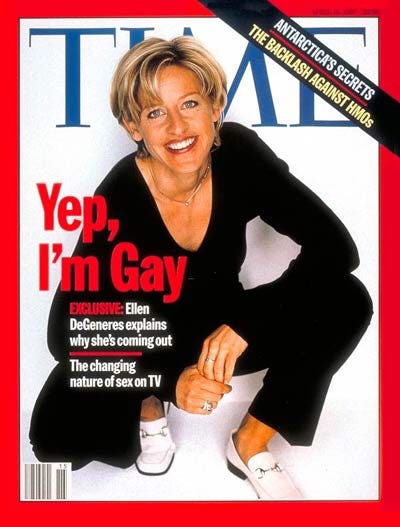
A few weeks after my 13th birthday, the word “gay” was everywhere thanks to the fact that popular comedienne and sitcom star Ellen DeGeneres had won a hard-fought battle with ABC to allow her character to come out of the closet as a lesbian. She came out on the cover of Time Magazine on the April 14, 1997 issue and it was announced that the character she portrayed on her titular sitcom would follow suit on a very special, top secret episode set to air on April 30th.
I distinctly remember how horrifying the vitriol from the Right was to me as a 13-year-old. To see a personality whom I adored and viewed as the epitome of goodness mocked, bullied, and boycotted for simply saying who she was shook me. If the goal of her opponents was to send a clear message to LGBT youth that they should think twice about following in her brave footsteps, then they at least succeeded with one confused teenager.
But that’s not to say that all the messages I heard about Ellen’s announcement were negative. To my surprise, my family was largely unfazed. From early on in its run, Ellen was appointment viewing for us. One of my family’s favorite activities was sitting down and watching primetime sitcoms together. As I got older, the more family-friendly fare of shows like Home Improvement and Boy Meets World gave way to more adult fare like Friends and Seinfeld. Prior to the coming out episode, Ellen fit somewhere in the middle. The humor was occasionally racy and nuanced satire was often featured, but Ellen’s goofy sense of humor made the whole thing go down so easily viewers often didn’t notice.
Looking back, I realize how nervous I was to watch the episode and how curious I was about how my family and friends would react to the episode. To my surprise (and relief), it just was not treated as a huge deal and we sat down to watch the legendary episode with little discussion or hesitation, despite the thundering parental advisory warnings.
Revisiting the Landmark Episode
By the time the landmark episode aired, Ellen was a well-established sitcom. It had already aired 83 episodes over 4 seasons. During its second season, it was one of the top 15 most watched show on television and averaged over 21 million viewers per episode. And Ellen DeGeneres’s performance in the lead role had already been awarded with multiple Emmy, Golden Globe, and Screen Actors Guild nominations. But despite its success, the show never really captured the attention of Hollywood or the nation until the coming out episode.
The overall lack of passion for Ellen was in large part due to the fact that outside of DeGeneres’s dazzling performance in the lead role, the series struggled for a long time to find its voice. During the 1993–1994 season it aired 11 episodes under the title These Friends of Mine and featured a supporting cast that all disappeared by the time the show moved into its third season. In addition to the disrupted rhythm caused by a revolving door of supporting characters, Ellen Morgan felt somewhat undeveloped as a character. Her insecurity, nervous humor, sense of justice, and fierce loyalty to her friends were well-established but much of her inner life was a mystery. In light of this, the decision to have her come out was about more than just breaking a taboo and appeasing the series’ star, it was also about establishing an identify for the show that had long lacked a strong and clear one.
Throughout the fourth season, there were hints that Ellen the character might come out. There were innuendos and sight gags galore and a recurring bit about her search for the right therapist provided plenty of fodder. But the ongoing coyness belied the fact that the creative team behind Ellen had something monumental planned. See, Ellen didn’t just come out at the end of a special issue episode presented with little fanfare in the middle of the season. It was an all-star event.
The hourlong episode was code named “The Puppy Episode” and was shrouded in secrecy. It was heavily hyped and slated to air right at the beginning of May Sweeps (which at the time was one of the most important times of year for television networks). The first half hour of the episode features a brilliant setup. Ellen finds herself supremely uncomfortable during a date with Richard, a man from her past who is in town on business. (Fun Fact: Richard is played by Steven Eckholdt, who just two months earlier had played a pivotal role in the breakup of Ross and Rachel on Friends.) She becomes anxious and exits the situation, only to run into his colleague Susan, who is in town with him.
The chemistry between Susan and Ellen was evident from the moment they met and it is clear that Ellen has a spark with Susan that doesn’t exist with Richard — and had never been seen with any of her male love interests throughout the show’s run. Susan was played with utter perfection by the marvelous Lara Dern, who received her third Emmy nomination for the role (she would have to wait until 2017 for her first win; she took home a trophy last year for her role in the HBO series Big Little Lies). When Susan makes it clear to Ellen that she’s gay, Ellen becomes wildly uncomfortable and engages in the self-deprecating motor-mouthed humor that made DeGeneres such a hit on the standup circuit — and subsequently landed her a sitcom of her own. Confused, she runs back to Richard for an attempted romp.
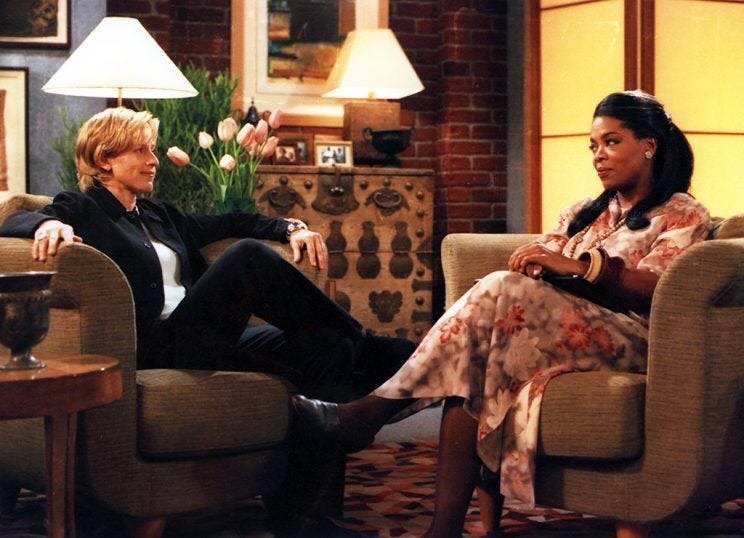
Jarred by the whole experience with Susan and Richard, Ellen goes to see her her latest therapist (played by none other than Oprah Winfrey) who helps her reach the conclusion that she is in fact gay. Realizing that Susan is about to leave town for good and she has little to lose, she races to the airport to tell Susan that she is in fact gay and has feelings for her. In true sitcom fashion, she accidentally makes her confession within range of the gate desk’s microphone, thus coming out to an entire section of LAX. But it turns out that Susan is not leaving town after all, she was just saying goodbye to Richard. She is in fact in town for several more days. Ellen smiles, filled with hope and validation.
The second half of this landmark hour of television focuses on Ellen’s decision to come out to her friends. It begins with a dream sequence, in which Ellen envisions a trip to the grocery store where she can’t escape comments about her gayness. The scene features cameos by the likes of film stars Demi Moore and Billy Bob Thornton and musicians k.d. Lang and Dwight Yoakam. Undeterred, she first comes out to her gay friend, Peter (Patrick Bristow, who had a recurring role on the series). Her attempt to come out to her straight friends is appropriately awkward and is met with enthusiasm by some (Clea Lewis’s irritatingly upbeat Audrey), reluctance by others (Joely Fisher’s vain and uptight Paige), and relative nonchalance by the rest (including three time Entourage Emmy winner Jeremy Piven who many forget had a major role on the series throughout most of its run.) She continues her romance with Susan only to find out that Susan is in a long-term relationship with another woman, leading to Ellen’s heartbreak. But nevertheless, Ellen has finally embraced her true identity and — more or less — has her friends along for the ride. At the end, her friends uncomfortably drag her to a lesbian coffee house, where she ends up playing wing-man to Paige as usual (somethings never change).
The episode is brilliantly funny from start to finish. It expertly balances satire with poignancy and never descending to the trappings of a typical sitcom “event” episode. It is chock full of cameos but somehow they add gravitas to the proceedings without becoming a distraction. It is not only the finest episode that Ellen ever produced, but also one of the best episodes of network television comedy that ever aired.

The Legacy of Ellen’s Coming Out Party
Network TV shows dating back to Soap in the early ’80s had featured LGBT characters in supporting roles from time to time, but never in a lead role. And no character on an established show had ever dared to come out before. The fact that Ellen not only broke new ground but did so with such fanfare and artistry made it a monumental moment in our cultural history. “The Puppy Episode” was watched by an astounding 42 million viewers, making it one of the most watched television events of the late 1990s. It won several awards, including the Emmy for Outstanding Writing, a Peabody Award, and a GLAAD Media Award. And it dominated the news cycle for weeks before and after its airing.
After “The Puppy Episode,” Ellen aired two additional episodes before wrapping the fourth season. The first featured her struggle to come out to her traditional parents. The second featured Paige continuing to struggle with Ellen’s identity and Ellen’s homophobic boss hostilely rejecting her. Any questions about whether Ellen would drop LGBT themes after the much-ballyhooed episode and return to the status quo were swiftly answered.
The following season of Ellen turned out to be its last. In fact, it was cancelled before the fifth season even wrapped. Many critics and fans felt the show did too much of an about-face in shifting from the show’s traditionally goofy humor to event episodes that boldly dealt with complex aspects of the LGBT experience. (It did produce at least one masterpiece, though, with the Emmy-winning episode “Emma” that features a guest appearance by Oscar-winner Emma Thompson that needs to be seen to be believed.) It finally became the show DeGeneres always dreamed of making, but not necessarily the one that many of her fans were particularly interested in watching.
After the demise of the show, it took Ellen DeGeneres a few years to regain success in Hollywood — her long-running daytime talk show began in 2003, 5 years after the sitcom wrapped. Nevertheless her status as an LGBT icon and as a creative force to be reckoned with in Hollywood were firmly established. And although the show came to an early end, it’s hard to deny that its mere existence provided a space for the slew of other LGBT-themed shows that emerged over the next decade (such as Will & Grace, Ugly Betty, and The L Word).
But the true legacy of “The Puppy Episode” occurred outside of Hollywood. Its true legacy was how it impacted people like me. When Ellen Morgan, riddled with profound anxiety about whether she would lose everyone and everything and suffering under the weight of decades of internalized homophobia, fell head over heels for Susan, it was a moment of joy that resonated with me in a manner unlike any other romantic moment I had ever seen depicted. When she was greeted with warmth and encouragement instead of hostile rejection by her therapist, it was a feeling of immense validation. When she inadvertently announced “I’m gay” into the loudspeaker at the airport and her world didn’t end, it was a moment of profound hope.
Although I didn’t fully acknowledge my identity as a gay man until 6 years after the episode aired, watching “The Puppy Episode” was a turning point in my development. The idea of being gay went from something I didn’t understand, had never seen positively portrayed, and deeply feared to something tangible, relatable, and acceptable. It was finally clear that it was possible to be gay, successful, and happy at the same time. For me it replaced the one-note caricatures from TV and film and the image of the tragic, sinful gay man peddled to me by my church with a face of bravery, hope, and contentment.
Tremendous progress has been made in representations of LGBT individuals in media in the last 21 years, but we still have a long way to go. Media still matters. LGBT visibility still matters. Maybe not to you, but to all of the children like me, sitting in front of their TVs, computers, and phones deeply confused about who they are and what their future could hold.
Writing this, I can’t help but wonder what the state of LGBT representation in media would be without Ellen. In fact, sometimes I wonder who I would be without Ellen.
[Note: All 109 episodes of the series are currently available to stream on Hulu and to purchase on iTunes and Amazon.]


