
11 Reasons Why SoundCloud Will Be Dead In A Year
The music platform is on its last legs.
[I produce electronic music as LUCKYKAT and run Katnap Music in case you’re not interested]
RIP SoundCloud. Cause of death: suicide.
The music industry was crushed during the COVID pandemic. Artists could no longer play live in venues, bars or nightclubs. In many countries, even buskers were banned in fear of the virus being passed through the germs on coins.
As the majority of the world population returns to the new normal, we have seen how music artists, labels and social music platforms have adjusted to this.
Artists who couldn’t play live turned their attention online to livestreaming platforms like Twitch. They could connect with fans anywhere in the world, get tips and even charge for online shows if they had a devoted following.
Forward thinking labels turned to NFTs as a way to generate more revenue for the artists they were representing. They attracted sponsors to livestreams, exclusive online only festivals and drive thru concerts.
Social music platforms like Spotify added a way to donate to artists. TikTok has given creators a way to make money from livestreaming on their app. But sadly one big player has completely dropped the ball during the time when artists needed them the most.
SoundCloud was founded in Sweden (also where Spotify was founded) in 2007 and is now headquartered in Germany. It has 175 million unique monthly users yet has been gradually annoying its community members with a poor business model, upload limits, an unbearable number of spam profiles which are not managed, fake labels that spam your inbox and very little engagement.
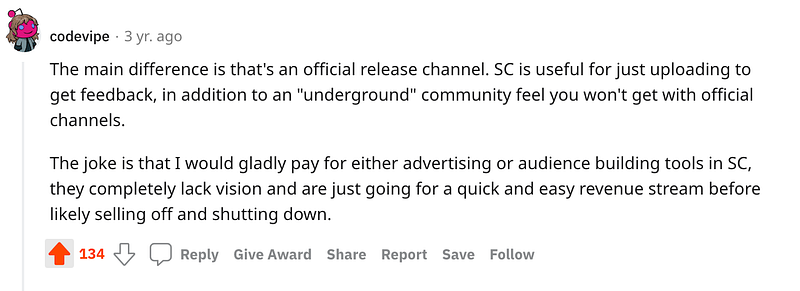
Having used SoundCloud for a several years and having investigated what other users think, this Reddit thread accurately exposes what the company has been doing over the last few years. Here are 11 reasons why SoundCloud will be dead in a year:
1. One Hour Upload Limit
You can only upload 1 hour of music. That is only 20 songs at 3 minutes each. If you produce progressive house or techno where average songs are 5–6 minutes, you will have significantly less evidence of your work to be able to show fans. It used to be unlimited but then this change was introduced to force users to have to upgrade.
2. Expensive Cost To Upgrade
Once you hit the 1 hour limit, you have to pay to upgrade. This is $12–16/month ($150–190 / year). But your fans are still hit with ads on the mobile app. So not only do you pay, SoundCloud makes money from your music by serving commercials you have no control over.
3. Ridiculous Amounts Of Spam
Every time you upload a new song, you receive likes from fake profiles. When you click on the profile, the banner reads something like, “get more views with a subscription”. When you report the profile, nothing happens. You get no reply from SoundCloud and the spam profile continues to like your future posts. Those same profiles will comment on your posts which clearly shows SoundCloud is allowing a toxic part of their community to operate or possibly running those profiles themselves as a way to make further money.
4. No Engagement From Community
When you upload songs, you have to rely on the engagement from your own following. SoundCloud drives no traffic to you regardless of how good your music is, the genre you are producing in or the amount of time you have been on the platform. They do not reward loyalty.
5. Basic Features Not Included In Free Level
To pin a song to your profile, SoundCloud forces you to upgrade. This seems excessive for such a basic feature. Why didn’t they address this in their beta launch? Surely their community would have told them that this needs to be included at the free level. Twitter doesn’t charge you to pin a tweet. Facebook doesn’t charge you to pin a post. So why does SoundCloud penny pinch from artists who typically don’t have a lot of money when they are starting out on the platform and in their careers?
6. Fraudulent Copyright Claims From Many Artists
They have millions of artists using copyrighted content then claiming it as their own. When you go into the song description, there is no credit given to the original copyright holder. Their algorithm will detect the song from one creator, assume it is theirs and then block any other songs with the same sample. When you file a dispute, they then ignore the fraudulent profiles and instead freeze the account of the innocent artists who are trying to do the right thing. They will then tell you that you owe their legal department for the incorrect copyright claim even though you know the profiles are using the copyright of other people and illegally claiming it as their own. It is a corrupt and highly unethical practice by SoundCloud yet when you try to expose their gross misconduct, they simply freeze you and make it look like you are the guilty one.
7. Failure To Adapt
They have failed to adapt compared to other music platforms. Like MySpace that had the market, it failed to change and listen to its core community members. As a result, Facebook came in fast, took the market and left every Millennial asking, “WTF is MySpace?” SoundCloud is going the exact same direction.
8. Only Bigger Artists Who Pay To Play Are Supported
The music that is highlighted is just like the Ads at the top of Google search results — pay to play promotions by big labels. It does NOT support small artists which was the reason they launched in the first place.
9. Value Proposition Is Poor
Artists used to use it to get feedback from the community but now that this doesn’t happen, they simply use SoundCloud to host demos. With SoundCloud proving they have no real use, artists are now using Dropbox or Discord to host their demos or connect with music professionals.
10. Labels Use It To Steal Music
A lot of labels have been known to steal music that gets good engagement. They simply scroll until they find an up and coming artist, get a ghost producer to remake the song and then release it with their distribution machine in place. The up and coming producer either never hears their version or does and tries to sue but has no leverage, capital and technically posting on SoundCloud it is difficult to be covered from a copyright standpoint as you have no ISRC (International Standard Recording Code) number which you get when you release through your distributor.
11. Competitors Are Innovating
There are competitors moving into the space like Audius. They are embracing cryptocurrency and have built a decent size community. The only concern is that their tech is unstable, the crypto coin won’t activate on your account and the ways to discover artists are extremely limited. These are the main reasons why SoundCloud is still on life support. TikTok is a not technically a direct competitor but when you can get very high engagement and a direct, visual connection to your fans, this is the app that could blow SoundCloud out of the water. Instead of searching on SoundCloud and being given links that are paid for, you can search for a genre on TikTok and instantly see and hear the new music that artists are putting out. It is a way more immersive and exciting experience.
If Audius or another competitor gets its act together fast, SoundCloud will be dead in a year.
#DeleteSoundCloud
I spend a lot of time on Twitter and have seen an increasing number of posts from producers and fans using the hashtag #DeleteSoundCloud .
If you think of a similar instance of this happening, it was with Uber. One blogger who was fed up with the service casually dropped #DeleteUber after a particularly frustrating experience with the ridesharing service. When he woke up the next morning, the hashtag had been used tens of thousands of times and it caused 200,000 users to delete the app over a weekend.
This is why I think the #DeleteSoundCloud hashtag will have a similar effect and cause a snowball effect in the music community that will push people over the edge, realize how they are so frustrated with SoundCloud and that it offers very little value to them, and subsequently delete their SoundCloud account.
Subscribe to my blog so you don’t miss a post: David Lowe ⭐️ Want my startup book? Grab a copy HERE.


