
100 years after his death, What remains of Lenin?
What does he have to say to us about capitalism?
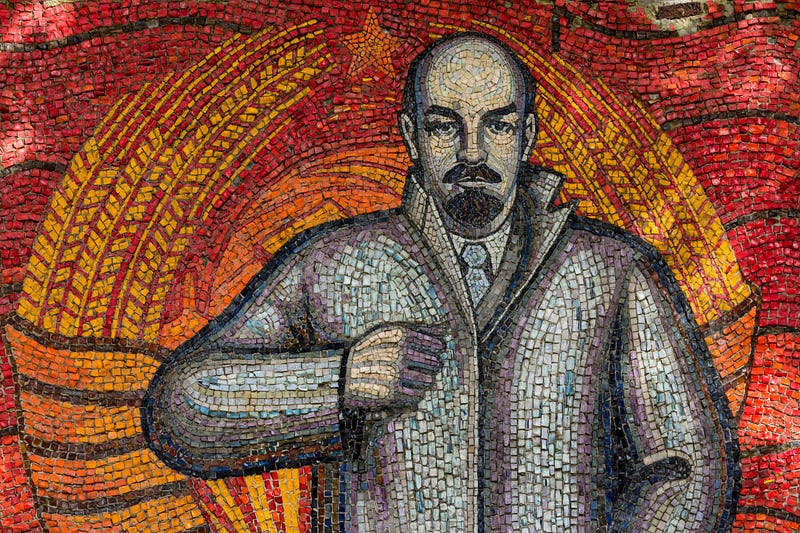
When the centenary of Vladimir Lenin’s birth was celebrated in 1970, the Soviet Union launched a massive campaign with commemorative stamps, specially minted coins, and new monuments inaugurated across the Federation. Two years of preparations culminated in a speech by the Politburo, led by Leonid Brezhnev, celebrating one of the most significant political figures of all time. Lenin had led the Bolshevik Party to victory in the first socialist revolution in the history of humanity, during a time of great imperialist powers at war, and emerging globalization without rules. The Kremlin proclaimed Lenin’s legacy would endure for centuries.
Now, on the centenary of his death on January 21, 2024, the country Lenin helped create has undergone radical changes. The Soviet Union no longer exists, replaced by a Russia steeped in consumerism and rapacious billionaires. The Communist International has vanished, and the communist movement replaced by geopolitical alliances with incoherent outlines and swarms of trolls disparaging the Western enemy, lacking a unifying ideology. Referring to Lenin in the West is now perceived as a sign of nostalgic backwardness at best and as a sign of political extremism at worst. But does Lenin truly have nothing to say to our present of democracies in crisis, bellicose movements, and technological changes?
Left-wing populism
Lenin’s analysis of the centrality of political organization, necessary to promote opposition to the czarist autocracy, proved correct. This includes his insight into the crucial role of media as an educational and coordinating tool.
However, according to Paolo Gerbaudo, a sociologist and political theorist at the Complutense University of Madrid, it is the left-wing parties of today, heirs to those of the mass era, that are incompatible with Lenin’s lessons. “That centralized party model, crucial in the struggle against capitalism, would require a social settlement, a long-term organizational investment that seems at odds with several contemporary cultural trends: presentism (obsession with the present), intolerance for discipline (especially party discipline), extreme individualism,” explains Gerbaudo.
With the decline of the Leninist idea of the party, characterized by a hierarchical, disciplined, and cohesive structure, “movementism” has gained ground — “a liquid and ‘horizontal’ organization, says Gerbaudo, somewhat inverting Lenin’s lesson on the need to build a strong cadre party”. Think also of the left-wing populist parties in Europe: Podemos, Syriza, France Insoumise. They have created charismatic leadership but are unable to apply Lenin’s maxim of “freedom of discussion, unity of action” when political debate spills over into social media flames, where differences of opinion become decisive and incompatible. Left-wing populism, perhaps due to this structural flaw, has not fully taken advantage of the crisis of capitalism to become a governing force.
A new Leninist party?
“Even outside the left, the 5 Star Movement, the Italian party with similarities to Leninism, has been largely anti-Leninist,” explains Gerbaudo. The entire idea of the platform party, where one equals one, the original model of the 5 Star Movement, is exactly the dream of eliminating the cadre party, creating an organization where all power is in the hands of members who self-organize without the need for organizational mediations.
Among all Italian parties, according to Gerbaudo, perhaps the one that most directly interprets the “Leninist” model is paradoxically, the Italian far-right party of neo-fascist origin, the League: “It has a fairly widespread territorial structure, especially in the northern regions, and despite Salvini’s charismatic-populist phase, it continues to have a certain degree of internal dialectic, where different interests, representing different segments of society, converge.” What about the neo-fascist party currently in government, founded by Prime Minister Giorgia Meloni, Brothers of Italy? “At the moment, it has not been able to match the enormous increase in consensus with the construction of a cadre party equal to its potential people’s party,” comments the professor.
Feminism
In his writings and speeches, Lenin argued that women are “doubly oppressed,” lacking equality in both the legal-political and domestic spheres. Secondly, Lenin supported the women’s rights movement, advocating for universal suffrage and supporting the struggle for freedom of divorce and abortion.
Valeria Finocchiaro, a philosopher who has studied Leninist political thought, has written the introduction to a new edition of Lenin’s writings on the women’s question, published by Pgreco. “Having read countless feminist pages, being a feminist myself, I am not ashamed to say that contemporary feminism is often disorienting, scattered in a thousand sometimes hard-to-understand currents.”
Lenin deserves credit for writing with clear, precise, and happy prose, using powerful images and completely abandoning the “mystique of femininity” so common in his time, the idea that women should be respected as special beings. His vision of society relieves women of the burden of labor, where domestic work can be rejected or at least equally divided between men and women. Finocchiaro writes: “Despite being over a hundred years old, these writings maintain a clarity and freshness that sometimes seem lacking in the theoretical twists of the contemporary world.”
In Russia
In Russia, before the war in Ukraine erupted, it seemed that only the most staunch communists remaining in Russia cared about Lenin-related anniversaries. President Vladimir Putin criticized Lenin’s concept of a federative state, with entities having the right to secede, attributing heavy responsibility to Lenin for the disintegration of the USSR in 1991 and the separatist aspirations of Ukraine.
In today’s Russia engaged in conflict with its once-fraternal neighbor, Lenin’s memory is trapped between two dominant ideological currents of the ruling elite: the idealization of the Soviet era — seen as a moment of pride for Russia and a check on geopolitical adversaries — and nostalgia for the pre-Soviet tsarist past that Lenin despised and sought to destroy.
Moreover, Lenin represents an internationalist ideology conflicting with current Russian nationalist currents that mock the so-called “color revolutions” worldwide and mainly aim to make Putin’s Russia a bastion of cultural conservatism.
Lenin’s rope
According to best-selling philosopher Slavoj Zizek, one should “reinvent” Lenin’s revolutionary spirit in today’s conditions. However, this means dealing with a capitalism that, despite being bruised but victorious after the October Revolution, remains paranoidly convinced it is on the brink of death. The endorsement of ultra-liberal Argentine President Javier Milei — a radical anti-communist — by the world’s richest man, Elon Musk, is significant because it shows that a part of the global elite fears a return of socialism and supports politicians proclaiming opposition.
Lenin said that capitalists would sell him the rope with which he would hang them. Tech entrepreneur Peter Thiel has recently argued that, with artificial intelligence, Silicon Valley giants have sold to communist China a tool for comprehensive social control, threatening to condition individual freedom and undermine democratic societies. A first step toward the return of global communism. AI, in the eyes of these new ironmasters, would be Lenin’s infamous rope.