
10 Ideas Worth Sharing This Week
Ideas about email, Facebook, productivity, and more.
Each week I share 10 ideas with my newsletter subscribers. Following is this week’s newsletter — sign up here to get future issues.
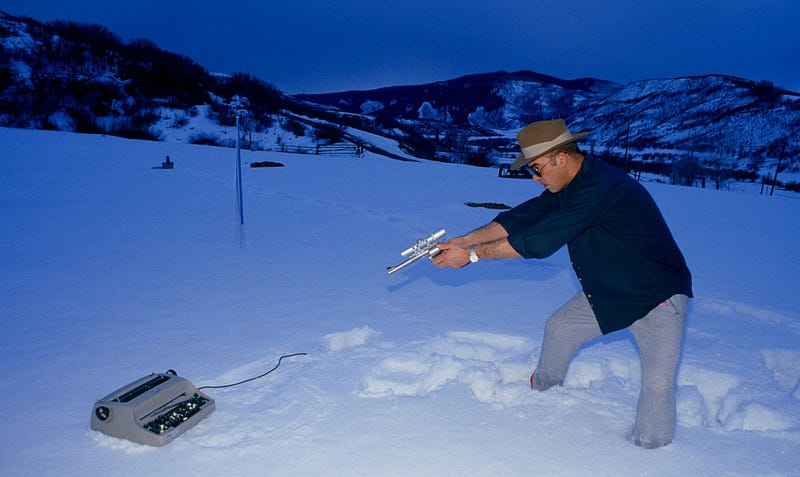
“Freedom is something that dies unless it’s used.” - Hunter S. Thompson
You’ll never know.
You won’t know if you can succeed. You won’t know if it’s a good idea. You won’t know how it will end.
You can wait, research, and contemplate all you want, but you’ll never know.
So stop waiting to know.
Go do the thing. Try it. Start.
Because when you do, that’s when you’ll know.
Now, on to this week’s ideas…
1. HOW TO MAKE DECISIONS LIKE AN OPTIMIST
“Incorporating optimism into our analysis of a problem allows us to more accurately assess it and make better decisions.”
I had a realization recently — when it comes to making decisions even optimists tend to be overly influenced by pessimism because things like fear, insecurity, and doubt color our perception of the problem.
In this post I offer four simple ways to use optimism to improve your decision making including to assume success as opposed to failure and to trust you won’t fall off a cliff.
2. WANT TO WRITE BETTER EMAILS? WRITE THEM LIKE THE MILITARY.
“Military professionals lead their emails with a short, staccato statement known as the BLUF (Bottom Line Up Front). It declares the purpose of the email and action required.”
It turns out the military is really good at email — who knew?
This Harvard Business Review article explains how the military writes emails in an efficient, effective format and demonstrates how those techniques can be applied to improve your own email communication.
The techniques include the use of keywords in subject lines, the reason you should link to files instead of attaching them, why you should use active verbs instead of passive ones, and more.
3. HOW TO MAKE WHAT YOU WANT FOR A LIVING
“Here’s my definition of art…art is when a human being does something that might not work.”
I share a lot of stuff from Seth Godin and James Altucher in this newsletter for good reason — they both share a lot of smart things.
So it shouldn’t be a surprise I highly recommend you check out this post which features highlights from a recent podcast episode in which they had a fascinating conversation about how to make what you want for a living.
They touch on everything from why you should never make something for the whole world (only YOUR world), why the only thing that matters is what you care enough to say, and how culture beats everything.
4. FACEBOOK’S IMPACT ON THE 2016 ELECTION CAN BE TRACED BACK TO A 2012 ELECTION TWEET
“While it was likely never the company’s intent to create a system that encouraged people to hear only what they wanted — whether or not it was true — Facebook didn’t get here by accident.”
A lot has been written about Facebook’s influence on the 2016 election, but this Buzzfeed article may be the best analysis of how and why that happened that I’ve seen.
The article traces the roots of Facebook’s influence back to the night of the 2012 election and Barack Obama’s celebratory tweet that went viral.
It was that social media moment that prompted a competitive reaction from Facebook and fueled their efforts to build what turned out to be a “petri dish for confirmation bias.”
5. STUDENTS HAVE NO IDEA WHEN NEWS IS FAKE
“More than two out of three middle-schoolers couldn’t see any valid reason to mistrust a post written by a bank executive arguing that young adults need more financial planning help.”
Speaking of fake news, this Wall Street Journal article drills down into how problematic the lack of media literacy is among middle school students.
A whopping 82% of students couldn’t distinguish between an ad labeled “sponsored content” and a real news story on a website. And the stats gets worse from there.
It’s yet another reason I believe every high school should teach a mandatory social media class.
6. THE PURPOSE OF LIFE, ACCORDING TO A 22-YEAR-OLD HUNTER S. THOMPSON
“Every man is the sum total of his reactions to experience. As your experiences differ and multiply, you become a different man, and hence your perspective changes.”
This one gets a little deep, but it’s worth it.
The site Tranquil Monkey has published a letter Hunter S. Thompson wrote before he was successful, offering advice to a friend who was trying to figure out the meaning and purpose of life.
Thompson ultimately concludes that “it is not necessary to accept the choices handed down to you by life as you know it.”
7. WHAT IT’S LIKE TO GROW UP ON THE INTERNET
“I am who I am because of the ideas I was exposed to, the people I met, and the skills that I learned — not in real life, but in a world that has landmarks but no physical location.”
This resonated with me and if you’ve found your way to reading my newsletter, I bet it will resonate with you as well.
It’s a post from designer Christine Røde, who explains how the Internet has become her “real home” over the years, offering her a community and sense of belonging she can take with her no matter where she lives or works.
8. WHY WHITE WORKING-CLASS PEOPLE VOTE AGAINST THEIR INTERESTS (HINT: THEY DON’T)
“It is easy to see why the right-wing narrative is so compelling — it offers formidable enemies (government and unions) and an economic vision that corporations will create new jobs if those enemies are defeated. In that narrative, white working class people will have opportunity again. The left offers no such clear enemy.”
Kirk Noden is a veteran community organizer who offers an interesting take on what’s really happening with white working-class voters and deconstructs the perception that they vote against their own interests.
In this column from The Nation, he suggests they’re not voting against their interests but rather voting for the only persuasive — if misleading — story they’re being offered to support.
No matter your personal politics, it’s an interesting dissection of the two distinct narratives being pitched to white working-class voters about the collapse of the industrial heartland and a solid explanation of why they choose to believe one of them.
9. “WHATEVER” IS NEVER THE RIGHT ANSWER
“The thing that I had spent my whole life thinking was the kindest option for others was in fact putting all the work on them.”
I used to say “Whatever” all the time, but I’ve learned to say it a lot less and found I completely agree with the sentiment of this Courtney Seiter post.
She spells out how she’s learned to make decisions by no longer being a “Whatever Person” and points out doing so has helped her know herself better, save time, and become a better leader.
10. FIVE WAYS TO CURB YOUR MEDIA ADDICTION AND BECOME MORE PRODUCTIVE
“Move replacement habits on to the home screen of your phone.”
It’s easy to get addicted to consuming media (social or otherwise), but it turns out it can be just as easy to kick the habit.
Tony Stubblebine shares five simple ways to battle your media addiction including to set a media consumption budget, move or delete Facebook and Twitter from your phone, and install Blocksite on your web browser.
FLASHBACK!
In the June 12th edition of this newsletter, I shared ideas about how LeBron James stays healthy, what happens when you stop talking about your work, the most important question to ask in any project, and more.


