
The Whatever People (or, How I Learned to Make a Decision)
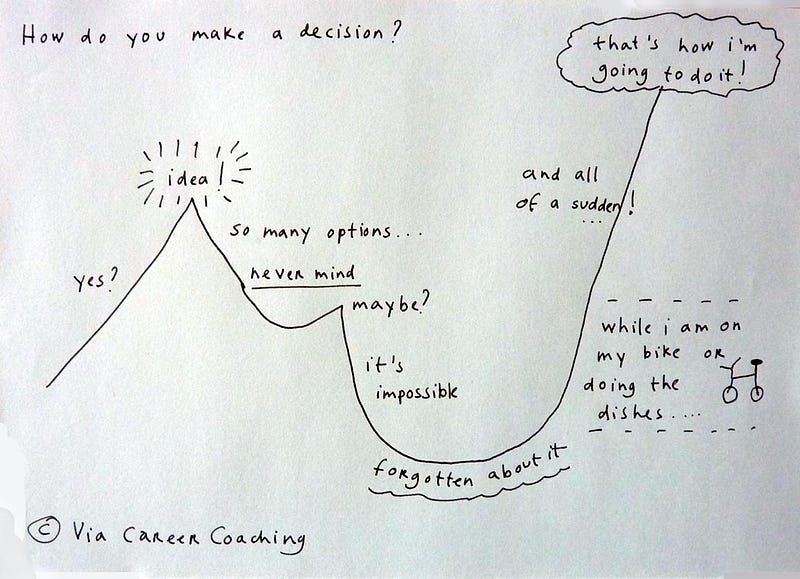
I come from Whatever People.
We’re a certain subset (quite often women, I‘ve noticed) whose general response to questions like “What time should we meet up?” “What do you feel like having for lunch?” or “Which seat would you like?” is something like:
“Oh, I don’t care. Whatever’s fine!”
I was raised to be a Whatever Person. I used to think this was both practical and kind. That you do other folks a favor by “being agreeable” and letting them call the shots. And I wasn’t super invested in most of those decisions anyway.
But sometimes…
Sometimes I secretly wanted Ethiopian food, or the window seat, or to get together slightly less early in the morning.
Even if I wanted it just a little.
And most of the time….
Most of the time, unbeknownst to me, I was annoying those around me with my noncommittal nature.
It’s rare that someone wants to be the one making all the decisions, all the time, which is the position I was putting people in. Who wants to constantly try and guess where I want to go and what I want to do?
The feedback that undid ‘Whatever’
I was totally oblivious to the downside of all my “agreeableness” until one day it affected my work.
I was courting a high-profile marketer for an interview and in my eagerness to get it scheduled, I went my usual course of “anytime is fine!”
I’m so grateful to have gotten some wonderful feedback from my team at this moment that totally changed my direction — in many ways.
The critique was both small and reasonable (It boiled down to: Name some specific dates and times! Even if that person can’t make them, they’ll name some others! This is how it works!) but it struck something deep within me.
The thing that I had spent my whole life thinking was the kindest option for others was in fact putting all the work on them.
I wasn’t being agreeable at all, I was being selfish — and I hadn’t even known it! Plus, all those “Whatevers!” were denying my own wants and needs — for no good reason.
That little bit of permission is all I needed to make a change.
Today, I’m happy to make the decision, however small. For lunch? This Italian spot gets good reviews, let’s try it. When to get together? I’m free Thursday morning for coffee.
This small change has paid surprisingly big dividends.
1. I know myself better
It turns out I did have opinions on all those little decisions after all. I just wasn’t letting myself speak them — or even feel them.
It’s incredibly liberating to practice this habit and learn more about myself with every decision. Instead of shunting the authority off to others, I explore my own feelings.
And as I learn to articulate what I want and make bigger decisions, my wants get clearer, stronger, more tangible. With each decision, I gain confidence.
2. I save so much time
“I don’t care, what do you want to do?”
“I don’t care, what do you want to do?”
Have you ever gotten stuck in an indecision loop with someone else? It can turn into a non-committing stalemate, both parties so afraid of making an unpopular decision they make none at all.
I spent a lot of time in these loops.
Even if I truly, deeply don’t care where we eat lunch, I do deeply value my time.
In nearly every case, it’s easier to make a call (even a mediocre one) than waste brain space dwelling on it or trying to get someone else to decide.
Email and phone tag, diminished. Pointless round-robin conversations, banished.
3. I lead more
The ability to make decisions big and small, in a timely fashion, and take responsibility for them, is a critical expression of confidence, and also leadership.” — The Confidence Code: The Science and Art of Self-Assurance
With the fear of making a bad or unpopular decision gone, things open up a lot.
One decision begets another until one day, you become a person who will Make A Call.
People who will Make A Call are quite in demand, as it turns out (maybe there are more Whatever People than I knew!).
They move fast. They can unblock others. They’ll give it to you straight.
These are all signs of leadership — something it’s tough to truly lean into when you’re afraid to decide which coffee shop to work in.
Don’t get me wrong, it’s not a straight line from choosing the lunch spot to landing in the C-suite. But leading necessarily means making decisions — uncomfortable ones, scary ones, ones where you don’t even have all the information you need to make a decision.
So all decision making — however small — can only be good practice for the bigger ones you’ll likely face eventually.
What’s at the root of ‘Whatever?’
It turns out, at the root of all my breezy “Whatevers!” was big, scary fear.
Fear of being too opinionated or bossy.
Fear of being less than perfect.
Fear of making the wrong call.
Fear of getting criticized.
In the end, getting criticized for not making a decision was the best thing that could have happened — because it was the worst thing that could have happened.
My worst fear came true and it…wasn’t that bad.
I learned something about myself. I got to fix it. I don’t make every decision now, but I get to be truly kind to people by being an equal partner in decision-making.
Are you a former or current member of the Whatever People? I’d love to hear your tips on banishing fear and making the call.