
1 Year of Mindful Drinking Taught Me These 3 Things about Our Toxic Drinking Culture
Why I still don’t plan to cut it out completely.
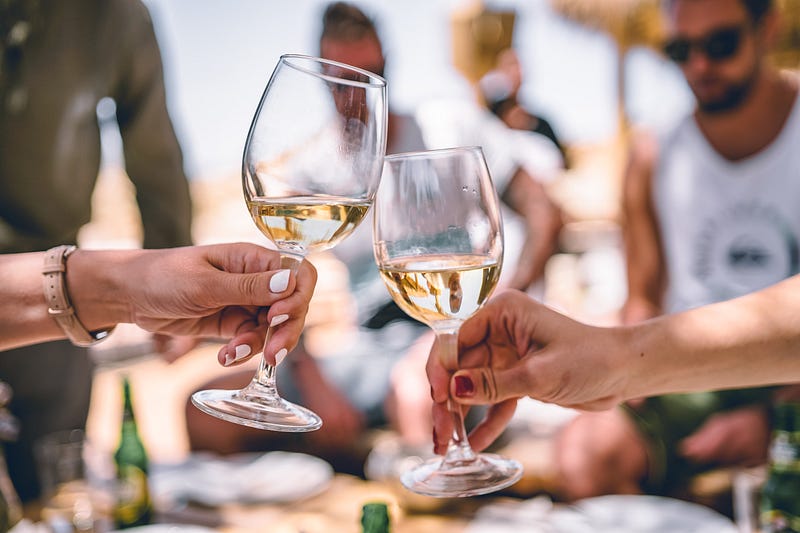
This year I had a grand total of 3 glasses of wine.
I didn’t purposely set a limit, it’s just what ended up happening. The actual goal was to be more mindful of when I chose to drink. I was curious about what I might learn about my own relationship with it and see how I might choose to change my habits moving forward based on what I learned with this more hands-on approach.
Over the course of the year, that decision has drastically changed how I view my relationship with drinking and our collective culture around it. This time has helped me see how obsessed we are with it to solve all of our problems. It helped me see that many of our socialized expectations around it are unintentionally toxic and more often than not, we enable long-term addiction and discourage healthy coping mechanisms.
I saw that our relationship with alcohol is often problematic, dangerous, and downright irresponsible.
But it doesn’t have to be. Not if we pay attention to how we use it.
Why perform this experiment?
I’m constantly trying to figure out which parts of me are myself, and which parts are mostly socialized. From there, I can decide which pieces I want to keep or discard from my life.
I feel like there’s a huge benefit to questioning the lessons that society teaches us so that we can create our own purposeful habits moving forward, rather than living our lives on auto-pilot. I’ve found that the easiest way to do this is to take a step back to get a clearer view of the situation. Being on the outside looking in often gives you a much better vantage point.
A lifetime of confusing experiences with alcohol…probably some pretty common ones.
For as long as I can remember, I’ve had a very confusing view of alcohol. As a kid, it seemed like one of the last markers of adulthood and something to be celebrated. This was the liquid gold that adults tied to the fun. As a kid, of course, I wanted to have fun. I assumed that one day, this is what I’d use it for.
However, I also grew up seeing another side of drinking, one that scared and angered me. I watched it fuel infidelity, fights, violence, hateful words that wouldn’t be remembered the next day by the person slurring them. I remember being put in the car too many times after someone had been drinking, and I remember hiding in the closet with my brothers during too many of those fights.
I saw both sides of what it meant to drink: To have fun and lose complete control…for better or for worse.
As an adult, I started to realize that I was drinking more often without really even thinking about it. I was drinking because I was at a Happy Hour with my coworkers, at a wedding, we had friends over on the weekend etc. and what I came to see was that I was often drinking without thinking much about it.
Once I realized I was doing this mostly due to auto-pilot rather than a genuine desire, that’s when I decided it would be educational and useful to take a step back to decide what I actually wanted my relationship to be with it.
I learned more than I imagined I would.
Lessons I’ve learned this year
Overall, we assume by default that people want to drink. It has honestly been a bit awkward at times to be the person that chooses not to. Mostly at the individual level, people haven’t pushed back, but sometimes they have. In those cases, it was almost as if my choosing not to drink, was a statement about their choice to do it. That wasn’t the intent, but there has been a distinct feeling of defensiveness that has come up a few times, and I honestly wasn’t expecting that.
At a larger scale, once I started purposely paying attention to the messaging that our culture pushes around alcohol… I couldn’t stop seeing it. It truly is everywhere, and I’m so glad that I took the time to see it and make my own decisions moving forward.
Here are the 3 big takeaways that I’ve walked away with.
1. We are conditioned to believe that alcohol can help us deal with negative experiences
We have a huge amount of social cues and years of conditioning to make us believe this one. Some examples:
- Had a hard day at work? — Have a drink when you get home.
- Tired of dealing with your kids and your spouse (this one has come up a lot in 2020 with COVID) — Grab a drink and chill out.
- Didn’t get that promotion or raise that you wanted at work? — Head out for some consoling drinks with friends.
- Need to deal with your family during the holidays? — Bring the eggnog or grab a beer to make it through!
…the list goes on and on.
I saw this messaging everywhere…on TV, on the radio, in conversations with friends and coworkers. It’s so pervasive that these suggestions are even joked about. What we’re learning here without even realizing it is that we should tie negative events that need processing, to alcohol.
The irony is that even though it may help you relax in the short-term, it doesn’t actually help you deal with your problems. Physiologically, alcohol takes a sledgehammer to the parts of your brain that you need for dealing with those situations, and renders you helpless while you’re under the influence. Without your higher functions, you’re not going to be able to adequately process any negative emotions or make a plan to fix things moving forward. The only thing it does is create a greater association between alcohol and coping, whether it deserves it or not.
Unfortunately, using alcohol as a coping mechanism becomes engrained through habit, and many of us never get around to doing the processing that so desperately needs to happen. By drinking to make it through a bad experience you haven’t helped to process anything, you’ve just put it off for another day.
The messaging that we get tells us that this is expected behavior, and even that it’s socially acceptable in many cases. When we allow ourselves to internalize that message, that a substance can help us deal with our problems, that’s how we set ourselves up for a lifetime of dangerous conditioning. Unfortunately, many people never get around to the processing part and become dependent on alcohol instead.
2. We use alcohol to loosen up and have a good time, even if we aren’t really having a good time
It’s not only negative experiences that we’ve tied to drinking, we’ve also paired it with the good times as well.
- Celebrating a new year? — Pop a bottle of champagne!
- Wedding? — Better figure out if you’re doing an open bar or bringing your own alcohol for the guests! (On average, people spend $2,500 on just the alcohol alone for their wedding.)
- Promotion? — No better way to celebrate than with a trip to the bar with your friends!
- Need to speak to that girl you’ve been too nervous to ask out? — Have some liquid courage and get over there!
Again, we see this messaging everywhere. It’s funny, we make jokes about it. everyone laughs.
What we’re really hearing here is that alcohol will help you to have a good time. It will help you loosen up, give you the confidence to be yourself, and help you enjoy socializing with other people.
Although it seems like this is a better alternative to pairing alcohol with coping with negative experiences, there are still some things to watch here as well.
Some of the issues that come with this
You might never learn to get over your own anxiety and stress around other people. You may need a few drinks to feel comfortable in your own skin, and you might come to accept that as normal. You could grow to use alcohol as a crutch to truly enjoy yourself. You might convince yourself that you’re having a good time and learn to ignore your own preferences because you can override them when you’ve had a few drinks.
On the more obvious end, you can make yourself vulnerable to making bad decisions, lower your filter, and open yourself up to being taken advantage of or making decisions that you wouldn’t have otherwise. It’s could be as small as an argument or as serious as cheating on your partner. I’ve seen both. Either way, you aren’t completely in control.
You don’t have to drink to bond with people, you can learn to have a good time without it. If you don’t know how and aren’t comfortable in your own head, you should probably spend some time learning rather than drinking those inadequacies away.
3. The drinking culture we partake in endangers our friends and family
By having these complex relationships with alcohol, we don’t only put ourselves at risk of developing a bad habit, we also expose our friends and families to these dangers by perpetuating these messages.
The Holidays are a perfect example. We assume by default that people drink to have a good time or to get through things, and so our family gatherings are often laden with heavy amounts of the stuff. We make it available, we make it a part of our traditions, and we engrain the role that alcohol plays in socializing with those around us. The messages are passed on, for better or for worse.
On average, we actually double our alcohol intake between Thanksgiving and New Years.
For those that have already become addicts, the Holidays can be especially difficult. Those of us that don’t identify as alcoholics don’t feel like we should have to abstain just because our family member has a problem, and the family member either struggles to be around it and possibly relapses…or may choose to simply forgo the celebration with their loved ones.
With alcoholics, we expect them to take control of their own situation. I get it, just because some people have a problem with it, that doesn’t mean the rest of us have to give it up entirely. But I do want to point out how much more difficult the choices that we make and the messages we give (oftentimes without even thinking about it) are helping to get and keep our friends and family members addicted. It’s dangerous.
Realizing all of this, It becomes hard to solely blame the alcoholics in your life for never developing any coping mechanisms because we’ve unknowingly always been telling them that alcohol is an acceptable coping mechanism. They just took it too far, the association was too strong for what we’re comfortable with.
I believe it’s helpful to know what we’re allowing into our lives and into our circles. If we’re playing with fire, we should at least be more aware of it. Those of us that choose to drink and perpetuate the culture around drinking are not as blameless as we may have once thought.
My relationship with drinking moving forward
I personally want to make sure that I don’t feed negative associations in my own life with alcohol. I know that it won’t solve the problem or do me any good in the long-term in dealing with those issues. So I refuse to pair them together.
When I’m upset, overwhelmed, disappointed, angry tired etc. I don’t drink. If I need to actively deal with a negative situation to get it taken care of, I make a plan to fix it with all of my faculties in order. If it’s out of my hands, I cope with those emotions sober and move on. I don’t let alcohol get me stuck in a cycle of never dealing with those issues or dragging the process out longer than it needs to.
Why keep drinking at all then?
I was actually born with a grape vineyard in my backyard, and spent the Fall smelling the ripe grapes in the air for weeks before they were picked.
I enjoy the taste of wine, especially paired with my favorite desserts. I love learning about it, tasting it, finding ways to bring out different flavors in the wine and food with different pairings. It’s almost a sensual experience for me. I love it…in the right setting.
That said, I’d drink it without the alcohol if I could find the same variety of taste without it since I’m not after the intoxicating effects. Unfortunately, I haven’t found a good substitute.
I don’t plan on cutting alcohol out of my life, and I’m not suggesting that other people should either. But I will be more aware of exactly which situations I’m choosing to pair alcohol with, and whether it’s an association that I want to purposely be building or not.
I’m proud to say that I’m happy with the 3 glasses of wine that I chose to have this year. I think that should be the goal, to know that you were in control of those situations, not that the situations were in control of you.
Conclusion
Taking a step back this year and questioning my own personal relationship with alcohol inside of an alcohol obsessed culture has been interesting. It’s become extremely clear that we try to use alcohol to find a shortcut to our dream lives. We use it to try and deal with the negatives, and to increase the positives…with varying results.
In the process we open ourselves and our loved ones up to the dangers of alcohol and addiction. Drinking can become the coping mechanism that we expect of full-grown adults, and it can quickly ruin relationships and spiral out of control.
By being aware of the default messaging that’s being fed to us, I’d encourage you to decide what you want your relationship with alcohol to be, and pay attention to when you’re making those decisions vs. when those decisions are being pushed on you. You might be surprised to find out that you can indeed develop much healthier coping mechanisms that actually work, and maybe you’ll be more aware of the messaging that you use around other people who are soaking in what you’ve got to say.
And for those that choose not to drink, don’t ostrecize them or jokingly push them into drinking just because you may choose to. Trust me, they already know they’re the odd one out and probably don’t need you to point it out.
Want more interesting and honest content? Sign up here to keep in contact.