
1 in 5 People Have Been in a Consensual Non-Monogamous Relationship
What’s going on behind closed bedroom doors?

When it comes to sex, people are a lot more open minded than we commonly believe.
According to a 2016 study published in the Journal of Sex and Marital Therapy, just over 20 percent of us have had a consensual non-monogamous (CNM) relationship at some point in our lives, which means both partners agreed that it was okay to have sex or romance with other people outside the relationship.
The study of 9,000 individuals had some flaws, including that it only sampled single people. But overall, it shed light on a practice that is gaining popularity, judging by the number of stories about it on Medium and in the press.
“Many people believe that CNM relationships are rare and, further, that they are primarily practiced by gay men. But is this really the case?…those who identified as men, as well as those who identified as non-heterosexual (specifically, gay, lesbian, or bisexual) were more likely to have had a CNM relationship at some point in their lives.
“However, it’s important to note that the vast majority of participants who reported having had CNM relationships were heterosexual (78–80%).
“In other words, although sexual minorities are more likely to have had a CNM relationship, they clearly aren’t the ones driving the high overall prevalence rate.” ~Sex and Psychology.com
Consensual Non-Monogamy is an umbrella term that covers many different kinds of relationships including but not limited to:
- Polyamory: having sexual or romantic relationships with multiple people at the same time
- Swinging: one couple having sex with another couple, or swapping partners
- Triads or Vees: two people having a sexual or romantic relationship with a third person, but not with each other
- Throuples: three people having a sexual or romantic relationship together
- Open relationships: a couple currently open to one or both partners having sex or romance outside their relationship
Also called Ethical Non-Monogamy, CNM is often in the news these days, which could be why I suggested it for my own long-term marriage.
My husband and I opened our relationship on a six-month trial basis in December of 2021, in part to investigate bisexuality, and I’ve been writing about the consequences since. You can find those stories on this list: Will Non-Monogamy Save My Marriage?
But is CNM really gaining in popularity, or is it just being talked about more? That’s hard to say.
The First Sexologist
When Alfred Kinsey came out with the Kinsey Reports, it was the first time in history that anyone had studied human sexuality on a large scale, and many of the results were shocking to mainstream society, including that just over 10 percent of us have homosexual feelings, and that half of men and a quarter of women had had sex outside their marriage.
Sexual Behavior in the Human Male, published in 1948, “was an utter revelation for a populace living in a time when masturbation was frowned upon, oral sex (even between husband and wife) was illegal in some states, and homosexuality was considered an extremely rare, criminal deviance,” according to the Los Angeles Times.
“Based on thousands of exhaustive, confidential interviews with churchgoers, college students, prison inmates and more, Kinsey reported, for example, that 92% of men had masturbated and half of married men had had extramarital affairs. A full 37% of men said they had had some form of homosexual experience at some point in their lives.”
Published five years later, Sexual Behavior in the Human Female continued to upend commonly held beliefs, including that women had little sexual feeling.
“A full 62% of women, for instance, reported they had masturbated, about half of the women said that they had engaged in premarital sex, and two-thirds of participants said that they had experienced overtly sexual dreams. The book was widely attacked as an affront to the dignity of womanhood.”
Because my husband and I have different levels of sexual desire, I was curious how often married people typically have sex. “The average frequency of marital sex reported by women was 2.8 times a week in the late teens, 2.2 times a week by age 30, and 1.0 times a week by age 50,” according to the report. So that cleared that up (not).
Nevertheless, what people do in their bedrooms was then, and still is today, mostly a mystery. But at least people talk about it now. And that’s a legacy of Alfred Kinsey, too. He brought human sexuality out of the shadows and made it a mainstream field of study, while exploding myths of normativity along the way.
“‘His №1 contribution was simply recognizing that sexual behavior is diverse and that people do very different things … that there was a marvelous and very substantial diversity of sexual behavior in all segments of the population,’ says Dean Hamer, author and molecular biologist at the National Institutes of Health, who has studied sexuality and genetics.”
The Right and the Call to be Different
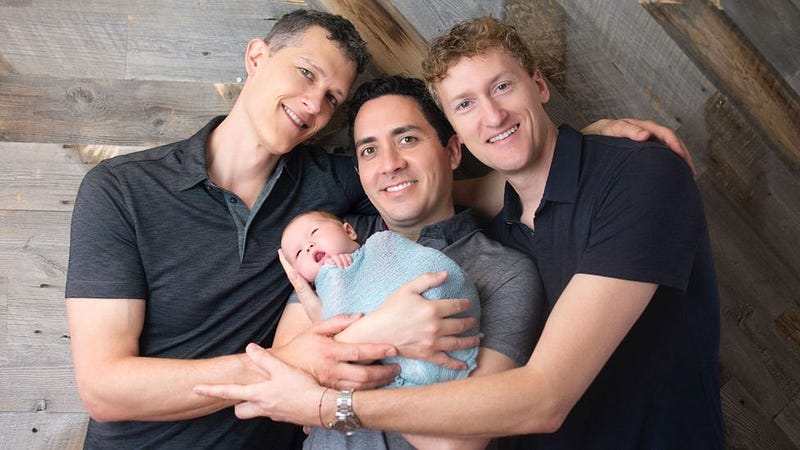
One story about the expanding sexual landscape involves a throuple in Southern California who are all listed as legal parents on their two children’s birth certificates. Three guys in a committed relationship went to court to ask for legal parenting rights, and a judge agreed to grant them. It was the first time in United States history that all members of a CNM relationship had been granted parenting rights. One of the partners, Ian Jenkins, wrote a book about it that came out last month: Three Dads and a Baby: Adventures in Modern Parenting.
Another story that stood out while researching this article was titled Are Straight People OK? How We Can Improve Heterosexuality in Teen Vogue, where sex and dating advice columnist Nona Willis Aronowitz reported that she often got questions from young women asking what to do when their boyfriends weren’t treating them right.
Aronowitz laid much of the blame on society’s limiting and outdated definition of masculinity.
She also interviewed Jane Ward, a professor of gender and sexuality at UC Riverside and the author of the 2020 book, The Tragedy of Heterosexuality. Ward said that the commonly held belief that living as a queer is more difficult than living straight isn’t true. Although discrimination happens and bigotry is real, that analysis “masks not only queer joy and pleasure but also queer relief not to be straight” and all the sexist strictures that entails.
In queer relationships, “no one is imagined from the very beginning to be incapable of passion or empathy or washing dishes because of their gender, or to be an old ball-and-chain because of their gender,” Ward said.
Ward discusses the difficulty in separating out your authentic desires from desires you adopted to conform to society’s expectations. But if we can, and we determine that we truly want to be in a heterosexual, monogamous relationship, then we need to throw out the old tropes and re-imagine what that means, she said.
“Let’s expand the notion of heterosexual attraction to include such a powerful longing for the full humanity of women, and for the sexual vulnerability of men, that anything less becomes suspect as authentic sexual desire.”
Parsing out what I really want versus what I think I want because I’ve seen it in a thousand movies, or read it in a multitude of books, or seen it play out in the relationships of family and friends, is a lot of what I’ve been working on while opening my own relationship.
For example, when I’m calm and secure, I honestly do not care if my husband has sex with someone else. In fact, I experience it as a kind of relief, because I know he will come home a happier man and in the meantime, I get to have some time to myself.
But other times, I’ll see how a couple in a romantic movie interacts, compare it to my own life, and think that something must be wrong with me.
That’s why I’m grateful to people like Alfred Kinsey and the scientists behind the 2016 study that shows that consensual non-monogamy is far more prevalent than it seems. It reminds me that I’m not some kind of freak of nature. What we’re doing is natural, and acceptable, and maybe even laudable. Because what a sad world it would be if all the people on the planet behaved the same.
Like Dean Hamer said above, there is “a marvelous and very substantial diversity of sexual behavior in all segments of the population.”
And I am part of that. I am marvelous.
For further reading…
Hubs and I just opened up our long-term marriage. Find stories about how it’s going on this List, or sexuality in general on this one. Get an email whenever I publish. Or sign up for Medium with my referral link. Let’s do this!


