
FUTURE
#1. How Do Our Economies Create Successful Abundance?
Let’s break down some walls

Look at the Galaxy in this picture. Look. And feel. Infinite possibilities are floating around us. We are weightless. So small. A speck of dust. And yet, we are so powerful because we are the center of our own universe.
Do you feel it? In your bones? We are part of this universe. We are biological beings with a body that is wiser than we will ever know with our rational minds.
And what do we do in our economies, silly beings that we are? We use scarcity to create money. Not multiple values. Just money.
Who can eat money? Who can live in money? Who can replenish the water in our bodies with money?
Money is valueless if we do not combine it with other values. Healthy air to breathe. Healthy water to drink. Healthy shelter in healthy houses.
Because we use scarcity in our economies, everything becomes expensive. The more scarce, the more expensive. And in our western world, the prices are soaring. Homeless people are not only the ultra-poor and mentally ill people anymore.
They are people like you and me. We just cannot afford homes anymore.
So, how can we create healthy economies for a better future?
Biomimicry shows the way. And in a series of articles, I will explain how it works. And how you can contribute with your own talents to what is happening in the world.
Luckily, the new world has already been birthed. She is on the brink of exponential growth now. And if we understand what’s happening, we will be able to step on this fast-moving train and take a ride.
Happy exploring economic systems!
Cluster Economies
There’s much that can be said about human systems and redesigning them according to planetary laws.
And this time, I want to focus on breaking down walls.
People who follow me know that In my perception, ecosystem restoration is the basis of everything we create. Our economies have always been based on 3 pillars. Land, labor, and capital.
Well, let’s change some thinking here.
If I look into the future, in the year 2222, the land will not be owned by people or countries, but by the planet herself. We do not need land to make our economies vibrant. Do you own land? I don’t.
And still, my personal micro-economy is very vibrant. With lots of different income streams and outgoing streams to friends and for my needs.
I balance time, freedom, and money in hugely creative ways.
Can we make economies vibrant without land? Of course. We do it all the time nowadays. I will not point it out here. Do some thinking for yourself and tell me in the comments what you see.
We are going from only economies of scale to combinations with economies of scope. Cluster economies. As you can see behind the link, just with economies of scale the price goes down when we cluster wisely. And huge clusters are emerging in economies right now.
The characteristics of the clusters?
- Interlinked businesses that use each other’s externalities. What are externalities? The by-products (waste) and by-effects (pollution) that are part of the process but cannot be used in the original company
- The businesses are designed with clever processes so they can take collective responsibility for all they create
- They create huge amounts of multiple values. Jobs. Profits. Healthy air. Healthy water. Health. Full stop.
El Hierro, an island belonging to Spain, has a good cluster economy. You can read about it here.
Born Global is building cluster economies in 6 biomes. Main (USA), Lebanon, France, Egypt, South Africa, and Costa Rica. I love working on these projects with my colleagues at Born Global. We are a truly global bunch!
Cluster economies can be created locally. And globally.
When is locally good? When it’s about physical goods. When globally? When it’s about immaterial goods such as information and education. Look at what I’m doing now via the internet. Reaching millions of people via one virtual platform. Medium.
Interacting with others. Building alliances.
What’s good about economies of scope? Let’s have a look at the local economy. One company buys a product from another and invests the money again in another product. They use each other’s waste streams. They use each other’s waste warmth. Waste energy. They share the talents of the people they employ.
And we all know that when it comes to people’s creativity 1+1=3.
Creativity grows exponentially whenever people are together. Bouncing ideas off each other. And supporting each other to finish projects so the value can be harvested from the project.
Harvesting is good. Investing is also good. Draining each other’s energy isn’t so good. So we all try to prevent that. No fear. No bullying. Only constructive criticism and loads of support!
What is utterly destructive for economies of scope?
Multinationals that suck money out of local economies and let them land in the pockets of anonymous shareholders.
These multinationals feel no connection to the land or the people. They just TAKE. Never give back. And all citizens pay the price. We have to breathe the filthy air. We have to pay huge energy prices while the big companies get big discounts. We have to drink microplastics.
Do you know that Australians drink a credit card of microplastics in their water every week? And I’m guessing it isn’t much different in the USA or Europe.
So sad! Making me sooooo angry!
Multinationals that suck money out of local economies and don’t give back are the destructive forces of economies
Economies of scope, however, thrive on a huge amount of citizens’ initiatives and varied SMEs. So, governments who want thriving economies without waste or pollution will create favorable conditions for citizens and SMEs to become creative and collaborate.
When will you jump on our bandwagon?
Breaking Down Walls
What’s this about breaking down walls then?
Well, we humans tend to think in silos. We think or-or-or. We think of clashing opposites. And then we put walls in between to stop the fights. And the result is that we don’t merge with diverse people. We are just stuck with our own kind.
And then creativity stops.
Disruptive design. Design thinking. Design sprints. Here we are putting clusters of very diverse people together to come up with out-of-the-box solutions for all kinds of problems.
And citizens’ assemblies are using collective intelligence to come up with solutions for very complex problems such as climate change.
Democracy that works!
Another wall is between budgets. Initial investment. Maintenance. Demolishing. We can never create anything healthy if we keep up the walls. And in my city Venlo, we built a very healthy city hall by breaking down walls between budgets.
The project was guided by Cradle to Cradle Expolab. It is a hugely innovative building. Built with non-off-gassing materials. Fully circular. After the lifespan of the building has expired, all materials will be reused and returned to the suppliers.
There’s healthy termite ventilation with a solar chimney. And reuse of greywater. The building cleans the air with plant technology indoors and outdoors. It is located in a polluted air area and we are now monitoring the benefits scientifically.
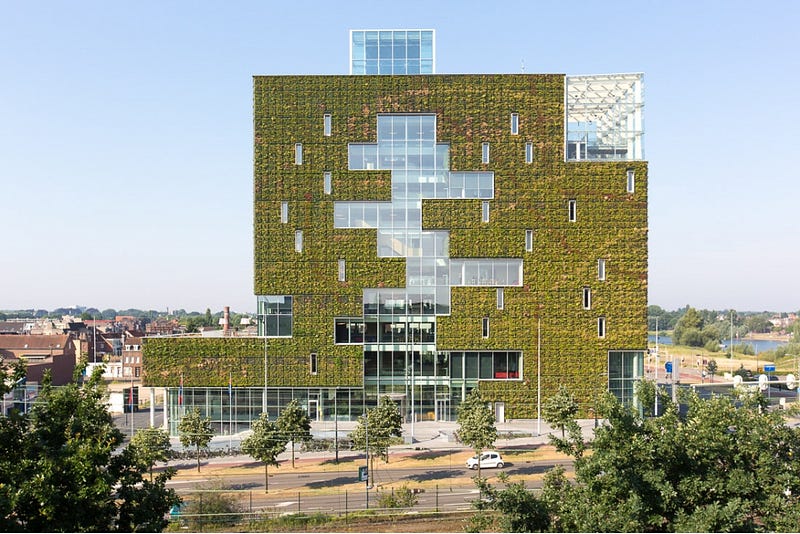
What is innovative financing by breaking down walls?
- Rest value of all materials is included. Full circular economy
- Breakdown of walls between initial investment, maintenance, and demolishing. Combined with a conservatively calculated % point of the budget for employee sickness leave
- We do research with the University of Maastricht Real Estate Finance branch into healthy building benefits and so many different costs from different budgets can be saved, it’s just fantastic. And of course, many values are created too
- We always calculate with cash flow instead of ROI. And already in the second year, we became positive on cash flow. On ROI it would have taken us 15 years. And don’t think this is just a budgeting trick
Cash flow is way more important than ROI! And all political parties in our city agreed on the investments into this healthy building instantly.
Convincing power of money and other created values combined…
Nature-based Solutions
Breaking down walls is also about consortiums of governments, NGOs, companies, research institutes, educational institutes, and then across country borders.
One such consortium is Building with Nature. I aligned with them in Holland and Indonesia. And many of the participants are Indonesian and Dutch. We create nature-based solutions with water knowledge.
All about benefits for human economies and biodiversity both. With wetlands, mangrove forestry, sponge cities, etc.
Floodwaters are managed and used at a later stage for healthy drinking water. Why waste a good flood? I wrote about it.
Ready to break down some walls?
Ready to break down some walls? It all starts with us, citizens. Hugely creative employees. Parents. SME-owners.
Let us know what walls you have broken down in your economy. Or ask questions about whatever you are curious about right now.
I’ll try to answer with concrete examples I have seen in the world. We are shifting, my friends, we are shifting…
Some old-school credibility for my writing can be found here. I’m a certified biomimicry professional and external expert to the European Commission.
Thank you, Mike, for adding your wise energy to my words on Abundanism. Systemic Design for a good future, and Wild Writing. © Désirée Driesenaar, 2022


