
‘Zidane: A 21st Century Portrait’, by Douglas Gordon and Philippe Parreno
The nature of portraits, the quiet power of film, and role of football as an form of art
Ed. This piece was first published at cityofsound.com on March 4th, 2007, and an edited verison was subsequently published in the book ‘On Perfection: An Artists’ Symposium’, by Jo Longhurst (ed.) (Intellect Books, 2013)
I’ve had a sporadic relationship with Douglas Gordon’s work, yet it’s had a profound effect on me when I’ve seen it, heard it. Maybe I’ve been lucky enough to have experienced his greatest hits, the two works based around Alfred Hitchcock; ’24 Hour Psycho’, in which the film is slowed down to play over a duration of 24 hours, and ‘Feature Film’, in which a zoom onto a conductor’s hands is foregrounded, guiding the performance of Bernard Herrmann’s soundtrack, while the movie itself is footnoted, diminished.
Both are fascinating, effective studies of time, movement, image and sound. His other work has been described as less successful, yet there was no way I was going to miss his collaboration with French artist Philippe Parreno, ‘Zidane: A 21st Century Portrait’.
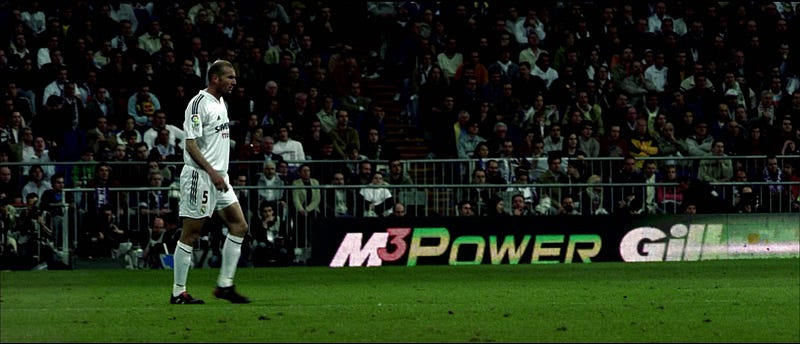
This is an utterly overwhelming piece. The ultimate time and motion study, it’s been described many times since its debut at Cannes last year, but for those unfamiliar with the idea, Gordon and Parreno set up 17 cameras to follow Real Madrid ‘galactico’ footballer Zinedine Zidane through the course of an average La Liga game. That’s it. They follow Zidane the player, not the match. The idea, in Parreno’s words, was to “make a feature film which follows the main protagonist of a story, without telling the story.”
It’s certainly not a traditional documentary — there is no exposition of the enigmatic Zidane’s life amidst the celebrity culture of Madrid, or of his French-Algerian heritage, growing up in the mean streets of Marseilles. There are merely a few superimposed fragments of text, apparently from Zidane, which add little in the way of context or explanation.
Without this, the film has only Zidane, and his movements, to portray. While the careful editing of image and sound is certainly an aesthetic intervention, it is otherwise the purest possible depiction of football.
Given Gordon’s previous work are studies of “time, movement, image and sound”, football is an alluring subject. (I’ve written previously about football, movement, etc.)
But this is also about portraiture, very clearly, and perhaps narrative too.
So these 17 cameras — including the first commercial use of two Panavision HD cameras with specially modified zoom, courtesy of the US Department of Defence — in the hands of the best camera operators in US and Europe — essentially Scorcese and Almodovar’s crews — follow this player, for around 90 minutes, through a fairly average La Liga game against Villareal. And it’s fascinating, both as a study of portraiture, movement, yes, but also as a study of football.
Zidane has the ball for about, oh, two to three minutes in total. It’s fairly extraordinary how little he sees of the ball, and yet how creative he is within those constraints. Of Zidane the player, more later, but this paucity of ball possession also illustrates the overwhelming sensation derived from watching him.
The solitude. The sheer loneliness of the player, particularly in the number 10 position (yes, he wears ‘5’ on his shirt, but Zidane is formally a classic number 10.) The pivot through which play is articulated, Zidane has the ball at his feet for a few minutes, yet spends every other microsecond focused on it. His eyes rarely leave it, or the space around it, or the potential space that could be extrapolated from the perceived trajectories of ball and players. His focus is extraordinary, the saturated light of the football stadium at night reducing his eye sockets to deep pools of blackness, his face wearing a mask of intense concentration. Where other players look at each other, the crowd, the referee, Zidane only has eyes for the ball.
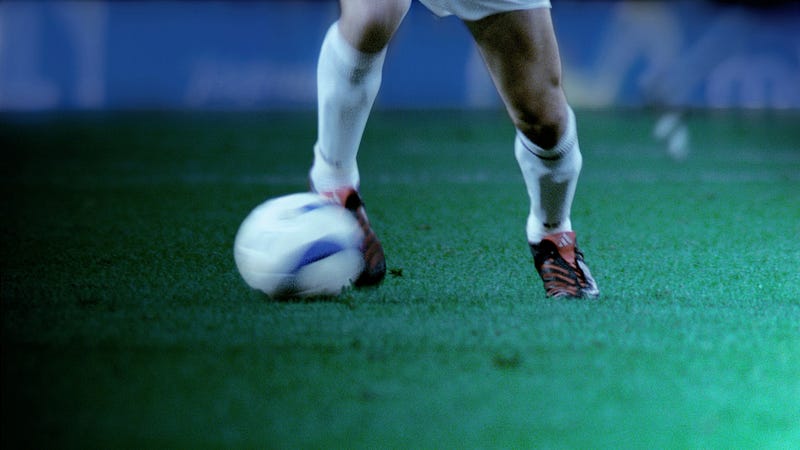
The combination of zooms and pans swirl and dart around him, and only occasionally leave him to sweep out to reveal the immense scale of football, the fans eye view and the televisual view through which we usually see the game. Yet principally, the cameras are so tight that he’s often alone in the frame, their gaze lingering over his hands, his feet, the famous bald profile dripping with sweat, the microphones picking up his pants, grunts, snorts, occasional cries.
Spanish football is perfect for this view. Close control, rapid interplay — all matador twirls and stilleto flicks. With the more expansive English game, you’d need a couple of cameras mounted in the roof. With the more studious Italian game, some kind of time-lapse, perhaps.
And Zidane himself, the centre around which everything revolves, is perfect as a subject. Paul Myerscough, in the LRB:
“Zidane. His cropped hair, his leanness, give an impression of asceticism. His features are still, his eyes shadowed under heavy brows. There are flickers of consternation, of irritation, of concern, impatience and contempt; he smiles only once, sharing a joke with Roberto Carlos. But for the most part he is impassive. Even after his finest moment, in the 70th minute of the game, when he glides through the Villarreal defence, spins on his right foot and loops a perfect cross with his left for Ronaldo to score at the far post, his expression barely changes. It has always been the convention in Hollywood cinematography that the close-up guarantees intimacy with its subject; in this, it shares with one important tradition of portraiture the notion that the image should express interiority. In Zidane, the relentless scrutiny of his face yields little in the way of an inner self, still less anything that would help us to account for his sublime skill. We feel for him, but do not identify with him; he is alone, lonely even, and distant, other.”
As Parreno notes, Zidane’s reclusive nature also reinforces this sense of distance, that as a person, compared to his then compatriots of Beckham, Figo, Ronaldo et al, “he only exists after the first kick, and before the last kick — he is the Total Footballer, after Cruyff”
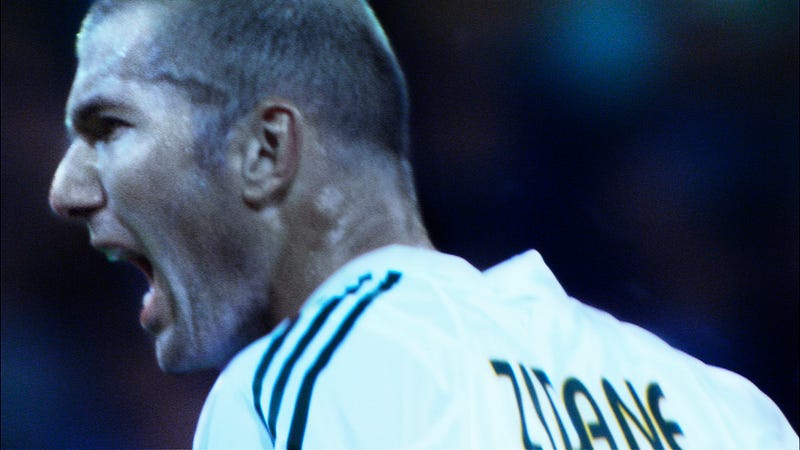
Gordon notes that the entire thing — Zidane, his performance, and the artwork — is really “an exercise in solitude.” Fragility too. It seems odd to describe such a commanding physical presence as fragile, but that’s what comes across. His dark concentration exists purely for the ball, the game, and given Zidane’s utter mastery of his particular subject — the ball — what it reveals most of all is the humbling impotence of the sportsman within the wider game, how even this greatest of players is incapable of controlling the result, even though he apparently effortlessly controls every ball pinged towards him, no matter the pace or direction.
Hence his frustration, perhaps, and his apparent fragility. Zidane himself notes, watching the film, that it shows the intensity and focus of concentration in a way you never see with TV coverage. It also shows that, although he wanted to “play the game of his life” given the presence of the cameras, you can’t control that, no matter how intense the focus.
Gordon and Parreno didn’t take football films as inspiration, thankfully, but rather Andy Warhol’s 1964 13 Most Beautiful Women. But more than this, they draw from the history of portraiture. Given that the production of the film was entirely unpredictable — no one knew what would happen in the match, whether Zidane would limp off after 5 minutes or play the game of his life — it was impossible to storyboard, or provide direction cues for the camera crew. So the ‘Making Of’ documentary reveals a live improvisation by Parreno, Gordon and the camera crew, directing on the fly. They have no control over the ‘actors’ in this particular drama. Intriguingly, in lieu of a storyboard, the only preparation the artists did with the crew was to take them to the Prado on the day of the game.
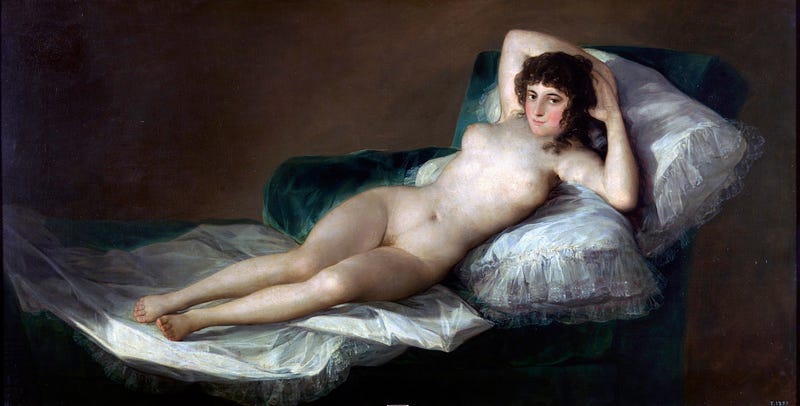
Having secured exclusive access to the gallery, Parreno and Gordon led the crew through a rapid yet extraordinary history of art, with particular emphasis on both the portraiture and reproductions of historical scenes in the art of Goya and Velázquez.
Velázquez, in particular, resonates. As the movie becomes near ambient in its impassive singular vision — almost like a visual version of an aural drone, or raga — Velázquez, as an artist who repeatedly endeavoured to capture the point between sleeping and waking, seems entirely apposite for this dreamlike, hypnotic trance.
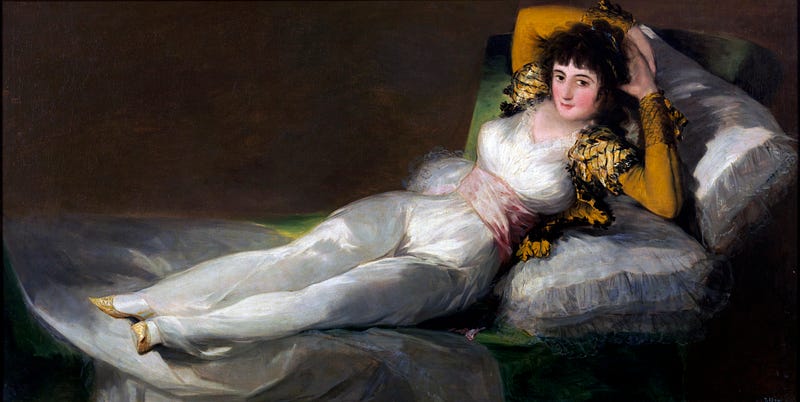
Also, Goya’s portraiture, most famously in the Maja pictures, clothed and naked, exploring different facets of portraiture of personality.
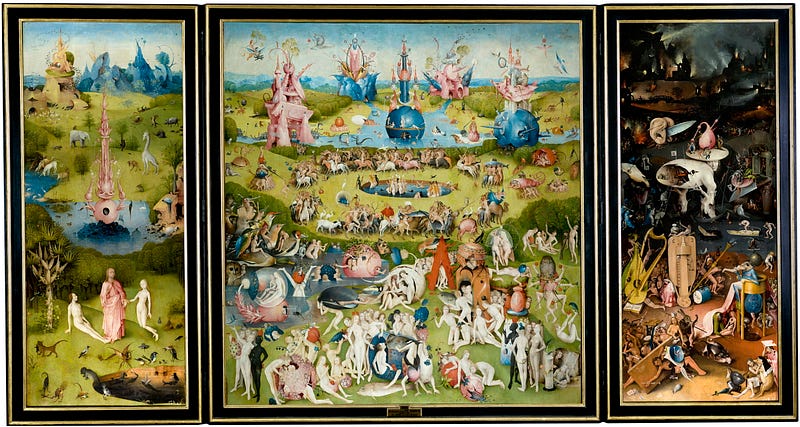
(Additionally, the crew paused in front of Hieronymous Bosch’s Garden of Earthly Delights, presumably to explore depiction of narrative of multiple parts, stretched over a physical space.)
Despite this art history lesson, the thing itself is pitched half way between film and art. In the accompanying documentary, a contributor notes that Zidane in close-up has a “darkness, density — reminiscent of Bresson” yet at other times, it’s “epic, like a John Ford western.”
Gordon and Parreno clearly like the idea of this playing in both galleries and cinemas (although whether it would’ve achieved a cinema release without Zidane’s extraordinary contributions to the last World Cup, both creative and destructive, is a moot point.) Gordon notes that it would “take people from the white cube into the black box, or the black box into the white cube”.
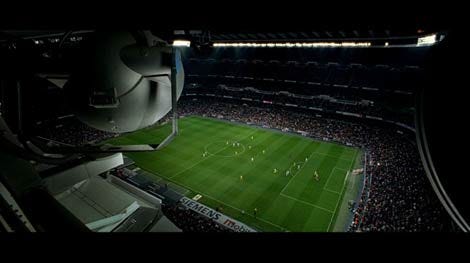
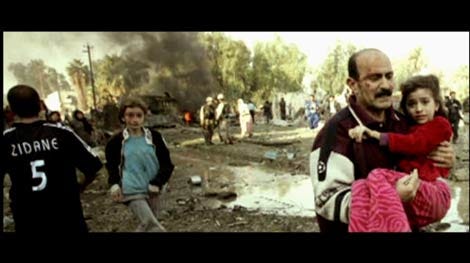
The only point at which the film feels a little clumsy — although I appreciate the idea — is at half-time in the game, when the cameras and the narrative suddenly zoom out, Powers of Ten-like, to reveal other events going on that particular day. Suddenly, it cycles through a series of events, quotidian and unusual, with subtitles bluntly stating the subjects: from Sir John Mills dying to the performance of a Bob Marley puppet on an Ipanema beach; a 48-hour marathon reading of Don Quixote; the “online release of new videogames” and “hundreds of toads swell to 3 times their normal size and explode in a fresh water pond in Germany”, an Asian-African summit closing in Jakarta, a car bomb in Najaf, Iraq killing nine, a collapsed mine in Turkey and so on. (At one point, the camera pauses on a still of the dreadful aftermath in Najaf, where a kid is spotted wearing a Zidane shirt.) Again, a little clumsy, although it presumably is further exploring these contrdictory overlaps between the actual insignificance of a game of football, and the almost overriding dramatic pull of such things.
The use of sound, as you’d expect from Gordon, is particularly strong. Not so much the musical soundtrack, composed for the film by fellow Glaswegians, Mogwai, although their languorous drones and dramatic dynamics work very well over the long distance of a football match. But the sound of the football match, from the close zooms of Zidane — his occasional polyglot shouts, his deep breathing, the soft crunch of his studs on grass — panning up to the incredible noise of the Madrilénos — of their endless barrage of horns, a drone echoed in Mogwai’s organs and guitars. The ‘Making Of’ documentary pauses on this process briefly. Unfortunately it fails to introduce the participants, but what I assume to be the principal sound engineer notes that they were so “dependent on sound — we’re almost defining the images by using sound.”
This is spot on — with the absence of traditional dialogue of any kind, the narrative is only perceived through a variety of flashpoints — goals, near misses, a sending off — leaving the rest of the match to be articulated in movement and sound. At one moment, the soundtrack appears to cut to another time and place altogether, layering the sound of kids playing football and dogs barking over that of the match. At other times, it cross-cuts rapidly from the compressed sound of TV coverage to the rich detail of the sound at the middle of the pitch. At other times, the soundtrack, and then silence. Gordon again:
“The silence of portraiture is very important.”
It’s a beautiful piece, to be absorbed carefully. It requires concentration from the viewer too, as the repeated image of Zidane searching for the ball, for space, and not finding it become almost entirely abstract interwoven patterns of white shirt, dark skin and green grass. Warhol’s Empire, or Brian Eno’s Mistaken Memories of Medieval Manhattan are precursors rather more than Escape to Victory.
As a result, I can see why one user at IMDB posted the comment : “The film is excruciatingly boring; it is a pain to watch, and it is better to watch paint dry.” I can only totally disagree, but those expecting something like a documentary or traditional coverage of a football match should indeed beware. This is a quite beautiful, challenging portrait, in sound and image.
And for the football fans amongst you, what of the player himself? Richard Williams, one of the foremost writers on the kind of player Zidane exemplifies, wrote:
“Virtually devoid of context, the economy of his movement and the sheer absence of fuss as he goes about his work are strikingly apparent, rendering the delicacy of his footwork even more moving.”
It is entirely moving. That’s exactly the right word. To a player, a player of almost any standard, watching Zidane is extraordinary. While all the above context indicates that even non-football fans will get something out of this, perhaps those who love and play the game will be even more fascinated in the detail.
In his book The Perfect 10, Richard Williams describes the appeal of watching Zidane, of how his transformation when in possession of the ball perhaps explains the passion of his endless pursuit of it:
“Zidane is a big man, 1.85 metres tall and weighing 78 kg. He has a slightly ponderous gait and shoulders that tend to stoop, giving the illusion of ungainliness. He does not have lightening-fast feet or much of a sprint. But when the ball comes to him he suddenly reveals the lightness of a ballet dancer and the footwork of a fencer. Gracefulness falls upon him. Then he can do anything he wants with the ball, from the impossible delicacy of a running spin through 360°, his famous roulette, to the shattering violence of a waist-high volley fired from a range of more than twenty yards with his notionally weaker left foot. And when he does something like that, no one in the stadium envisages any other outcome.”
Even given that few minutes’ possession of the ball, he so rarely gives the ball away. He’s always progressive, always trying to create. It’s one of the purest acts of complete creativity I’ve ever seen. Nothing is mundane, or regressive — every flick, every move, every dribble is trying to create, to lift the team, to shift the play upfield towards the opposition’s goal, to keep the ball moving into interesting spaces.
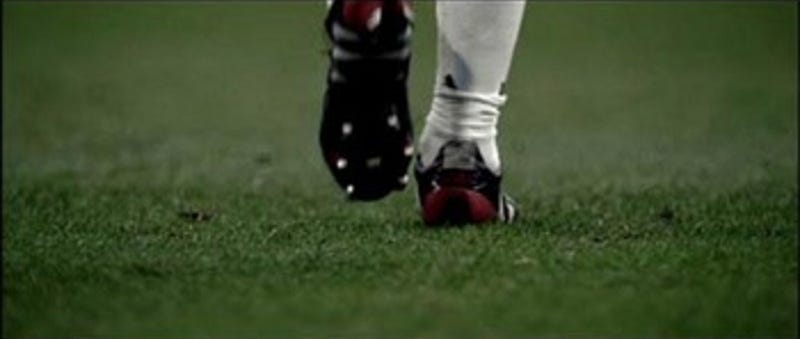
His first touch isn’t just immaculate, to use a well-worn football cliché; it’s an immaculate conception, as it inherently contains the logic and purpose of the next few moves. He traps the ball, body forming a triangle as one should, no matter what angle and pace it arrives at, and in trapping it, he’s also moving it forward, away from the defender, into space. There are details you’ve never seen before. The cameras and edits pause several times on Zidane’s habit of tapping his toes into the grass, scuffing and pawing the ground like a thoroughbred in the stalls, or as Williams has it “a reflexive gesture like a trumpeter emptying his spit-valve between phrases”.
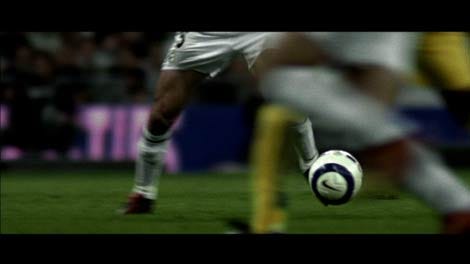
Even given the tight angles of Spanish football, and 21 other men sharing the pitch, he appears alone, so often, throughout. This is exaggerated by his complete concentration. His face betrays little emotion; even when Madrid score twice, one goal his own making, there is no smile — his face remains the same granite-hewn angles. In fact, he smiles only once, when sharing a joke with fellow left-sided player, the Brazilian Roberto Carlos.
And then within minutes, right at the end of the game, he suddenly loses it, and is attacking one of the opposition in a melée which is frankly nothing to do with him. It’s shocking, out of nothing, apparently. And yet had his frustration had been unconsciously and invisbibly growing throughout an hour of pushes, kicks, shoves by Villareal’s markers; and of his teammates’ inability; of his own inability to direct the game as he saw it in his mind’s eye; perhaps even the lapse of concentration when he allowed himself to smile; maybe just the endless uncertainty of football itself? Or maybe none of those things.
It’s a curious and dramatic reflection of how he ended his career at the World Cup in 2006, which everyone knows by now. There’s little point attempting to connect these events into a coherent explanation — there is none. There is only the recording of the event itself.
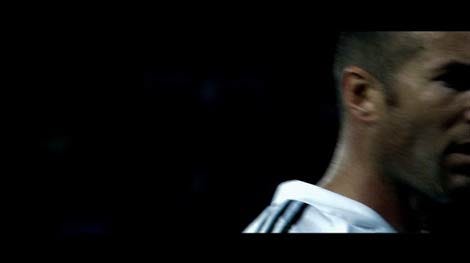
Gordon “didn’t want to make a heroic portrait, actually it’s the portrait of an anti-hero.” We expect too much of people we want to be heroes, and Zidane’s career constantly reminded us of this, even as perhaps the greatest player ever. Just because someone plays like an angel, doesn’t mean they are an angel cf. Miles Davis and a million other artists. It doesn’t excuse it. It just is. Myerscough, in the LRB:
“Searching his face for 90 minutes brings us no closer to understanding his actions at the end of this game, just as no account of his interaction with Materazzi can account for his final self-immolation. If that’s what it was.”
I adored this movie, or artwork, whatever it is. I pored over every aspect of the DVD extras. DVD is a satisfying way of experiencing it, given the intensity of focus it allows through proximity. Yet I suspect it will work very well installed in a dark gallery space, with a pin sharp projection from floor to ceiling and bathed in surround sound — as per a Christian Marclay piece.
I’ve grabbed a random section of the film, below — it seemed in keeping with the spirit of the piece to pick a section at random, rather than the ‘highlights’ the trailer might. Given YouTube’s limits on duration and dimension, it is of course entirely the wrong medium to convey a piece of work which is about stretched time and space.
Last words to Zidane:
“Magic is sometimes very close to nothing at all.”
Ed. This piece was originally published at cityofsound.com on March 4th, 2007, with an edit subsequently published in the book ‘On Perfection: An Artists’ Symposium’, by Jo Longhurst (ed.) (Intellect Books, 2013).


