
SELF-MASTERY
Zhan Zhuang is an exercise system that combines meditation with physical rigor — by standing still.
Physically it’s more challenging than it sounds — when you first start, your fast-twitch muscles are likely to rebel by shaking and trembling.
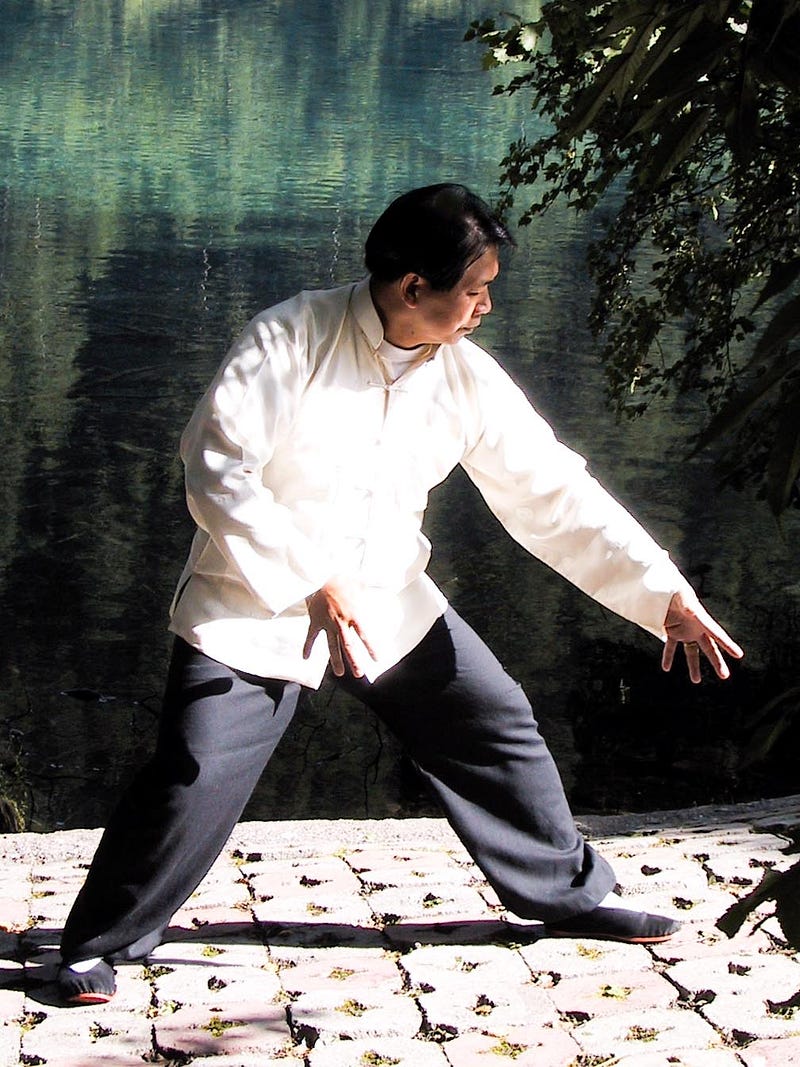
Qigong, known as Zhan zhuang (ZZ), is a martial art that changed my life. I want to ensure that people who are curious about it are able to indulge that curiosity easily.
I was about 19 when I decided to revisit martial arts. I had been engaged in martial arts on and off before that (and I include Jet Li movie marathons as engagement) since I was 6.
I restarted with Taiji, taught in a South London suburb by an extraordinary teacher. I progressed to working with the creator of that style of Taiji — and holder of a lineage of Qigong call Zhan zhuang (pronounced Jam jong) — Master Lam Kan Chuen. Little did I know how much this would transform my view of the world and come back to help me whenever I needed it.
Quite often as a teenager, you can’t decide if you want to fit in or stand out. Unlike 90% of my friends, I didn’t go to university as I didn’t feel it was for me. But choosing a subject to study, perhaps linked to a career, helps to give purpose at this key stage in a young person’s life. I got the structure and direction I badly needed from martial arts.
“Energy is the foundation of life. Without energy we die.”
— Master Lam in “Chi Kung: The Way of Healing”
What Is Zhan Zhuang?
Quickly, Zhan zhuang (ZZ) became central to my practice. It’s also known as Standing Like a Tree and Standing Stake. It’s a form of Qigong, or Chinese energy exercise, that emphasises stillness over movement. It’s connected to a number of martial arts but most directly Yiquan/Dachengchuan (vaguely translating to intention boxing/great-achievements boxing).
“Grandmaster Wang (Xiangzhai) combined the yin yang of the internal martial arts to … his martial art. The very name “Yiquan” expresses its efferent orientation of control and will.”
— Jan Diepersloot in “The Tao of Yiquan”
It’s essentially a system of standing exercises. Movement primarily takes place in the warm up (which I recommend even if you’re only standing still), transitioning from one posture to another, in some ancillary exercises, and in the cool down.
You’re choosing one of eight (-ish, depending on who you learn from) postures and just staying there. You may stay in one posture for a few minutes, or you might stay in one posture for an hour (that’s very advanced). There aren’t a huge amount of rules, but don’t mistake that for simplicity.
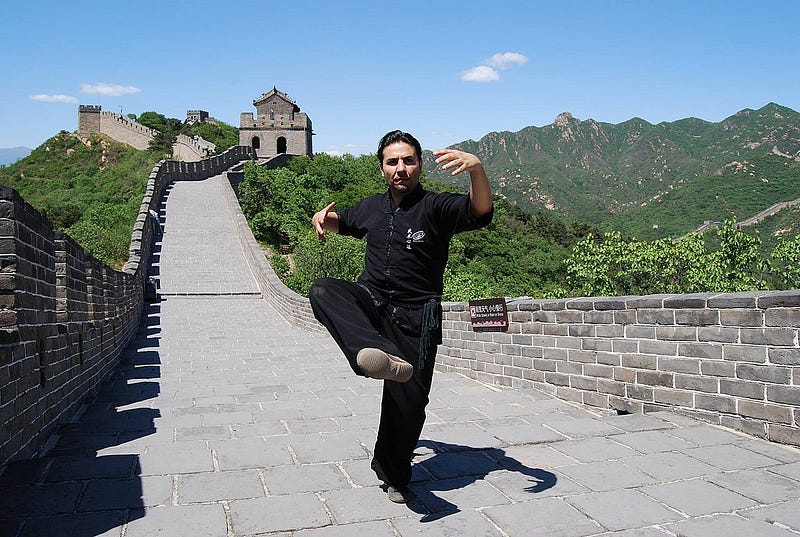
Physically it’s more challenging than it sounds, and when you first start, your fast-twitch muscles are likely to rebel by shaking and trembling. Over time, you’ll get strong, and if you’re a martial artist, or any kind of athlete, you may find some parts of your sport improve.
But someone once told me, “It’s more of a mental exercise than a physical one,” and they aren’t wrong. It shares some similarities with meditation but with an added bonus of pain and discomfort (after a while). You can only really stand for any period if you achieve dynamic relaxation in both mind and body: You can’t tense up, or you'll exhaust yourself quickly. You can’t relax completely, or you’ll collapse in a pile on the floor. The challenge is to find the maximum relaxation without losing posture.
Where the goal of lotus-position meditation is to keep energy/blood/qi around the central nervous system/chakras so the limbs aren’t engaged, ZZ is designed to maximise circulation and nourish the whole body, including the mind. Neither is right or wrong, but if you practice sitting meditation, I’d recommend mixing in standing mediation.
“The two largest vessels of chi in this exterior system are in the legs, and it is in these extremities that any chi not used in our everyday endeavours is stored.”
— Kosta Danaos in “Nei Kung”
How to Practice
The main thing is to find a teacher. There’s help for this below, though it may not be easy. I recommend it for the same reason that people recommend meditation teachers and coaches — you’re your own worst enemy with any deep practice and need someone else who’s skillful to keep one step ahead of you.
When I started, I was encouraged to aim for 20 minutes. Slightly more than that is where I find myself 20 years later. I feel pretty crappy typing that, but 20 minutes is good: Do a five-minute warm up, ten minutes of practice, maybe two postures, and give yourself five minutes to warm down.
In this YouTube playlist, a little over an hour in total, Master Lam will guide you through all the basic postures. It’s based on his UK TV programme “Stand Still, Be Fit.”
From my experience, I’d add the following advice:
- Try not to be too attached to doing it well or badly
- How the weight is distributed in your feet — evenly and splayed — is more important than you think
- If you’re shaking too much, change up or down gears — slightly increase or decrease the difficulty. But shaking is OK.
- Take your time — treat the whole thing as a patience exercise. You’re not going to jump into a one-hour dragon posture.
- Your body has learned a version of relaxed, straight, and symmetrical that it’ll need to unlearn
- The more your head lifts up (use visualization to lift it — don’t try to, as this will create tension), the more your upper back relaxes, the more your head lifts, and so on
- On days your mind is wandering a lot, just systematically work through all of the muscles and tendons, telling them to relax. Do this deliberately several times, and practice will go quickly.
Now, honestly, 20 minutes is really easy. Most days I can do that without anything to support my mind. On days I feel mentally not in the right place but physically able, I will do ZZ for nearly an hour in front of the television. To some this is sacrilege, but as someone who’s struggled, I say it’s better than nothing. Maybe just be careful about what you’re watching, as I’ve heard some people say that ZZ opens you up.
My aim, which I’ve managed for prolonged periods many times in my life, is 30 minutes a day of actual standing (i.e., not warm up or cool down). I’m currently in my longest period of consistent practice in probably 15 years, but I’m still not hitting this regularly. I know some days I can do an hour (time permitting), but I’ve noticed I then struggle over the next few weeks. So I’m all for 30 minutes.
What Are the Benefits?
For me, learning ZZ was very different from anything else I’ve tried. It was deeply practical but retained an air of the mystical. Over several years of practice, I got physically a lot stronger and faster (despite rarely running), but also I changed internally. People talked about me seeming more balanced and grounded. I tried a number of healing arts and I was described as a natural, something I put almost entirely down to regular ZZ practice, although to this day I still don’t get it.
Harder to believe is that increased circulation without directing to specific skeletal muscles allows you to truly train the whole body. For me, this meant less (next-to-zero) bruising — until I did Wing Chun regularly, as the bruised and swollen forearms with that were a given. It also meant better digestion and the ability to move my ears independently. Yeah, weird.
I like the idea and feel I benefit from exercise meditation—that’s what attracted me to Tai Chi many years ago. It’s what still holds an allure for me in martial arts in general but ZZ specifically. It feels like mentally it can be all things — all the benefits and challenges of meditation in some form — plus physical and sometimes mental endurance. When I practice regularly I remember my dreams and even lucid dream at times.
“To learn martial arts, first learn chi kung.”
— Chinese saying from ancient times
The foundations I laid in those early years have held me in good stead. I still struggle, for reasons I hope to one day solve, to maintain a daily practice. But despite trying several martial arts in the 20 years since then, ZZ continues to pull me back.
I see my relationship with Zhan zhuang much like a struggling romance. I know we’re meant to be together. It speaks to something deep inside of me. It’s a knowledge of self.
I don’t feel like it’s something I’m just not doing —a sort of laziness. Like some relationships, it feels like I’m running away from it. When I practice ZZ consistently I feel much better in myself — I give to it, and it gives more back. It brings out the best in me, and I have come home. But the smallest part of my brain seems to hold sway and tells me I don’t deserve this. Something about ZZ makes me feel less mediocre, and yet I keep walking away.
I have heard, and read of, other benefits. Most commonly:
- Decreased blood pressure
- Increased speed of recovery from injury
- Heightened senses
- Positive impact on mental health (particularly mood)
- Greater physical endurance
- More youthful appearance
- Manipulate the qi of yourself and others
But they seem to be fairly inconsistent, and very few are investigated scientifically (see the end of this article for academic references). I’d encourage you to give it a try and see how it benefits you.
More broadly, Wong Kiew Kit (a Shaolin monk) has this to say in “The Complete Book of Zen” about chi kung (qigong):
“The training of energy and the training of mind in Shaolin Chi Kung have a mutually beneficial effect: when a practitioner is in a meditative state, his energy effects are enhanced; conversely, the good effects of his energy training lead him to deeper levels of consciousness where he may have glimpses of Cosmic reality. As he progresses to the highest level of chi kung he may achieve cosmic realization.”
A word of warning: I never used to get ill. I still don’t really, but early on in my practice, having rapidly accelerated to 2+ hours of ZZ training a day, I got really sick. Extreme fatigue for almost a month. Flulike symptoms on and off. Please try to find a teacher. Please take it easy.
If you Want to Know More …
Having decided to include some sort of reference to Zhan zhuang as part of a book I’m writing, I found its presence on the internet is almost like an inside joke (which is very consistent with Chinese wisdom traditions, by the way).
I found a lot of Facebook pages, blogs, and websites that aren’t up to date or properly maintained. Good knowledge is hard to come by, beyond just a repetition of introductions to the art and random email addresses. So I’ve tried to verify some teachers and prioritised linking to pages that seem to have been updated recently, but the approach is best summarised by the Lam Association:
”We are as well-known as we are obscure.”
Take Some Action
I haven’t seen a compendium of resources anywhere. So here it is — the things you can do to get into Zhan zhuang.
Read the best (introductory) books
- “The Way of Energy” by Master Lam Kam Chuen
- “Chi Kung: Way of Power” by Master Lam Kam Chuen
- “Warriors of Stillness” by Jan Diepersloot
- “The Complete Book of Yiquan” by C S Tang
- “Dachengchuan” by Wang Xuanjie
- “Static Postures Manual: Qi Gong Standing Meditation” By Jeronimo Milo
Find a teacher
As I describe above, a teacher is invaluable in learning the discipline. I’m happy to add to this list. However this isn’t intended to be a generic qigong teachers list, as they aren’t hard to find, but specifically Zhan zhuang teachers.
U.K.
- Tony Dove, West Country: https://www.standinglikeatree.co.uk/ — my original teacher.
- William Walker, London: http://www.standing-still.co.uk
- Dragon Nation, Wales: http://www.dragonnation.co.uk/
- Steven Williams, Liverpool: http://www.sifustevenwilliams.com/classes.htm
- James Drewe, London and Kent: https://www.taiji.co.uk/
- David Lees, Darbyshire: https://www.wuweiwisdom.com/
- Richard Antonowicz, London: https://www.mertontaichikung.co.uk/
North America
- Richard Reoch http://richardreoch.info/complementary-health-care/
Europe
- Master Lam teaching and Thomas Apfel in U.K. and Germany” https://chi-kung.org
- Jan Bosscher in Netherlands” https://www.taichi.nl/
- School for Inner King Fu, Germany: http://da-cheng-chuan.de/
- Cosima Scheuten, Netherlands: https://gardenofchi.com/
- Peter den Dekker, Netherlands: http://www.stilldynamics.org/index.html
Australia
- John Whitmore, Melbourne, https://godsgreenberet.wixsite.com/zhan-zhuang-qigong
The above list is limited but lots of people seem to work through local reputation and their online presence is limited. If you have a suggested edit please add it in the comments.
Read up on some online resources
- A great collection of blog posts by Jack Bland of Dragon Nation
- “How to Meditate Standing Up” via HuffPost
- Michael Weichhardt on Medium
- “Combining Meditative Traditions for Peak Athletic Performance” via Medium
- “Four Paradoxes of Standing Meditation” via Martial Development
- “Cultivate Boundless Energy With An Ancient Standing Meditation Called Zhan Zhuang” via Scott Jeffrey
- Wang Xiangzhai on Wikipaedia
- Igor Micunovic in the Wall Street International
Follow someone on Medium
A shout out to those who are bringing qigong, Zhan zhuang and related topics to this platform (comment if you think you should be added to this list):
Dive into the Academic Studies
Studies are still too few, particularly in English. Scientific rigour is often still based, for understandable reasons, on the idea that the underpinning theory must start with established mainstream knowledge, making penetrating mainstream ideas with new ones tough.
This is made all the harder by the fact that the high-level practitioners able to conduct these kinds of studies have a history of being shunned by — and shunning — the traditional medicine of which scientific method is associated.
- “A Comprehensive Review of Health Benefits of Qigong and Tai Chi”
- “Tai Chi and Qigong for the Treatment and Prevention of Mental Disorders”
- “Acute Physiological and Psychological Effects of Qigong Exercise in Older Practitioners”
- “Qigong as a Traditional Vegetative Biofeedback Therapy: Long-Term Conditioning of Physiological Mind-Body Effects”
- “Qigong for hypertension: a systematic review of randomized clinical trials”
- “The effect of Three-Circle Post Standing (Zhanzhuang) Qigong on the physical and psychological well-being of college students” — although this isn’t a study, it’s an interesting read.


