
Stop Wasting Your Time
停止浪费时间
A Simple Framework for Making Better Decisions
做出更好决策的简单框架
照片由 Jack Hunter 在 Unsplash 上拍摄
I have an unfinished essay in my drafts folder called “Quitting is Underrated.” It’s been there since 2017. You can bet your ass I’m never completing it. Hold up a second while I delete it … because this is that essay’s ultimate form.
我的草稿文件夹里有一篇未完成的文章,叫做 "辞职被低估了"。它从 2017 年开始就在那里了。你可以打赌,我永远不会完成它。等一下,我把它删掉......因为这就是那篇文章的最终形式。
Today, we’re going to talk about giving up. Every day, we’re inundated with tales of people in films or on the news who gave it their all, never gave in, kept showing up, and persevered in the face of unimaginable rejection. I’m here to tell you that they’re exceptions rather than the rule, and if you strive to be one of those people, you’ll probably be wasting your time.
今天,我们来谈谈放弃。每天,我们都会在电影或新闻中看到一些人的故事,他们全力以赴、永不言弃、坚持不懈,面对难以想象的拒绝也锲而不舍。我在这里要告诉你,他们只是例外,而不是规则,如果你努力成为其中的一员,你很可能是在浪费时间。
I hate to be the one to spill apple juice in your single-malt, but they’re not making a biopic about you, you don’t have a cheering section, and the news crew ain’t knocking on your door.
我不想把苹果汁洒在你的单一麦芽威士忌里,但他们不是在拍关于你的传记片,你没有啦啦队,新闻组也不会敲你的门。
Your current crush won’t be your soulmate. You’re not repeatedly betting the house on green and coming away with fat stacks of cheddar. Your life will likely reside in the fat part of the great bell curve of human potential. I’m not saying that’s what you aim for. I’m managing your expectations.
你现在的暗恋对象不会是你的灵魂伴侣。你不会反复把房子押在绿色上,然后得到一大堆肥美的切达奶酪。你的人生可能会停留在人类潜能钟形曲线的肥胖部分。我并不是说这就是你的目标。我是在管理你的期望值。
However, you might be capable of rising to the top quintile in most of the key areas of life that matter: health, love, impact, wisdom, wealth, joy, and your vocation. You take care of that, and you’ll probably be just fine. I know a lot of folks who are earning solid B-plusses in everything.
然而,你可能有能力在生命中大多数重要的关键领域:健康、爱情、影响力、智慧、财富、快乐和你的职业,上升到前五分之一。处理好这些,你可能会过得很好。我认识很多人,他们在所有方面都取得了稳固的 B 等成绩。
The B-plusses are my brand of human. They’re content, witty, kind, and making a difference. Most of the folks I know who are at the very pinnacle in a select few areas, or pushing maniacally for perfect scores, are secretly miserable, sociopathic, or severely lacking in other key areas.
B-plusses 是我心目中的人类形象。他们满足、机智、善良、与众不同。我认识的大多数人都在少数几个方面达到了巅峰,或者疯狂地追求满分,但他们暗地里却很悲惨、反社会,或者在其他关键方面严重不足。
Why?
为什么?
Well, let’s set aside the elephant-in-the-room answers of privilege or trauma for now (because that explains 95% of them).
好吧,让我们暂时抛开 "特权 "或 "心理创伤 "这些 "大象在房间里 "的答案(因为这可以解释 95% 的问题)。
Folks who aim for the stars tend to make life harder than it needs to be, stack their decks against them, and hold themselves to militant standards no mortal can reach. You kittens don’t need to do that. Your life’s not a GaryVee video. It’s C-SPAN IRL. Go easy on yourself.
那些以明星为目标的人,往往会把生活搞得比需要的还要艰难,把自己堆得高高的,用凡人达不到的激进标准来要求自己。你们这些小猫没必要这么做。你们的生活不是加里维的视频这是C-SPAN的现实。对自己好一点
Easier Is Often Better
通常越简单越好
“John, aren’t you supposed to do hard things?
"约翰,你不是应该做艰难的事情吗?
Aren’t they the things that are worth it?”
这些不都是值得的东西吗?"
No, comrades; they’re not.
不,同志们,它们不是。
Just because something is difficult doesn’t mean the reward for doing it is automatically better.
做一件事很难,并不意味着做这件事的回报就一定更好。
If you’ve already won — or even already finished — the race, the extra mile is meaningless. If you’re already showing 19 at the table, you don’t need to hit.
如果你已经赢了,甚至已经完成了比赛,那么多跑一英里就毫无意义了。如果你已经在赌桌上赢了 19 块,你就不需要再打了。
There’s a fine line between taking on a worthwhile challenge, and taking on unnecessary stress.
接受有价值的挑战和承受不必要的压力之间有一条微妙的界线。
“But John, how do I know if the stress is unnecessary?”
"但是约翰,我怎么知道压力是不是不必要的?"
Good question: The body can’t tell the difference between types of stress, or even the difference between excitement and fear. Their physical manifestations are identical, but if you train your mind, you can suss out the particulars. Per The Atlantic:
问得好:身体无法区分压力的类型,甚至无法区分兴奋和恐惧。它们在身体上的表现是一样的,但如果你训练自己的思维,就能分辨出其中的特殊性。大西洋月刊
… anxiety and excitement are both aroused emotions. In both, the heart beats faster, cortisol surges, and the body prepares for action. In other words, they’re “arousal congruent.” The only difference is that excitement is a positive emotion‚ focused on all the ways something could go well.
......焦虑和兴奋都是被唤醒的情绪。在这两种情况下,心跳都会加快,皮质醇激增,身体为行动做好准备。换句话说,它们是 "唤醒一致 "的。唯一不同的是,兴奋是一种积极情绪,它关注的是所有可能发生的事情。
We’ve all done stressful things. We’ve all done exciting things. Sometimes we avoid stressful and exciting things to avoid the sensation of losing control. We assess our risk tolerance, and we boldly forge ahead or wilt in the face of pressure, or binge-watch Superstore while stuffing our faces full of pizza — which I highly recommend doing, because that sitcom is highly underrated and pizza is a divine manifestation and very properly rated.
我们都做过有压力的事。我们都做过令人兴奋的事情。有时,我们会逃避压力和刺激,以避免失控的感觉。我们会评估自己的风险承受能力,然后勇敢地向前迈进,或者在压力面前萎靡不振,或者一边狂看《超级市场》,一边把披萨塞得满脸都是--我强烈建议大家这么做,因为那部情景喜剧被严重低估了,而披萨是神的化身,评价非常恰当。
So, how do we decide what to do?
那么,我们如何决定该怎么做呢?
How do we decide what risks are worth taking?
我们如何决定哪些风险值得冒?
How do we decide if we’re taking too big a swing, or playing too small?
我们该如何判断是挥杆太大,还是太小?
How do we know if we’re setting ourselves up for failure, or sticking with Sisyphean tasks long after their expiry date?
我们怎样才能知道自己是在为失败埋下伏笔,还是在西西弗任务到期后仍在坚持?
Ladies and gentlemen, I am pleased to present to you, The Gorman Decision Matrix.
女士们,先生们,我很高兴向你们介绍戈尔曼决策矩阵。
Partially because I want to help; partially because I’m a narcissist who names things after myself.
部分原因是我想帮忙;部分原因是我是个自恋狂,喜欢用自己的名字命名事物。
Hot Take: We Calculate Risk Wrong
热门话题:我们计算风险的方法错了
All courses of action fall upon two continuums: what we expect the outcome to be (outcome), and how much that outcome matters (stakes). These combine to form the risk of the decision.
所有的行动方案都有两个连续体:我们预期的结果(结果)和结果的重要性(利害关系)。这两个因素结合在一起,就形成了决策的风险。
“Isn’t decision-making about balancing risk v. reward?”
"决策不就是要平衡风险与回报吗?"
No.
不
Risk is uncertainty, which means it’s a derivative variable.
风险就是不确定性,这意味着它是一个衍生变量。
For clarity, I’m nixing the word “reward” to instead be “most likely outcome,” because a reward is something we calculate post hoc. We’re strictly talking about ante hanc calculations here. As you’ll soon see, high risk isn’t necessarily the same as high stakes.
为了清楚起见,我把 "奖励 "一词改成了 "最有可能的结果",因为奖励是我们事后计算出来的。我们在这里严格讨论的是事前计算。你很快就会明白,高风险并不一定等同于高赌注。
Every day, we do things with low stakes: share dank memes, brush our teeth, make our bed, and eat lunch.
每天,我们都在做一些低风险的事情:分享垃圾备忘录、刷牙、整理床铺、吃午饭。
Every day, we do things where we expect a poor outcome: check our emails, answer calls from unknown numbers or cheer for the Atlanta Falcons. None of those are high risk.
每天,我们都会做一些预期结果不佳的事情:查看电子邮件、接听陌生号码打来的电话或为亚特兰大猎鹰队加油。这些都不是高风险。
The takeaway here: most likely outcome and stakes are the important variables.
这里的启示是:最可能的结果和风险是重要的变量。
To illustrate, let me go ahead and post a blank version of the Matrix.
为了说明问题,请允许我发布一个空白版本的母体。
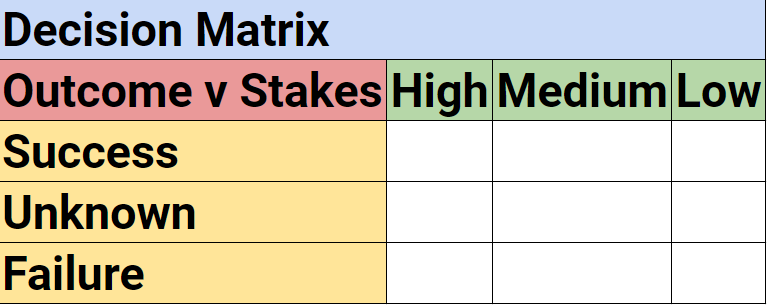
空白矩阵 // 约翰-戈尔曼
In the chart above, I’ve broken out in yellow the three buckets of “most likely outcome.” They’re quite creatively named: “success,” “unknown”, and “failure.”
在上图中,我用黄色标出了三类 "最可能的结果"。它们的名字很有创意"成功"、"未知 "和 "失败"。
Success means a near-guaranteed chance of success.
成功意味着几乎可以保证成功的机会。
Unknown means something in the nebulous middle.
未知 "指的是模糊不清的中间地带。
Failure means a near-guaranteed chance of failure.
失败意味着几乎肯定会失败。
In green, I’ve categorized “stakes” by how much the given course of action matters to you. I’ve named these, creatively again: “high,” “medium” and “low.”
在绿色部分,我将 "利害关系 "按照特定行动方案对你的重要程度进行了分类。我又创造性地给它们起了个名字:"高"、"中 "和 "低"。
High means it matters a great deal to you.
高 "意味着这对您来说非常重要。
Medium means it matters enough.
中等意味着它足够重要。
Low means it barely matters at all.
低意味着几乎不重要。
Every course of action you take falls into one of those nine blank buckets. Let me drill into these nine areas a little further, to give you some extra clarity.
你所采取的每一个行动都属于这九个空白桶中的一个。让我再深入分析一下这九个方面,让你的思路更加清晰。
We’ll start in the upper left and work our way down, and then over.
我们先从左上角开始,然后一路向下,最后结束。
Box №1: “North Stars.” Likely success, high stakes.
第1号盒子:"北极星"。可能成功,风险很大
In the upper-left, we have our “North Stars.” These are our Big Wins. These are our must-haves. Our “Born to Run.” These are the courses of action we take that capitalize on our own greatness. These are your tentpole productions — your Marvel Cinematic Universe. This is marrying your best friend. Sure, there’s a lot on the line … but you’re more than capable of rising to the challenge.
左上方是我们的 "北极星"。这些是我们的 "大赢家"。这些是我们的必备品。我们的 "天生能跑"。这些是我们的行动方针,是我们自身伟大的资本。这些就是你的 "头炮"--你的 "漫威电影宇宙"。这就是与你最好的朋友结婚。当然,这关系重大......但你完全有能力迎接挑战。
Box №2: “Moonshots.” Unknown outcome, high stakes.
第2号盒子:"月影"。结果未知,风险很大
In the middle left, we have our “moonshots.” These are our COVID-19 vaccines. These are our Apollo Program. This is Taylor Swift’s “Folklore,” or Kanye West’s “My Beautiful Dark Twisted Fantasy.” These are the game-changers, the paradigm-shifters. Everything’s riding on it, but it’s anyone’s guess whether or not it’ll work. When it does, though … oh my lord.
左中部是我们的 "登月产品"。这些是我们的 COVID-19 疫苗。这些是我们的阿波罗计划这是泰勒-斯威夫特的 "民间传说" 或是坎耶-维斯特的 "我美丽黑暗扭曲的幻想"这些都是改变游戏规则的范式转换器一切都取决于它,但谁也无法预料它是否会成功。但一旦成功......哦,我的上帝。
Box №3: “Waterloos.” Likely failure, high stakes.
盒子№3:"Waterloos"。很可能失败,风险很大
In the lower left, we have our “Waterloos.” What’s the №1 rule in warfare? Never invade Russia. Didn’t work for Napoleon (I know, I know, “Waterloo” wasn’t the Russia campaign). Didn’t work for Hitler. Waterloos are massive strategic blunders that leave you licking your wounds for a long, long time. These are sunk costs and time sinks. These are unhappy marriages and Jean Van de Velde taking driver on the 72nd hole of the Open Championship, needing just to card a double-bogey to win the Claret Jug. He didn’t.
左下方是我们的 "Waterloos"。战争的第一条规则是什么?永远不要入侵俄罗斯。对拿破仑没用(我知道,我知道,"滑铁卢 "不是俄国战役)。对希特勒也没用。滑铁卢是巨大的战略失误,会让你舔舐伤口很久很久。这些都是沉没成本和时间损失。这是不幸的婚姻,也是让-范-德-维尔德(Jean Van de Velde)在公开赛第72洞开球,只需打出双柏忌就能赢得克里特杯。他没有做到。
Box №4: “Confidence Boosters.” Likely success, medium stakes.
第4号箱子:"信心助推器"。可能成功,中等赌注。
The top-middle is your strike zone. This is your wheelhouse. This is me writing copy for apparel companies, or (by my standards) straightforward Medium columns. This is Season 2 of Chappelle’s Show. This is almost every Tom Petty record between Damn the Torpedoes and Wildflowers. This is your swim lane. These are your get-right games against the New York Jets in almost any calendar year.
中上部是你的打击区。这是你的主场。这是我为服装公司撰写的文案,或者(按照我的标准)直截了当的《Medium》专栏。这是《查普尔秀》第二季。这是汤姆-佩蒂(Tom Petty)在《该死的鱼雷》和《野花》之间的几乎所有唱片。这是你的泳道。这是你在任何日历年对阵纽约喷气机队的比赛。
Box №5: “Growth Opportunities.” Unknown outcome, medium stakes.
框 5:"增长机会"。未知结果,中等风险。
These are the most pivotal decisions on the board. That’s why they’re in the dead center. They’re more common than moonshots, and less guaranteed than confidence boosters. When you’re trying to make a change in your life, you’re likely in the center square. If you succeed, you might raise the stakes. With enough repetition, these might become confidence boosters. If you don’t, it might dissuade you from continuing down that road. These are fitness programs, new side hustles, dietary changes, new relationships, or anti-depressants.
这些是棋盘上最关键的决定。这就是为什么它们位于最中间的原因。它们比 "登月计划 "更常见,比 "增强信心计划 "更不可靠。当你试图改变自己的生活时,你很可能在中间的方格。如果你成功了,你可能会提高赌注。如果重复得足够多,这些可能会成为信心的助推器。如果不成功,它可能会让你打消继续走下去的念头。这些都是健身计划、新的副业、饮食改变、新的人际关系或抗抑郁药物。
Box №6: “Demoralizers.” Likely failure, medium stakes.
方框№6:"打击士气"。可能失败,中等风险
In the lower center, these are the things that leave you crestfallen. When someone tells you things like “you’ve set yourself up for failure,” it’s because you’ve entered this box: these are often used as measuring sticks. Applying for jobs you want, but aren’t qualified for. Getting rejected by someone you’ve been crushing on. Burning the turkey on Thanksgiving. Or, as I once did: offering to help someone swap out their garbage disposal and leaving them with a kitchen floor full of water. This box is when you’re in over your skis, and it can feel like the end of the world … but it usually isn’t.
在中间偏下的位置,这些是让你感到沮丧的事情。当有人对你说 "你为自己的失败埋下了伏笔 "之类的话时,那是因为你已经进入了这个方框:这些通常被用作衡量标准。申请你想做却没有资格做的工作。被暗恋的人拒绝。感恩节烧火鸡。或者,就像我曾经做过的那样:帮别人换垃圾处理器,结果厨房里满地都是水。当你陷入困境时,你会感觉世界末日就在眼前......但通常不会。
Box №7: “Layups.” Likely success, low stakes.
第7号盒子:"上篮"。可能成功,赌注不大
In the upper right, we have “layups.” Here’s a prime example: I used to host an open mic night in Downtown Austin and one time, Gary Clark Jr. showed up to just rip through a few songs he was workshopping. Gary Clark Jr. plays arenas and theatres and has no business showing up at my open mic. But he did, and he crushed it, and I felt sorry for the poor sap who went next. (Me.) These are your classic “big fish, small pond” moments. This is setting the game to “beginner” mode when you should be playing on “All-Madden.” This is me mailing in a self-published Medium piece just to have some “fresh content.” (Maybe like this one!)
右上方是 "铺垫"。这里有一个最好的例子有一次,小加里-克拉克(Gary Clark Jr.)来了,只唱了几首他正在练习的歌。小加里-克拉克在竞技场和剧院演出,根本没资格出现在我的麦克风开放夜。但他还是来了,而且一鸣惊人,我真为下一位可怜虫感到遗憾。(我)这就是典型的 "大鱼吃小鱼"。这是把游戏设置为 "新手 "模式,而你应该玩 "全麦登"。这是我在 Medium 上邮寄了一篇自己发表的文章,只是为了有一些 "新鲜内容"。(也许就像这个!)。
Box №8: “Heat Checks.” Unknown outcome, low stakes.
第8号盒子:"热检查"。结果未知,赌注不大
If you’re not familiar with the “heat check,” I’ll let fellow all-star Texan, basketball enthusiast and Internet GAWD Shea Serrano take it from here:
如果您对 "热量检测 "还不太了解,那就请德克萨斯州的全明星球员、篮球爱好者和互联网大神谢-塞拉诺(Shea Serrano)来为您介绍一下吧:
A heat check is (mostly) a basketball term. It’s used to reference a shot attempt, specifically a difficult one attempted after a handful of easier, wiser shots have been made. Think of this: you make a layup, then you make a wide-open midrange jumper, then you make a wide-open 3-pointer. That’s great. Those are smart shots. You’re feeling very good about yourself and all the decisions you’ve made in life that have led you to that point, so the next time down court you receive the ball and then chuck up a 29-foot fadeaway. That’s the heat check. You are literally checking to see if you are figuratively hot.
热检(主要)是一个篮球术语。它指的是一次投篮尝试,特别是在完成了几次更容易、更明智的投篮后尝试的高难度投篮。想想看:你上篮得分,然后又投进一个空位中距离跳投,接着又投进一个空位三分球。这很好。这些都是聪明的投篮。你对自己以及你在生活中做出的所有决定感觉非常好,这些决定让你走到了今天这一步,所以下一次你在球场上接球,然后投出了一个 29 英尺的远投。这就是热身检查。从字面上看,你是在检查自己是否热得发烫。
This is when you take Joe Rogan’s advice — which I would not ordinarily agree with — and “try elk.” This is a casual micro-dose on a weekend. This is your first time trying anything that can’t kill or embarrass you.
这时,你就会接受乔-罗根的建议--我通常不会同意他的建议--"尝尝麋鹿肉"。这是周末的一次随意微量尝试。这是你第一次尝试任何不会杀死你或让你难堪的东西。
Box №9: “Fool’s Errands.” Likely failure, low stakes.
第9号盒子:"傻瓜的差事"可能失败,赌注不大
And, finally, in the lower-right, this is repeatedly subjecting yourselves to energy vampires. A second date with a dude who yells at the waitress and sleeps on a mattress in the kitchen. This is calling your mom because she asks “why you don’t call me anymore” when you know damn well why you don’t call her anymore. Doing these things won’t ruin your life or career, they’ll just put you in a bad mood. I almost called these “Einsteins” because of his definition of insanity, but I realized that some “Einsteins” can have much higher stakes. This is mostly telling your kid “No more iPad for the evening” when you know damn well an hour later you’ll be handing it over to shut that demon-spawn up for the night.
最后,在右下方,这就是反复让自己遭受能量吸血鬼的侵害。第二次约会,对方对女服务员大吼大叫,还睡在厨房的床垫上。打电话给你妈妈,因为她问 "你为什么不再给我打电话了",而你却很清楚自己为什么不再给她打电话。做这些事不会毁了你的生活或事业,只会让你心情不好。我几乎要把这些事情称为 "爱因斯坦 "了,因为他给 "精神错乱 "下了一个定义,但我意识到,有些 "爱因斯坦 "可能有更大的风险。这主要是告诉你的孩子 "晚上不要再玩 iPad 了",而你很清楚一小时后你就会把 iPad 交给他,让那个恶魔之子今晚闭嘴。
Common Time Management Errors
常见的时间管理错误
Time management and procrastination gangsta Nir Eyal gave a tight presentation at a Quartz membership masterclass called “How To Be Indistractable,” based on his book of the same name.
时间管理和拖延症大师尼尔-埃亚尔(Nir Eyal)根据他的同名著作,在石英会员大师班上做了一场名为 "如何变得难以捉摸"(How To Be Indistractable)的精彩演讲。
One of his mantras was “People tend to over-emphasize personality and under-emphasize context.”
他的口头禅之一是:"人们往往过分强调个性,而忽视背景"。
This is what psychologists refer to as the Fundamental Attribution Error.
这就是心理学家所说的基本归因错误。
As this applies to human decision-making and time management, this causes us to do one of two things:
由于这适用于人类的决策和时间管理,因此会导致我们做两件事中的一件:
- Procrastinate — because we doubt our capabilities and yearn to distract ourselves with lower-stakes actions where we expect a more certain outcome (usually success, but also failure, as we’ll see in a minute)
拖延--因为我们怀疑自己的能力,渴望用一些风险较低的行动来分散注意力,因为在这些行动中,我们期待着更确定的结果(通常是成功,但也有失败,我们马上就会看到)。 - Overextend — because we ascribe too much of our previous successes to ourselves, and therefore see ourselves as infallible (see: “approach life with all the confidence of a mediocre white man”), we constantly measure ourselves
过度扩张--因为我们把太多以前的成功归功于自己,因此认为自己是无懈可击的(见:"以平庸白人的自信对待生活"),我们不断衡量自己
His top-line solution is to “adopt a growth mindset, and think about challenges and obstacles as context and problems to solve instead of as flaws.”
他的首要解决方案是 "采用成长型思维模式,将挑战和障碍视为背景和需要解决的问题,而不是缺陷"。
The opposite of distraction, he correctly points out, is not “focus,” it’s “traction.” Traction pulls us toward what we want to do and who we want to become.
他正确地指出,分心的反面不是 "专注",而是 "牵引"。牵引力将我们拉向我们想做的事和想成为的人。
Let’s look into procrastination and overextension and see how they apply to our Decision Matrix.
让我们来了解一下拖延症和过度扩张症,看看它们是如何应用到我们的决策矩阵中的。
Procrastination
拖延症
Classic procrastination pushes our decision-making to the right of our decision matrix. This is a self-doubt issue. You’re going to see a lot more Layups. We substitute low-stakes activities because they’re less emotionally daunting. We play Tetris or order takeout instead of coding and cooking.
典型的拖延症会将我们的决策推向决策矩阵的右侧。这是一个自我怀疑的问题。你会看到更多的 "Layups"。我们会用低风险的活动来代替,因为它们不那么令人生畏。我们玩俄罗斯方块或叫外卖,而不是编码和烹饪。
Yet, the hallmark of procrastination doesn’t just mean playing smaller or doing things that matter less. It also means seeking the reassurance of a certain outcome, which means we’ll move towards the top and bottom of the matrix, and be much more likely to engage in lower-risk activities that have a guaranteed sense of failure.
然而,拖延症的特点并不仅仅意味着玩得小一点或做一些不那么重要的事情。它还意味着寻求确定结果的保证,这意味着我们会向矩阵的顶部和底部移动,并且更有可能参与那些有失败保证的低风险活动。
We’ll fill up our time with things like “demoralizers” and “fool’s errands” because they jive with our emotional state at the time: we’re doubting ourselves, and these decisions and activities align with how we see ourselves.
我们会用 "打击士气 "和 "愚蠢的差事 "来填满自己的时间,因为它们符合我们当时的情绪状态:我们在怀疑自己,而这些决定和活动符合我们对自己的看法。
Overextension
过度伸展
Overextension is slightly different than procrastination because it’s not a self-doubt problem, it’s a self-worth issue.
过度拖延与拖延症略有不同,因为它不是自我怀疑问题,而是自我价值问题。
That might sound like hair-splitting, but it isn’t.
这听起来好像是在吹毛求疵,其实不然。
Here, we take on too much because we feel compelled to — either due to our hubris (see: Donald Trump, the President) or due to our insecurities (see: Donald Trump, the businessman).
在这里,我们承担了太多,因为我们觉得不得不这样做--要么是因为我们的狂妄自大(见:唐纳德-特朗普,总统),要么是因为我们的不安全感(见:唐纳德-特朗普,商人)。
Overextension pushes our decision-making to the left of the box because we’re trying to prove ourselves. It also encourages banking on higher risk and therefore more toward the center. Since we loathe failure, we avoid it, but guaranteed success will always feel like small potatoes.
过度扩张会将我们的决策推向左侧,因为我们想证明自己。它还鼓励我们承担更高的风险,因此更倾向于中心。因为我们厌恶失败,所以我们避免失败,但保证成功总是让人觉得小菜一碟。
Better Decisions, Visualized
更好的决策,可视化
If your goal in life is to “level up,” and maximize your likelihood of success in ways that leave a lasting impact, then your goal is to constantly strive in the direction of upper-left. There’s a prioritized order to it. Here it is:
如果你的人生目标是 "更上一层楼",最大限度地提高你成功的可能性,从而留下持久的影响,那么你的目标就是不断向左上方努力。这是有先后顺序的。就是这样:
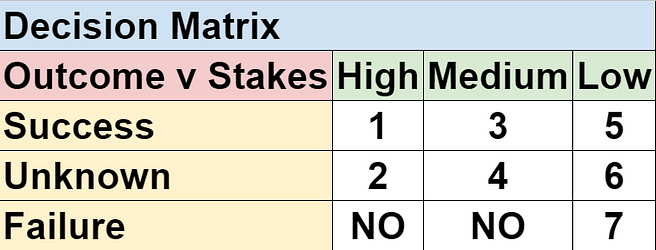
Optimal Decisions, Charted
最佳决策,图表
You want to eventually spend the bulk of your time doing high-stakes work with a high likelihood of success. That’s why it’s №1 in the matrix.
你希望最终把大部分时间花在高风险、高成功可能性的工作上。这就是矩阵中№1的原因。
But the way you get there is important. You start in the lower right and move up the column before venturing into the next column to the left.
但到达目的地的方式很重要。您要从右下方开始,在进入左侧的下一列之前,先向上移动一列。
You do this in as many domains of life — career, relationships, health, happiness, altruism, etc. — as possible.
在事业、人际关系、健康、快乐、利他主义等生活的各个领域,都要尽可能做到这一点。
Mastery is moving up the column. (Improving your odds of success.)
掌握就是向上移动。(提高成功几率)。
Leveling up is moving over a column. (Raising the stakes.)
提升水平就是越过一栏。(提高赌注)。
Spend too much time moving over, and you’ll flame out. Spend too much time slumming it on the right and you’ll waste your time.
花太多时间在右边,你就会被淘汰。花太多时间在右边,就会浪费时间。
True excellence and optimal time management, though, means embracing uncertainty. The middle row is where you take your risks. You cannot reach the top row without first slogging it in the middle.
然而,真正的卓越和最佳的时间管理意味着拥抱不确定性。中排是你承担风险的地方。不从中间开始,就无法到达顶排。
If you’re experiencing self-doubt, keep going. It means you want it, and that discomfort and fear means you’re growing.
如果你正在经历自我怀疑,那就坚持下去。这意味着你想要它,这种不适和恐惧意味着你在成长。
If you’re experiencing annoyance, meaninglessness, misery, or frustration, just walk away (if you can, and you can’t always). It’s futile, or you’re playing small, or the juice ain’t worth the squeeze.
如果你正在经历烦恼、无意义、痛苦或挫折,那就走开吧(如果可以的话,但你不能总是这样)。这样做是徒劳的,或者你在小打小闹,或者果汁不值得一榨。
Knowing what to quit and what areas of life to immediately leave (if you can) are the keys to managing your time in a way that delivers good things for you and yours.
知道哪些事情应该放弃,哪些生活领域应该立即离开(如果可以的话),这些都是管理时间的关键,这样才能为你和你的生活带来美好的事物。
Final Thoughts
最终想法
Most of what you do in life won’t be in the upper left.
你生活中的大部分事情都不会在左上角。
Most of life is uncertain, and very little of what we get to spend our time on matters a great deal in the grand scheme.
人生中的大部分时间都是不确定的,我们能花时间做的事情很少有大的意义。
But we can get there, sometimes, and maximize the care we take in doing so.
但我们有时可以做到这一点,并最大限度地小心谨慎。
We can embrace that uncertainty, and know when to walk away from things that are too hard for us, or don’t mean enough. Give up. Really. It’s so much better.
我们可以接受这种不确定性,知道什么时候该放弃那些对我们来说太难或不够重要的事情。放弃。真的。这样好多了。
All of you are capable of rising to the top quintile in most of the key areas of life that matter — health, love, impact, wisdom, wealth, joy, and your vocation. I know plenty of folks who are earning solid B-plusses in everything.
你们每个人都有能力在人生的大多数重要领域--健康、爱情、影响力、智慧、财富、快乐和你的职业--跻身前五分之一。我认识很多人,他们在所有方面都获得了稳固的 B 等。
And you have full permission to grade yourself on a curve. What looks like success to you may not look like success to someone else, and there’s no need to compete or compare.
你完全可以给自己打分。在你看来是成功的事,在别人看来却未必是成功的事,没有必要去竞争或比较。
For example: I run half-marathons in a shade under three hours. That’s not fast, but I’m doing it with lungs that work about as well as a $20 printer. That’s good enough for me because I enjoy it and it reminds me that I’m capable of more than I once was.
举个例子:我跑半程马拉松只需不到三小时。这不算快,但我的肺活量和 20 美元的打印机差不多。这对我来说已经很好了,因为我喜欢它,它提醒我,我比以前更有能力。
I’m not going to write the Great American Novel, I’m not going to crack the Billboard 200, and I’m not on my way to a sprawling estate in Marin County. That’s fine — all those things are not necessary for a meaningful life.
我不会写出伟大的美国小说,我不会打入公告牌 200 强,我也不会在去马林县(Marin County)的路上拥有一座庞大的庄园。没关系,所有这些都不是有意义生活的必要条件。
Good enough is good enough, and arbitrary markers of success are just video game numbers deemed important by a warped society that’s profoundly sicker than either you or I.
足够好就是足够好,任意的成功标志只是被一个比你我都更变态的扭曲社会视为重要的电子游戏数字。
In sum: Life is short. We should all be finding ways to make our lives easier, less stressful, and most importantly make sure we are happy. Especially now, when there’s so much out there making life hard, stressful and miserable.
总而言之:人生苦短。我们都应该想方设法让自己的生活更轻松、压力更小,最重要的是确保自己快乐。尤其是现在,有太多的事情让我们的生活变得艰难、紧张和痛苦。
You embrace uncertainty, mitigate failure, master new skills and habits, and funnel your life in the direction you want it to go. That’s how you get to the top quintile — that cozy little straight B-plus zone. And if you find you get to where you think you want to be and decide it’s not what you had in mind, or it’s too hard, you can always just quit. I recommend it.
你拥抱不确定性,减少失败,掌握新技能,养成新习惯,让你的生活朝着你希望的方向发展。这样,你才能达到最高的五分之一--那个舒适的小B-plus区。如果你发现自己达到了自己想要的目标,却发现这并不是你想要的,或者太难了,你可以放弃。我建议你这样做。
Let’s Connect: Instagram. LinkedIn.
让我们联系:Instagram.LinkedIn.


