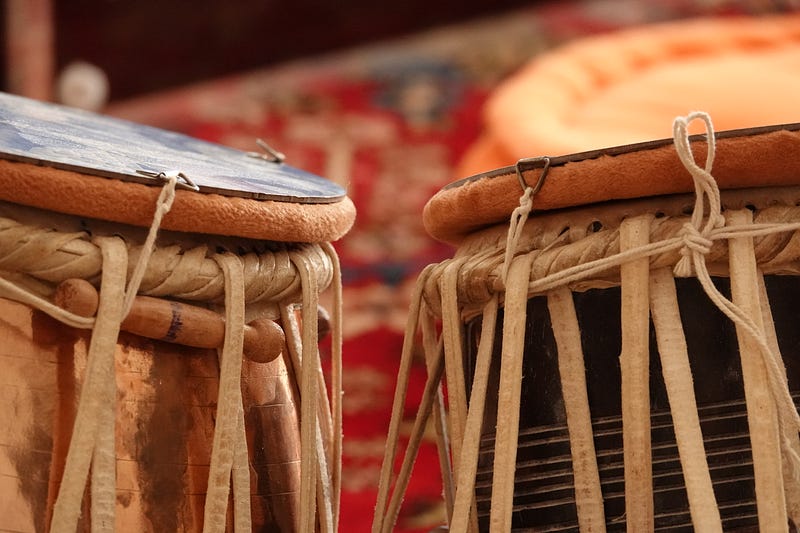
TABLA
Zakir Hussain: Awards and More Awards
On Zakir Hussain winning the Kyoto Prize in Arts and Philosophy and the Padma Vibhushan
Few musicians have been responsible for putting Indian classical music, especially the music from the northern parts of India, on the world map. In chronological order, the most prominent names that come to mind are Ravi Shankar, Allah Rakha, Salamat & Nazakat Ali Khan, Dagar Brothers, Zakir Hussain, and Nusrat Fateh Ali Khan. They introduced the world to all the different aspects of Indian classical music — instrumental, vocal, and percussive.
All of these artists changed the world of music forever for good. They took their artistry to a new level, never achieved before. There’s no better example of this than Zakir Hussain. Few people have such command over their instruments as he. He made the tabla speak, or the tabla spoke through his hands. It’s not surprising, then, that he’s made the list of tremendous people like Noam Chomsky, Jane Goodall, Karl Popper, Akira Kurosawa, Masatoshi Shima, and others by winning 2022’s Kyoto Prize in Arts and Philosophy, widely considered to be the Nobel Prize in arts and philosophy.
The Kyoto Prize laureates give a lecture on their respective fields. Zakir Hussain gave that lecture by introducing his instrument, its language, and tradition to an even wider audience. This is a great place to start for anyone looking to understand the beautiful world of the tabla.
I have been tremendously fortunate to have seen him perform many times over a decade or so. Many of my favorite recordings from the past, both vocal and instrumental, have are where Zakir Hussain is playing the tabla. There’s something about his presence that makes his fellow performers bring their best. Take the example of Vasantrao Deshpande, who, almost four decades ago, in a college auditorium in Pune, probably gave his last public performance. Although he was at the peak of his career, Zakir Hussain did play a role in bringing out the best in him at this concert.
He has magically succeeded in all his musical endeavors collaborating with musicians worldwide. Even before the maddening 70s, when he dropped acid and jammed with the Grateful Dead and some members of Jefferson Starship to the current day, he’s been at the top of his game.
Although his listeners call him the best tabla player, he knows and has acknowledged that there’s no such thing. He said that there are many tabla players that are as good as he is, if not better. This humility automatically lifts him up to a pedestal above all others. But that’s not where he wants to be. He wants to be among his peers. His sheer respect for other musicians, other forms of music, and other forms of art shows that he’s past the point where the artist locks horns with his ego to build a larger-than-life image of himself. In an interview with TM Krishna, Zakir Hussain talked about this struggle with the ego and how to handle it, especially when playing in front of a live audience.
He also keeps mentioning what his father taught him: don’t try to be a master son, just be a student. It shows that he has preserved this ethic to date. I’ve heard him appreciate great masters of other gharanas, even though, in the past, different gharanas didn’t use to gel together. There was a fair bit of animosity. He has spoken at length about these things in several interviews. His mastery over the tabla, his love for other musicians and for humanity, his message of peace and love, and his pursuit of even more after achieving all that he has makes definitely make him worthy of all the accolades people can bestow on him. The world needs role models now more than ever before, and he’s definitely one of them.
I’ll leave you with two things — a documentary about the history of Indian music, released in 1987, and a list of essential recordings of Zakir Hussain.
It’s hard to imagine anyone being able to top this, but someone, in time, probably will. Till that time, listen and get lost in these essential recordings of Zakir Hussain’s performances on available on YouTube:
I’ve only listed the recordings where the year of the performance was mentioned, or I was able to guess it.
- Zakir Hussain, 1967
- Ali Akbar Khan & Zakir Hussain, USA, 1975
- John McLaughlin, Vikku Vinayakram, and Zakir Hussain, Montreux, 1976
- Sultan Khan & Zakir Hussain, Valencia, 1978
- Vilayat Khan & Zakir Hussain, BBC Proms, 1981
- Ali Akbar Khan, Ravi Shankar, and Zakir Hussain, Carnegie Hall, 1982
- Zakir Hussain & Sultan Khan at Doordarshan Studios, 1985
- Zakir Hussain & Appa Jalgaonkar, California, 1987
- Shiv Kumar Sharma & Zakir Hussain, Tokyo, 1988
- Buddhadev Dasgupta & Zakir Hussain, Albany, 1989
- Amjad Ali Khan & Zakir Hussain, California, 1990
- V. G. Jog & Zakir Hussain, California, 1991
- Shiv Kumar Sharma & Zakir Hussain, Kolkata, 1992
- Zakir Hussain, Delhi, 1993
- Sultan Khan & Zakir Hussain, Delhi, 1994
- Vilayat Khan & Zakir Hussain, Stuttgart, 1995
- Amjad Ali Khan & Zakir Hussain, Delhi, 1999
- John McLaughlin, Shakti, and Zakir Hussain, Vienna, 2004
- Zakir Hussain, Kolkata, 2006
- Patri Satish Kumar & Zakir Hussain, 2007
- The Unstoppable Indian: Zakir Hussain (Interview), 2008
- John McLaughlin + Zakir Hussain + 4th Dimension, 2010
- U. Srinivas & U. Rajesh with Zakir Hussain & AK Palanivel at Tiruvaiyarum, 2011
- Remember Shakti, Moscow, 2012
- Charles Lloyd, Eric Harland, and Zakir Hussain, Vienna, 2013
- Niladri Kumar & Zakir Hussain, Chicago, 2014
- Rakesh Chaurasia & Zakir Hussain at the Crossroads Festival, Kraków, Poland, 2015
- Zakir Hussain, Mumbai, 2016
- Zakir Hussain, Marcus Gilmore, Taufiq Qureshi, Anantha Krishnan, and Sabir Khan, 2018
- Zakir Hussain Meets Berklee, 2019
- Zakir Hussain & Sabir Khan, Delhi, 2020
Happy listening!