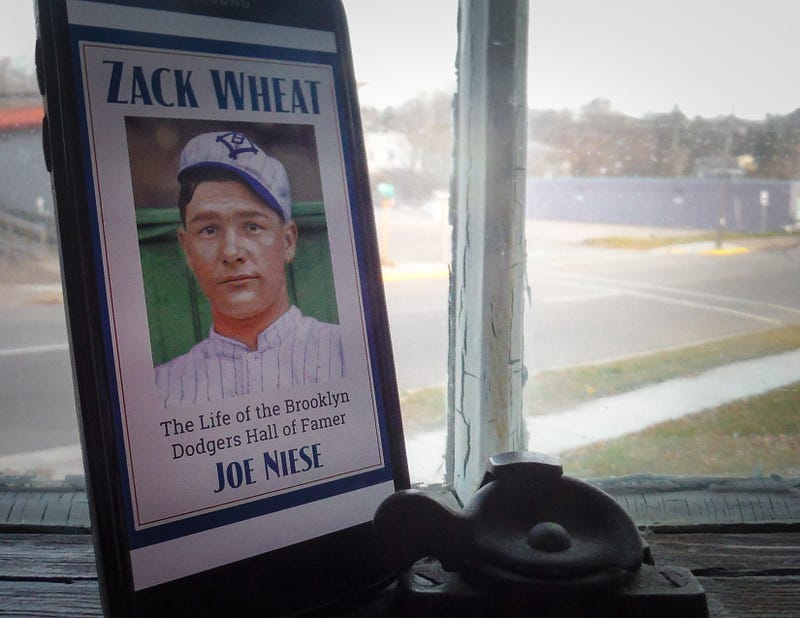
Zack Wheat: The Life of the Brooklyn Dodgers Hall of Famer
Author Joe Niese offers an exhaustively researched take on the life of one of baseball’s finest
I’ve had people ask me why I spend so much time watching sports when it seems so incongruous with my other, more intellectual pursuits. My response is always the same. Watching sports relaxes me. I don’t know why, and I don’t know how. All I know is that I can turn on a game and forget the problems of the world for three hours. Honestly, I don’t even care why it works. Most other things in life make me irritated, so I’m not inclined to question the ones that bring me relief.
I gave extra thought to the magic and the joy of sports while I was reading Joe Niese’s excellent biography on Zack Wheat. The grand nostalgia surrounding all things baseball is capable of reminding us of everything that’s great about America. With recent political events, I was in dire need of reading this book, and I feel rejuvenated having done so.
All eras of baseball have their unique appeal, but there’s something particularly special about Wheat’s time. He played for the Brooklyn Dodgers from 1909 to 1927. Just think about that for a moment. If Captain America went to war in 1939, growing up, Zack Wheat must have been the favorite player of a young Steve Rodgers.
The thought is fitting, because by all accounts, Zack Wheat was a straight laced, decent guy who was all about the game. One anecdote in Niese’s book recounts that he said hello at the beginning of the season, goodbye at the end of the season, and in between he only spoke through the echo of his bat.
Zack Wheat is a book that allows the reader to get lost in the numbers. It’s exhaustively and diligently researched including some excellent quotes from contemporaries as well as newspaper articles of the age. It would be tempting for a writer to insert interpretation into a work like this, but Niese is disciplined and he allows the subject matter to speak for itself. What emerges is a very authentic portrait of a fascinating player.
I liked the focus on the games as well as the reflections Niese collected of Wheat himself providing insight into hitting and other aspects of his craft. It’s always interesting to learn about the larger than life figures from history that had the good fortune of dedicating their adult lives to what could be called a child’s game.
I always like to think of how a book might be adapted to a film, and one amusing anecdote stands out. As a promotional gimmick, one of Wheat’s teammates agreed to try to catch a baseball thrown from an airplane. Little did he know, prior to takeoff, the pilot forgot to grab a ball and substituted a grapefruit at the last second. At the moment of the catch, the player misjudged and the grapefruit hit him in the chest. The impact knocked him flat and created an explosion of red pulp and juice that led the poor man to think he’d been mortally wounded. The teammates, having realized what truly happened, thought the situation hysterical. Needless to say, this isn’t the kind of spectacle you’d ever witness at a modern sporting event.
It’s a joy to visit American baseball of the 1910s and 1920s. Despite the other hardships of the era, there’s an innocence that can be felt with every swing of the bat. Zack Wheat is the kind of biography that delights in getting its hands dirty in the facts of the age. Niese does not contaminate this snapshot of the past with modern sensibilities. He merely collects the relevant information, arranges it for peak impact, and turns it over to us to enjoy at our leisure. If you love baseball, Zack Wheat provides another avenue for exploring a bygone, beautiful era of the game.
Other great reads