
THE YOU EXPERIENCE
You’ve Been Listening Wrong All Along
Those are the painful words that entered my mind when I learned this powerful, albeit simple listening technique.
Soft skills matter, and we’re not talking about them enough. This series explores real-life situations and practical examples of techniques you can apply right away to design how others experience you.
If you poll today’s greatest leaders and seasoned mentors and ask them to tell you what skills are needed for success, a person’s ability to be a good listener inevitably comes up. Listening, or active listening, ranks high on the list of soft skills needed to build better relationships and connect with an audience of 1 or 100.
But why? If we’re constantly being told we need to listen better, why aren’t we getting better at it? Why does it keep topping the list of required soft skills? Aren’t we listening?
Maybe it’s that we’ve never had more distractions than we do today. Or possibly it’s because we’ve fooled ourselves into thinking we can multi-task our way through everything. Regardless, we’re being told we’re not listening enough, and I couldn’t agree more.
Let’s dive into a listening technique that will change your perspective entirely and transform this skill in you from an afterthought, to an art.

Introduction to “Ting”
I want to introduce you to the word, “Ting”. It’s the Chinese word for “listen”. On the surface, that might not mean too much. But the corresponding Chinese character for Ting paints a remarkable picture of how we should all be listening to each other.
The image below illustrates the strokes needed to write Ting and the six primary areas of the character. Immediately, you should notice the beautiful teaching moment that emerges when you look at it.
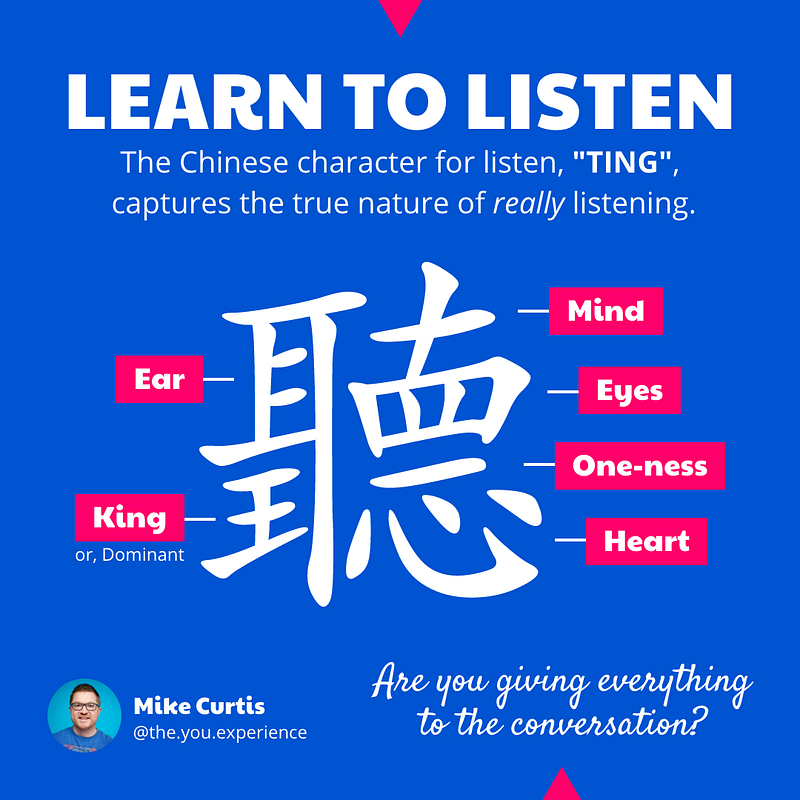
When I first came across this word and it’s character, I couldn’t help but think to myself, “Way to go, Mike…You’ve been listening wrong all along.” I knew for a fact I wasn’t employing each of these areas when I listened to someone. I quickly abandoned my old way of listening, and embraced Ting as my new normal.
What does it mean to listen with Ting?
The character shows us the way.
👂 Listening with our ears
By definition, listening is to give one’s attention to a sound. In order to listen, we must first employ the use of our ears. We have to hear the words being spoken. If that means moving closer to them to hear them, then do it. If you need to remove other noisy distractions, then do that too, but our ears come into play first.
👑 King (or dominant one)
This character representing “King” is deliberately placed right under “ear”, thus signifying that the ears are the king or the dominant, primary place to start when engaging in active listening.
🧠 Listening with our mind
As the words enter our ears, they travel into our minds and we process what we’re hearing. If we let other distractions cloud our thoughts, we aren’t truly listening to someone. Don’t be so distracted by your own thoughts that you miss out on what the other person is saying. All too often we are formulating our next big thought and it mutes anything the person has to say. Free your mind and give space for their words to sink in.
👁 Listening with our eyes
When we listen with our eyes, we ask ourselves, “What am I not hearing?” Our eyes catch the non-verbal cues, body language, restlessness, fidgeting, smiles, pacing, crossed-arms, and other emotions that our ears miss. Listening with our eyes also means making eye contact. As an experiment, try making eye contact with someone for seven uninterrupted seconds and see what a difference it makes, it’s really hard!
💭 Listening by being at one with the other person
If you are “at one” with the conversation, you give your undivided, undistracted attention to the person talking. Get off your phone, shut your laptop, stop checking your smartwatch every time it buzzes, and quit looking away from the person; be at one with the conversation.
❤️ Listening with our hearts
The deepest form of real communication can’t exist without our heart being involved. Listening with our heart shows empathy, compassion, caring, and a genuine concern for what the person is saying. Listening with our heart allows us to find balance and access deeper connections in our conversations.
The Takeaway
Art is the expression or application of human creative skill and imagination. The art of listening, as outlined above using Ting, will set you apart from the crowd and endear you to others.
Listening is a skill, which means through practice, you can learn to be better at it. Listen using the principles taught by Ting and you will stand out. You will be more memorable. Instead of trying to be interesting all the time, you will become interested in them and they will take notice.
Today — not tomorrow or next week — but today, I want you to try listening differently. I want you to listen with your eyes or your heart. If that’s too hard, try being at one or listening with your mind. I don’t care which one you pick, just try something. Pick one and run with it. As you get better, start to combine them until you’re using them all.
I promise that the experience others have of you will improve if you simply use Ting to listen to them.
Ignited by the words and advice of Mariah Hay, VP of Product at Help Scout, my mission is to help you, “Apply your UX skills to the way people experience you.”