
You're Probably Winning More Than You Think
Studies show that bronze is a happier place to be than silver
I was talking with friends recently. We were supporting some of our coworkers who ran a half-Marathon race. I've run a few myself over the years.
I never won the whole race. Nobody does — well, obviously, somebody wins, but we don't run these events to win the race. We do it for the satisfaction of finishing and finishing well.
That might mean beating our personal best time. For many runners, the satisfaction of achieving the distance is enough glory. Setting out to challenge ourselves and do something to our best ability has its own rewards.
I wrote a screenplay, Martin Eden, some years ago. I adapted the story from a 1909 novel by Jack London. I chose this because it's a story I love, and the source material is in the public domain, so I didn't need to purchase the rights.
Martin Eden is a story about love, transformation, self-education, class struggle, and the disillusionment of fame and material success.
It was my first attempt at writing a screenplay. I learned the Final Draft software, read other scripts, and educated myself on dialogue and the three-act storytelling structure. It's a book that resonates with my life journey, which helps a ton.
To my amazement, my script placed second in an international screenplay competition I entered. My script also placed in at least a half-dozen national and international competitions. My work was a semi-finalist in Sundance's Screenplay competition.
For me, that was a win. Sure, it would be nice to see my work optioned or purchased for production, but I never imagined I would be getting contact from Hollywood producers and other industry professionals.
The film eventually got produced, but it wasn't my screenplay. An Italian-French production company made the movie — it was released in 2019. Who knows if my efforts somehow prompted that production? My script was posted in multiple places for anyone to read. I'm thrilled about that ride. I'm still very proud of the achievement.
Another friend, Derek, came that morning to support the half-Marathon runners. He has a brilliant creative mind, and his passion outside his day job is theater and stage. He's an exceptionally talented director.
While waiting for our friends to cross the finish line, We were talking about Derek's last directing achievement, Buried Child, written by Sam Shepard. The play opened on Broadway. Okay, it's a storefront theater on Broadway Street on Chicago's north side.
The show was nominated for the 2023 Chicago's Jeff Awards in its category for Best Production and Principle Actor. As we shared this achievement with another coworker who'd since retired and been globetrotting for some months, Derek, somewhat sheepishly, interjected that the show didn't win anything.
Humility is a valuable quality, but I reminded my friend that he did win. He didn't walk away from the award ceremony that night with a tangible token of that win, but the fact that the play and the work of Derek and team were among the best-of-the-best on award night is a sure win.
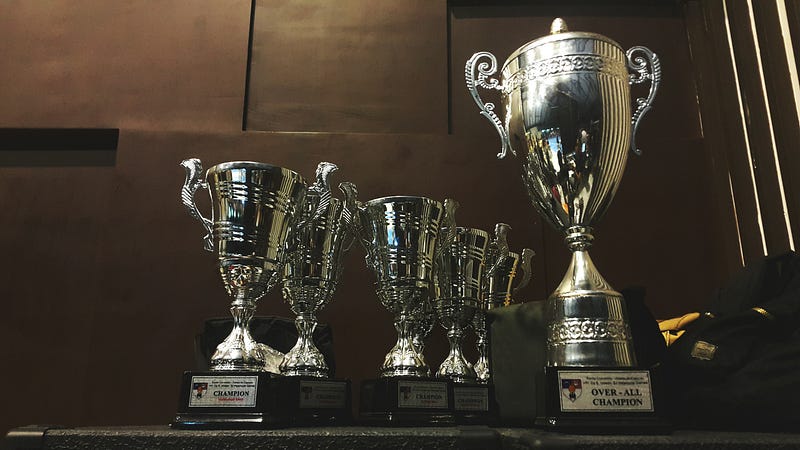
We must celebrate these as wins just as much as the winner who walks away with the trophy. We'd do better to focus on how we've succeeded rather than comparing ourselves to others or lamenting how we might've failed.
In one of the screenplay competitions I entered my script, I placed in the "Top 100" Now, that doesn't sound very exciting, but when I discovered there were about 5000 entries, that's a huge win for a first-time effort.
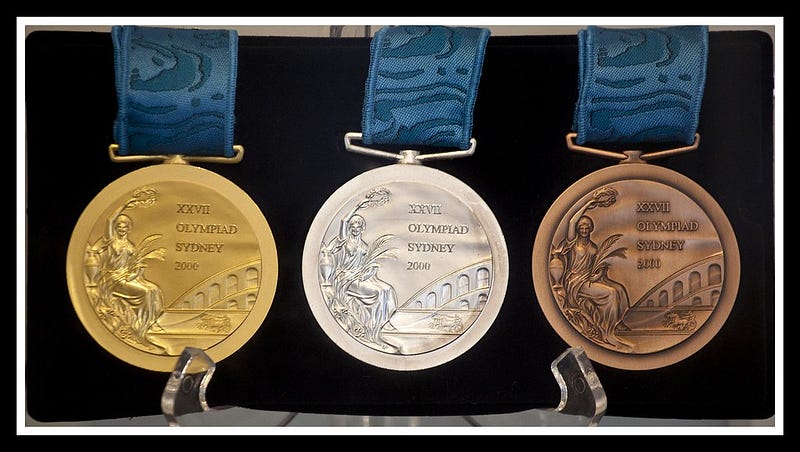
A few decades ago, researchers conducted a study with footage from the 1992 Summer Olympics. Participants were asked to analyze and rate the reactions of athletes who won silver and bronze medals.
The bronze medalists appeared much happier across various sporting events than those who had beaten them and captured the silver.
The researchers then examined interview footage of the athletes. They noticed that second-place finishers focused on what they almost did. They almost got the gold. They almost took first place.
On the other hand, the third-place finishers celebrated what they (at least) did. At least they got a medal. At least they weren't going home empty-handed.
This is an example of counterfactual thinking — when you obsess about what could've been. The silver medalists were happy to make the podium but, at the same time, were beating themselves up for not winning. Some were even tortured by how close they came.
The bronze medalists were just as thrilled to be there. They felt fortunate, aware that they were close to having no medal at all.
And this doesn't only apply to elite athletes. The researchers followed up this study with another in which they interviewed amateur competitors. They found that the results were very similar.
So whether you plan to make an Olympic medal stand or not, there remains a valuable lesson here. As we move through life, it can be tempting to imagine what could've been and what you failed to do. It's especially true when we fall short of certain hopes, dreams, or expectations.
Instead, practice focusing on what did happen and the success you achieved; you'll be much happier and more at peace. Like those bronze medalists, there's almost always a positive way to frame things.
We should always go for the gold, but no matter where you end up, you want to celebrate how far you've gone.
Inspired by: Calm/The Daily Jay Podcast
Thanks for reading! If you find value and entertainment in my work, please consider supporting me directly here: Medium membership for $5 a month. I will receive a small portion of your subscription fee as a commission. You will receive unlimited, ad-free access and start writing your own stories.


